




The 2023 report from The Lancet Countdown on health and climate change emphasizes that climate change is exacerbating health issues and resulting in loss of lives. A significant development in addressing this concern is the United Nations COP28 climate summit in Dubai, which, on December 3, will feature a dedicated day focused on addressing the health impacts of climate change. Notably, this marks the first instance of a COP hosting such an event. Over 50 health ministers are slated to participate in discussions, where countries are expected to disclose their financial commitments prioritizing health. In anticipation of this meeting, Nature outlines three key ways in which climate change is negatively affecting human health.
The deadly effects of heatwaves
According to Wenjia Cai, a climate and health researcher at Tsinghua University in Beijing, the annual occurrence of heatwaves induced by climate change is causing fatalities. Elevated temperatures heighten the susceptibility to cardiovascular disease and heat stroke, a condition where the body loses its ability to regulate temperature through sweating. This, in turn, can result in multi-organ failure and, ultimately, death.
Individuals over the age of 65 are particularly vulnerable to the impacts of extreme heat. The aging process renders them less adept at cooling themselves down, as their sweat glands become less sensitive to chemical signals from the brain. Moreover, this demographic is more prone to cardiovascular diseases, further exacerbating their susceptibility to the adverse effects of high temperatures.
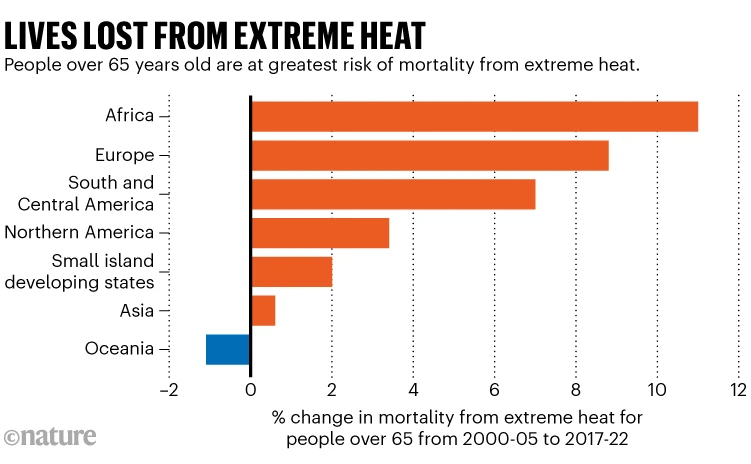
The Lancet report, released on November 14, indicates that in Africa, there was an estimated 11% increase in the mortality rate of individuals over 65 years old due to extreme heat from 2017 to 2022 compared to a baseline period of 2000 to 2005. This increase is measured as a fraction of deaths per 100,000 people. Similarly, Europe experienced an 8.8% rise, and South and Central America saw a 7% increase during the same time frame.
Infants under one year old are also highly susceptible to the perils of extreme heat. This vulnerability arises because the systems regulating their body temperature are not yet fully developed, as highlighted by Cai.
A shelter against malaria
The expansion of infectious diseases into new regions is being influenced by global warming. A notable example is malaria, caused by the parasites Plasmodium falciparum and P. vivax, transmitted to humans through bites from Anopheles mosquitoes carrying the parasites. The proliferation of mosquitoes is facilitated by warmer temperatures, and these insects lay their eggs in stagnant water, creating favorable conditions for the spread of malaria in previously unaffected areas.
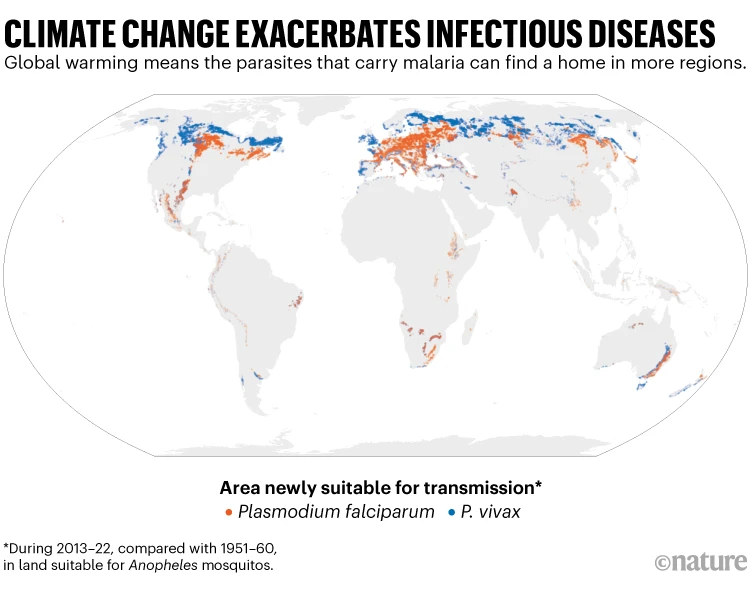
Scientists Rachel Lowe and Martin Lotto Batista at the Barcelona Supercomputing Centre in Spain have estimated that nearly 10% of the world’s land area, once considered too dry or too cold for the transmission of P. falciparum malaria between 1951 and 1960, has become suitable for malaria transmission from 2013 to 2022. During the same period, approximately 17% of land previously unsuitable for P. vivax malaria transmission became suitable. Suitability for malaria transmission was determined based on the presence of precipitation, humidity, and temperature levels conducive to malaria spread for at least one month per year, on average, over a decade.
Additionally, warmer conditions are contributing to the increased spread of viral diseases such as dengue, Zika, and chikungunya, as well as expanding the range of harmful Vibrio bacteria.
Rachel Lowe, a climate and health scientist at the Barcelona Supercomputing Centre and the Catalan Institution for Research and Advanced Studies in Barcelona, points out that factors such as increased drought, rising sea levels, reduced access to clean water, and migration contribute to larger breeding grounds for pathogens. This scenario is particularly pronounced in low- and middle-income countries. Lowe emphasizes that a combination of climate change, land-use change, and agricultural practices can elevate the risk of disease spillover from animals to humans, potentially leading to pandemics.
Heat and hunger
The escalating global temperatures are resulting in a growing number of people losing access to safe and nutritious food. High temperatures and droughts lead to crop failures, while extreme weather events prevent outdoor workers from laboring, causing a loss of income and making it challenging to afford sufficient food. Shouro Dasgupta, an environmental economist at the Euro-Mediterranean Center on Climate Change in Venice, Italy, describes this as a vicious cycle. Food insecurity heightens people’s vulnerability to diseases, diminishing their capacity to work, thereby reducing income and impeding their ability to afford an adequate amount of food.
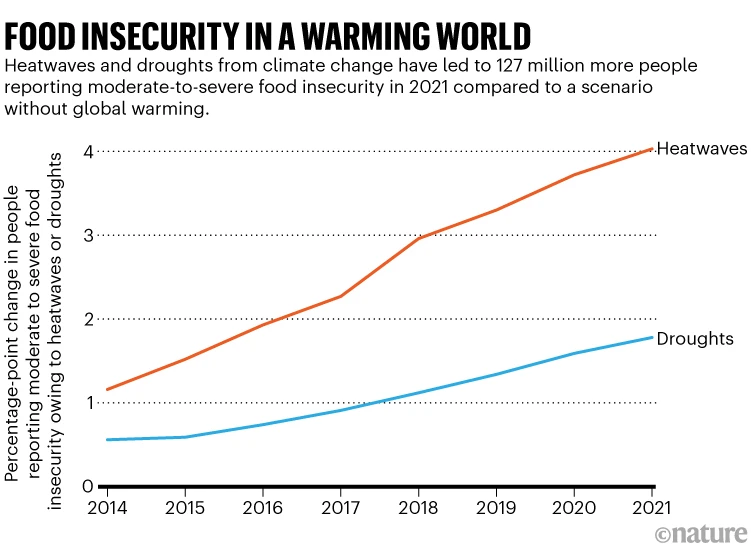
Shouro Dasgupta and fellow environmental economist Elizabeth Robinson, affiliated with the Grantham Research Institute on Climate Change and the Environment in London, developed a mathematical model based on historical data to understand how the increased frequency of heatwaves and droughts affects food insecurity. Utilizing this model, they projected that, in 2021, an additional 127 million people would have encountered moderate-to-severe food insecurity due to the impacts of climate change compared to a scenario without global warming. Severe food insecurity in this context refers to situations such as running out of food or enduring an entire day without any meals.
Adapt to survive
Researchers suggest that if countries can enhance their resilience to climate change, it can lead to significant health benefits. Climate scientist Dominic Kniveton from Sussex University, UK, discovered a notable decrease in deaths caused by storms and flooding events in countries classified as ‘highly developed’ according to the Human Development Index. Specifically, the average number of deaths per event decreased from 86 during 1990–99 to 16 during 2013–22. Kniveton attributes this decline to adaptation efforts, including restrictions on construction in high-risk coastal areas and the construction of defensive structures to mitigate flash flooding.
Resources
- JOURNAL Wong, C. (2023). Climate change is also a health crisis — these 3 graphics explain why. Nature, 624, 14-15. [Nature]
Cite this page:
APA 7: TWs Editor. (2023, December 6). 3 Graphics That Reveal Why Climate Change Is a Threat to Health. PerEXP Teamworks. [News Link]


1 comment