





Astronomers have wrapped up an extensive investigation into the triggers of star formation in the universe’s largest galaxies, utilizing NASA’s Chandra X-ray Observatory and other telescopes. Their findings were unexpected, revealing that the conditions for stellar conception in these exceptionally massive galaxies have remained unchanged over the last ten billion years.
Michael Calzadilla of the Massachusetts Institute of Technology (MIT), who led the study, highlighted the surprising aspect. He pointed out that despite various potential influences on star formation over the past ten billion years, the primary factor for these huge galaxies boils down to whether the hot gas surrounding them can cool off quickly enough.
The study emphasized that clusters of galaxies, the universe’s largest gravitational structures, are characterized by substantial amounts of hot gas observed in X-rays. This hot gas, with a mass several times that of all the stars in hundreds of galaxies within typical galaxy clusters, plays a pivotal role in determining the rate of star formation.
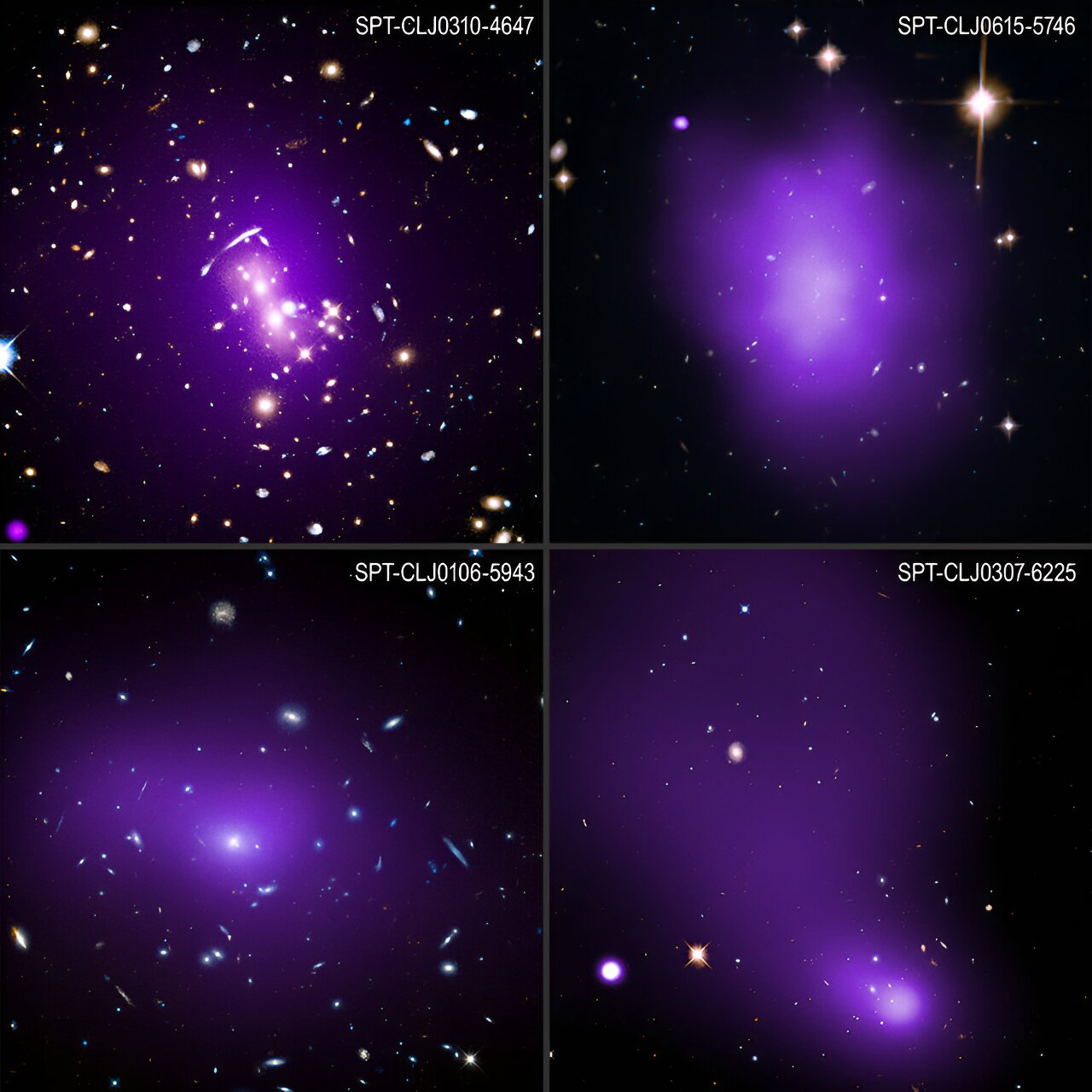
Michael Calzadilla and his research team delved into the examination of the most luminous and massive category of galaxies in existence, known as brightest cluster galaxies. Their focus was on 95 galaxy clusters, specifically targeting the central regions where these brightest cluster galaxies reside. The selection of these galaxy clusters, deemed brightest cluster galaxies, was already an extreme subset—they represent the most massive clusters identified in an extensive survey conducted using the South Pole Telescope (SPT). These clusters are situated at distances ranging from 3.4 to 9.9 billion light-years away from Earth.
In their investigation, the team made a remarkable discovery regarding the triggering mechanism for star formation in the studied galaxies. They identified that the pivotal factor lies in the amount of disordered motion within the hot gas, a physical parameter referred to as “entropy.” When the entropy level falls below a critical threshold, star formation is initiated. This critical threshold marks the point at which the disordered motion in the hot gas is conducive to its inevitable cooling, leading to the formation of new stars.
One of the co-authors of the study, Michael McDonald from MIT, expressed the awe-inspiring nature of this revelation. He emphasized the significance of a singular numerical value determining the formation of billions of stars and planets in these immense galaxies, spanning a staggering ten billion years of cosmic history.
Previous efforts to discern the factors influencing star formation in immense galaxies throughout cosmic history have been undertaken, but this survey stands out as the first to amalgamate X-ray and optical observations of cluster centers across a vast range of distances. This unique approach enables researchers to establish a connection between the fuel essential for star formation—identified through Chandra’s detection of hot gas—and the actual formation of stars, observed through optical telescopes, spanning a significant portion of the universe’s evolution.
To enhance their comprehensive study, the team employed radio telescopes to investigate jets of material emanating from supermassive black holes within these clusters. The process, known as “feedback,” involves the hot gas cooling to form stars and subsequently fueling the black holes. This, in turn, generates jets and other energetic activities that heat the surroundings, temporarily inhibiting further cooling. When the black hole exhausts its fuel, the jets cease, and the cycle recommences.
Co-author Brad Benson, affiliated with the University of Chicago and Fermilab in Illinois, likens the study’s findings to assembling various chapters that narrate the tale of star formation throughout a significant portion of the universe’s lifespan. Unlike a traditional written story, this cosmic saga is conveyed through the diverse perspectives of X-ray, optical, and radio light.
A surprising revelation from this study challenges prior notions that factors beyond the cooling of hot gas might exert a more significant influence on star formation in the distant past. Approximately ten billion years ago, during a period astronomers term “cosmic noon,” the frequency of galaxy collisions and mergers within clusters was notably higher. During this epoch, the rates of star formation were generally elevated, and the supermassive black holes at the centers of galaxies were voraciously pulling in material at accelerated rates.
Co-author Lindsey Bleem, affiliated with Argonne National Laboratory in Illinois, emphasized the unexpected consistency in the type of star formation observed, even during cosmic noon when other dynamic processes could have dominated. Despite the stark differences in the appearance of the universe at that time, the fundamental trigger for stars to form in these galaxies appears to have remained constant.
Moreover, previous investigations into nearby clusters have revealed an intriguing threshold level of disorder in the hot gas. This disorder, researchers found, is crucial for the occurrence of feedback from supermassive black holes, manifested in the form of jets. This finding underscores the intricate interplay between various cosmic processes influencing star formation in the vast tapestry of the universe’s evolution.
In the recent study led by Calzadilla’s team, an intriguing discovery challenges the established notion of an entropy threshold for feedback, particularly in galaxies located within more distant clusters. The findings suggest that approximately ten billion years ago, clusters may not have been as effectively regulated by black hole feedback. This could be attributed to the time it takes for the hot gas to initiate cooling onto the central galaxy, followed by a subsequent period for the cooled gas to reach the central galaxy’s supermassive black hole. Only after this sequence of events can jets form and impede further cooling of the surrounding gas.
However, an alternate explanation is considered – the possibility that radio signals might not offer a definitive indication of jet activity during these early cosmic epochs.
The study’s outcomes rest on a comprehensive dataset derived from various sources, including X-ray data from NASA’s Chandra X-ray Observatory, radio data from the SPT (South Pole Telescope), the Australia Telescope Compact Array, and the Australian SKA Pathfinder Telescope, as well as infrared data from NASA’s WISE satellite. Optical observations were conducted using telescopes such as the Magellan 6.5-m Telescopes, the Gemini South Telescope, the Blanco 4-m Telescope (DECam, MOSAIC-II), and the Swope 1m Telescope. The extensive dataset encompasses nearly 50 days of Chandra observing time.
Calzadilla presented these groundbreaking results at the 243rd meeting of the American Astronomical Society in New Orleans. Additionally, he is the primary author of a paper submitted to the Astrophysical Journal, providing an in-depth exploration of this research, accessible on the pre-print server arXiv. The study’s multi-faceted approach, drawing from diverse observational methods and instruments, contributes valuable insights into the dynamic processes governing star formation and black hole feedback across cosmic time.
Resources
- ONLINE NEWS Watzke, M. & Chandra X-ray Center. (2024, January 12). Astronomers find spark of star birth across billions of years. Phys.org. [Phys.org]
- JOURNAL Calzadilla, M. S., McDonald, M., Benson, B. A., Bleem, L. E., Croston, J. H., Donahue, M., Edge, A., Floyd, B., Garmire, G. P., Hlavacek-Larrondo, J., Huynh, M., Khullar, G., Kraft, R., McNamara, B. R., Noble, A., Romero, C., Ruppin, F., Somboonpanyakul, T., & Voit, G. M. (2023). The SPT-Chandra BCG Spectroscopic Survey I: Evolution of the entropy threshold for cooling and feedback in galaxy clusters over the last 10 GyR. arXiv (Cornell University). [arXiv.org]
Cite this page:
APA 7: TWs Editor. (2024, January 13). Astronomers Uncover the Spark of Star Birth. PerEXP Teamworks. [News Link]


