



The review reveals that the last instance when atmospheric carbon dioxide consistently reached the levels driven by human activities today was 14 million years ago, a period much more distant than some existing assessments suggest. It emphasizes the high sensitivity of long-term climate to greenhouse gas concentrations, with potential cascading effects that could unfold over many millennia. The collaborative effort involved over 80 researchers from 16 nations and spanned seven years. The findings are published in the journal Science.
Bärbel Hönisch, a geochemist at Columbia University’s Lamont-Doherty Earth Observatory and coordinator of the consortium, explains that while the correlation between adding carbon dioxide to the atmosphere and temperature increase has been established, the study enhances our understanding of the climate’s sensitivity over extended periods. The research provides a more robust insight into the long-term dynamics of climate in response to changes in greenhouse gas concentrations.
Current mainstream estimates suggest that, on scales ranging from decades to centuries, each doubling of atmospheric CO2 is likely to lead to an increase in average global temperatures between 1.5 to 4.5 degrees Celsius (2.7 to 8.1 degrees Fahrenheit). However, a recent influential study argues that the prevailing consensus might underestimate planetary sensitivity, proposing a range of 3.6 to 6 degrees Celsius of warming per doubling.
Regardless, based on existing trends, all estimates indicate that the planet is dangerously close to or could surpass the 2-degree warming threshold that scientists widely agree should be avoided if possible. In the late 1700s, the atmosphere contained approximately 280 parts per million (ppm) of CO2. Presently, this figure has risen to 420 ppm, representing an increase of about 50%. Projections suggest that by the end of the century, CO2 levels could reach 600 ppm or even higher. Consequently, the Earth is already experiencing a rise along the uncertain warming curve, with temperatures having increased by approximately 1.2 degrees Celsius (2.2 degrees Fahrenheit) since the late 19th century.
The estimates of future warming, regardless of the eventual temperatures, largely rely on studies examining the historical correlation between temperatures and CO2 levels. Scientists analyze various materials, such as air bubbles trapped in ice cores, the chemistry of ancient soils and ocean sediments, and the anatomy of fossilized plant leaves.
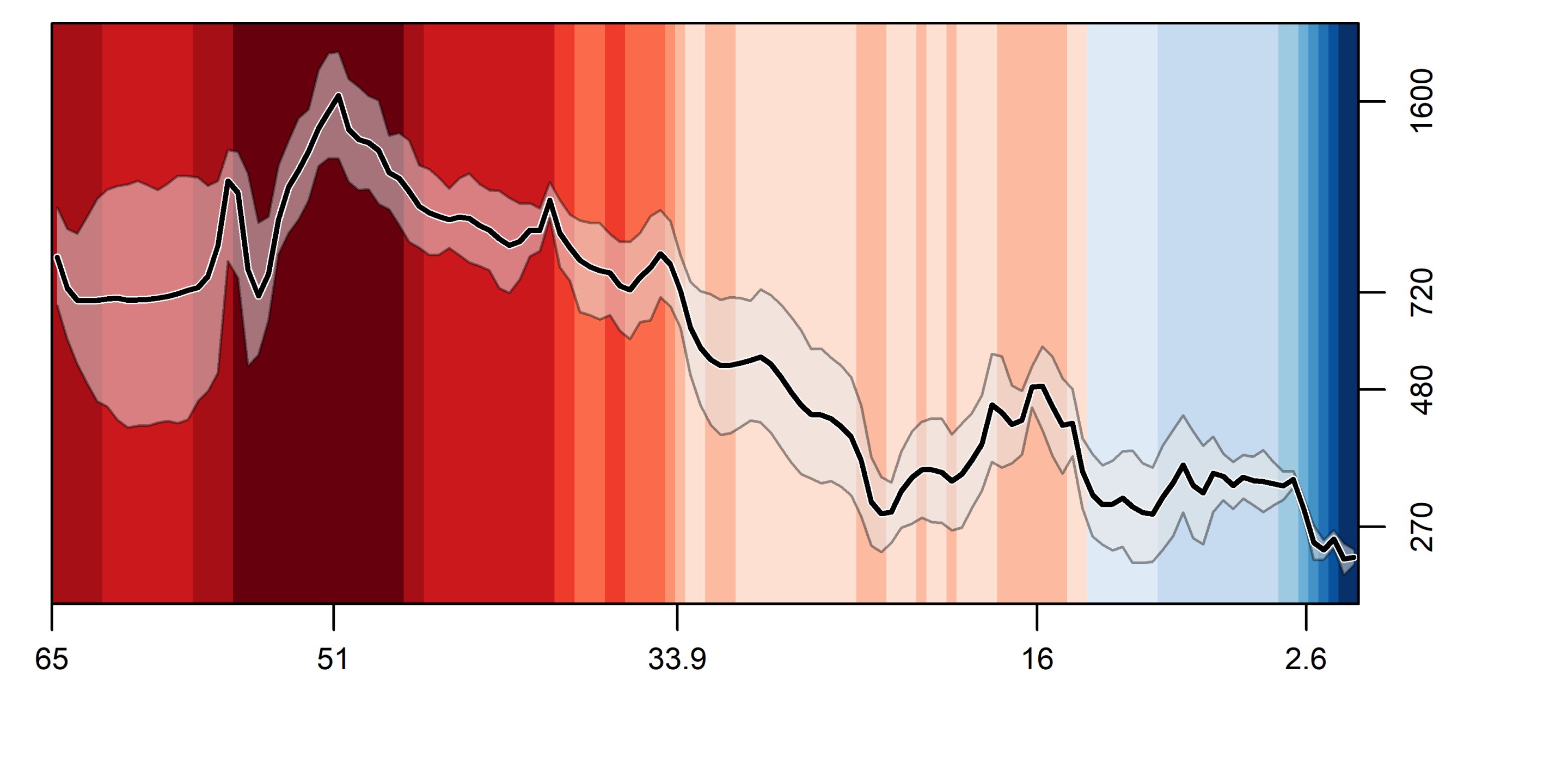
The consortium did not gather new data; instead, they conducted a comprehensive review of published studies, evaluating their reliability based on evolving knowledge. They excluded outdated or incomplete studies in light of recent findings, and adjusted others to incorporate the latest analytical techniques. The outcome is a new 66-million-year curve illustrating the relationship between CO2 levels and temperatures, indicating what they term “Earth system sensitivity.” According to this measure, a doubling of CO2 is projected to warm the planet by a substantial 5 to 8 degrees Celsius.
However, it’s essential to note a significant caveat: Earth system sensitivity pertains to climate changes over hundreds of thousands of years, not the shorter time frames of decades and centuries relevant to human impact. The authors emphasize that over extended periods, temperature increases may result from interconnected Earth processes that extend beyond the immediate greenhouse effect caused by CO2. These processes include the melting of polar ice sheets, altering the Earth’s ability to reflect solar energy, changes in terrestrial plant cover, and shifts in clouds and atmospheric aerosols that can either intensify or mitigate temperatures.
Co-author Dana Royer, a paleoclimatologist at Wesleyan University, emphasizes that the study’s findings may not directly provide specific temperature predictions for the year 2100. However, he underscores its relevance to current climate policy discussions. The research strengthens existing understandings of the climate system, indicating that there are persistent, cascading effects with implications lasting for thousands of years.
Hönisch highlighted the utility of the study for climate modelers working to forecast future climate scenarios. The newly enhanced observations from the research can be incorporated into their models, allowing for a more nuanced understanding of processes operating on both short and long time scales. It’s worth noting that all the data from the project are accessible in an open database and will be regularly updated.
The new study, focused on the Cenozoic era, doesn’t drastically alter the generally accepted connection between CO2 and temperature but adds strength to the understanding of specific time periods while refining measurements in others.
The distant period from approximately 66 million to 56 million years ago has been somewhat perplexing, as Earth was largely ice-free, yet certain studies suggested relatively low CO2 concentrations. The consortium, after excluding the least reliable estimates, determined that CO2 levels were actually quite high, ranging from around 600 to 700 parts per million, comparable to what might be reached by the end of this century.
The researchers affirmed the conventional belief that the warmest period occurred about 50 million years ago, with CO2 spiking to as much as 1,600 ppm and temperatures reaching up to 12°C higher than today. Around 34 million years ago, CO2 levels dropped sufficiently for the present-day Antarctic ice sheet to begin forming.
Following some fluctuations, there was a prolonged decline in CO2 levels, coinciding with the evolution of the ancestors of many contemporary plants and animals. This suggests that variations in CO2 not only influence climate but also have repercussions for ecosystems, as indicated by the paper’s authors.
The recent assessment reveals that approximately 16 million years ago was the last period when CO2 consistently exceeded current levels, reaching about 480 ppm. By 14 million years ago, it had declined to the current human-induced level of 420 ppm. The decrease continued, and around 2.5 million years ago, CO2 levels dropped to approximately 270 or 280 ppm, initiating a series of ice ages. CO2 remained at or below this level when modern humans emerged about 400,000 years ago and persisted until human-induced atmospheric alterations began on a significant scale around 250 years ago.
Gabriel Bowen, a professor at the University of Utah and study co-author, emphasized that regardless of the specific degree of temperature change, it’s evident that human activities have already placed the planet in a range of conditions unprecedented in the history of our species. This observation prompts reflection on the appropriate course of action moving forward.
The consortium has expanded into a broader project with the goal of mapping the evolution of CO2 levels and climate over the entire Phanerozoic eon, spanning from 540 million years ago to the present.
Resources
- ONLINE NEWS Columbia Climate School. (2023, December 7). A new 66 million-year history of carbon dioxide offers little comfort for today. Phys.org. [Phys.org]
- JOURNAL The Cenozoic CO2 Proxy Integration Project (CenCO2PIP) Consortium, Hönisch, B., Royer, D. L., Breecker, D. O., Polissar, P. J., Bowen, G. J., … Zachos, J. C., & Zhang, L. (2023). Toward a Cenozoic history of atmospheric CO2. Science, 382(6675), eadi5177. [Science]
Cite this page:
APA 7: TWs Editor. (2023, December 8). Today’s Situation Looks Bleak Compared to 66 Million Years of Carbon Dioxide History. PerEXP Teamworks. [News Link]


