



Two and a half months following the secure landing of NASA’s inaugural asteroid sample-return mission, technicians have meticulously collected over 70 grams of asteroid dust and pebbles from the spacecraft’s canister exterior. This quantity surpasses previous amounts retrieved from asteroids by over tenfold, exceeding NASA’s declared success criteria for the mission. Notably, some of the collected pebbles present a perplexing combination of chemical elements, adding an element of mystery for researchers.
However, these early findings fall short of the expectations held by planetary scientists since the mission’s touchdown on September 24. Recent revelations from the Johnson Space Center in Houston disclosed that two of the 35 screws securing the sample-return canister’s lid proved unyielding, hindering access to the remaining asteroid material. While curators utilized tweezers to extract what they could, NASA is currently in the process of crafting new screwdrivers to unlock the canister, which traveled billions of kilometers across the Solar System to reach and return from the asteroid Bennu.
In the absence of access to the complete sample, Dante Lauretta, a planetary scientist at the University of Arizona, who oversees scientific analysis for OSIRIS-REx, described the situation as akin to “Schrödinger’s sample.” The uncertainty persists about the contents within until the canister is successfully opened.
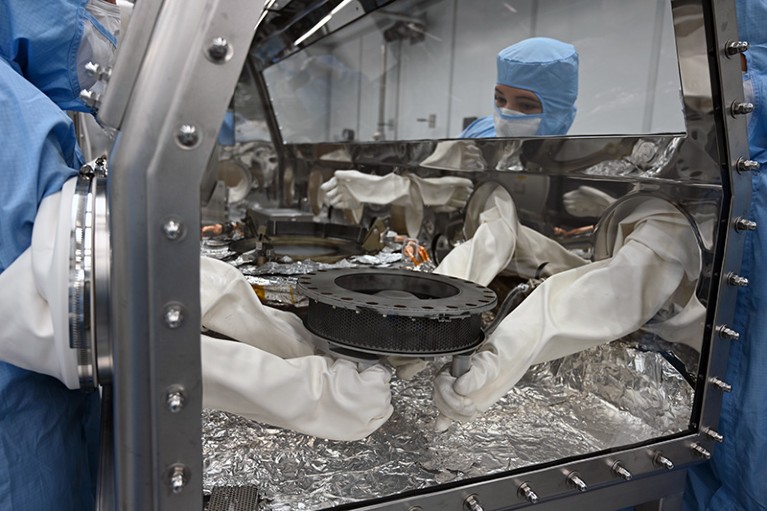
Nevertheless, the 70.3 grams of extracted material offer ample opportunities for scientific exploration. Preliminary analyses indicate that the Bennu fragments contain an abundance of volatile chemical elements, remarkably preserved in the frigid conditions of space since the inception of the Solar System over 4.5 billion years ago. Dante Lauretta emphasized the significance of this discovery, stating that the mission has already proven worthwhile by providing abundant pristine material from the early stages of the Solar System.
Precious cargo: The challenges and opportunities
As meteorites plummet to Earth, they traverse the planet’s atmosphere, undergoing heating and potential alterations to their chemical composition. To safeguard its extensive payload from such changes, the OSIRIS-REx spacecraft implemented protective measures.
Notably, within the gathered collection is a substantial 3.5-centimeter-long rock, the largest specimen procured from Bennu. Its size proved significant enough to momentarily jam the spacecraft’s collection mechanism during OSIRIS-REx’s brief contact with the asteroid’s surface in 2020. This encounter involved the spacecraft vacuuming up an array of pebbles and dust. While the majority of the Bennu material appears dark, almost black, this particular rock possesses an additional bluish sheen, a characteristic reminiscent of highly reflective boulders observed on Bennu’s surface during OSIRIS-REx’s orbital observations.
Examining smaller fragments within the Bennu sample reveals contrasting features, with some displaying light-colored reflective coatings, creating a stark contrast against the darker pebbles. However, microscopic inspection exposes a highly brittle layer that readily breaks to unveil a darker interior. Chemical analysis disclosed an unusual combination of magnesium, sodium, and phosphate in this light-colored surface skin—a composition rarely, if ever, observed in meteorites. This aspect presents a current puzzle for scientists.
Further exploration of Bennu’s composition exposes additional components such as hydrated clay minerals (phyllosilicates), carbonates, magnetite, and sulfide minerals. While these findings align with expectations, they contribute valuable insights. The Bennu sample also encompasses organic compounds, characterized by carbon-carbon or carbon-hydrogen bonds, including a significant presence of ringed molecules known as polycyclic aromatic hydrocarbons. Such organics, akin to those found in Earth’s meteorites, may have played a role in the emergence of life on our planet.
The process of freeing the samples
To date, curators have meticulously documented over 1,000 Bennu particles exceeding half a millimeter in size, according to Lauretta. This robust cataloging effort provides a comprehensive inventory of the varied components collected during the OSIRIS-REx mission. Notably, this mission stands out as a significant advancement, as prior asteroid sample-return endeavors, such as Japan Aerospace Exploration Agency’s Hayabusa and Hayabusa2 missions to Itokawa in 2005 and Ryugu in 2018, respectively, only yielded a combined teaspoonful of material.
Beyond the 70.3 grams of Bennu material already logged, an estimated 30 to 70 grams remain ensconced within the core of OSIRIS-REx’s sample-return canister, as per Lauretta. The impending challenge involves unlocking the canister, obstructed by the recalcitrant screws. NASA is crafting specialized screwdrivers, mindful of the need to prevent sample contamination. Currently housed within a nitrogen-filled glovebox, the samples await extraction, a process that may extend over several weeks until the technicians successfully release the stuck screws.
Resources
- JOURNAL Witze, A. (2023). ‘Head-scratcher’: first look at asteroid dust brought to Earth offers surprises. Nature. [Nature]
Cite this page:
APA 7: TWs Editor. (2023, December 13). Asteroid Dust from Earth Reveals Unexpected Findings. PerEXP Teamworks. [News Link]