



APA 7: TWs Editor & ChatGPT. (2023, November 8). Study Discovers Increased Unpredictability of El Niño-Southern Oscillation Due to Deforestation in the “Maritime Continent.” PerEXP Teamworks. [News Link]
Additionally, El Niño leads to increased and extended periods of heavy rainfall in South America, elevating the risk of flooding. In contrast, regions like Australia and Indonesia experience drought conditions during El Niño, which can be detrimental to water supplies and agricultural irrigation. These conditions tend to reverse during La Niña events.
Recent findings in Geophysical Research Letters propose a significant influence of continental deforestation, particularly within the “Maritime Continent.” This region, situated between the Indian and Pacific Oceans and encompassing Indonesia, Borneo, New Guinea, the Philippine Islands, and the Malay Peninsula, are expected to have a substantial impact on ENSO.
Alterations in land use, like deforestation, lead to decreased evapotranspiration and changes in surface albedo, resulting in the warming of the surrounding environment. These changes, in turn, affect the complex interactions between land, atmosphere, and oceans, thereby modifying the local climate.
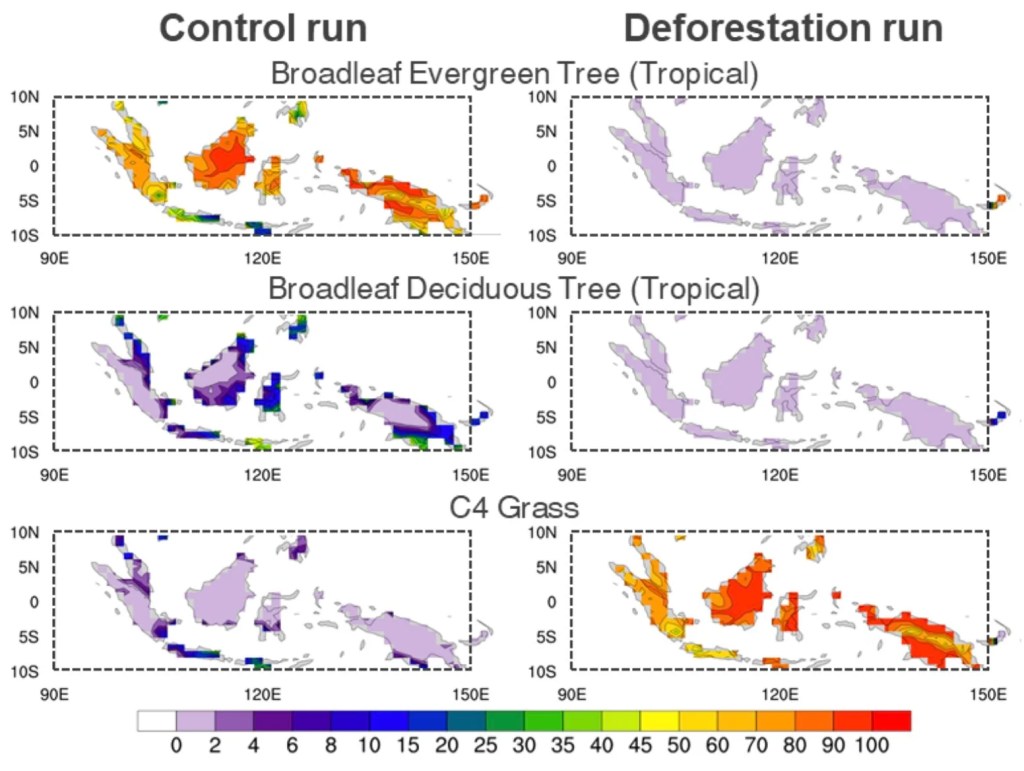
In a study led by Dr. Ting-Hui Lee and a team from the University of California, researchers employed the Community Earth System Model to project potential deforestation scenarios spanning a century. This simulated transformation involved replacing native broadleaf evergreen and deciduous trees with C4 grass. The findings revealed that such changes intensified the El Niño-Southern Oscillation (ENSO), leading to a higher occurrence of ENSO events and a shift toward the central Pacific. This phenomenon is driven by the seasonal footprinting mechanism, in which mid-latitude sea surface temperatures during the winter influence the subtropical atmosphere in the subsequent spring and summer.
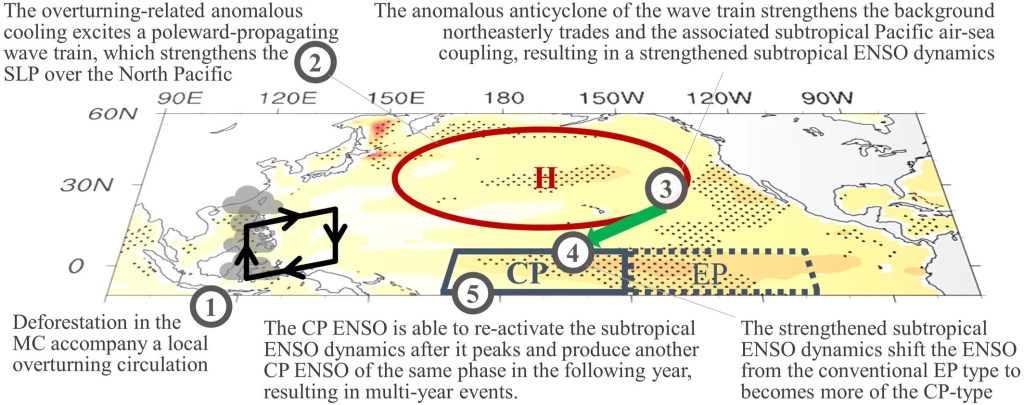
On the flip side, reduced air pressure in the tropical western Pacific hampers atmospheric convection, leading to unusual temperature differences between land and sea. This cooling effect prompts the movement of colder water towards the poles through a phenomenon known as a Rossby wave train. Consequently, it creates a favorable shift in sea level pressure over the subtropical northeastern Pacific, and when combined with atmospheric high pressure during boreal winter (December-February), it intensifies ENSO events.
The high atmospheric pressure system in the subtropical north Pacific reactivates the seasonal footprinting mechanism and leads to sustained La Niña conditions over multiple consecutive years, deviating from the typical alternating pattern with El Niño events. According to the research team, ongoing deforestation is projected to elevate the occurrence of these multi-year La Niña events in the coming decades, with simulations indicating a potential 13.8% increase. This trend has already been illustrated by the presence of three multi-year La Niña events in the 21st century: 2010–2012, 2016–2018, and 2020–2022.
Moreover, the shift of ENSO-like events toward the central Pacific can be attributed to a positive change in trade winds within the northeastern Pacific. This alteration intensifies localized wind speeds, leading to enhanced cooling of the ocean’s surface.
In the simulations, it was found that the probability of El Niño events increased by 11.7% due to deforestation when compared to the background model levels. Likewise, the occurrence of La Niña events was heightened by 14.6% in these simulations, especially in areas with extensive tree removal.
Although additional research is needed to fully grasp the real-time consequences of deforestation in contrast to simulation models, the prospect of ENSO dynamics shifting toward more frequent multi-year events raises concerns regarding predictability. This has significant implications for communities trying to prepare for and minimize the impacts of such events.
Resources
- NEWSPAPER Bird, H. (2023, November 7). Deforestation across the “Maritime Continent” is making El Niño-Southern Oscillation more unpredictable, finds study. Phys.org. [Phys.org]
- JOURNAL Lee, T., Yu, J., Lin, Y., Lo, M., & Xiao, H. (2023). The potential influence of maritime continent deforestation on El Niño‐Southern Oscillation: Insights from idealized modeling experiments. Geophysical Research Letters, 50(20). [Geophysical Research Letters]


