





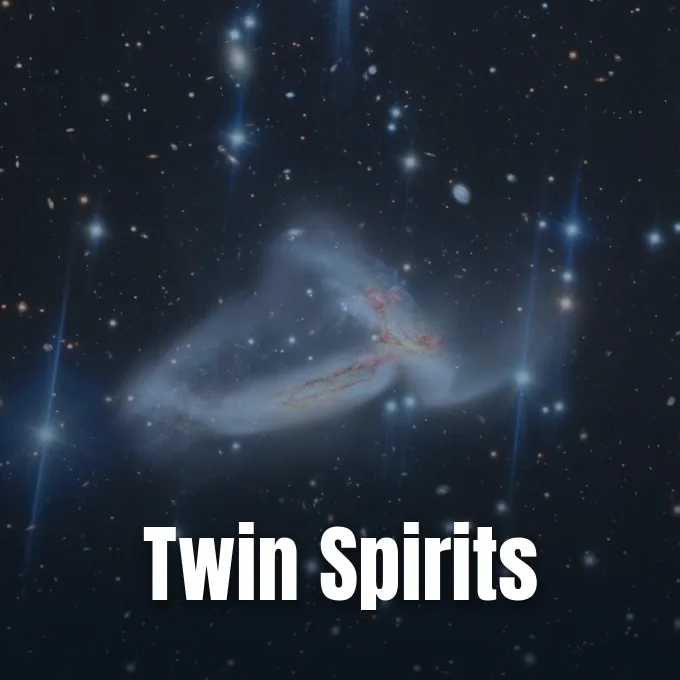
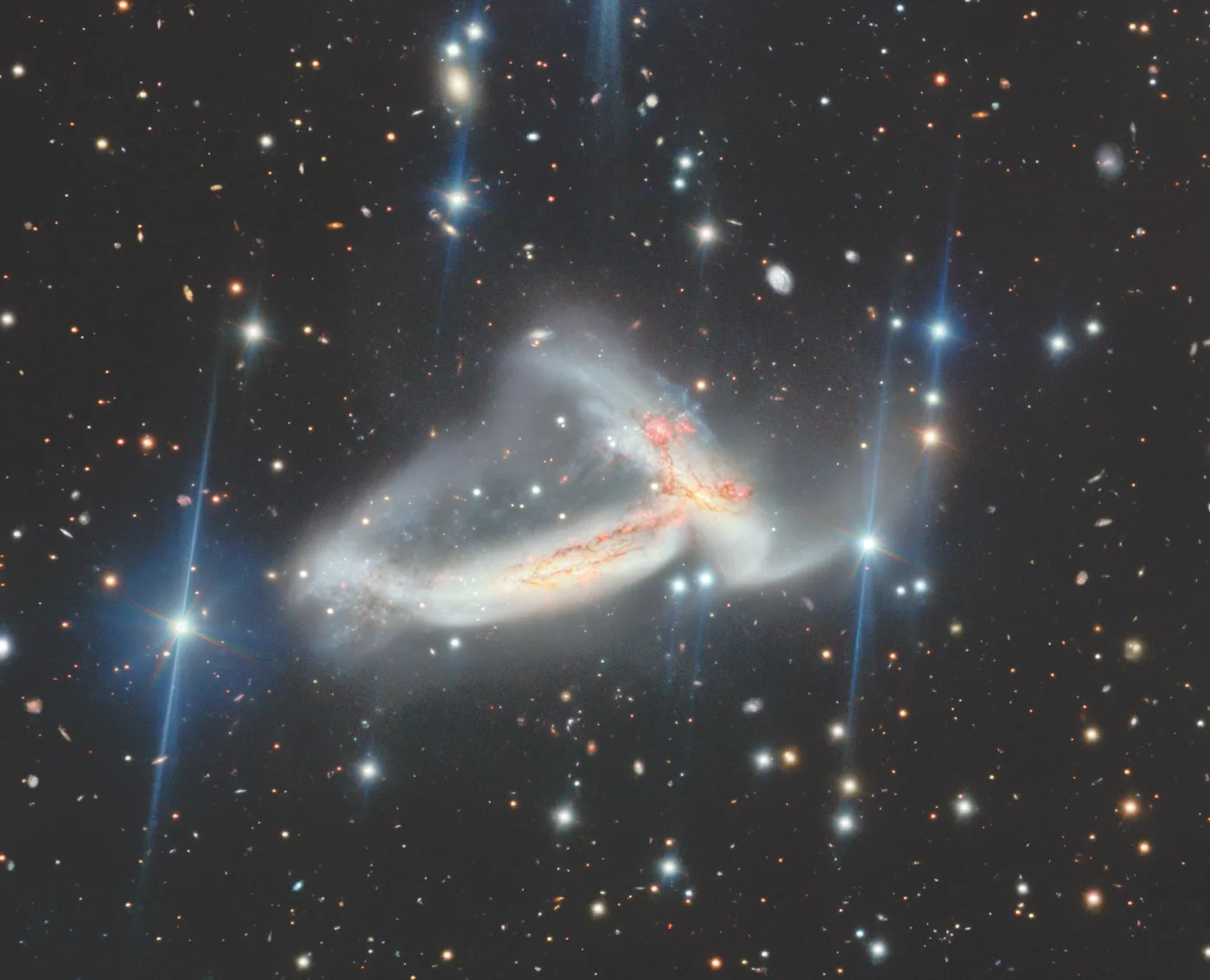
Hawaiʻi high school interns working with the Gemini North telescope on Maunakea captured an image of interacting spiral galaxies NGC 7253, located 200 million light-years away in the constellation Ka Lupe o Kawelo (Pegasus). The students selected the pair during their summer internship and gave it a Hawaiian name, Nā ʻUhane Māhoe Huki Pū i ke Ola, translating to the twin spirits pulling together creating life. Over billions of years, the two galaxies will draw into each other and trigger the birth of new stars [6].
Target Selection on Maunakea
German astronomer Albert Marth first spotted NGC 7253 on September 9, 1863, entering the object into standard sky catalogs as two connected bodies known as NGC 7253A and NGC 7253B. The system stayed under that catalog designation for 163 years without a common name, known mostly through coordinates in professional sky surveys. In October 2025, three high school interns joined Project Hōkūlani at the Gemini North Hilo Base Facility to pick a target for modern observation [5].
The student team brought together Raiyan Rahman and Rafan Rahman from Waiākea High School with Alia Tamanha from the Volcano School of Arts and Sciences. They reviewed catalog entries to find an object that carried both scientific value and a direct link to local sky lore. They chose NGC 7253 because it sits inside Ka Lupe o Kawelo, the Kite of Kawelo, which is a traditional Hawaiian constellation matching the stars of Pegasus. “NGC 7253 is a fascinating object because it’s two galaxies that are merging into one over billions of years. But we mainly picked this object because it was one of the few that actually lay within a Hawaiian constellation, Ka Lupe o Kawelo,” Raiyan Rahman said [6].

The three students spent one week working with observatory staff in Hilo to prepare the observation run. They studied how the 8.1-meter telescope schedules exposures and how astronomers track deep-sky targets through the atmosphere above the summit [1].
Images From the Gemini North Telescope
The Gemini North telescope recorded the colliding spiral galaxies during clear night skies on Maunakea in October 2025. Listed collectively in the Atlas of Peculiar Galaxies as Arp 278, the two spirals lie about four million light-years apart from each other while moving through their long collision. The resulting exposure became the clearest view ever made of NGC 7253, resolving fine gas ribbons and trailing debris that older instruments could not separate [4].
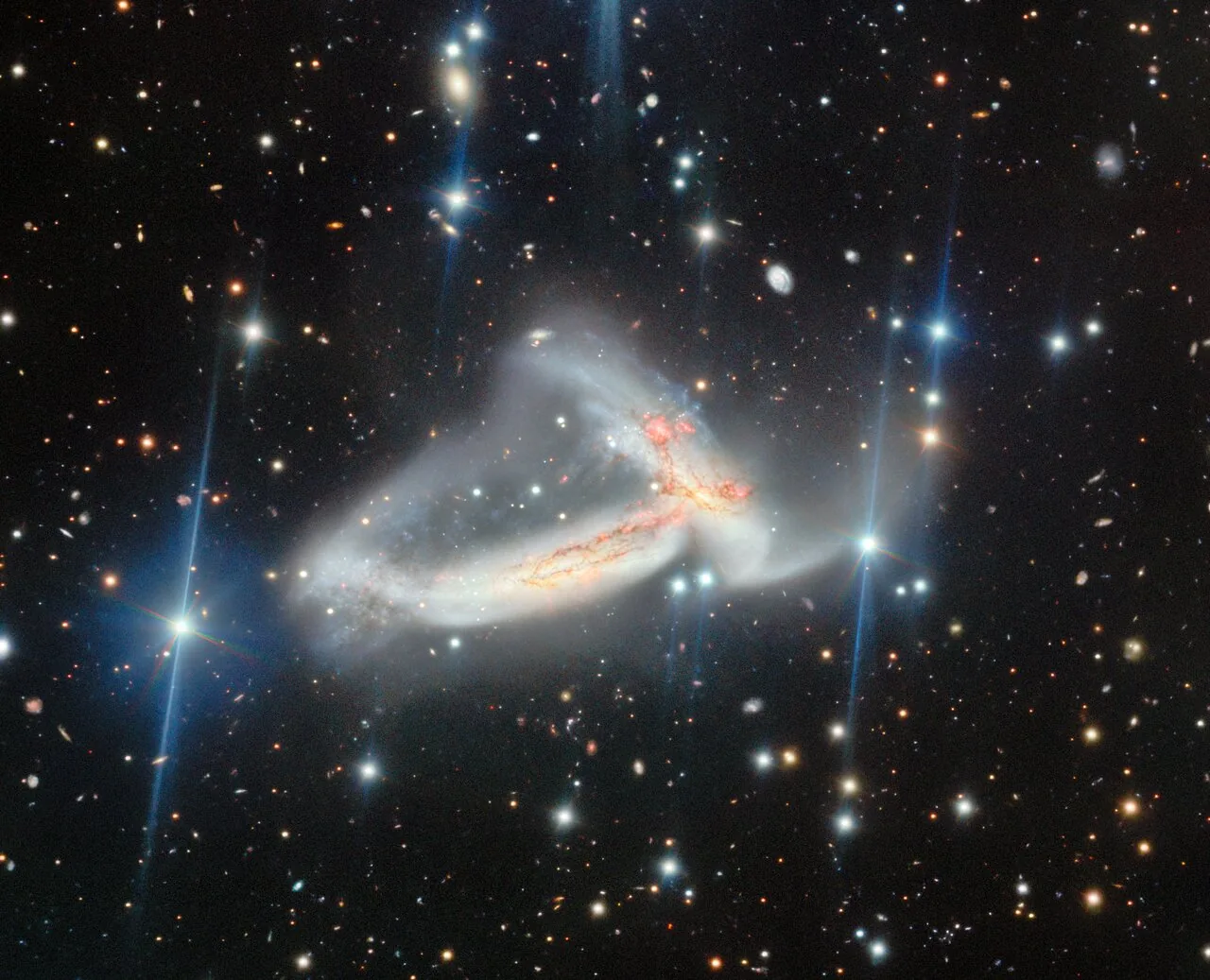
An image processing team featuring J. Miller, M. Rodriguez, T.A. Rector, D. de Martin, and M. Zamani worked with the raw telescope data to build the final release image. Rector, based at the University of Alaska Anchorage, helped balance the color channels to distinguish between old stellar populations and young clusters. The 8.1-meter primary mirror on Maunakea collected enough light to reveal distant background galaxies scattered through the surrounding field. The image shows the two spirals caught in an early-to-mid stage collision where their central disks remain intact while tidal friction tears their outer arms into elongated arcs [2].
Meaning of the Hawaiian Name
In June 2026, a second group of Project Hōkūlani interns took on the task of naming the newly processed image. The team included Mylin Wilson from Keaʻau High School along with Manu Silva-Sampaio and Samantha Silva-Sampaio from Kamehameha Schools. They studied the shapes in the image and consulted cultural traditions to craft the Hawaiian title Nā ʻUhane Māhoe Huki Pū i ke Ola. Each part of the name speaks to a distinct physical feature of the galaxies and to the shared work of the students [6].
The opening phrase, Nā ʻUhane Māhoe, points to the twin spirits seen in the two similarly sized spirals and their wispy arms. It also honors the twin structure of the International Gemini Observatory, which pairs Gemini North in Hawaiʻi with Gemini South on Cerro Pachón in Chile. Samantha Silva-Sampaio explained that ʻoli, or chants, and summit visits helped the interns connect their heritage with science. “ʻUhane in this image reminds us that astronomy is not just science or spirit; it’s both at the same time,” Manu Silva-Sampaio said [6].
The words Huki Pū describe the gravitational pull dragging the galaxies together, while also describing how astronomers, educators, and students joined hands to finish the project. Wilson explained that learning from many mentors made their internship a kākou, or collective, practice. The closing words, i ke Ola, point to the life that emerges when colliding gas clouds form new stars. Manu Silva-Sampaio added that stars sustain life on Earth because the Sun is a star that makes human survival possible [6].



Star Formation in Merging Spirals
How do two distinct galaxies pull each other into a unified structure? In deep space, galactic mergers unfold across billions of years rather than through sudden destructive impacts. As NGC 7253A and NGC 7253B pass each other, their stars rarely collide because vast empty space separates individual star systems. Gravitational fields instead distort the spiral structures, drawing out long tidal tails and creating gas bridges between the two cores [3].
Interstellar gas clouds compress as gravitational forces pull material toward the center of the merger. Dense pockets of atomic hydrogen heat up under this pressure until they collapse into stellar nurseries, sparking new waves of star birth. Ionizing radiation from these young, massive stars energizes the surrounding gas to create H II (pronounced “h-two”) regions, which appear as glowing pink knots throughout the arms. The merger taking place 200 million light-years away will supply raw materials for new solar systems long after the two cores unite into an elliptical galaxy [5].
How the Gemini North Telescope Trains Students
Project Hōkūlani operates as an educational partnership between the International Gemini Observatory and the University of Hawaiʻi at Mānoa. The program supports middle and high school students in Hawaiʻi by introducing them to careers in science, technology, engineering, and mathematics. Students work with professional astronomers, gaining first-hand experience with real telescope scheduling, target selection, and scientific analysis instead of merely reading textbook summaries [4].
The image of NGC 7253 was created through the NOIRLab Legacy Imaging Program, a project that began at Gemini North in 2002 under the name Gemini Legacy Imaging Program. The initiative reserves set observing time on Maunakea to collect color data for public outreach. Every year, six local students on Hawaiʻi Island contribute to selecting targets, analyzing data gathered by the Gemini North telescope, and naming the finished astronomical portraits [6].
Cultural Heritage and Modern Astronomy
The naming of NGC 7253 joins an ongoing effort to weave Indigenous language and culture into modern sky observations. For over a century, catalog entries like Arp 278 or NGC 7253 reduced complex cosmic phenomena to numbers and letters. By placing the Hawaiian name at the forefront of the public release, the observatory acknowledges that Maunakea has hosted the Gemini North telescope on land carrying profound cultural reverence for Native Hawaiians [5].
NSF NOIRLab operates the International Gemini Observatory on behalf of the U.S. National Science Foundation and international partners in Canada, Chile, Brazil, Argentina, and the Republic of Korea. In managing facilities on Maunakea in Hawaiʻi and Cerro Tololo and Cerro Pachón in Chile, the organization recognizes the sacred connection that Kanaka Maoli communities maintain with Maunakea. Giving local youth authority over naming deep-space objects helps build mutual respect between astronomical research facilities and island residents [6].
The Astronomy Picture of the Day featured the portrait on September 4, 2026, showing the world how youth education and deep-space research can come together. Nā ʻUhane Māhoe will continue its cosmic dance in Pegasus for billions of years, but its new name anchors it firmly to the island community that brought its light to the world [4].
- ONLINE NEWS Klesman, A. (2026, November 8). Gemini North reveals Twin Spirits in Pegasus. Astronomy Magazine. [Article Link]
- ONLINE NEWS Klesman, A. (2026, November 8). Gemini North reveals Twin Spirits in Pegasus. NewsBreak. [Article Link]
- ONLINE NEWS Orbital Radar Newsroom. (2026, September 4). Twin Galaxies: A Dance of Creation in Pegasus. Orbital Radar. [Article Link]
- ONLINE NEWS BedrockNews. (2026, September 4). Twin Spirits Pulling Together: Hawaiian Students Name a Galactic Collision Through Gemini North. BedrockNews. [Article Link]
- ONLINE NEWS Cosmic Herald. (2026, September 7). Hawai’i High Schoolers Name a 200-Million-Light-Year Galaxy Pair Caught by Gemini North. Cosmic Herald. [Article Link]
- PRESS RELEASE NSF NOIRLab. (2026, September 1). Hawai‘i Students Name Image of Glittering Galaxy Pair Nā ʻUhane Māhoe Huki Pū i ke Ola. NOIRLab. [Article Link]
APA 7: PerEXP Teamworks. (2026, November 9). Hawaiʻi Students Use Gemini North Telescope to Study Mergers. PerEXP Teamworks. https://perexpteamworks.com/en/gemini-north-telescope-merging-galaxies/


