





Astronomers watching the outer edge of the Andromeda galaxy have recorded a rare cosmic event where a swollen supergiant swallowed its smaller companion. NASA’s James Webb Space Telescope captured the aftermath just 47 days after the eruption peaked, giving researchers an early look at a stellar merger as it unfolded in space [1]. The pair had orbited in M31 for centuries before the final plunge [3]. The collision left behind a single rejuvenated object that researchers nicknamed Bao. By combining space observations with ground telescope records, scientists tracked each phase of the stellar merger [1].
Observing the Stellar Merger in Real Time
Lead author Viraj Karambelkar, a NASA Hubble Fellow at Columbia University in New York, reported the discovery in Nature with co-authors Kishalay De and Nadia Blagorodnova [1]. In an earlier study in The Astrophysical Journal, Karambelkar identified the progenitor system as WNTR23bzdiq and WTP19aalzlk in M31 [3]. The final outburst was cataloged as AT 2025abao. “Stellar mergers are very, very difficult to observe in real time because they are hard to predict,” Karambelkar said. The team noticed unusual infrared activity in 2023, continued monitoring the system, and watched it erupt in late 2025. Webb captured the immediate aftermath just 47 days after the outburst reached peak brightness, providing an early look at the collision [1].
Astronomers first proposed common envelope evolution in the 1970s to explain how stars end up in tight orbits that seem too close for initial formation. Stars evolve over millions of years. In an interview about the event, Karambelkar said that watching a complete merger within years or decades makes the process seem brief. “It lasts for a few years, maybe a few decades,” Karambelkar said, adding that the event is “really like a blip on the entire cosmic time scale” [2].
Webb joined the campaign under an approved Director’s Discretionary Time program on December 24, 2025. Webb observed Bao 47 days after peak brightness. Karambelkar called the follow-up an important opportunity to characterize the system before, during, and right after the merger [1].
Warning Signs Before the Eruption
For thousands of years, the two stars circled each other in relative calm without colliding. That stability ended when the smaller companion began brushing against the swollen outer gas envelope of the giant star. “We thought an outburst from such an extended star would take years,” said co-author Nadia Blagorodnova, an associate professor at the University of Barcelona in Spain. The brightness peaked within a single week [1].
Archival optical data from 2003 to 2015 showed small brightness fluctuations under 0.3 mag in the progenitor star. NASA’s retired NEOWISE mission then logged a steady mid-infrared brightening of 1 mag over 10 years. Between 2018 and 2021, the system underwent a 0.5 mag optical rise, followed by an optical outburst lasting roughly 1000 days from 2021 to 2023 and another 1 mag rebrightening in 2024 [3]. Co-author Kishalay De, an assistant professor at Columbia University in New York, said that the companion star peeled off the primary star’s outer layers into space [1].
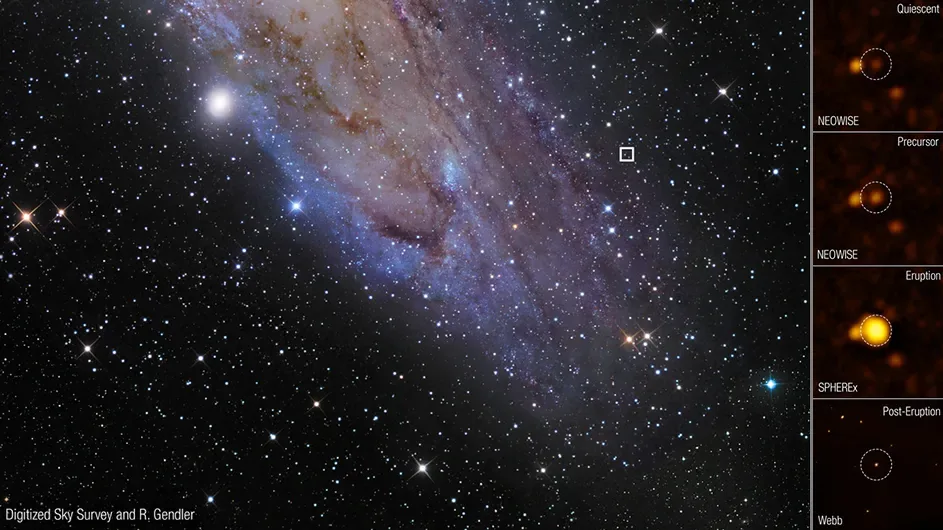
By September 2024, measurements from the WINTER survey revealed that the system was growing brighter while shedding dust clouds into space. In July 2025, NASA’s SPHEREx mission observed the object during a routine all-sky survey and registered a telling pattern. The star was fading in visible light while glowing brighter in infrared wavelengths. Thick dust was shrouding the binary system [1].
How Common Envelope Evolution Unfolds
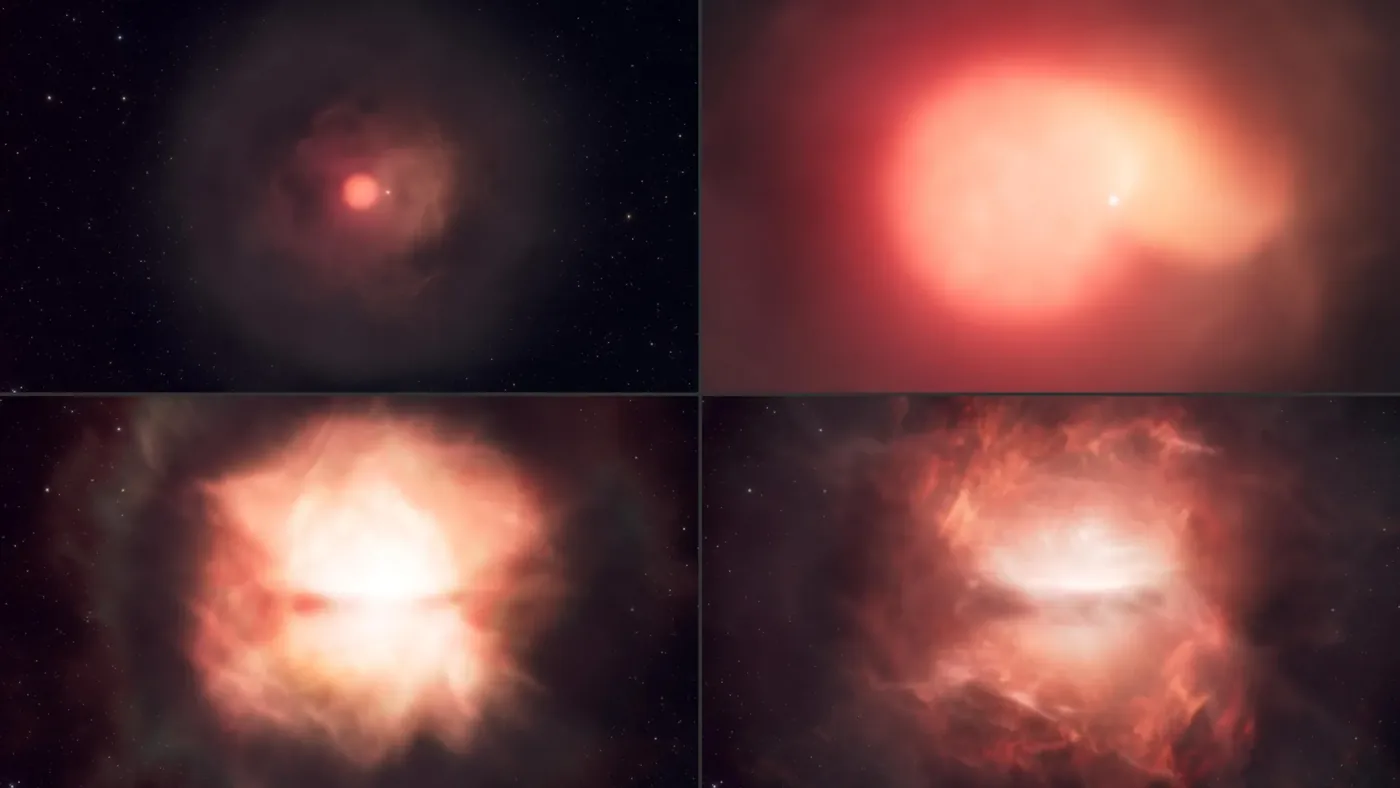
Common envelope evolution occurs when an aging star expands into a giant and swallows its companion inside a shared cloud of gas. As the engulfed star drags through the gas, friction drains its orbital energy and pulls it inward. The pair either merges or tightens its orbit [2]. The theoretical framework explains how close binary pairs form in galaxies [1].
The companion completed its merger after just seven orbits (about seven years), a fast pace compared to previously observed mergers of smaller stars that required thousands of orbits. PerEXP Teamworks earlier reported how Webb unveiled previously unseen features in an iconic supernova remnant, showing how infrared observatories detect expanding gas shells. Friction stripped material from the main star so fast that the envelope could not shed heat slowly. The rapid loss of energy accelerated the inward spiral [1].
Astronomers note that common envelope interactions do not always end in a collision. In some binary pairs, the envelope gets expelled before the stars merge, leaving two stripped stellar cores locked in tight orbits. Surviving binaries can later evolve into compact objects such as neutron stars or black holes, trigger supernovae, produce gravitational waves, or form millisecond pulsars. Studying Bao helps astronomers measure how energy transfers during these encounters [1].
Simulations Reveal Big Bao and Little Bao
Karel Temmink, a doctoral student at Radboud University in Nijmegen, Netherlands, led numerical simulations comparing Webb mid-infrared observations with theoretical models. The primary supergiant, nicknamed Big Bao, was an early-AGB star with a mass of 7 ± 2 solar masses. Before the merger, the star had an effective temperature near 3500 K, a radius 350 times larger than the Sun, and an initial luminosity of 1.6 × 10^4 solar units that rose to 5 × 10^4 solar units during eruption [1, 3]. “It was an absolute beast of a star, completely outshining its companion in the data,” Temmink said. The computer models showed that the giant star dominated the total light output of the system [1].
The team calculated the mass of the companion star for the first time. Nicknamed Little Bao, the companion had an estimated mass of 0.7 solar masses (roughly 70% of solar mass), making it dimmer and less massive than our Sun. Earlier simulations suggested Little Bao might hold enough orbital energy to flee the giant star. The smaller star could not break free. Further modeling proved that friction dragged the companion directly into the dense envelope [1].
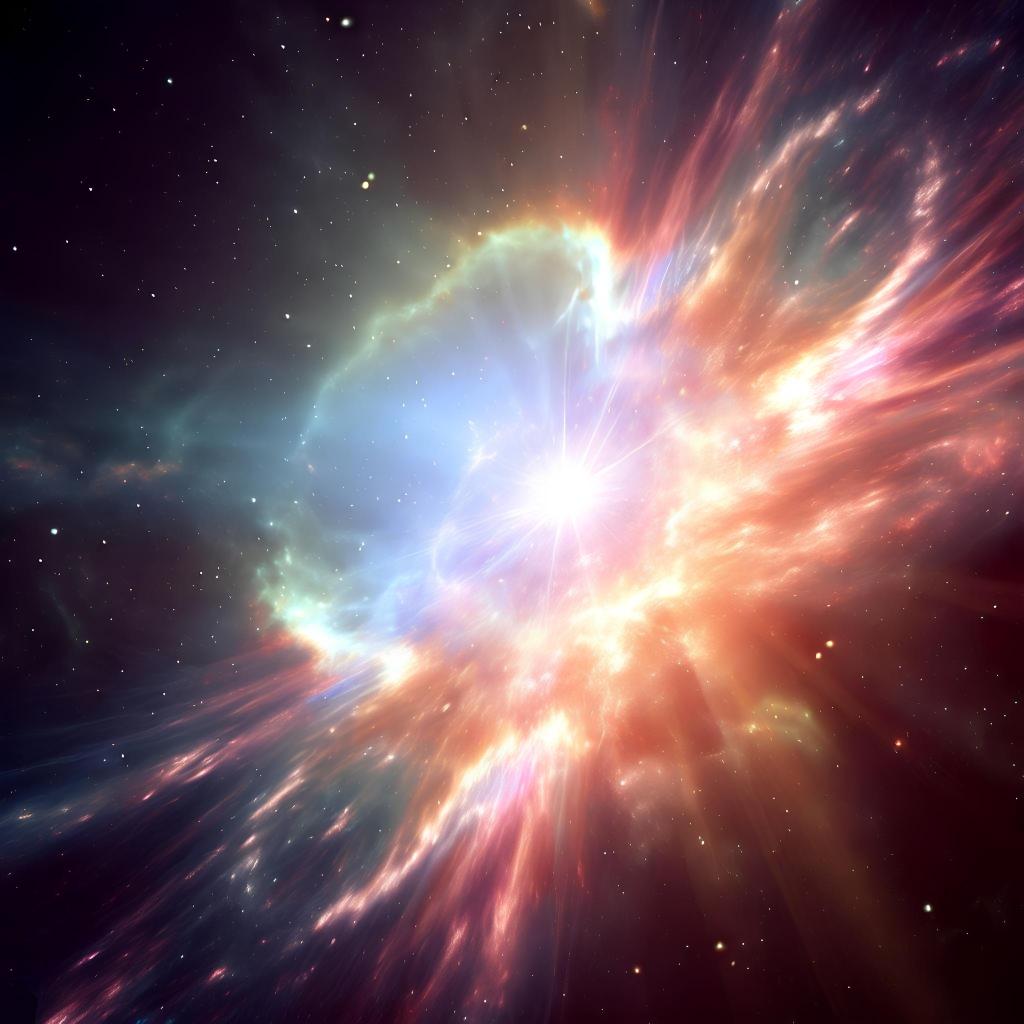
The final descent dragged Little Bao into the supergiant core, producing a massive outburst that blew off the outer layers. De described the climactic stellar merger as “almost like a bomb exploding inside a living star” [1]. The expansion velocity reached 5 km per second while temperatures remained steady near 3600 K [3]. The surviving star was nicknamed Bao. Researchers at Columbia University and the University of Barcelona are still monitoring how the merged star reorganizes its structure [1].
Telescope Data Tracking the Outburst
Ground monitors caught the first signs of the actual explosion on October 17, 2025, when the Zwicky Transient Facility (ZTF) registered a sharp spike in brightness and temperature. The automated alert mobilized observatories worldwide. Teams quickly aligned ground and space instruments to observe the eruption from multiple angles before the light faded [1].
In November 2025, NASA’s now-retired Neil Gehrels Swift Observatory and NOIRLab’s Gemini North telescope in Hawaii provided ultraviolet, optical, and near-infrared measurements that documented the expanding fireball [1]. Optical and near-infrared spectra showed the eruption transitioning from M1 to late M7 or M8 star features [3]. When Webb pointed its instruments at Bao on December 24, 2025, the telescope gathered mid-infrared spectra that revealed dust grains expelled by the giant over hundreds of years. Combining data from Swift, Gemini North, and Webb allowed astronomers to track the cooling gas as it formed fresh dust shells in the outer regions of M31 [1].
Mid-infrared imaging proved helpful for mapping material obscured at visual wavelengths. The telescope’s instruments detected warm dust shells that the main star had cast off long before the final stellar merger began. PerEXP Teamworks also documented how a protostar in Perseus shines brightly in Webb’s view, offering another view of gas and dust dynamics in deep space. These infrared measurements allowed the research team to measure how much gas was shed during the eruption and calculate how energy transferred to the surrounding envelope [1].
Future Surveys Following Stellar Merger Events
Observing AT 2025abao as it happened marks an important shift in studying stellar merger events. Astronomers caught the transition as it occurred. Instead of analyzing ancient remnants left behind thousands of years ago, astrophysicists obtained real-time measurements across the entire eruption cycle. The data provides benchmark figures for how a common envelope sheds gas and whether binary stars survive or merge [1].
Astronomers expect to find many more interacting binaries as next-generation observatories begin wide surveys. NASA’s Nancy Grace Roman Space Telescope will repeatedly scan crowded star fields through its Galactic Bulge Time-Domain Survey to catch transient events. Karambelkar said that researchers should prepare for a wave of new observations as wide-field infrared monitors track changing stars across nearby galaxies. “There’s going to be a large influx of similar discoveries just ahead,” Karambelkar said [1].
The research effort received partial funding through NASA’s Astrophysics Data Analysis Program. The James Webb Space Telescope operates as an international partnership between NASA, ESA (European Space Agency), and CSA (Canadian Space Agency). Follow-up monitoring of Bao continues. Long-term observations will show how the merged star settles over coming years [1].
- ONLINE NEWS NASA. (2026, November 21). A giant star swallowed another star. James Webb reveals the aftermath. ScienceDaily. [Article Link]
- ONLINE NEWS Ars Technica. (2026, November). Watching as a giant star swallowed its neighbor and exploded. Ars Technica. [Article Link]
- ACADEMIC JOURNAL Karambelkar, V. R., Kasliwal, M. M., De, K., Frostig, D., Stein, R., Mo, G., Lourie, N. P., Simcoe, R. A., & Blagorodnova, N. (2025). The Slow Brightening of WNTR23bzdiq/WTP19aalzlk: Possible Onset of Common Envelope Evolution in an Asymptotic Giant Branch Star?. The Astrophysical Journal, 993(1), 109. [Article Link]
APA 7: PerEXP Teamworks. (2026, November 22). James Webb Captures Stellar Merger in Andromeda Galaxy. PerEXP Teamworks. https://perexpteamworks.com/en/stellar-merger-andromeda-giant-star/


