



The gray wolf (TR: bozkurt) symbol, which has a deep meaning in Turkish culture, has represented the identity and unity of Turks for centuries. This mysterious figure appears in many fields, from mythology to history, literature, and politics. Here, what is curious about the origin, meaning, and current place of the gray wolf sign, which Turks have adopted and included in daily life, along with other symbols!..
What are the symbols adopted by the Turks and their meanings?
Turks have a rich and deeply rooted cultural heritage, reflected in the various symbols they have adopted throughout history. These symbols embody a range of meanings, from national identity to cultural significance and religious beliefs.
Crescent and star
The Turkish flag features a white crescent and a five-pointed star on a red background. The crescent and the star are therefore prominently featured on the Turkish flag and are perhaps the most widely recognized symbols associated with Turks.
The crescent (TR: hilal) has historically been used as a symbol by various civilizations in the region, including the Byzantine Empire. For the Turks, the crescent symbolizes progress and movement towards the future.
The five-pointed star (TR: beş köşeli yıldız) represents light and guidance. In the context of the Turkish flag, it is often seen as a symbol of the principles of the Republic of Turkey, including laicism (TR: laiklik) and reformism (TR: inkılapçılık). Legend has it that after the The Second Battle of Kosovo in 1448, in which the Turks were victorious, the reflection of the crescent moon with a star appeared in pools of blood. Sultan Murad II (TR: II. Murat, Koca Murat) adopted this symbol, symbolizing his desire for progress and enlightenment.
The six-pointed star (TR: altı köşeli yıldız) represents the understanding that “As above, so below.” (TR: “Yukarıda olduğu gibi aşağıda da vardır.”) The upward-pointing triangle depicts the spiritual realm, and the downward-pointing triangle depicts the material world. This understanding suggests that everything in the universe is interconnected and that understanding oneself will lead to understanding the universe. It reflects the idea that the whole exists within its parts and vice versa.

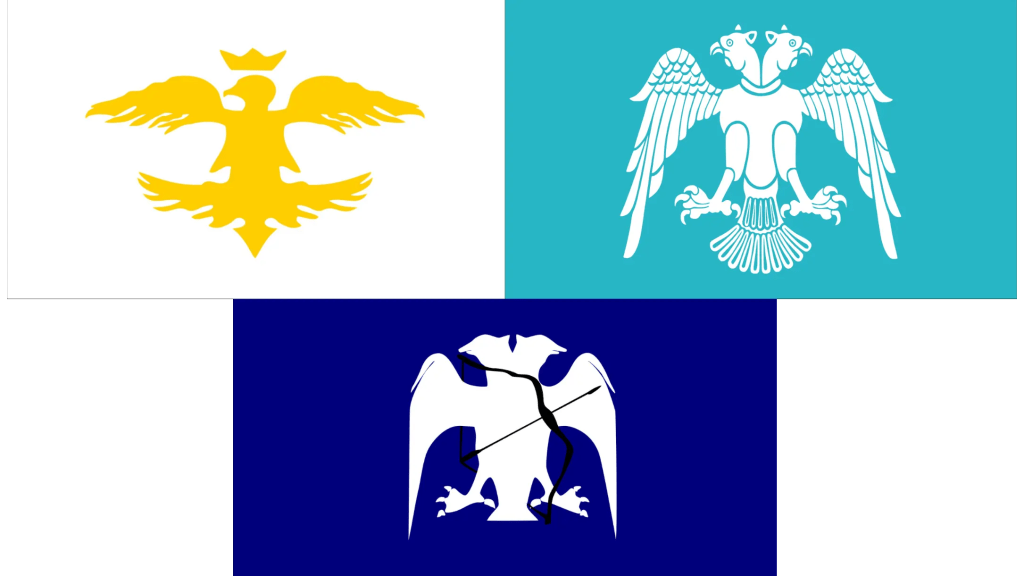
It is known as the Star of David in Judaism, the Shatkona in Hinduism, and the Seal of Solomon (TR: Süleyman’ın Mührü, Mühr-ü Süleyman) in Islam. The oldest example was found in the Temple of Heliopolis in Egypt and dates back 2000 years. It has adorned Indian temples, ancient churches, synagogues, and Shinto shrines. Karamanids, one of the widely known Turkish states, embroidered the six-pointed star on its flag.
An ancient Turkish symbol, the Seljuk Star (or tamga), an eight-pointed star, was common during the Great Seljuk Empire (1037 – 1157). This empire, which had a Turko-Persian cultural influence, used the star as a stamp or seal.

Red and white colors
The red and white colors of the Turkish flag carry deep meaning. While red (TR: kırmızı) represents the bloodshed by soldiers in the struggle for independence and the courage of the Turkish people, white (TR: beyaz) symbolizes peace and the longing for peace. In other words, “Peace at Home, Peace in the World” represents the desire for a future (TR: İstikbal) in independence (TR: İstiklal).
Evil eye bead
It is a common symbol used to ward off evil and protect against negative energy. This symbol, which emerged in the Mediterranean region around 1500 BC and was used in Jewish, Christian, Muslim, Buddhist, and Hindu societies to protect against evil eyes, entered the lives of Turks during the Tengricism (Shamanism) period in Central Asia. The Turks called the evil eye Isabet-i Ayn and started to use evil eye beads (TR: nazar boncuğu; Old Turkish: munçuk, moncuk, monşak, monçak, monçok, or muyınçak) to protect themselves from these bad effects.

Tulip
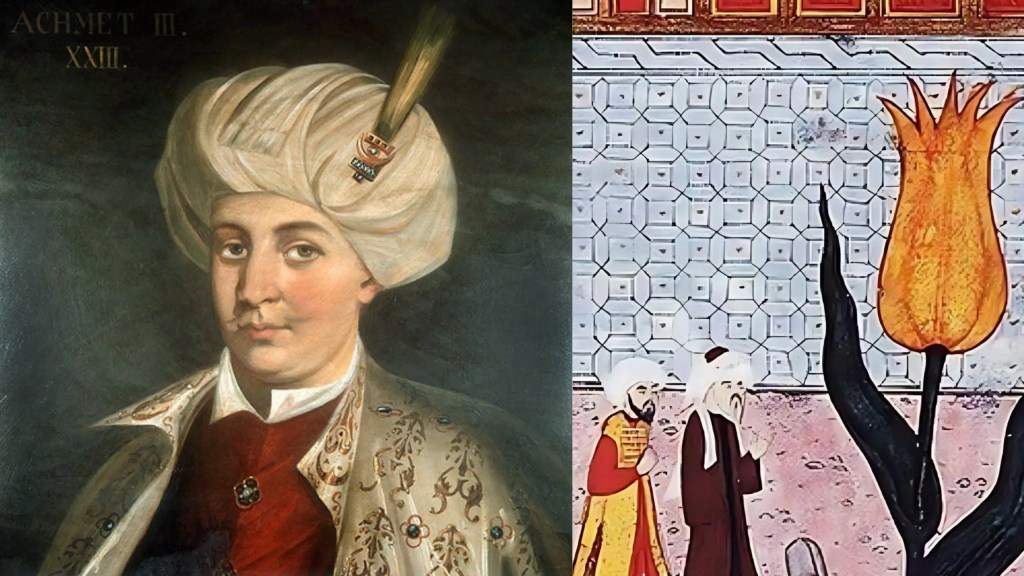
Originally a wildflower native to the steppes of Central Asia, the tulip (TR: lale) has a special place in Turkish culture. During the Ottoman Empire, the tulip became a symbol of beauty, elegance, and perfection, especially during the Tulip Period (TR: Lale Devri) of the early 18th century, a period of peace, prosperity, and cultural flowering.
Dragon
In early Turkish iconography, the dragon is depicted as Büke. It symbolizes cosmic power and might. The name Büke itself carries a deep meaning.
Dragons symbolize God (TR: Tanrı, Old Turkish: Tengri) in ancient Turkish tradition. However, it is important to note that dragons were not worshiped as gods, but rather served as powerful symbols.
Another dragon in Turkish mythology is the Evren (EN: Universe). It represents might and power, reflecting the larger cosmic order and natural forces. Apart from all these, there is a very large creature known as Yelbegen, Yelbeğen, Yilbeğen, or Celbeğen, also depicted as a dragon.

Double-headed eagle
The double-headed eagle is an ancient symbol whose use predates the arrival of the Turks in Anatolia but was also adopted and used by the Seljuk Turks. This symbol reflects the dominance and influence of the Great Seljuk Empire, representing its sovereignty over both the East and West.
Gray wolf: a symbol used by Turks for centuries
The gray wolf sign has a deep significance in Turkish culture. Representing courage, freedom, and warrior spirit, this symbol is rooted in ancient Turkish mythology. Symbolizing rebirth and rebirth, the gray wolf has been associated with various Turkic peoples throughout history. From the Gokturk Khaganate to today’s Turkish republics, this emblem continues to inspire pride and identity among the Turkish people.
The meaning and symbolism of the gray wolf
The gray wolf has been a powerful symbol in many cultures around the world throughout history, but its importance, especially in Turkish culture, has a deep-rooted history. It is also called kökböri (gökbörü) or böri (börü).
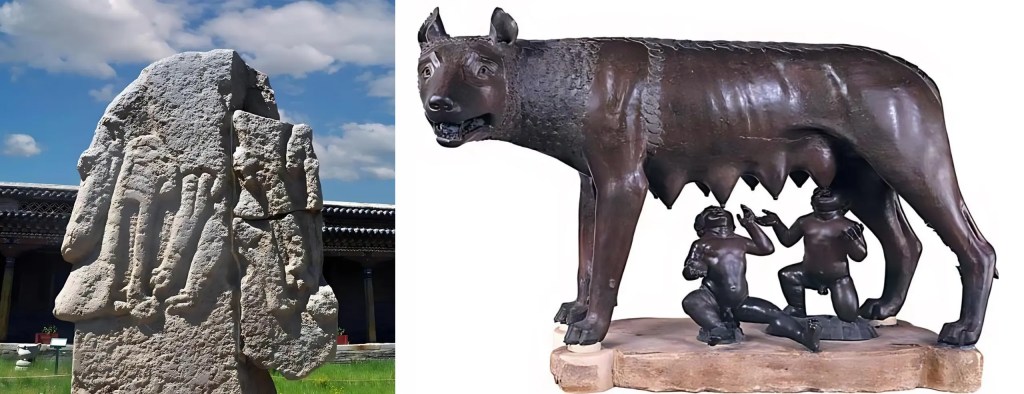
In Turkish mythology, the gray wolf is often depicted as a guide and protector. The saga of the she-wolf Asena (or Aşina, EN: Ashina) is just one of the many stories of the wolf that give well-being and confidence to the Turkish people. The wolf is seen as a symbol of guidance and endurance. It symbolizes strength, loyalty, freedom, and the divine connection between the Turkish people and the natural world.

The Göktürk Khaganate (552 – 744) featured a wolf on their blue flag. According to them, this emblem represented war, fighting spirit, freedom, speed, and nature. According to their beliefs, when there was a threat to the Turkish nation, a wolf would appear and guide them. They would even place wolf-headed golden poles (brigades, Old Turkish: tuğ) in front of their tents to protect themselves from possible dangers. According to the Ergenekon Epic, the Turks found their way under the leadership of Börteçine (Bozkurt), a female wolf who guided them when they came out of Ergenekon by melting the iron mountains.
In the Kul Tigin Inscription, which is considered the most important part of the six-part Orkhon Inscriptions of the sixth century, a child sucking milk from a wolf is depicted, emphasizing the close bond between humans and wolves in their culture. In Turkish folk culture, carrying wolf teeth was believed to protect against the evil eye.

The historical role of the gray wolf
The historical importance of the gray wolf in Turkish culture dates back to ancient times. The legend of Asena, a mythical wolf who nursed and protected a Turkish child who would later become a great leader, emphasizes the wolf’s role as the protector and ancestor of the Turkish people. This legend – among others – cemented the gray wolf as a central figure in Turkish lore and historical consciousness.
The Wolf Ashina is part of the epics, or origin stories, of all Turkic and Mongolian tribes. The most well-known version of the legend of Ashina the Wolf comes from the Gokturks (Celestial Turks or in other words: Blue Turks), a prominent confederation of Turkic tribes. According to the epic, the ancestors of the Gokturks were massacred by a neighboring tribe. Only a young boy whose legs were amputated survived, but he was saved by a she-wolf. The she-wolf nursed the boy back to health, and later the boy and the wolf had ten sons. One of these sons was named Ashina and became the ancestor of the Gokturk Khaganate.
The Uyghur version of the legend, the Uyghur Derivation Epic (TR: Uygur Türeyiş Destanı), is similar to that of the Gokturks. The Uighurs also believe that their ancestors were saved by a wolf, from which they descended. One of the ancient Hun rulers had two daughters who were famous for their beauty, and there was a belief that they were created to marry the gods. When the ruler heard these rumors, he built a high tower in the north of his country to protect his daughters from people and locked them up there. One day, God, whom the ruler prayed to marry his daughters, came in the form of a brown wolf and married them and had many children. Some of these children, the Nine Oghuz-Onogur, had a voice similar to the voice of the gray wolf (otherwise known in Old Turkish: Gök Oğul). These children, who carried their father’s grizzly spirit, multiplied over time. This legend is a symbol of endurance and survival against adversity.
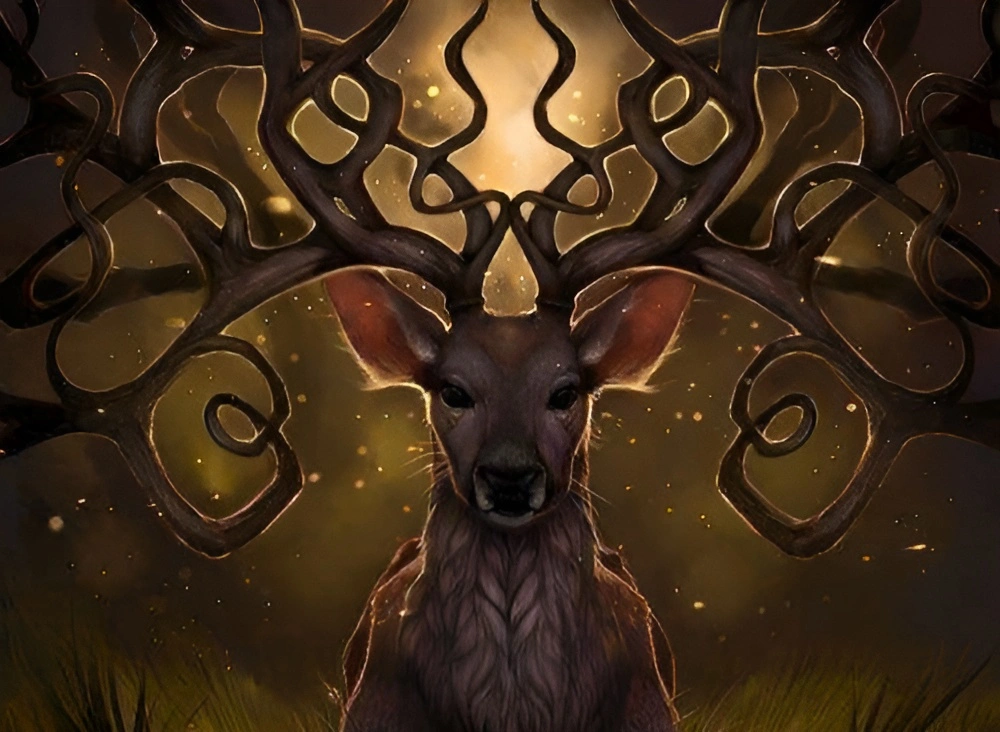
On the other hand, the Mongolian version of the wolf legend is closely linked to Mongolian identity. According to one legend, Mongolians trace their ancestry to a blue-gray wolf and a female deer (Mongolian: Kubamaral, Govamaral / Goa Maral, Guvamaral; Turkish: Alasığın, Alageyik, English: Fallow Deer). This pair is considered the original ancestors of the Mongolian people and their union marks the beginning of the Mongolian lineage.
The wolf symbol was used by various Turkic tribes living in Central Asia in the fourth and fifth centuries. The Wusuns (or Usuns, TR: Usunlar), a Turkic tribe, were among the first to adopt this symbol around 174 BC. In the fourth and fifth centuries AD, the wolf motif was adopted by other Turkic tribes, including the one known as the Kao-Ch’e (or Kang, TR: Kanglılar).
On the other hand, historical research shows that the sign of the gray wolf was also used by various Turkic tribes, including the Huns, Kyrgyz, Yakuts, Bashkirs, Kipchaks, and Pechenegs, to indicate their ancestry. The 10th-century Iranian poet Firdavsi depicted Turkish women making a sign similar to a gray wolf in his poetic epic Shahnameh, based on ancient Iranian legends.

The symbol of the wolf, the symbol of the gray wolf, maintained its importance during the Seljuk period, albeit less prominently than in previous Turkish states. The symbol manifested itself in cultural and artistic depictions. In the Ottoman period, although it had a less central position, it continued to be accepted especially by the public, and used in certain contexts as a cultural emblem. The Ottomans, who converted to Islam, incorporated more diverse symbols.
In Turkey, the name “Asena” is thought to mean she-wolf. Ziya Gökalp, in his article titled Türk Devletinin Tekâmülü (EN: Evolution of the Turkish State) in Küçük Mecmua (EN: Little Jour) published in Diyarbakır in 1922, stated that according to the Chinese, Asena means wolf. The dynasty to which the former rulers of the Gokturk Khaganate belonged, known as Ashina, Zena, Asen, or Shunnu, is thought to have descended from this she-wolf, according to legend. This name is derived from the word Açina.

Mustafa Kemal Atatürk emphasized the importance of national unity. As part of this effort, he had Köprülüzâde Mehmed Fuad (Ord. Prof. Dr. Mehmet Fuat Köprülü) establish the Institute of Turkic Studies in Istanbul, which aimed to research and promote Turkish culture and heritage. The emblem of the institute featured the symbol of the gray wolf and underneath it the inscription Let the Turkish Fire of Knowledge Smoke (TR: Türk’ün İlim Ateşi Tütsün).
Mahmut Esat Bey participated in the Turkish War of Independence with the Kuvayımilliye gangs in Kuşadası and served in many important positions, such as Member of the Administrative Board of the Anadolu ve Rumeli Müdafaa-i Hukuk Group (The Defence of Law in Anatolia and Rumelia Group, Group I), Izmir MP and Deputy Minister of Economy. In 1927, 8 Turkish sailors lost their lives when the Turkish ship Bozkurt collided with the French ship Lotus in the Aegean Sea. The Turkish Courthouse arrested the French captain after the incident, which led to a dispute between Turkey and France. To solve this problem, Mahmut Esat Bey, with the approval of Atatürk, took the matter to The Hague Court of Justice. On September 7, 1927, Mahmut Esat Bey, who represented the Turkish government in The Hague, won the case with his effective defense, and this case was known as the “Lotus-Bozkurt Case” (TR: Lotus-Bozkurt Davası) in the world legal literature. Mustafa Kemal Atatürk, the founder and first president of the Republic of Turkey, gave Mahmut Esat Bey the surname Bozkurt upon his success.

Published in 1932 in England, Gray Wolf was the first biography of Mustafa Kemal Atatürk to be published while he was still alive. This work was written in a style that did not idolize Atatürk, did not ignore his human aspects, and was even hostile to some. In Kılıç Ali’s memoirs, he said that the book was banned in Turkey and that Atatürk was curious about the book and had it translated from abroad and then examined it together with those concerned.
The book painted a portrait of Atatürk as “a man of great talent, with a stubborn energy, but a ruthless, impulsive demeanor, a free spirit, fond of pleasures and ambitions, and with little regard for friendship”. Interestingly, however, after the chapters on Atatürk’s alcohol consumption and entertainment life, the author Harold Courtenay Armstrong also praised Atatürk’s “lion-like courage” for his homeland and nation. Mustafa Kemal was not angry when he heard these lines, on the contrary: “There are deficiencies; let me complete them so that the book can be published and read in the country!” indicating that the importation of the book was a mistake.
Atatürk, remembering the promise he had made at the dinner table, evaluated the book, made corrections through Necmeddin Sadak, and responded with an article published in the “Akşam” newspaper on December 7, 1932. This response was later published in a book by Sadi Borak under the title Armstrong’tan Bozkurt: Mustafa Kemâl ve İftiralara Cevap.

In summary, the symbol of the gray wolf is intertwined with the Turks and the states they have established from the past to the present. It is an important element representing the power, independence, and libertarian spirit of the Turks and still lives in Turkish culture.
Current use of the gray wolf sign
The gray wolf sign has historical and cultural significance and has gained importance today.
BF Tractor Azerbaijan (BF Traktör Azerbaycan, Tractor Sazi / Tractor Sazi), in full Bashgah-e Futbol Tractor Azerbaijan (Başgâh-ı Futbol Traktör Azerbaycan, Persian: باشگاه فوتبال تراکتور آذربایجان), is a sports club based in Tabriz, the capital of the East Azerbaijan province of Iran. Founded in 1970, the club was relegated in the 2001–02 season but was promoted back to the Iranian Super League (Lig-i Berter-i Khalīj-i Fars / Lig-i Berter-i Halîc-i Fars) in the 2009–10 season and still competes in this league. In 2021, Tractor Sazi Football Club was voted the most popular club in Asia in a poll conducted by the Asian Football Confederation (AFC). With more than 35 million fans, Tractor is the Turkish team with the highest number of supporters and also has the highest average attendance in the league. Also known as the “Red Wolves”, (TR: Kızıl Kurtlar) the team’s famous fan group is the Tractor Gray Wolves (TR: Traktör Bozkurtları).
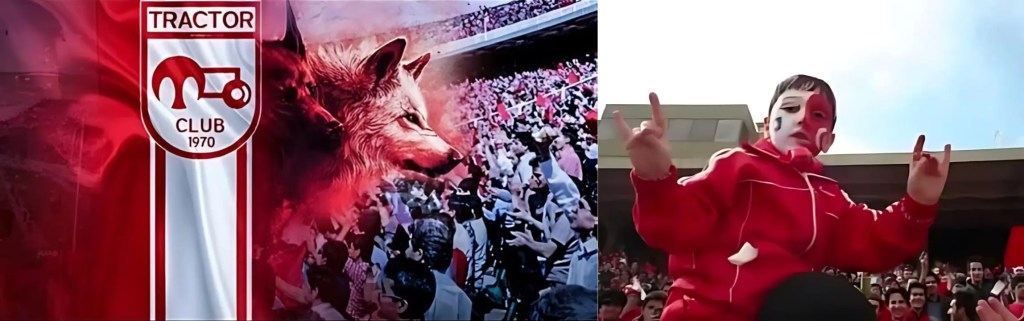
Under the leadership of Turkist thinkers such as Hüseyin Nihal Atsız with his works Bozkurtların Ölümü (EN: The Death of the Gray Wolves, 1946) and Bozkurtlar Diriliyor (EN: Gray Wolves are Rising, 1949), and Alparslan Türkeş, the Fourth Chairman of the Republican Peasant Nation Party (TR: Cumhuriyetçi Köylü Millet Partisi) and the Founding Chairman of the Nationalist Movement Party (TR: Milliyetçi Hareket Partisi, shortly: MHP; 1965 – 1997), the sign of the gray wolf became an important element of Turkish nationalism. This was a period in which the place of the gray wolf in nationalist symbolism was strengthened.
Although the gray wolf sign and salute are associated with the Idealist Hearths (Idealist Clubs Educational and Cultural Foundation, TR: Ülkü Ocakları), a far-right paramilitary organization associated with the MHP, and several politicians, Prof. Dr. Hanım Halilova stated that the gray wolf sign is not the sign of the MHP but one of the symbols of Turkishness.

The Grey Wolf sign has been used by the American professional wrestling organizations NWO and WWE since the 1990s. The WWE has called it “the most iconic sign in the history of professional wrestling.”. Kevin Nash, who made the sign for the first time, stated that the originator of the gesture, Sean Waltman, was “inspired by Turks making the Turkish wolf sign” in a bar in Europe. Others who have used the sign include groups such as D-Generation X, The Club, and Bullet Club.

Turkey National Football Team player Merih Demiral made a gray wolf sign after scoring the second goal in the 2024 European Football Championship’s Last 16 Round match against Austria on July 2. This led to an investigation by UEFA “due to the ban on political symbols” and a ban from 2 matches. This decision was heavily criticized, as similar cases in Turkey do not result in bans. Similar incidents that caused reactions include Tosic’s not being banned despite giving the Serbian Chetnik salute after Kolarov’s goal in the 90+1 after Serbia’s 2-0 win over Albania in the 2016 European Championship qualifiers and the fact that Albanian footballers Xhaka and Shaqiri were not banned despite making the “double eagle” sign, the symbol of Albania, after their goals in the Switzerland-Serbia match at the 2018 World Cup.

In conclusion, symbols deeply rooted in Turkish culture and history are important elements that reflect the identity and spirit of the Turkish nation. Symbols such as gray wolf, crescent and star, red and white colors, evil eye bead, tulip, dragon, and double-headed eagle are values that Turks have adopted and attached meaning to throughout history. In particular, the grey wolf has existed for centuries as one of the most powerful symbols symbolizing the Turkish nation’s nobility, courage, and fondness for freedom. Inspiring Turkish society in the historical process and reinforcing the sense of unity, the gray wolf symbol is still an important part of Turkish culture, and it’s used in various areas of the modern world. Each of these symbols helps us understand the rich cultural heritage of the Turkish nation and its values throughout history.
- WEBSITE Bi’ Dolu Baskı. (n.d.). Türk Bayrağının Anlamı ve Tarihi. Bi’ Dolu Baskı [Bi’ Dolu Baskı]
- BOOK Çoruhlu, Y. Türk Sanatında Hayvan Sembolizmi. (1995). Ötüken Neşriyat.
- WEBSITE Peker, A. U. (2018). Selçuklu Mimarisi’nde Anlam. Academia. [Academia]
- WEBSITE Andreas. (2024, March 12). Turkey flag unveiled: colors, meaning, coat of arms, flag map, and similar flags | MAPPR. Mappr. [Mappr]
- WEBSITE Nazarlığın tarihsel kökeni nereye dayanıyor? – BBC News Türkçe. (2018, February 20). BBC News Türkçe. [BBC News Türkçe]
- WEBSITE İstanbul Lale Vakfı. (2022, December 14). Geçmişten günümüze lale. . . İstanbul Lale Vakfı. [İstanbul Lale Vakfı]
- JOURNAL Duman, H. (2019). Türk Mitolojisinde Ejderha. Uluslararası Beşeri Bilimler Ve Eğitim Dergisi, 5(11), 482-493.
- WEBSITE Akademik Tarih. (2020, May 30). Türk Kültür ve Sanatında Çift Başlı Kartal. Akademik Tarih [Akademik Tarih]
- BOOK Gökalp, Z. (1989). Şiirler ve Halk Masalları: Ziya Gökalp Külliyatı-1. Türk Tarih Kurumu.
- JOURNAL Altun, Z. (2019). Türk Kültüründe “Kurt Kavramı” Üzerine Bir İnceleme. 21. Yüzyılda Eğitim Ve Toplum, 8(22).
- DICTIONARY ENTRY Wikipedia English. (2024). Tractor S.C. In Wikipedia English. [Wikipedia English]
- DICTIONARY ENTRY Wikipedia English. (2024). Wolf salute. In Wikipedia English. [Wikipedia English]
- ONLINE NEWS TRT Haber. (2024, July 5). İlber Ortaylı: Bozkurt, Türk milletinin sembolüdür. TRT Haber. [TRT Haber]
- ONLINE NEWS Oda TV. (2024, July 5). Prof. Dr. Hanım Halilova: Türkeş’e bunu ben öğrettim. Oda TV. [Oda TV]
APA 7: Çarıkçıoğlu, A.E. (2024, July 7). Bozkurt: Türk’ün Milli Sembolü. PerEXP Teamworks. [Makale Bağlantısı]
This article was originally written in Turkish and the citation has been edited in accordance with APA guidelines.
This translation was made by Ahmet Ege Çarıkçıoğlu


