



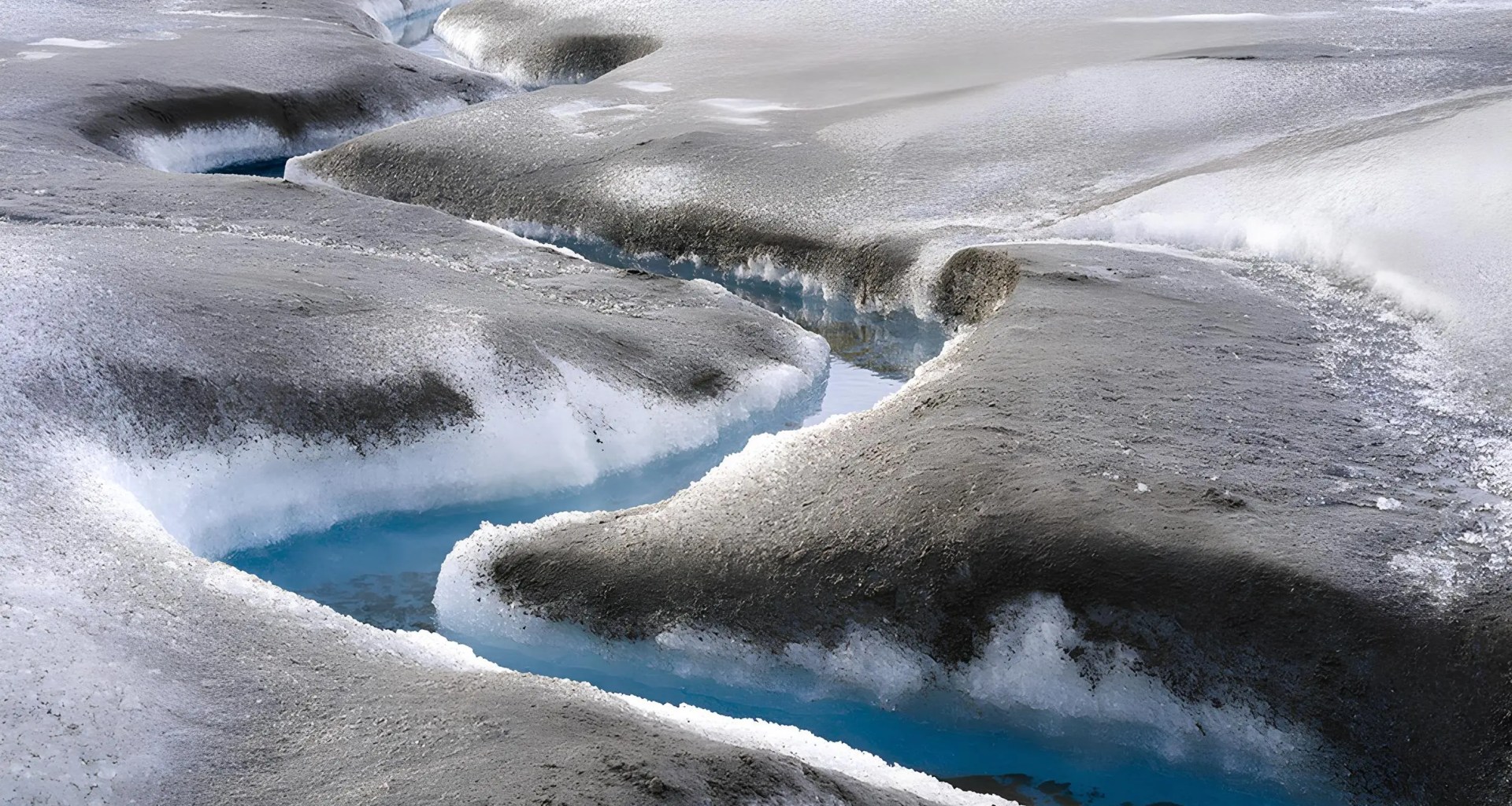
A scientific assessment involving over 200 researchers warns that climate change has brought the world perilously close to breaching multiple planetary “tipping points.” These points, once crossed, could trigger irreversible effects on crucial natural systems essential for human livelihoods. The report emphasizes the urgent need to confront these dangers head-on and accelerate efforts to prevent them.
While some scientists remain cautious about overemphasizing tipping points due to challenges in defining risks and assessing their likelihood, the consensus is that the risks are real and escalating as global temperatures rise.
Tim Lenton, a climate scientist at the University of Exeter, UK, who led the report with support from the Bezos Earth Fund, stated, “These tipping points pose threats of a magnitude that has never been faced before by humanity.” The report was released at the 28th United Nations Climate Change Conference (COP28) in Dubai, where government officials are conducting the first formal appraisal of progress under the landmark 2015 Paris agreement to curb climate change.
Emissions continue to grow unabated
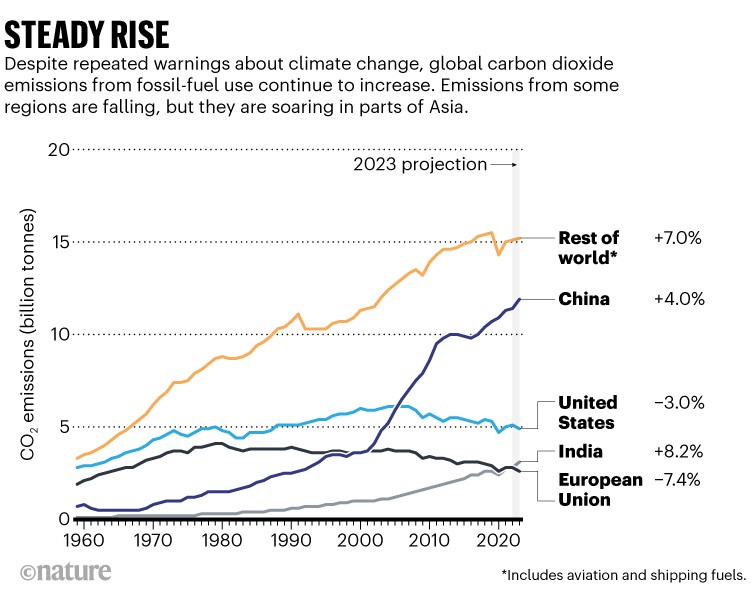
At COP28, additional information underscored the magnitude of the challenge at hand. On December 5, scientists revealed that the current global fossil-fuel emissions for this year are anticipated to reach an unprecedented level of approximately 37 billion tonnes of carbon dioxide. This marks a 1.1% increase compared to the emissions recorded in 2022 (refer to the ‘Steady rise’). Furthermore, Climate Action Tracker, a scientific coalition monitoring climate policies, approximated that the existing commitments from nations to reduce emissions, in accordance with the Paris Agreement, might still result in a global temperature rise of 2.5 °C above pre-industrial levels by the year 2100.
The report on tipping points provides an overview of potential outcomes. It evaluates evidence concerning the causes and likelihood of 26 climate tipping points—critical thresholds whose crossing could lead to potentially irreversible changes in Earth’s system.
The most immediate peril is directed at coral reefs globally, currently under threat even at existing levels of warming. Additionally, there is a looming risk of irreversible collapse for the ice sheets in Greenland and West Antarctica, with the potential to significantly elevate sea levels in this century and beyond.
The report issues a warning that with just 1.5 °C of warming above pre-industrial levels, northern forests, as well as mangroves and other coastal ecosystems, are in jeopardy. Furthermore, it cautions that a mere 2 °C of warming could lead to the replacement of significant portions of the Amazon rainforest with savannah, disrupting life across South America and exacerbating carbon emissions into the atmosphere.
No time to waste: Act now
Manjana Milkoreit, a political scientist at the University of Oslo and co-author of the report, emphasizes the heightened urgency for short-term action when considering tipping points. The Intergovernmental Panel on Climate Change has evaluated various scenarios aiming to achieve the 1.5 °C goal. However, almost all of these scenarios permit temporary temperature overshoots before a decline occurs as humans extract CO2 from the atmosphere later in this century. These overshoot scenarios elevate the risk of surpassing tipping points, rendering it impossible to restore the climate to its current state.
Milkoreit underscores that decisions made by humanity in the next decade or two could have repercussions for life on the planet for thousands of years. She notes, “The governance systems we have today are not well suited to a problem of that nature.”
A question about messaging
However, from a social and political perspective, some researchers question whether emphasizing tipping points brings about meaningful change. Michael Oppenheimer, a climate scientist at Princeton University in New Jersey, expresses skepticism. He believes that the rising frequency of extreme weather events and other tangible climate impacts is more likely to sway public opinion and spur action than warnings of potential climate catastrophes. Moreover, Oppenheimer contends that if governments took adequate measures to shield their citizens from well-known climate impacts, concerns about tipping points might be alleviated.
Despite concerns, the report also offers a glimmer of hope. It identifies potential positive tipping points within social, political, and economic systems. If crossed, these points could yield cascading benefits for the climate. Scientists point to evidence of one such positive tipping point, where declining costs of wind and solar power prompt increased investments in clean energy, diverting resources away from fossil fuels.
It is evident that incremental policies pursued by governments thus far are insufficient, notes Lenton. He asserts, “We need to find and trigger some positive tipping points that accelerate action down an alternative pathway.”
Resources
- JOURNAL Tollefson, J. (2023). Catastrophic change looms as Earth nears climate ‘tipping points’, report says. Nature. [Nature]
Cite this page:
APA 7: TWs Editor. (2023bq, December 11). Impending Environmental Crisis: Earth Approaches Critical “Tipping Points.” PerEXP Teamworks. [News Link]


