



In a recent scientific inquiry published in the Proceedings of the National Academy of Sciences, biologists from the University of Utah (the U) have introduced an innovative methodology for elucidating the intricate interactions within the synaptonemal complex of the nematode C. elegans.
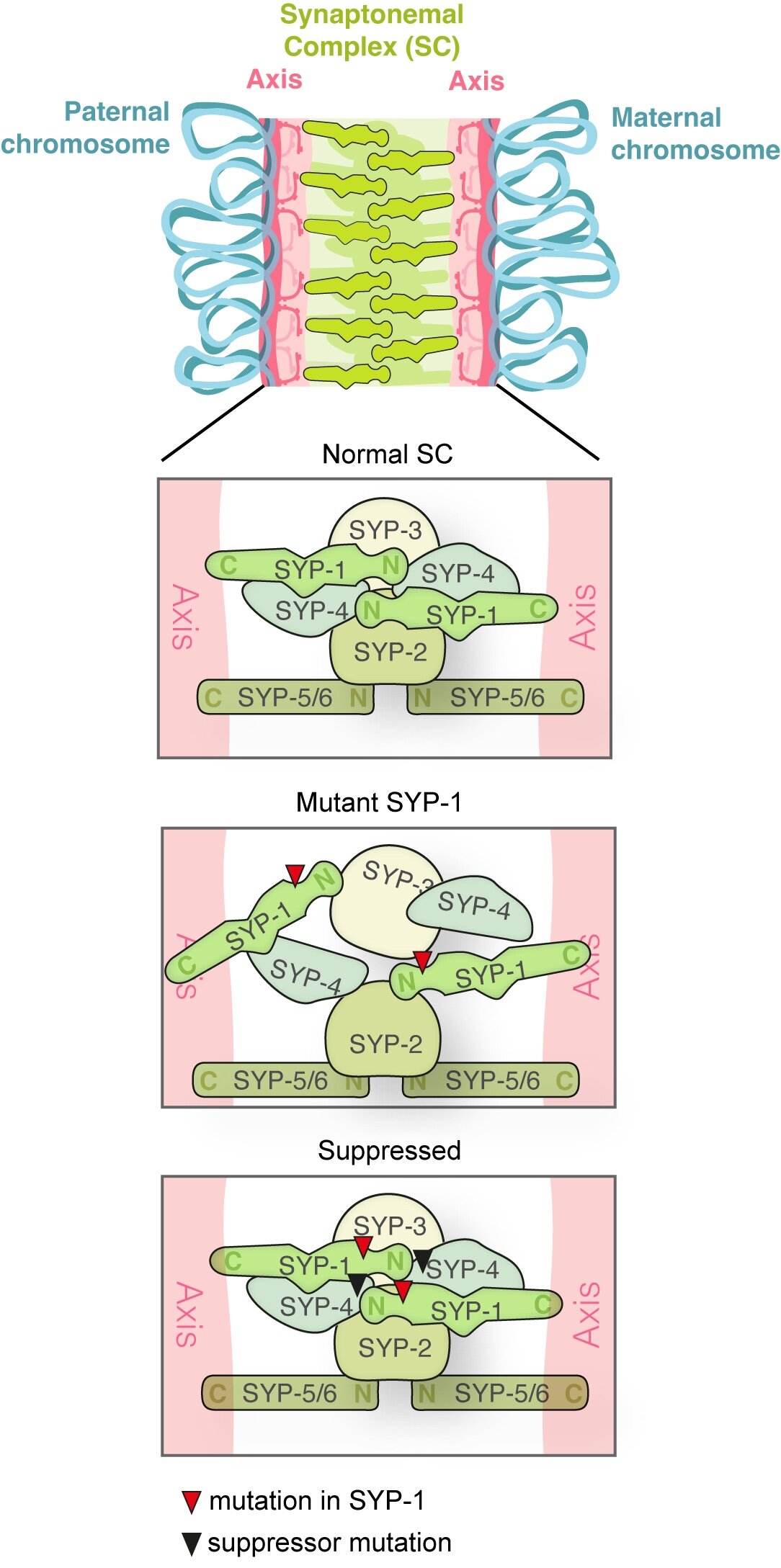
This groundbreaking study unveiled a trio of protein segments critical in guiding chromosomal interactions. The researchers precisely identified the locations where these segments interact with each other, unraveling previously elusive details of the synaptonemal complex dynamics. The devised method leverages genetic suppressor screening, offering a pioneering blueprint for investigating extensive cellular assemblies that traditionally resist conventional structural analysis techniques.
Central to the study is the recognition of the vital role played by meiosis, the cellular process responsible for producing reproductive cells with a unique mix of genes from both parents. Unlike other cells in our bodies that carry two copies of each chromosome, reproductive cells such as sperm and egg cells undergo meiosis to reduce their chromosome numbers to one. This reduction ensures genetic variability in offspring. The study emphasizes the criticality of precise chromosomal alignment and the exchange of accurate genetic information during meiosis for maintaining fertility. Any deviation from this intricate process poses a risk to reproductive success.
This comprehensive exploration not only enhances our understanding of the molecular intricacies governing meiosis but also presents a novel avenue for studying large cellular assemblies, showcasing the potential of genetic suppressor screening as a versatile tool for advancing structural analysis in cellular biology. As we delve deeper into the mechanisms orchestrating genetic variability, the insights derived from this study may pave the way for advancements in reproductive biology and fertility research.
The intricate process of generating reproductive cells, or gametes, is a fundamental aspect shared by a diverse range of organisms, including humans, fungi, plants, and worms. At the heart of this process is the synaptonemal complex (SC), a crucial cellular structure that orchestrates chromosomal interactions during sexual reproduction. Despite its pivotal role, understanding the regulatory mechanisms of proteins within the SC has been a longstanding challenge, primarily due to the complexity of this multi-step process occurring within internal organs, making it difficult to recreate in a laboratory setting.
Addressing this longstanding gap in knowledge, a recent study led by Ofer Rog, an associate professor of biology at the University of Utah (the U), presents a groundbreaking method to scrutinize the intricate workings of the SC. The traditional methods of studying cellular structures often rely on crystallization, which poses limitations when dealing with systems characterized by dynamic and transient interactions, colloquially referred to as “loosey-goosey.” Many cellular interactions are loosely bonded, presenting a challenge for traditional techniques that require stability, such as those involving crystallization. In the words of Ofer Rog, the senior author of the study, this new approach allows researchers to overcome the constraints of traditional methods, providing a means to investigate even the relatively weak or transient interactions within cellular structures.
The study emphasizes the significance of this innovative approach, offering a powerful tool to explore and understand cellular processes that were previously challenging to study due to their dynamic nature. By unlocking the secrets of the SC and its protein interactions, researchers are poised to gain deeper insights into the mechanisms governing sexual reproduction across various organisms. This advancement not only broadens our understanding of fundamental biological processes but also paves the way for potential applications in reproductive biology and related fields.
The birds, the bees & the nematodes
Embarking on the intricate journey of meiosis, the process pivotal for the formation of reproductive cells, requires a closer look at chromosomes—those slender, DNA-laden structures that carry the genetic blueprint during cell division and from one generation to the next. In standard cells, there exists a specific number of chromosomes; for instance, humans possess 46 chromosomes, while the nematode C. elegans has 12. Chromosomes occur in pairs known as homologous chromosomes, each harboring genes inherited from both parents.
As meiosis unfolds, homologous chromosomes undergo a choreographed arrangement, aligning themselves into elongated structures along a central axis. This axis serves as the backbone for the ensuing process. Simultaneously, the synaptonemal complex (SC) materializes between these parallel axes. The homologous pairs, with their genes arranged in matching order, engage in a delicate dance, introducing small variations that contribute to the unique genetic makeup of each individual.
To envision this process, one can liken it to a zipper mechanism. The axes of chromosomes represent the two sides of a zipper, while the synaptonemal complex acts like the teeth of the zipper, locking onto each other to pull and align the chromosomal sides correctly. While scientists knew that the SC in C. elegans forms between homologs, the researchers from the University of Utah (the U) are the pioneers in pinpointing the precise location where the SC interacts with itself to facilitate genetic exchanges.
As explained by Ofer Rog, the senior author of the study, the meticulous alignment of chromosomes during genetic exchange ensures that no information is lost in the process. It’s akin to ensuring that when segments are exchanged between chromosomes, both chromosomes remain intact, preserving the full complement of genetic information. This revelation about the intricate choreography of the synaptonemal complex during meiosis adds a layer of understanding to the mechanisms safeguarding the fidelity of genetic information transfer, unraveling the nuanced dance of chromosomes in the quest for reproductive cell formation.

In a meticulous experiment, the researchers undertook the task of breeding 50,000 nematodes, deliberately introducing temperature-sensitive defects in the synaptonemal complex (SC). These defects hindered the worms’ ability to form the crucial SC protein zipper required for the proper alignment and connection of chromosomes during meiosis. At elevated temperatures, the worms faced a challenge: without the functional zipper, the gene exchanges crucial for meiosis were either entirely impeded or occurred in incorrect numbers. Conducting these experiments was Lisa Kursel, the lead author and a postdoctoral researcher.
The experimental approach involved initially cultivating the nematodes at a permissive, cooler temperature. Subsequently, the researchers exposed them to a chemical that induced millions of mutations along their chromosomes. The critical observation focused on whether any of these chemically induced mutations could rectify the nematodes’ infertility at a warmer temperature. The mutations that successfully restored fertility were identified as suppressor mutations—a key element in unraveling the intricacies of the nematodes’ reproductive capabilities.
To pinpoint the nematodes with suppressor mutations and restored fertility, the researchers placed them on agar plates enriched with bacteria. The outcome was striking: agar plates with fertile nematodes were soon devoid of the worms as their progeny consumed the available food. In contrast, the sterile nematodes on agar plates succumbed before completing this task, allowing the bacteria to flourish.
This methodical approach not only provided insights into the genetic factors influencing fertility but also demonstrated the utility of suppressor mutations in overcoming temperature-sensitive defects. The experiment’s success lay in its ability to identify specific genetic alterations that counteracted the initial infertility, shedding light on the complex interplay of temperature, genetics, and reproductive mechanisms in nematodes.
Once the researchers successfully obtained fertile nematodes through the introduction of suppressor mutations, the subsequent phase of the study involved scrutinizing whether these mutations effectively “fixed” the problematic protein zipper within the synaptonemal complex (SC). To achieve this, the team meticulously screened every single base pair on the DNA—amounting to a staggering 100 million base pairs. This comprehensive analysis aimed to identify specific mutations that reinstated the worms’ reproductive capabilities.
Remarkably, the research pinpointed that all the beneficial mutations were concentrated within short segments of three proteins: SYP-1, SYP-3, and SYP-4. Moreover, these mutations exhibited distinctive signatures of interaction, offering crucial insights into the dynamic relationship between these proteins. For instance, the original mutations altered the electric charge from positive to negative, while the beneficial mutations reverted this charge back. Ofer Rog explained this observation by likening the interaction between SYP-1, SYP-3, and SYP-4 to magnets, where positive and negative regions attract each other. Such “sticky” interactions could play a pivotal role in tethering the chromosomes together, ensuring the proper execution of meiosis.
A significant revelation came from the examination conducted by Jesus Aguayo Martinez, a co-author of the study, who assessed the behavior of the suppressor mutation in nematodes lacking the original SC-disrupting mutation. Contrary to expectations, the nematodes with only the suppressor mutations did not exhibit fertility defects, in stark contrast to those with the original mutation. This unexpected finding emphasized the resilience and effectiveness of the suppressor mutations in restoring normal fertility levels, even when decoupled from the initial mutation.
In essence, this comprehensive exploration of the genetic landscape, coupled with the functional aspects of the identified mutations, unraveled the intricate dance of proteins within the synaptonemal complex. The study not only elucidates the molecular intricacies underlying fertility but also underscores the resilience and compensatory mechanisms within the nematode’s genetic toolkit.
Future directions
Delving into the role of the synaptonemal complex (SC) in meiosis not only sheds light on the reproductive mechanisms of nematodes but also holds the potential to enhance our understanding of fertility in humans. The SC, serving a comparable function across eukaryotes—from nematodes and fungi to plants and humans—plays a crucial role in facilitating chromosomal exchanges during meiosis. Previous research by the Rog Lab at the University of Utah revealed that the SC’s structure is remarkably consistent and functions similarly, ushering in parental chromosomes to facilitate genetic exchanges.
Despite this structural uniformity, a fascinating aspect emerges when examining the actual sequences of the protein components constituting the SC—they differ among organisms. This departure from the conventional pattern is intriguing, as many cellular structures carrying fundamental functions, such as cell division, genome duplication, or metabolism, tend to be highly conserved across diverse organisms and, in some cases, can be interchanged between them.
Ofer Rog, contemplating this anomaly, poses a crucial question: “What is special about the SC? Why can it perform the same essential function and exhibit structural similarity while being composed of different building blocks?” This enigma prompts further inquiry into the evolution of the SC across species, as well as exploration into other cellular structures that defy conventional evolutionary patterns.
In ongoing efforts, researchers such as Lisa Kursel, Jesus Aguayo Martinez, Ofer Rog, and other members of the Rog Lab are conducting extensive analyses on the evolutionary trajectories of the SC across diverse species. By unraveling the complexities of this enigmatic cellular structure and exploring its variations, they aim to gain deeper insights into the underlying principles that govern the evolution of essential cellular components, challenging and expanding our understanding of evolutionary processes in the realm of reproductive biology and beyond.
Resources
- ONLINE NEWS Potter, L. & University of Utah. (2024, January 3). Nematode proteins shed light on infertility. Phys.org. [Phys.org]
- JOURNAL Kursel, L. E., Martinez, J., & Rog, O. (2023). A suppressor screen in C. elegans identifies a multiprotein interaction that stabilizes the synaptonemal complex. Proceedings of the National Academy of Sciences of the United States of America, 120(50). [PNAS]
Cite this page:
APA 7: TWs Editor. (2024, January 4). Nematode Proteins Unveil Insights into the Puzzle of Infertility. PerEXP Teamworks. [News Link]


