





In contemporary research, organic electrochemical transistors (OECTs) have become a focal point of interest, drawing attention not only for their biocompatibility but also for unique attributes such as their capacity to amplify ionic–electronic signals and detect ions and molecules.
Efficient transport of both ions and electrons is crucial for achieving these distinctive characteristics in OECT semiconductors. Conjugated materials, specifically those endowed with hydrophilic glycol chains, have demonstrated commendable efficiency while maintaining a soft structure conducive to ion permeation. However, challenges arise as these materials exhibit less-than-ideal semicrystalline traits and disordered fractions when transformed into solid films.
Addressing these concerns, researchers led by Professor Myung-Han Yoon from the Gwangju Institute of Science and Technology in Korea have embarked on a study aiming to enhance the steady-state performance of OECTs. They employ a strategic approach, leveraging both molecular design and structural alignment to mitigate energetic and microstructural disorders in the resulting films. Their focus is on developing high-performance OECT devices utilizing poly(diketopyrrolopyrrole) (PDPP)-type polymers as active layers.
The research team varies the number of repeating units of ethylene glycol (EG) side chains in PDPP, ranging from two to five. They gauge the success of their efforts using a figure-of-merit that considers the product of charge carrier mobility and volumetric capacitance. The outcomes of their study, emphasizing advancements in OECT technology, have been made available online in the journal Advanced Materials.
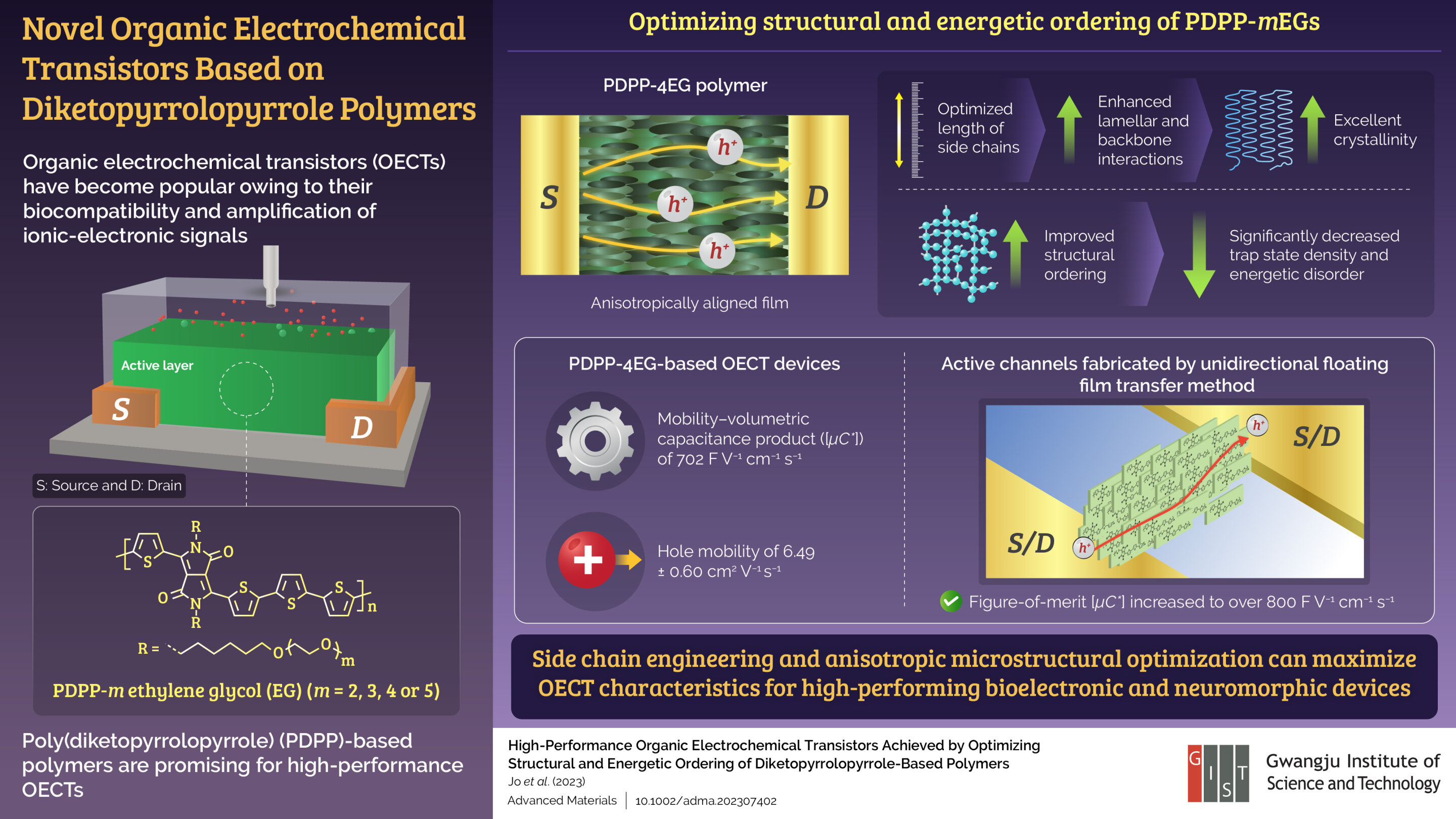
Professor Myung-Han Yoon, explaining the motivation behind their research, highlights the challenges associated with using mixed conductors in electrochemical transistors and the limitations of conventional microstructure control processes in achieving significant performance improvements. The flexibility and hydrophilicity of molecular structure side chains often lead to strong intermolecular cohesion, hampering enhanced performance. To address this, the research team introduces a novel mixed conductor material featuring an alkyl-EG hybrid side chain structure. This innovation aims to strike a balance by providing the molecule with the appropriate hydrophobicity and structural stability.
In their experimental approach, the researchers employed ultraviolet-visible (UV-vis) absorption spectroscopy, confirming the formation of J-aggregates in polymers with three, four, and five EG units. Cyclic voltammetry measurements revealed a gradual decrease in oxidation onset values corresponding to an increase in the number of EG polymers.
Electrochemical impedance spectroscopy, however, unveiled comparable volumetric capacitance values across all polymers within the PDPP family. As a result, the researchers leaned on charge carrier mobility as the primary metric to differentiate and assess the performance of these polymers. This comprehensive analysis allows for a nuanced understanding of the impact of molecular variations on the electrochemical behavior of the PDPP-based mixed conductor material.
The OECT device, utilizing PDPP-4EG and crafted through the spin-casting technique, demonstrated exceptional performance metrics. Notably, it achieved a figure-of-merit value of 702 F V-1 cm-1 s-1, coupled with a charge carrier mobility of 6.49 cm2 V-1 s-1, and an impressive transconductance value of 137.1 S cm-1. The subthreshold swing values were remarkably low at 7.1 V dec-1, and the interface trap states numbered only 1.3 x 10¹³ eV-1 cm-2. PDPP-4EG exhibited minimal energetic disorder, showcasing well-developed crystalline domains with the least microstructural disorder.
To further enhance structural alignment within the OECT channel, the researchers turned to the unidirectional floating film transfer method (UFTM). Employing this technique, the J-aggregates underwent unidirectional compression upon introducing the polymer film to a hydrophilic liquid. The OECTs based on UFTM PDPP-4EG films surpassed expectations, yielding an impressive figure-of-merit value exceeding 800 F V-1 cm-1 s-1.
Professor Yoon emphasizes the long-term significance of this research, particularly in the context of the evolving field of artificial intelligence and the anticipated development of neuromorphic devices. Organic mixed conductors, identified as promising materials in this domain, hold the potential for substantial advancements. Overcoming the performance limitations of organic materials, as addressed in this study, contributes to the ongoing efforts to foster the development of reliable organic mixed conductors. This, in turn, opens avenues for diverse applications, including next-generation wearable sensors, computers, and healthcare systems, ultimately enhancing human convenience and technological capabilities.
Resources
- ONLINE NEWS Gwangju Institute of Science and Technology. (2024, January 17). Researchers optimize the performance of novel organic electrochemical transistors. Phys.org. [Phys.org]
- JOURNAL Jo, I., Jeong, D., Moon, Y., Lee, D., Lee, S., Choi, J., Nam, D., Kim, J. H., Cho, J., Cho, S., Kim, D. Y., Ahn, H., Kim, B. J., & Yoon, M. (2023). High‐Performance organic electrochemical transistors achieved by optimizing structural and energetic ordering of diketopyrrolopyrrole‐based polymers. Advanced Materials. [Advanced Materials]
Cite this page:
APA 7: TWs Editor. (2024, January 17). Scientists Fine-Tune the Operation of Innovative Organic Electrochemical Transistors. PerEXP Teamworks. [News Link]


