






The outcomes of the research have been documented in the journal Nature Communications. Situated beneath the liquid outer core, the Earth’s inner core is a compact, solid sphere primarily composed of iron and nickel, extending approximately 1,200 kilometers (746 miles) in radius. This region assumes a pivotal role in Earth’s geophysical processes, influencing the magnetic field and contributing to the broader dynamics of the Earth’s interior.
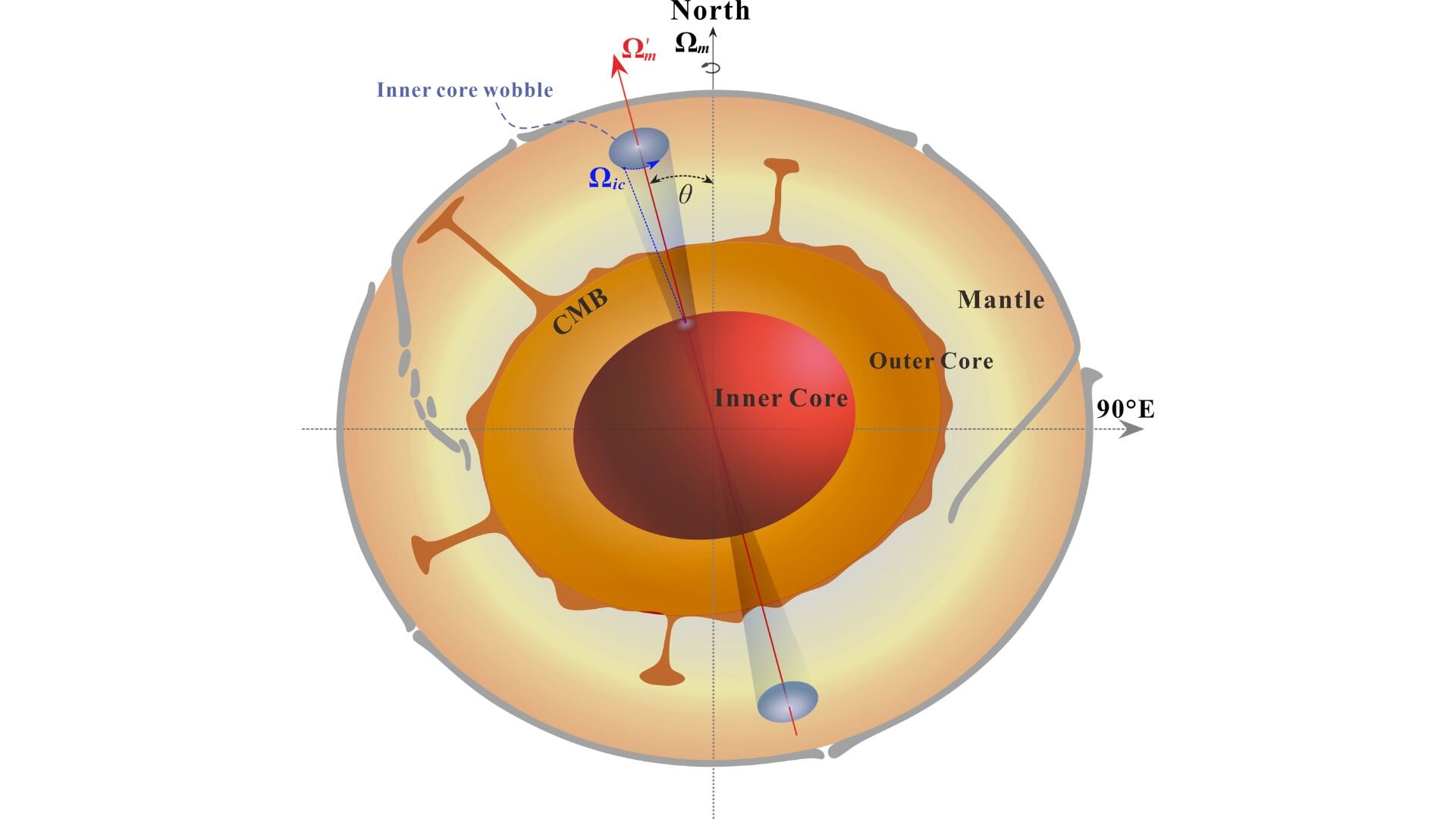
Comprehending the characteristics and actions of the inner core holds paramount importance in demystifying Earth’s structure, seismic behaviors, and the intricacies of its magnetic field. The Inner Core Wobble (ICW) pertains to the periodic oscillation of the Earth’s inner core around its rotation axis, characterized by a cyclical movement of the inner core’s figure axis.
The recent study establishes that the ICW of Earth exhibits a periodic motion with a cycle lasting approximately 8.5 years. This wobbling motion has been identified through measurements of polar motion, which captures the periodic movement of the Earth’s rotational axis, as well as length-of-day variations (ΔLOD) and alterations in Earth’s rotational speed.
Professor Hao Ding, co-author of the study and Dean of the Geophysics Department at Wuhan University, found inspiration in the unconventional density structures unveiled in Earth’s free oscillation. The discovery of an 8.5-year signal in polar motion and length-of-day variations prompted further investigation, leading to the comprehensive study detailed in the research.
Oscillatory and rotational motion of the Earth
The Earth comprises four distinct layers—the crust, mantle, outer core, and inner core. Traditional models of Earth’s rotation have been based on the assumption of a uniform density distribution within the mantle and core along the radial direction, extending from the center outward. This assumption implies that the rotation axis of the Earth’s core aligns with that of the mantle.
However, Dr. Ding highlighted that Earth’s free oscillation, a phenomenon encompassing natural oscillations of the entire planet, reveals highly heterogeneous density structures within the Earth’s interior. This challenges the realism of the previously held assumption of uniform density.
In 2018, Professor Ding’s analysis of the Earth’s polar motion (PM) unveiled a signal with an approximately 8.5-year period, indicative of an Inner Core Wobble (ICW). This unexpected revelation gained further support when a similar signal appeared in the length-of-day variations (ΔLOD) of Earth’s rotation, prompting a significant shift in perspective.
Building upon these unexpected findings, the researchers conducted a meticulous analysis of polar motion and length-of-day variations, confirming the presence of the approximately 8.5-year signal as a manifestation of the Inner Core Wobble.
This conclusion was reached after ruling out three external sources of excitation—namely, atmospheric, oceanic, and hydrological influences. Notably, the 8.5-year signal extends beyond polar motion alone, consistently appearing in the periodic movement of the Earth’s rotational axis, or ΔLOD.
The simultaneous occurrence of this signal in both polar motion and length-of-day variations strongly suggests a profound and interconnected relationship between the Inner Core Wobble and these rotational dynamics, challenging prior assumptions and paving the way for a deeper understanding of Earth’s internal processes.
The small angle between the inner core and the mantle
To elucidate the 8.5-year signal detected in polar motion (PM) and length-of-day variations (ΔLOD), researchers scrutinized the amplitudes of the Inner Core Wobble (ICW) in both phenomena. Through this examination, they deduced the existence of a static tilt angle of 0.17 degrees between the rotation axis of the Earth’s inner core and the mantle.
This revelation implies a potential eastward differential rotation angle of the inner core, measuring less than 1 degree, and a misalignment in the symmetry axes between the lower mantle/core-mantle boundary layer and the upper mantle.
According to Dr. Ding, these deviations provide valuable constraints for constructing a three-dimensional density model of the mantle. Moreover, they question previously held assumptions, particularly those related to the liquidity-core oblate, and underscore potential deviations from the traditionally theorized perfectly spherical form.
The ~8.5-year periodicity of the ICW reveals an additional layer of Earth’s complexity. This periodic motion suggests a density jump of approximately 0.52 g/cm³ at the boundary of the inner core. In simpler terms, there is a noticeable change in density at the interface between the inner core and its surrounding layers.
While the primary focus of the research centers on the inner core, the identified static tilt and Inner Core Wobble may extend their influence to broader geophysical phenomena. Dr. Ding highlights that the static tilt could induce changes in the shape of the liquid core, resulting in altered fluid motion and, consequently, a shift in the geomagnetic field. These insights contribute to a deeper understanding of Earth’s internal dynamics and open avenues for exploring the intricate relationships between the Earth’s core and mantle.
Future directions for research
The study’s revelation of the Earth’s Inner Core Wobble (ICW) and its corresponding static tilt challenges conventional assumptions regarding Earth’s rotation. The identification of an 8.5-year periodicity in the ICW, coupled with the noticeable density jump at the inner core boundary, offers unprecedented insights into the complexities of our planet’s interior dynamics.
Dr. Ding and his research team anticipate further exploration of the stratified structure and density of the Earth’s core in their future investigations. Their objective is to delve deeper into understanding the patterns and periods of core motions, aiming to address longstanding challenges in geoscience research related to the Earth’s core.
As Dr. Ding explained, the stratified structure and density of the Earth’s core have posed persistent challenges in the realm of geoscience. The team aims to shed light on the periodic oscillation and differential rotation of the Earth’s core, with the ultimate goal of gaining clarity on these distinct and potentially coexisting conceptual theories. This ongoing research endeavors to unravel more intricacies of Earth’s internal dynamics, contributing to a refined understanding of the fundamental principles governing our planet’s core.
Resources
- ONLINE NEWS Gururaj, T. & Phys.org. (2023, December 18). Challenging assumptions: The 8.5-year rhythm of Earth’s inner core. Phys.org. [Phys.org]
- JOURNAL An, Y., Ding, H., Chen, Z., Shen, W., & Jiang, W. (2023). Inner core static tilt inferred from intradecadal oscillation in the Earth’s rotation. Nature Communications, 14(1). [Nature Communications]
Cite this page:
APA 7: TWs Editor. (2023, December 18). The 8.5-Year Cycle of the Earth’s Inner Core: A Puzzling Phenomenon that Challenges Assumptions. PerEXP Teamworks. [News Link]


