



Clouds, comprising tiny water droplets, ice particles, or a combination of both, are dynamic elements integral to our planet’s climate system. They play a pivotal role in modulating the amount of sunlight absorbed or reflected at their cloud tops. The altitude at which clouds form, as well as their composition, determines their varied impacts on climate. Understanding cloud formation in polar regions, particularly those susceptible to climate change, is of paramount importance. This understanding serves as a foundation for studying the subsequent influence of these clouds on ice sheets.
While numerical models have significantly advanced our capability to simulate cloud formation, they often fall short in accurately incorporating the role of aerosol particles. These particles act as starting points for the formation of ice crystals in clouds, impacting the process of ice cloud formation. Biases in accounting for aerosol particles can introduce errors into the predictions of ice cloud behavior within the atmosphere.
To enhance the precision of numerical models in representing cloud formation, Assistant Professor Kazutoshi Sato and Jun Inoue, both affiliated with the National Institute of Polar Research in Japan, turned to real-world observations, satellite data, and climate data. Their objective was to unveil the mechanisms behind ice cloud formation in the Southern Ocean, specifically examining the influence of bioaerosols emitted from oceans.
Dr. Inoue highlights that advancing our understanding of ice cloud formation linked to marine bioaerosols holds the potential to enhance the accuracy of cloud phase representation in numerical models. These insights, recently published in the journal Geophysical Research Letters, contribute to refining the performance of such models in simulating cloud-related processes.
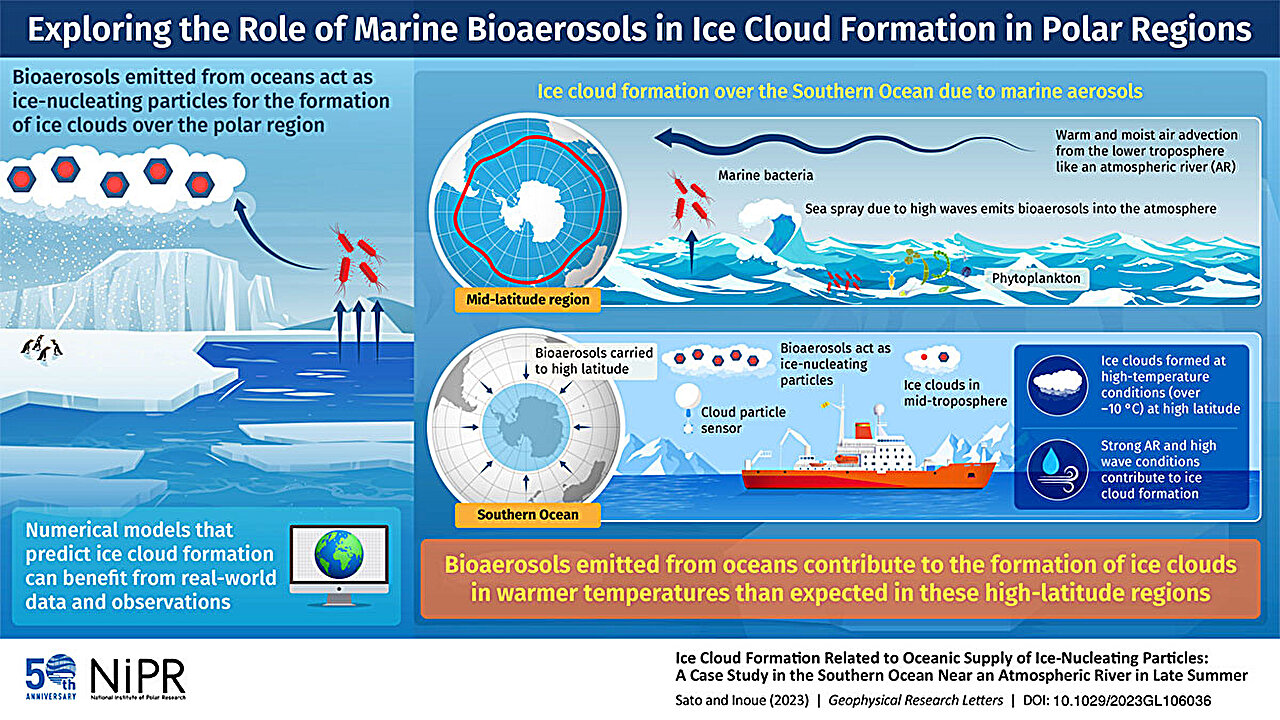
The exploration began with an expedition to the Southern Ocean encircling Antarctica from November 2022 to March 2023. During this period, researchers observed the formation of ice clouds in the mid-troposphere at temperatures above –10°C. Simultaneously, they identified liquid water clouds in the upper troposphere at temperatures below –20°C. The unusual aspect was that ice clouds typically form at colder temperatures, prompting the researchers to investigate the reasons behind the occurrence of ice clouds at milder temperatures.
Through a backward trajectory analysis, the scientists traced a stream of warm, moist air back to its origin in southern Africa. Subsequently, utilizing satellite data, they discovered that this air mass encountered regions with a high concentration of chlorophyll-a, a pigment associated with phytoplankton, as it traversed the mid-latitude Southern Ocean. Additionally, the researchers observed elevated levels of dimethylsulfide (DMS) in the air in areas where powerful and intense waves were present in the water.
What makes the existence of DMS significant in this context?
Dimethylsulfide (DMS), a sulfur-containing compound often associated with phytoplankton activity, is known for its role as a nucleus in the formation of liquid water clouds. Additionally, its presence in the atmosphere serves as an indicator of marine bacteria. These bacteria can be released into the atmosphere through sea spray generated by high wave conditions. According to the researchers, marine bacteria carried in the moist warm air from the mid-latitude Southern Ocean act as ice nucleating particles. This phenomenon contributes to the formation of ice clouds at temperatures higher than anticipated over the high-latitude regions of the Southern Ocean.
Dr. Sato reported that they utilized a cloud particle sensor sonde to identify ice clouds at a high latitude, even when temperatures were above −10°C. This discovery occurred in proximity to a flow of warm and moist air originating from the mid-latitude region, commonly known as an atmospheric river (AR).
The atmospheric river received marine bioaerosols from the mid-latitude ocean, particularly during high wave conditions. These bioaerosols, associated with phytoplankton activity and containing marine bacteria, reached the layer where ice clouds form. The observations suggest that the marine bioaerosols, transported via the atmospheric river, play a role in the formation of ice clouds even under conditions with relatively high temperatures.
Numerical models have faced challenges in accurately replicating the formation of ice clouds under conditions with higher temperatures. The results from this experimental study offer insights that could enhance the precision of numerical climate modeling, particularly in regions vulnerable to climate change, such as polar areas.
Resources
- ONLINE NEWS National Institute of Polar Research. (2023, December 8). Research finds marine bacteria, atmospheric rivers can contribute to formation of ice clouds. Phys.org. [Phys.org]
- JOURNAL Sato, K., & Inoue, J. (2023). Ice cloud formation related to oceanic supply of Ice‐Nucleating particles: a case study in the Southern Ocean near an atmospheric river in late summer. Geophysical Research Letters, 50(23). [Geophysical Research Letters]
Cite this page:
APA 7: TWs Editor. (2023, December 9). How Marine Bacteria and Atmospheric Rivers Help Create Ice Clouds? PerEXP Teamworks. [News Link]


