



An international collaboration of astronomers has made a groundbreaking discovery within the Milky Way, unveiling a previously unknown celestial object that defies conventional classification. This remarkable find, made possible through the utilization of the MeerKAT Radio Telescope, involves researchers from esteemed institutions such as The University of Manchester and the Max Planck Institute for Radio Astronomy in Germany.
Situated approximately 40,000 light years away in a densely populated region of stars referred to as a globular cluster, the newfound object is orbiting a rapidly spinning millisecond pulsar. What sets this discovery apart is its unprecedented characteristics—it surpasses the mass of the heaviest known neutron stars while simultaneously weighing less than the lightest black holes documented.
The astronomers harnessed the precise temporal signals emitted by the millisecond pulsar, akin to clock-like ticks, to ascertain that this enigmatic entity falls within the elusive category known as the black hole mass gap. This observation hints at the potential identification of a radio pulsar–black hole binary, a celestial pair that could offer novel opportunities for testing Einstein’s general relativity and delving into the intricacies of black hole physics.
The comprehensive findings of this groundbreaking discovery have been detailed in the prestigious journal Science, marking a significant advancement in our understanding of celestial phenomena within the Milky Way.
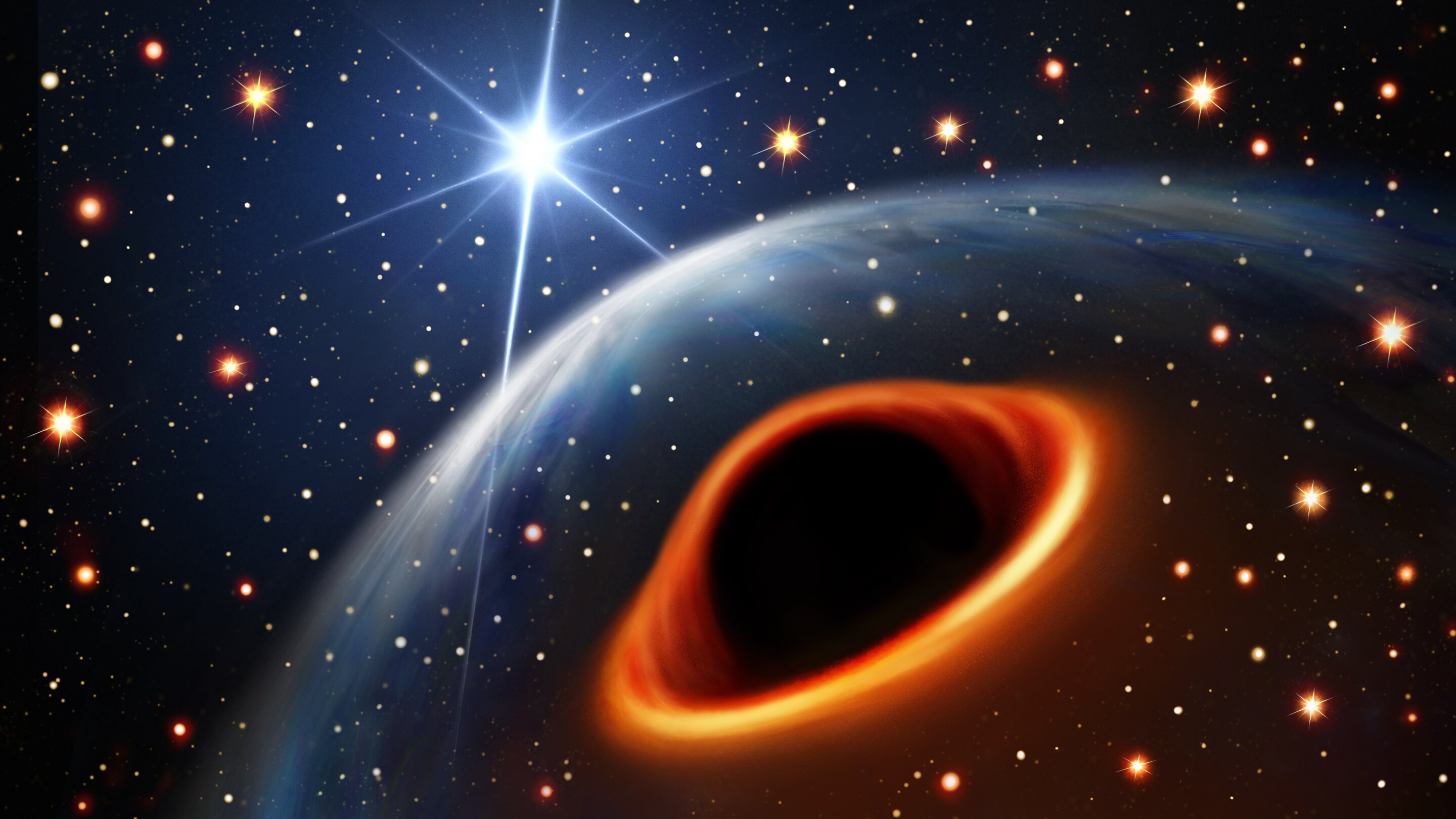
Ben Stappers, the project lead from the UK and Professor of Astrophysics at The University of Manchester, expressed enthusiasm about the potential nature of the newly discovered celestial companion. Whether it’s a pulsar–black hole system or a massive neutron star, both scenarios hold significant scientific value. In the case of a pulsar–black hole system, it presents a crucial target for testing gravitational theories, while a heavy neutron star offers fresh insights into nuclear physics under extreme densities.
Neutron stars, remnants of collapsed dead stars with ultra-dense cores, can undergo collapse if they accumulate too much mass, often through interactions with or consumption of another star. The aftermath of such collapses is a subject of speculation, with the possibility of these neutron stars transforming into black holes—objects so gravitationally powerful that even light cannot escape their clutches.
Astronomers propose that a neutron star requires a mass 2.2 times that of the sun to undergo collapse. However, the observed lightest black holes stemming from such events are significantly more massive, creating what is termed the “black hole mass gap,” with these black holes being around five times the mass of the sun.
The enigmatic nature of compact objects within this mass gap has presented a challenge for detailed study until now. The recent discovery, made possible by the highly sensitive MeerKAT telescope, represents a significant leap forward in our ability to unveil and analyze these celestial entities. It offers a promising glimpse into the potential advancements that the Square Kilometer Array, with its exceptional sensitivity, may bring to our understanding of the universe.
The newfound celestial object emerged from the diligent observations of the MeerKAT telescope as it scrutinized the densely populated star cluster known as NGC 1851, situated in the southern constellation of Columba. NGC 1851 stands out as a concentrated assembly of aging stars, tightly packed together in contrast to the rest of the galaxy’s stellar distribution. Within this crowded environment, stellar interactions occur, leading to orbital disturbances and, in more extreme cases, stellar collisions.
The international team of astronomers, contributing to the Transients and Pulsars with MeerKAT (TRAPUM) collaboration, postulates that the recently discovered massive object orbiting the radio pulsar in this stellar cluster resulted from a collision between two neutron stars. The crowded conditions within NGC 1851 create an environment conducive to such dramatic celestial events.
Utilizing the remarkable sensitivity of the MeerKAT telescope, the team successfully identified faint pulses emanating from one of the stars. This revelation pinpointed the object as a radio pulsar, a specialized type of neutron star characterized by rapid rotation, emitting beams of radio light akin to a cosmic lighthouse illuminating the vast expanse of the universe. The intricate dynamics of NGC 1851, unveiled through this discovery, provide valuable insights into the complex interactions shaping stellar evolution within densely populated stellar clusters.

The pulsar, known for its extraordinary spin rate of over 170 rotations per second, emits rhythmic pulses akin to the ticking of a clock with remarkable regularity. Through the precise technique of pulsar timing, researchers could meticulously track the changes in the timing of these pulses, enabling them to make exceedingly accurate measurements of the pulsar’s orbital motion.
Ewan Barr, leading the study in collaboration with Arunima Dutta at the Max Planck Institute for Radio Astronomy, likened the precision of their measurements to placing an almost flawless stopwatch into orbit around a star situated nearly 40,000 light years away. The microsecond-level precision in timing these orbits provided valuable insights into the dynamics of this celestial system.
The consistently regular timing of the pulses not only facilitated precise measurements of the system’s orbital parameters but also revealed that the companion orbiting the pulsar was no ordinary star. Instead, it turned out to be an incredibly dense remnant of a collapsed star. Furthermore, the companion’s mass defied conventional categorization—it exceeded that of any known neutron star while simultaneously being smaller than any documented black hole. This placement squarely within the black-hole mass gap introduces an intriguing mystery about the companion’s true nature.
While the research team refrains from definitively classifying the discovery as the most massive neutron star, the lightest black hole, or a novel exotic stellar variant, the significance lies in the unveiling of a distinctive cosmic laboratory. This system provides an unprecedented opportunity to delve into the properties of matter under extreme conditions in the universe, offering a promising avenue for further exploration.
Arunima Dutta emphasizes that the exploration of this system is far from over, and unraveling the true identity of the companion holds the potential to revolutionize our comprehension of neutron stars, black holes, and the enigmatic entities residing within the black-hole mass gap.
Resources
- ONLINE NEWS University of Manchester. (2024, January 18). Lightest black hole or heaviest neutron star? MeerKAT uncovers a mysterious object in Milky Way. Phys.org. [Phys.org]
- JOURNAL Barr, E. D., Dutta, A., Freire, P. C. C., Cadelano, M., Gautam, T., Krämer, M., Pallanca, C., Ransom, S. M., Ridolfi, A., Stappers, B. W., Tauris, T. M., Krishnan, V. V., Psaltis, D., Bailes, M., Behrend, J., Buchner, S., Burgay, M., Chen, W., Champion, D. J., . . . Possenti, A. (2024). A pulsar in a binary with a compact object in the mass gap between neutron stars and black holes. Science, 383(6680), 275–279. [Science]
- JOURNAL Fishbach, M. (2024). Mystery in the “mass gap.” Science, 383(6680), 259–260. [Science]
Cite this page:
APA 7: TWs Editor. (2024, January 19). MeerKAT Explores an Unusual Object That Might Be a Black Hole or a Neutron Star. PerEXP Teamworks. [News Link]


Hey there! Stumbled upon your post on the WordPress feed and couldn’t resist saying hello. I’m already hooked and eagerly anticipating more captivating posts. Can’t seem to find the follow button, haha! Guess I’ll have to bookmark your blog instead. But rest assured, I’ll be eagerly watching for your updates!
Wow !