



APA 7: TWs Editor & ChatGPT. (2023, November 3). Revising Assumptions: Starfish, Once Thought Headless, May Surprise Us. PerEXP Teamworks. [News Link]
Recently, research teams affiliated with Stanford University and UC Berkeley, led by distinguished investigators from the Chan Zuckerberg Biohub in San Francisco, conducted a study that unveils a remarkable revelation. Contrary to the traditional belief, their findings indicate that gene signatures related to the development of the sea star’s head are prevalent throughout its juvenile form, while the genes responsible for shaping the torso and tail sections of this marine creature are notably absent.
To unravel the mysteries of sea star development, scientists employed an array of advanced molecular and genomic methods. Concurrently, a group at the University of Southampton utilized micro-CT scanning, providing an unparalleled level of detail in comprehending the creature’s structure and form during its growth and development.

Another astonishing discovery revealed that the molecular signatures typically linked to the front section of the head were actually concentrated in the middle of each of the sea star’s arms. Furthermore, these signatures became increasingly more posterior as they extended towards the edges of the arms.
The research, which was published in Nature on November 1, proposes that over the course of evolution, sea stars underwent a transformation where they essentially shed their bodies to become organisms composed primarily of heads.
Laurent Formery, a postdoctoral scholar and the lead author of the new study, explained that their research suggests the sea star is essentially lacking a trunk, resembling just a head as it moves along the seafloor. This contradicts previous assumptions about these animals.
A puzzle resembling a star
The typical body plan for nearly all animals, humans included, exhibits bilateral symmetry. This means that an animal can be divided into two equal, mirror-image halves along a single axis extending from its head to its tail. In 1995, the Nobel Prize in Physiology or Medicine was awarded to three scientists who utilized fruit flies to illustrate how the bilateral head-to-tail body plan, present in most animals, is generated by a series of molecular switches controlled by specific genes. These genes are expressed in well-defined head and trunk regions during development.
Subsequent research has verified that this genetic programming is conserved across a wide range of animal species, encompassing vertebrates like humans and fish, as well as numerous invertebrates like insects and worms.
The body structure of sea stars has been a persistent enigma in the realm of animal evolution. In contrast to the bilateral symmetry seen in many animals, adult sea stars and their echinoderm relatives, like sea urchins and sea cucumbers, exhibit a distinctive five-fold symmetry. This unique pattern lacks a clearly defined head or tail, leaving scientists puzzled about the underlying genetic mechanisms that govern this atypical body plan.
Various theories have emerged among scientists to decipher the sea star’s body structure. Some have postulated that the head-to-tail axis in sea stars may stretch from their armored upper side to the lower side covered in tube feet. Alternatively, there’s the idea that each of the sea star’s five arms represents a duplicated version of a conventional head-to-tail axis.
Researchers have encountered obstacles in their endeavors to firmly validate these theories. The primary hindrance stems from the fact that conventional methods for identifying gene expression, mainly refined within a limited range of model organisms like mice and flies, do not function effectively within the early developmental tissue of sea stars. The team, including Lowe and his colleagues, had long yearned to employ genetic data to address this question, mapping genetic activity during sea star development. However, the absence of sophisticated genetic toolkits, cultivated over years of study for conventional model organisms, made such an all-encompassing analysis a formidable task.

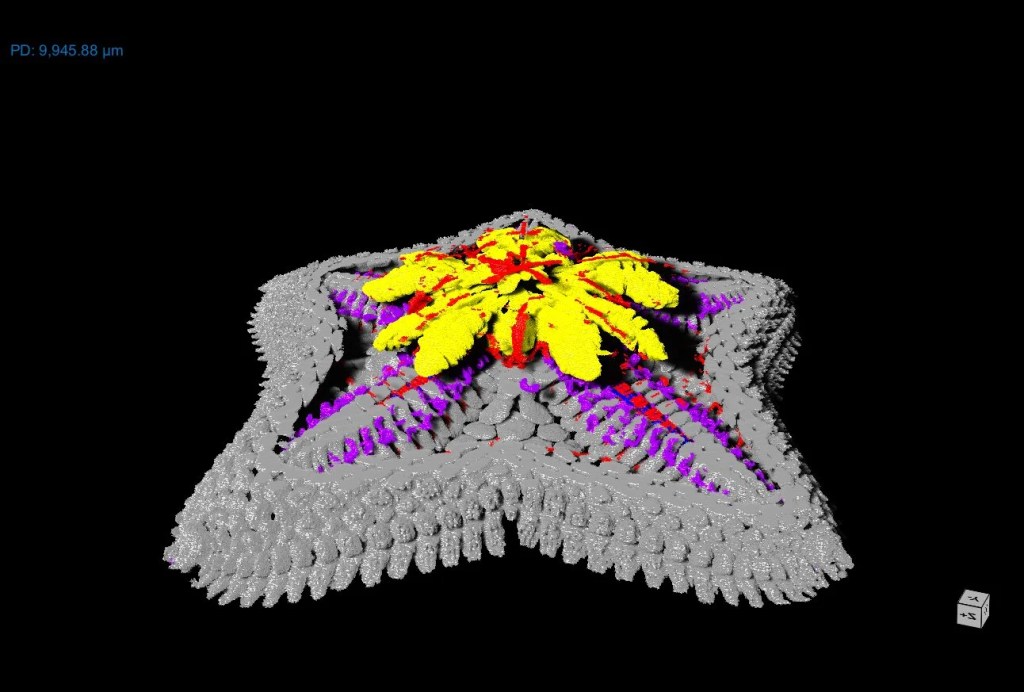
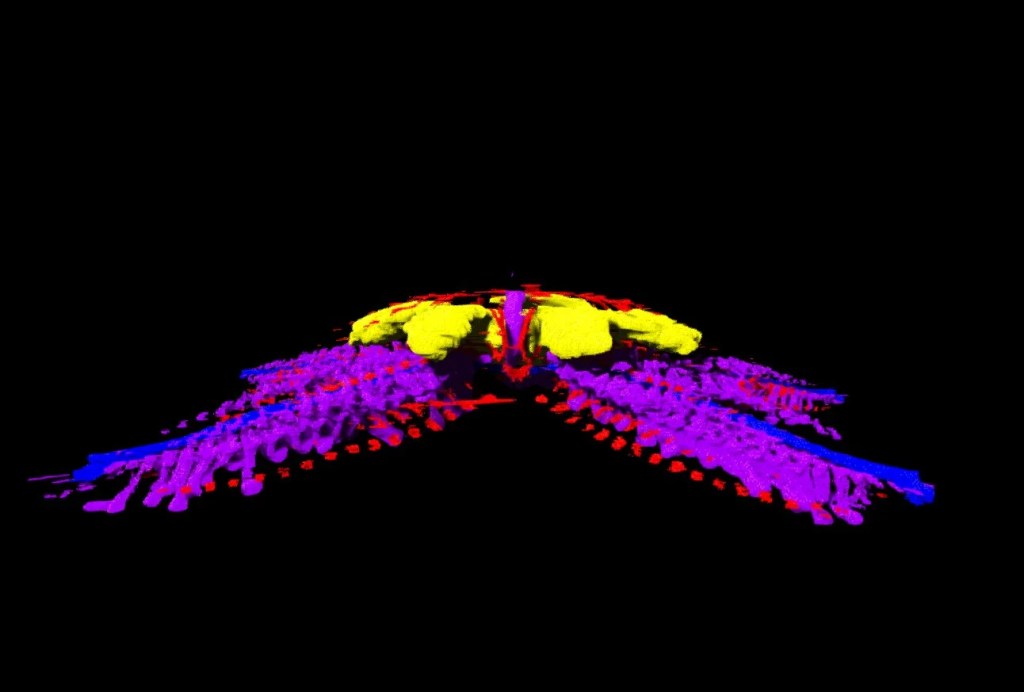
Micro-CT scanning of a sea star reveals various components, including the skeletal structure (Gray), digestive system (Yellow), nervous system (Blue), muscular system (Red), and the water vascular system (Purple). (Credit: University of Southampton) Micro-CT scanning of a sea star reveals various components, including the skeletal structure (Gray), digestive system (Yellow), nervous system (Blue), muscular system (Red), and the water vascular system (Purple). (Credit: University of Southampton) This micro-CT scan of a sea star unveils its internal structures, including the skeletal system (In gray), digestive system (In yellow), nervous system (In blue), muscular system (In red), and the water vascular system (In purple). (Credit: University of Southampton)

Revolutionary technological advancement
The solution to this issue emerged during a meeting of Biohub Investigators in San Francisco when another researcher recommended that Lowe reach out to PacBio, a company based in Silicon Valley known for developing genome-sequencing devices. Over the past five years, PacBio had been refining a method for sequencing extensive amounts of genetic material using small chips, resembling postage stamps. These chips were densely packed with millions of individual chemical reactors, all capable of simultaneously decoding lengthy segments of DNA contained within.
In contrast to conventional sequencing methods that necessitate cutting genetic material into smaller fragments for accuracy, PacBio’s approach, known as HiFi sequencing, can extract precise data from intact DNA strands of gene size. This innovation significantly accelerates the process while reducing costs, providing Lowe and his team with the ideal tool to develop a comprehensive process for investigating sea star genetics from the foundation up.
The significant improvements in sequencing technology have transformed the research process. What would have previously taken months can now be completed in a matter of hours, and it’s far more cost-effective than it was just half a decade ago. These advancements allowed the researchers to essentially begin anew with an organism that isn’t typically studied in laboratory settings. They were able to conduct a highly detailed study that would have been unfeasible a decade ago. This insight was shared by David Rank, who is also a co-senior author of the new study and a former PacBio Scientific Fellow.
Thanks to this technology, the research team was able to sequence the sea stars’ genomes and utilize a method known as spatial transcriptomics. This approach allowed them to precisely identify which sea star genes were active in specific locations within the organism. To identify potential patterns indicative of a head-to-tail axis, the researchers analyzed variations in gene expression along three different directions across the sea star’s body: from its central region to the tips of its arms, from its upper side to its underbelly, and from one side of its arms to the other.
To gain a more detailed understanding of the behavior of specific crucial genes, the researchers individually tagged them with fluorescent dyes. This meticulous approach allowed them to generate an intricate map showcasing the distribution of these genes throughout the sea star’s body.
Contrary to the leading hypotheses regarding the structure of sea star body plans, the researchers discovered that the gene expression associated with the forebrain in bilaterally symmetrical animals like humans was concentrated along the midline of the sea stars’ arms. In contrast, genetic expression resembling the human midbrain was observed toward the outer edges of the arms.
The researchers found that although sea stars expressed genes marking various subregions of the head found in humans and other bilaterally symmetrical animals, only one of the genes typically linked to the trunk region in animals was expressed, and it was primarily located at the extreme edges of the sea stars’ arms.
The results indicate that echinoderms, particularly sea stars, exhibit an exceptional level of decoupling between the head and trunk regions, as observed today. According to Formery, some peculiar-looking ancestral sea stars found in the fossil record did appear to possess a trunk. These findings raise numerous new questions that researchers can now delve into.

Unlocking new horizons
The team’s forthcoming research aims to tackle questions regarding the presence of similar genetic patterning in sea urchins and sea cucumbers. Additionally, they plan to delve into the lessons the sea star might offer about the evolution of the nervous system within echinoderms, which remains a relatively enigmatic area of study.
Deepening our understanding of sea stars and their close relatives has the potential to unravel critical enigmas in animal evolution. Furthermore, this research may serve as a wellspring of inspiration for medical innovations. Sea stars, known for their distinctive locomotion through water-pumping tube feet and their unique digestive process involving extruding their stomachs, likely possess unconventional strategies for maintaining their health. By delving into these strategies, we could unearth novel approaches for addressing human diseases.
Rokhsar emphasized the challenges inherent in studying less familiar organisms. However, he underscored the value of exploring the behaviors and mechanisms of unusual animals, as this expanded perspective could ultimately contribute to solving ecological and biomedical challenges.
Resources
- NEWSPAPER Chan Zuckerberg Biohub. (2023, November 1). Long presumed to have no heads at all, starfish may be nothing but. Phys.org. [Phys.org]
- JOURNAL Formery, L., Peluso, P., Kohnle, I., Malnick, J., Thompson, J. R., Pitel, M., Uhlinger, K. R., Rokhsar, D. S., Rank, D. R., & Lowe, C. J. (2023). Molecular evidence of anteroposterior patterning in adult echinoderms. Nature. [Nature]
- JOURNAL Lacalli, T. C. (2023). A radical evolutionary makeover gave echinoderms their unusual body plan. Nature. [Nature]


hey
cool blog 🙂 will give it a follow and a like !
Hey there! Came across your post on the WordPress feed and couldn’t resist saying hello. I’m already hooked and eagerly looking forward to more captivating posts. Can’t seem to find the follow button, haha! Guess I’ll have to bookmark your blog instead. But rest assured, I’ll be keeping an eye out for your updates!
hey
lovely blog hope all is well
happy blogging.
hey
lovely blog hope all is well
happy blogging.
hey
cool blog 🙂 will give it a follow and a like !
hey
cool blog 🙂 will give it a follow and a like !
Hey there! Stumbled upon your post on the WordPress feed and couldn’t resist saying hello. I’m already hooked and eagerly anticipating more captivating posts. Can’t seem to find the follow button, haha! Guess I’ll have to bookmark your blog instead. But rest assured, I’ll be keeping an eye out for your updates!
may i leave a link to my blog here? feel free to post a comment on my site and leave your link 🙂 helps both our sites !!
Hope to see your comment soon 🙂
https://pomeranianpuppies.uk/2023/04/14/do-pomeranians-shed-a-lot/
hey
lovely blog hope all is well
happy blogging.
https://ketodietrecipes.co.uk/
Great Read!
Hey there! We truly appreciate reading people’s blogs and the entertaining content that creators like you share . Your unique voice contributes to the vibrant online community that we all value . Keep creating and empowering your audience, because your words can make a positive impact on the world. We can’t wait to discover what you’ll create next!
Great Read!
Thanks for information
Excellent article!
great post – thanks !!