



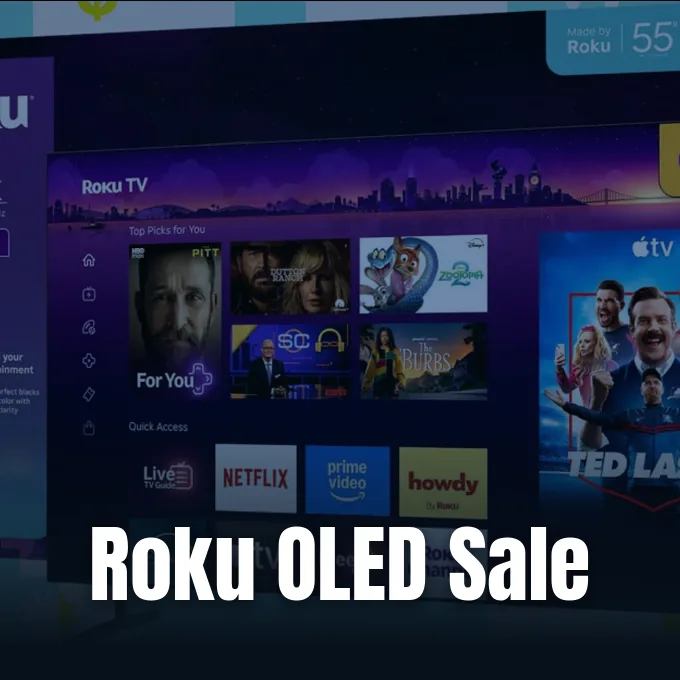
Retail storefronts slashed pricing on Roku hardware this week as promotional checkout codes lowered entry costs across the company’s inaugural television displays. The premier Roku OLED TV rollout marked the brand’s first venture into organic light-emitting diode technology, challenging entrenched home theater competitors. Shoppers entering coupon vouchers at Amazon and Best Buy unlocked immediate savings reaching $400 below launch pricing [2].
Roku OLED TV Discounts at Checkout
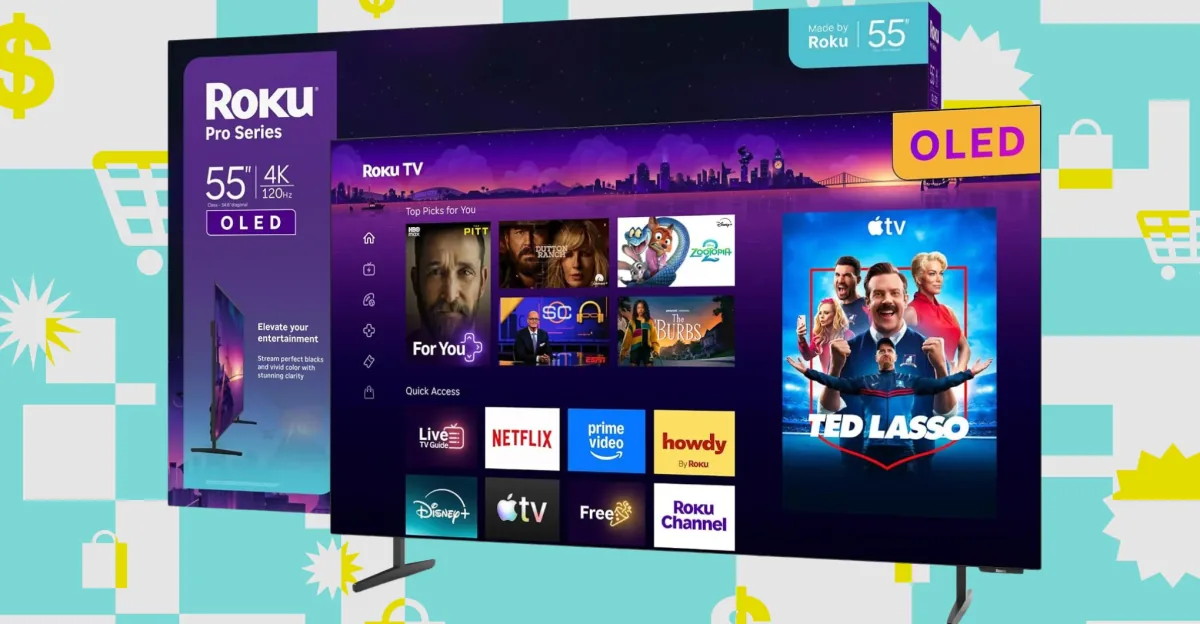
Amazon initiated the primary pricing reduction through promotional checkout vouchers that lowered launch prices substantially across the new product lineup. Entering the promotional code ROKUOLED300 at checkout deducted a $300 discount from the 55-inch model, moving its standard $999 introductory price down to $699. The base tier starts at $699. Buyers selecting the larger 65-inch screen utilized code ROKUOLED400 to cut $400 from its $1,299 retail cost, yielding an identical $799 balance [2].
Parallel savings quickly surfaced across competitive retail storefronts as rival distributors responded to the online marketplace. Reporter Paul Lilly of HotHardware confirmed that Best Buy matched the aggressive pricing structure on the 65-inch Roku OLED TV, offering the unit for $799.99 through a hidden promotional coupon code that remained functional following its Friday rollout. That matches Best Buy pricing. Shoppers gained immediate access to premium display technology without paying typical multi-thousand-dollar launch premiums [1].
The code knocks $400 off. Amazon applied the promotional discounts directly at digital registers [2].
Hardware Specifications of the Pro Series
Roku engineered the Pro Series displays with premium hardware capabilities intended to compete directly against established market leaders in home entertainment. Both the 55-inch and 65-inch Roku OLED TV panels deliver 4K resolution paired with a native 120Hz refresh rate, ensuring fluid motion handling for high-frame-rate cinematic playback and competitive gaming. The physical chassis integrates four full-bandwidth HDMI 2.1 connectivity ports, enabling multiple modern gaming consoles and external media players to run uncompressed high-bandwidth signals simultaneously without requiring manual cable swapping. The panel refreshes at 120Hz. High dynamic range support extends across Dolby Vision and HDR10+, providing expanded contrast ratios, heightened peak luminance, and deep black levels inherent to self-emissive organic diode architecture [2].
Gaming performance received substantial engineering attention through dedicated firmware optimizations designed to minimize latency during fast-paced play. The displays include auto low latency mode (ALLM) with variable refresh rate (VRR) powered by AMD FreeSync Premium to eliminate screen tearing during intense graphical sequences. Roku bundled an updated backlit remote control alongside its proprietary operating system, removing the requirement to occupy external HDMI connections with separate streaming hardware [2].
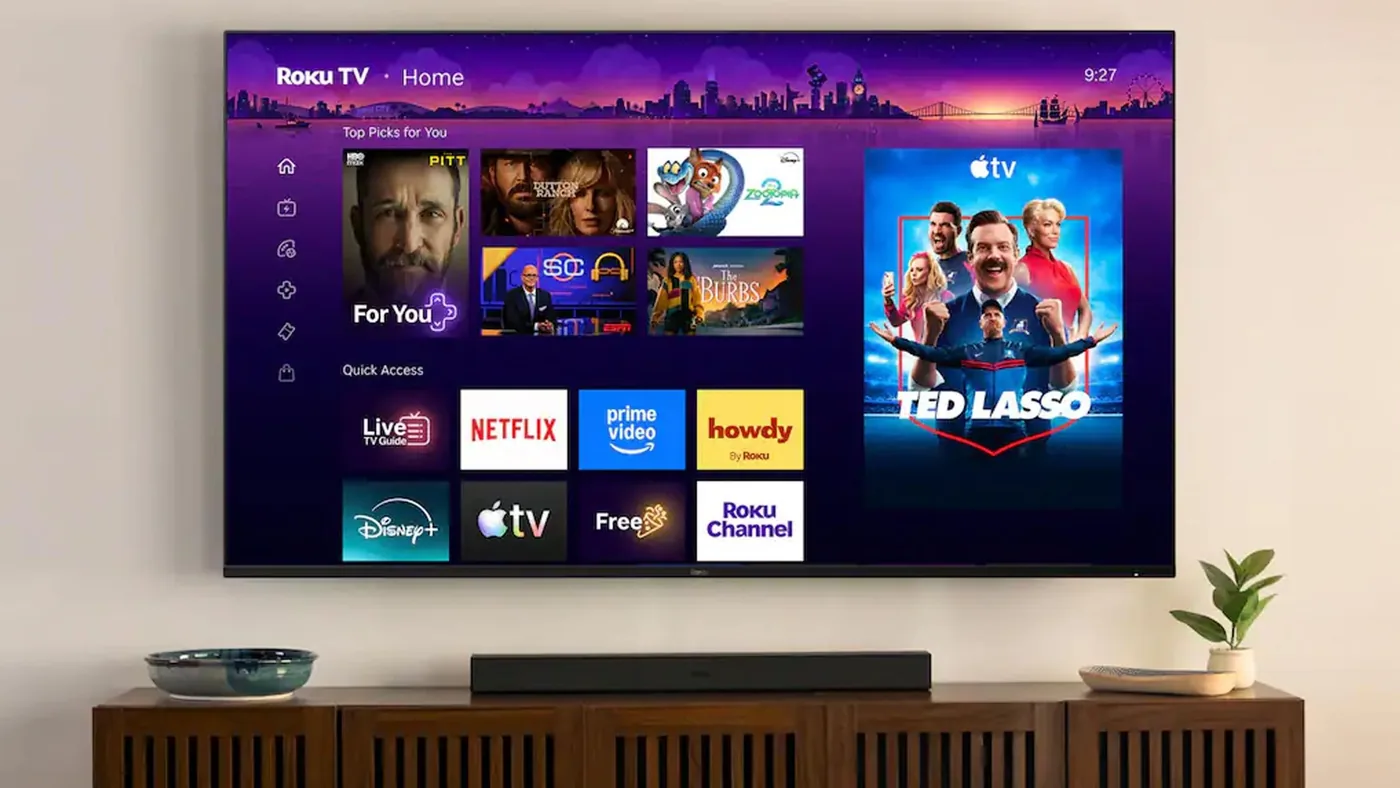
Software responsiveness complements the physical design, providing direct access to streaming applications without the input navigation friction seen on rival platforms. Enthusiasts evaluating gaming hardware investments alongside television upgrades frequently monitor dedicated console ecosystems like the Valve Steam Frame reservations to pair high-refresh displays with compatible gaming gear. The integrated Roku OS ecosystem ensures rapid source switching and automatic picture calibration across connected peripherals [2].

Roku Pro Series OLED Against QLED Rivals
Prospective television buyers often weigh the delicate balance between maximum peak brightness and organic contrast when selecting home theater displays. Roku’s previous 65-inch Pro Series 4K QLED mini LED television dropped to $699.99 at Best Buy, representing a substantial $500 discount from its original retail price. Best Buy cut $500 off. While the QLED panel avoids any risk of (organic burn-in), the newly discounted 65-inch Roku OLED TV at $799.99 commands an attractive $100 premium for viewers prioritizing true contrast ratios [1].
Third-party testing underscores distinct performance boundaries between the differing display technologies. Display review authority Rtings evaluated the QLED mini LED model with scores mostly in the high sevens across the board, praising its glossy VA panel and noting that it looks ‘quite good in home theaters and other dark spaces due to its very good black levels.’ Rtings scored it in the high sevens. However, that older QLED model provides only two full-bandwidth HDMI 2.1 ports compared to the four ports standard on the new OLED sets [1].
Screen dimensions introduce another decisive variable into retail purchasing calculations. Shoppers can acquire the 75-inch QLED mini LED model for $899.99 at Best Buy [1].
Premium Market Pressure from LG C6
Roku’s pricing maneuver directly impacts tier-one display manufacturers who have traditionally dominated high-end home theater markets. The competitive 65-inch LG C6 Series OLED Evo AI TV listed on sale for $1,599.99 at Best Buy, essentially double the $799 sale price of Roku’s 65-inch offering. While the LG platform provides a faster 165Hz refresh rate alongside updated Dolby Vision 2 processing, budget-conscious consumers face a steep $800 gap between the competing panels [1].
Enthusiasts shopping at the higher end of the spectrum encounter even wider price gulfs among luxury installations. Best Buy offered the 77-inch LG C6H Series OLED TV with Hyper Radiant Color technology for $2,699.99, shaving $1,000 from its normal price tag [1]. Meanwhile, Roku announced its own premium sequel, the Pro Series LX, arriving in October with a $1,299 starting price, an anti-reflective polarizer, (a 144Hz refresh rate), and claims of doubling standard Pro Series brightness. That hardware targets bright viewing environments where conventional self-emissive panels historically struggled to maintain sufficient ambient contrast against uncontrolled daytime sunlight [2]. The upcoming model claims double brightness.
The technological divergence highlights how rapidly high-refresh organic panels have diversified across price brackets. Where traditional flagships demand multi-thousand-dollar budgets for marginal brightness increments, entry-tier hardware now delivers foundational OLED picture quality for hundreds less. Buyers must decide whether proprietary high-luminance processing warrants paying twice the price of an entry-level Roku OLED TV [2].
Roku OLED TVs Reshape Budget Home Theaters
The promotional discount arrives amid broader consumer electronics markdowns across major retail distribution channels. Technology roundups highlighted by The Verge noted contemporaneous price cuts, including Amazon’s initial discount on the Nothing Phone 4A Pro down to $449 for the 8GB and 128GB edition, alongside discounted DJI Osmo Nano camera kits at $349 and Ember warming mugs for $34.99 at Woot [2]. Yet the $400 deduction on Roku’s primary visual centerpiece represents the season’s most consequential entertainment bargain.
By pushing modern 55-inch Roku OLED TV pricing down to $699 and 65-inch displays to $799, Roku established an affordable entry point across the home theater market. The aggressive markdown undercuts traditional retail thresholds that historically prevented mainstream households from adopting self-emissive organic panels. With four HDMI 2.1 inputs and integrated streaming software, the Roku OLED TV eliminates auxiliary peripheral expenses for first-time adopters [2].
Whether these coupon codes reflect temporary retail clearance or a permanent reset in consumer expectations remains the central question for competing television manufacturers. As inventory shifts and promotional codes face eventual expiration, the accessibility of sub-$800 organic light-emitting displays establishes a formidable precedent across consumer technology [1].
- ONLINE NEWS Lilly, P. (2026, September 26). Roku QLED 4K and Gorgeous LG C6H OLED TVs Are Up to Thousands Off at Best Buy. HotHardware. [Article Link]
- ONLINE NEWS Bourque, B., & Faulkner, C. (2026, September 25). Roku’s First OLED TVs Are Up to $400 Off, Starting at $699. The Verge. [Article Link]


1 comment