



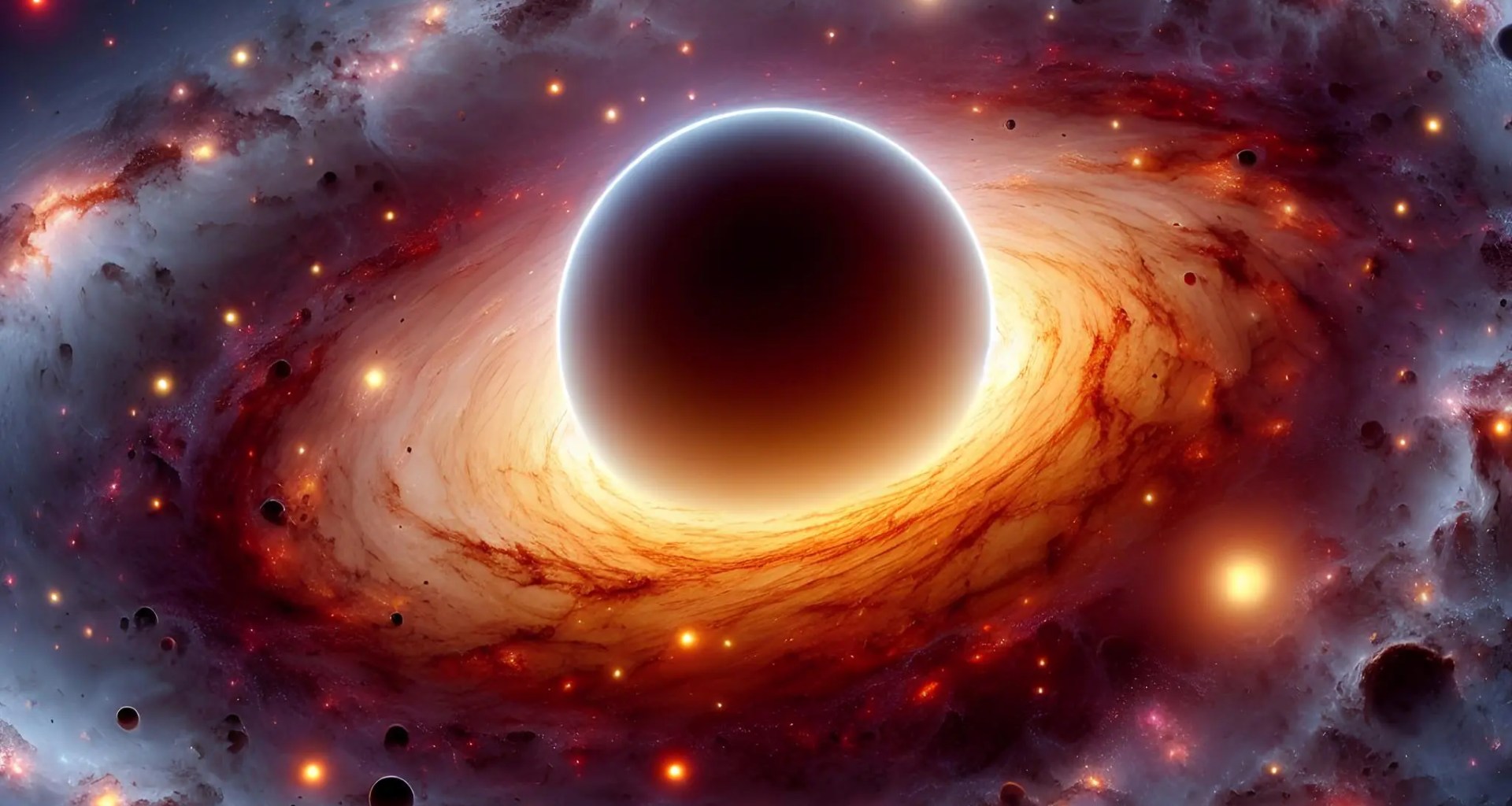
Astronomers have made a groundbreaking discovery, revealing that the supermassive black holes located at the centers of early galaxies are significantly more massive than previously thought. This unexpected revelation not only challenges existing theories but also provides a novel perspective on the origins of all supermassive black holes, offering valuable insights into the earliest phases of their host galaxies’ development.
In mature galaxies like our Milky Way, the total mass of stars far exceeds that of the central black hole, maintaining a ratio of approximately 1,000 to 1. However, in the recently discovered distant galaxies, this mass differential undergoes a remarkable reduction, dropping to 100 or even 10 to 1, and in some instances reaching an equilibrium of 1 to 1. This implies that the mass of the black hole in these early galaxies can be comparable to the combined mass of all the stars within its host galaxy.
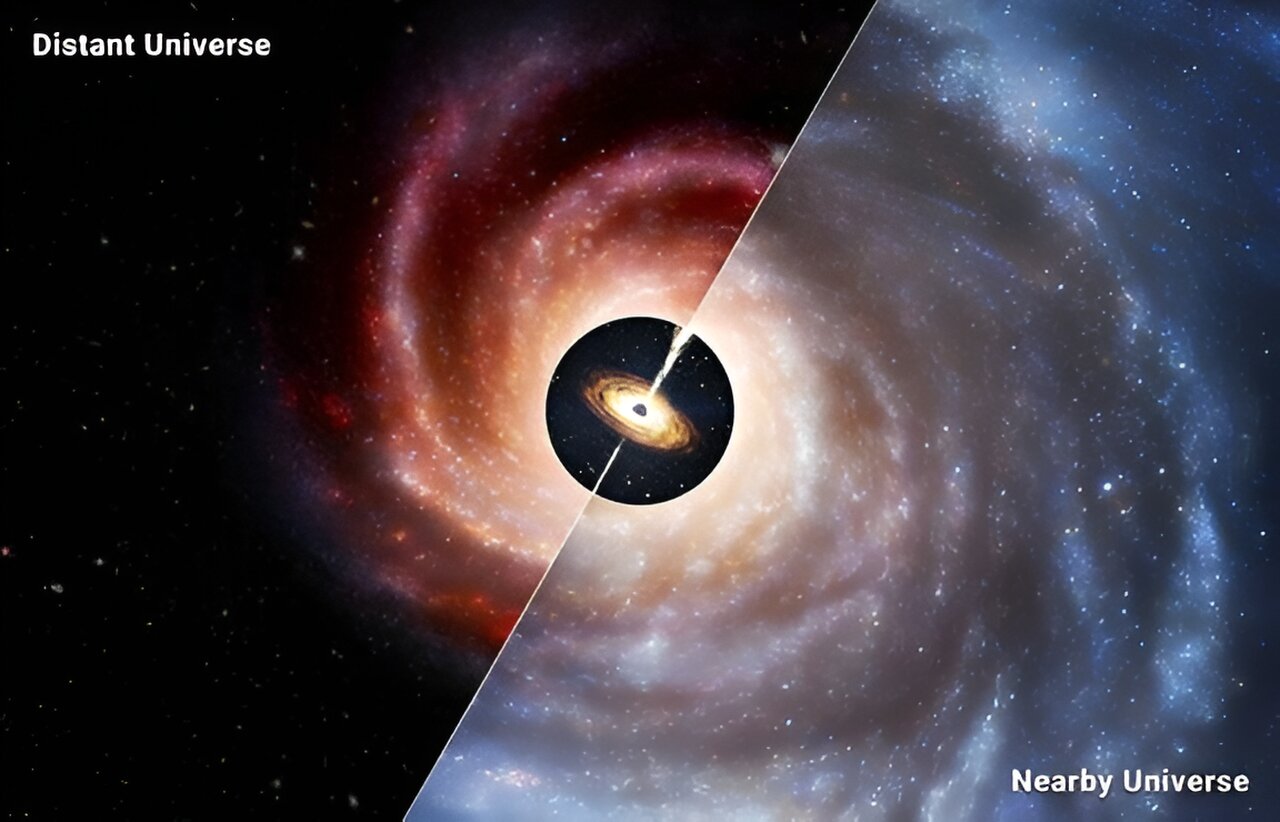
This unexpected revelation is a product of observations made possible by the James Webb Space Telescope (JWST), NASA’s state-of-the-art observatory that commenced operations in late 2021. Prior to the JWST era, astronomers faced limitations in studying distant black holes, with their observations often restricted to extremely bright quasars dominated by massive, matter-consuming black holes that overshadowed the stars in their host galaxies.
Fabio Pacucci, a Clay Fellow at the Center for Astrophysics | Harvard & Smithsonian (CfA), highlights the significance of the JWST in this discovery, noting its ability to observe lower-mass yet still supermassive black holes in smaller, distant galaxies. The telescope’s capabilities enable scientists to not only scrutinize these early black holes but also observe the stars within their host galaxies, providing a unique opportunity to study the co-evolution of black holes and galaxies during their formative stages.
Fabio Pacucci, the lead author of a recently published study in The Astrophysical Journal Letters, presented groundbreaking findings at the 243rd meeting of the American Astronomical Society in New Orleans, LA. The study, co-authored by Roberto Maiolino, a professor at the University of Cambridge (UK), challenges established theories by revealing that distant, young galaxies exhibit a deviation from the well-established correlation between black hole mass and stellar mass observed in nearby, mature galaxies.
The research, enabled by the James Webb Space Telescope (JWST), focused on 21 galaxies located approximately 12 to 13 billion light-years away. Through a meticulous statistical analysis of data obtained from three published JWST surveys, the team observed central black holes within these distant galaxies. Remarkably, these black holes displayed masses in the range of tens or hundreds of millions of times that of our sun, still classified as supermassive but notably smaller in comparison to the colossal black holes powering most previously observed distant quasars. These quasars were characterized by black holes boasting billions of times the mass of the sun.
Roberto Maiolino emphasizes the pivotal role of the JWST in this study, asserting that it will enable researchers to explore the formation of the first supermassive black holes by identifying smaller and more distant black holes. These predictions align with the findings of the current study, hinting at the abundance of such black holes in the early universe.
The implications of these discoveries extend beyond astronomical curiosity. Understanding the characteristics of these early galaxies and their black holes challenges existing models, providing valuable insights into the intricate processes that shaped the cosmos during its formative stages.
Xiaohui Fan, a professor at the University of Arizona and co-author of the study, highlights a compelling observation: black holes in the early galaxies scrutinized by the James Webb Space Telescope (JWST) are ten to a hundred times more massive than the scaling relation predicted by local universe observations. This intriguing revelation implies a significant deviation in the ratio of stellar mass to black hole mass in these early galaxies, more than a dozen billion years ago, compared to contemporary galaxies.
This departure from the local scaling relation holds crucial implications for understanding the origin of supermassive black hole precursors, often referred to as “black hole seeds.” The study delves into the estimation of the stellar mass to black hole mass ratio, a metric pivotal in unraveling the formation pathways of these black hole seeds.
Astronomers broadly contemplate two primary pathways for the genesis of black hole seeds: “light” or “heavy” seeds. Light seeds, with masses ranging from 100 to 1,000 times that of the sun, are theorized to originate from the remnants of the universe’s initial colossal stars. On the other end of the spectrum, heavy seeds, starting at 10,000 to 100,000 solar masses, could arise from the direct gravitational collapse of immense gas clouds.
The study’s findings, unveiling overmassive black holes in early galaxies, align with the concept of heavy seeds. This pathway, starting from a higher mass, supports the rapid formation of supermassive black holes in the early universe. The simulations and theoretical calculations associated with the heavy seed scenario predict that these black holes should be comparable or even surpass the mass of the stellar component of the young galaxies they inhabit. This nuanced understanding offers a tantalizing glimpse into the cosmic processes governing the evolution of galaxies and the formation of their central supermassive black holes.
Unraveling the mysteries of how galaxies took shape and co-evolved around the seeds of primeval black holes remains a paramount astrophysical question. The processes through which these black holes grew—whether predominantly through gas accretion or mergers with other black holes—and how stellar mass accumulated within galaxies—whether independently or through mergers with larger galaxies—are key aspects that currently lack definitive answers.
Fabio Pacucci and his team anticipate that the James Webb Space Telescope (JWST) will play a pivotal role in shedding light on these enigmatic processes. As additional JWST studies unfold, they hope to gain insights into the intricate mechanisms that governed the evolution of galaxies around these early black hole seeds.
Pacucci elucidates that, over cosmic time, there is a noticeable convergence in the ratio of stellar mass to black hole mass towards the local 1,000 to 1 ratio observed in the modern universe. This convergence unfolds as the black hole and its host galactic system evolve together, engaging in mergers with other galaxies and fostering the formation of numerous stars. However, the team acknowledges that a comprehensive understanding of how this cosmic dance originated requires a deeper exploration into the universe.
The collaborative efforts of researchers, including Xiaohui Fan, Roberto Maiolino, Bao Nguyen from the University of Arizona, and Stefano Carniani from Scuola Normale Superiore in Pisa, Italy, contributed to this study. The JWST surveys employed in their research encompass the JWST Advanced Deep Extragalactic Survey (JADES), Cosmic Evolution Early Release Science Survey (CEERS), and the Galaxy Assembly with NIRSpec IFS survey (GA-NIFS). These surveys serve as invaluable tools for peering into the distant cosmos and unraveling the complex interplay between galaxies and the supermassive black holes at their cores.
Resources
- ONLINE NEWS Harvard-Smithsonian Center for Astrophysics. (2024, January 9). Unexpectedly massive black holes dominate small galaxies in the distant universe. Phys.org. [Phys.org]
- JOURNAL Pacucci, F., Nguyen, B. X., Carniani, S., Maiolino, R., & Fan, X. (2023). JWST CEERS and JADES Active Galaxies at z = 4–7 Violate the Local M •–M ⋆ Relation at >3σ: Implications for Low-mass Black Holes and Seeding Models. The Astrophysical Journal Letters, 957(1), L3. [The Astrophysical Journal Letters]
Cite this page:
APA 7: TWs Editor. (2024, January 10). Small Galaxies in Distant Universe Surprisingly Host Dominant Massive Black Hole. PerEXP Teamworks. [News Link]


