



The sun actively emits solar flares capable of affecting Earth, potentially causing blackouts and disrupting global communications. However, the sun’s flares pale in comparison to the thousands of “Super flares” detected by NASA’s Kepler and TESS missions. These super flares originate from stars 100–10,000 times brighter than our sun.
The underlying physics between solar flares and super flares are believed to be the same, involving a sudden release of magnetic energy. Super-flaring stars, characterized by stronger magnetic fields, produce more luminous flares. However, some exhibit an intriguing behavior—initial, brief brightness enhancement followed by a secondary, longer-duration yet less intense flare.
A research team, led by Kai Yang, a Postdoctoral Researcher at the University of Hawaiʻi Institute for Astronomy, and Associate Professor Xudong Sun, has developed a model to elucidate this phenomenon. Their findings, published in The Astrophysical Journal, leverage insights gained from studying the sun and apply them to cooler stars. Despite the inability to observe these flares directly, the team utilized the changing brightness of these stars over time to discern the intricate details of these comparatively small yet impactful events.
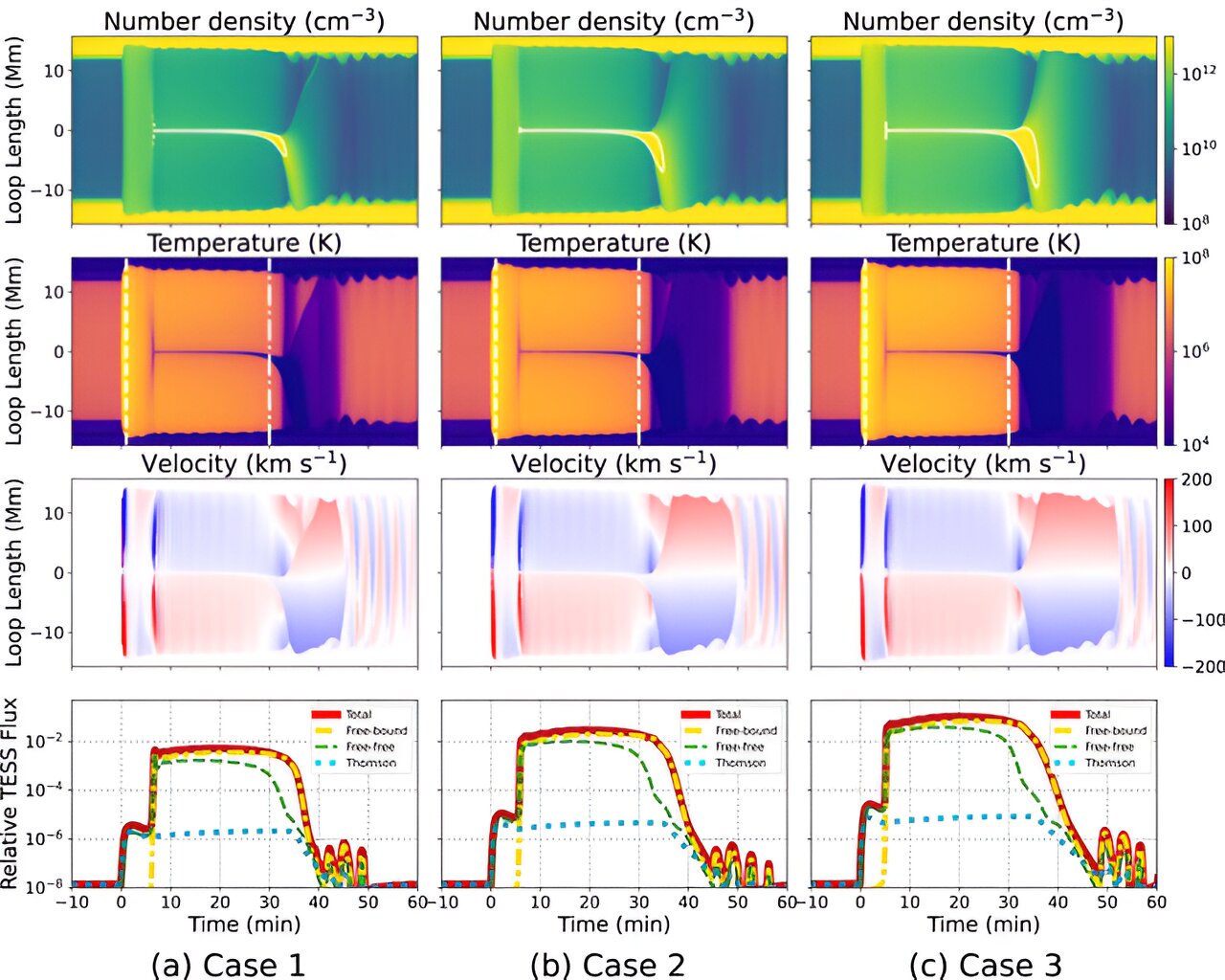
Light curves
Until now, it was believed that the visible light produced in stellar flares originated solely from the lower layers of a star’s atmosphere. Particles, energized through magnetic reconnection, cascade from the hot, sparse corona (the outer layer of a star) and heat these lower atmospheric layers.
Recent studies have proposed the idea that emission from coronal loops—hot plasma confined by the star’s magnetic field—might also be observable in super-flaring stars. However, this would require an extremely high density within these loops. Unfortunately, the challenge lay in testing this hypothesis, as there was no method to observe these loops on stars other than our own sun.
In a serendipitous turn, astronomers analyzing data from the Kepler and TESS telescopes identified stars exhibiting an unusual light curve—resembling a celestial “peak-bump,” characterized by a sudden increase in brightness. Intriguingly, this light curve bears a striking resemblance to a solar phenomenon known as solar late-phase flares, where a second, more gradual peak follows the initial burst.
Sun pointed out that the light curves observed in the study were reminiscent of a phenomenon observed on the sun known as solar late-phase flares.
Producing similar late-phase brightness
Researchers posed the question: Could the same process, involving energized, large stellar loops, lead to comparable late-phase brightness enhancements in visible light? In response to this inquiry, Yang conducted fluid simulations, commonly utilized to replicate solar flare loops, modifying them to increase the loop length and magnetic energy. The outcome revealed that the substantial energy input from a large flare drives a significant mass influx into the loops, resulting in dense and bright visible-light emission, aligning with predictions.
These investigations unveiled that the observed “bump” flaring light occurs when the super-hot gas cools at the highest point of the loop. Due to gravity, this cooled material descends, creating what is known as “coronal rain,” a phenomenon often observed on the sun. This confirmation strengthens the team’s confidence in the model’s realism.
Resources
- ONLINE NEWS University of Hawaii at Manoa. (2023, December 6). Physics behind unusual behavior of stars’ super flares discovered. Phys.org. [Phys.org]
- JOURNAL Yang, K., Sun, X., Kerr, G. S., & Hudson, H. S. (2023b). A possible mechanism for the “Late phase” in stellar white-light flares. The Astrophysical Journal, 959(1), 54. [The Astrophysical Journal]
Cite this page:
APA 7: TWs Editor. (2023, December 7). The Physics of Super Flares in Stars. PerEXP Teamworks. [News Link]


