



The cosmological puzzle known as “Hubble tension” arises from conflicting measurements of the Hubble-Lemaitre constant, creating a challenge for cosmologists. Researchers from the Universities of Bonn and St. Andrews are introducing a novel solution: by employing an alternative theory of gravity, the discrepancies in measured values can be readily accounted for, effectively eliminating the Hubble tension. This study has been recently published in the Monthly Notices of the Royal Astronomical Society (MNRAS).
The ongoing expansion of the universe prompts galaxies to move apart from each other, with their speed of separation being proportionate to the distance between them. Edwin Hubble, a prominent US astronomer, was among the first to recognize this correlation.
Calculating the rate at which two galaxies drift apart requires knowledge of their separation distance, multiplied by a constant factor known as the Hubble-Lemaitre constant—a crucial parameter in cosmology. Determining this constant’s value involves examining the distant reaches of the universe, revealing a speed of nearly 244,000 kilometers per hour per megaparsec distance (where one megaparsec equals just over three million light-years).
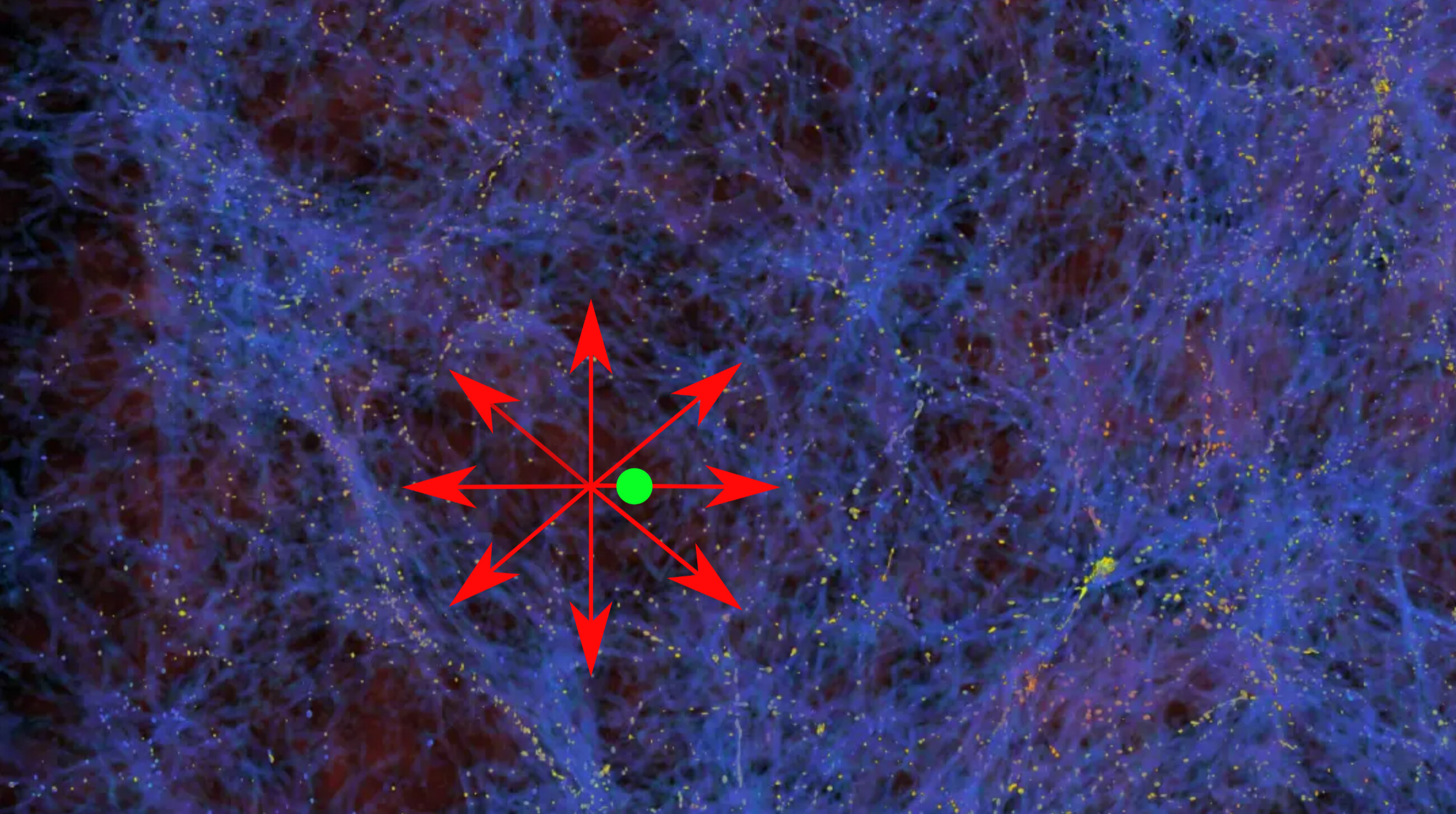
The Hubble constant dilemma: Is it 244,000 or 264,000 km/h/Mpc?
Prof. Dr. Pavel Kroupa from the Helmholtz Institute of Radiation and Nuclear Physics at the University of Bonn elaborates on an alternative method for determining the Hubble-Lemaitre constant. By studying category 1a supernovae, a specific type of exploding star that is relatively close to us, scientists can precisely measure the distance of these celestial bodies from Earth. Furthermore, the phenomenon of objects changing color as they move away from us is observed in these supernovae. Similar to the way an ambulance siren sounds deeper as it moves away, the color change intensifies with the increasing speed of the supernova’s movement.
Calculating the velocity of category 1a supernovae based on their observed color shift and establishing a correlation with their distance yields an alternative value for the Hubble-Lemaitre constant, measuring just under 264,000 kilometers per hour per megaparsec distance. According to Kroupa, this suggests an intriguing observation—the universe seems to be expanding more rapidly in our immediate vicinity, up to a distance of approximately three billion light-years, than it does on a broader scale. This observation poses a notable discrepancy that challenges the expected uniformity of the universe’s expansion.
Recent observations suggest a possible explanation for the observed discrepancies in the expansion of the universe. It is proposed that Earth occupies a region within space characterized by a relatively low density of matter—a concept likened to an air bubble within a cake. In contrast, the surrounding space outside the bubble exhibits higher matter density. Gravitational forces originating from the denser surroundings exert a pull on galaxies within the bubble, causing them to move toward the periphery of this low-density region. Dr. Indranil Banik from St. Andrews University explains that this gravitational influence results in galaxies moving away from us at a faster rate than would be expected under normal circumstances. These deviations in the rate of expansion could be simply elucidated by the presence of a local “under-density” in the cosmic structure.
In a recent study, a different research team conducted measurements of the average speed of numerous galaxies positioned approximately 600 million light-years from Earth. Sergij Mazurenko from Kroupa’s research group, who played a role in the current study, elaborates on their findings. The results indicated that these galaxies are receding from us at a rate approximately four times faster than what the standard model of cosmology would predict. This observation adds to the growing body of evidence suggesting that deviations from the expected rate of expansion are present in various regions of the universe.
The universe’s dough has a bubble
The challenge arises because the standard model of cosmology doesn’t account for the existence of under-densities or “bubbles” in the cosmic structure. According to this model, matter should be uniformly distributed in space. However, the observed deviations, such as the presence of regions with lower matter density, pose a dilemma. If matter were uniformly distributed as per the standard model, explaining the forces responsible for propelling galaxies to their high speeds becomes problematic.
Kroupa explains that the standard model relies on Albert Einstein’s theory of gravity. However, he suggests that the behavior of gravitational forces might deviate from Einstein’s expectations. To explore this possibility, the research teams from the Universities of Bonn and St. Andrews employed a computer simulation that incorporates a modified theory of gravity. This alternative perspective aims to assess whether adjustments in our understanding of gravitational interactions could account for the observed anomalies in the universe’s expansion.
The theory known as “modified Newtonian dynamics” (abbreviated as MOND) was introduced by the Israeli physicist Prof. Dr. Mordehai Milgrom approximately four decades ago. Despite being regarded as an outsider theory within the scientific community, Kroupa notes that in their calculations, MOND consistently and accurately anticipates the existence of the observed under-densities or “bubbles” in the cosmic structure. This suggests that MOND might offer insights that align with the observed phenomena, challenging the conventional understanding of gravitational dynamics.
If we entertain the idea that gravity aligns with Milgrom’s postulates, the Hubble tension would cease to be a puzzle. In this scenario, there would exist only one constant governing the expansion of the universe, and any observed deviations could be attributed to variations in the distribution of matter across space. This perspective suggests a potential resolution to the discrepancies in our understanding of the universe’s expansion.
Resources
- ONLINE NEWS University of Bonn. (2023, December 2). A new possible explanation for the Hubble tension. Phys.org. [Phys.org]
- JOURNAL Mazurenko, S., Banik, I., Kroupa, P., & Haslbauer, M. (2023a). A simultaneous solution to the Hubble tension and observed bulk flow within 250 h−1 Mpc. Monthly Notices of the Royal Astronomical Society, 527(3), 4388–4396. [Monthly Notices of the Royal Astronomical Society]
Cite this page:
APA 7: TWs Editor. (2023, December 4). The Hubble Tension: A New Possible Explanation. PerEXP Teamworks. [News Link]


