



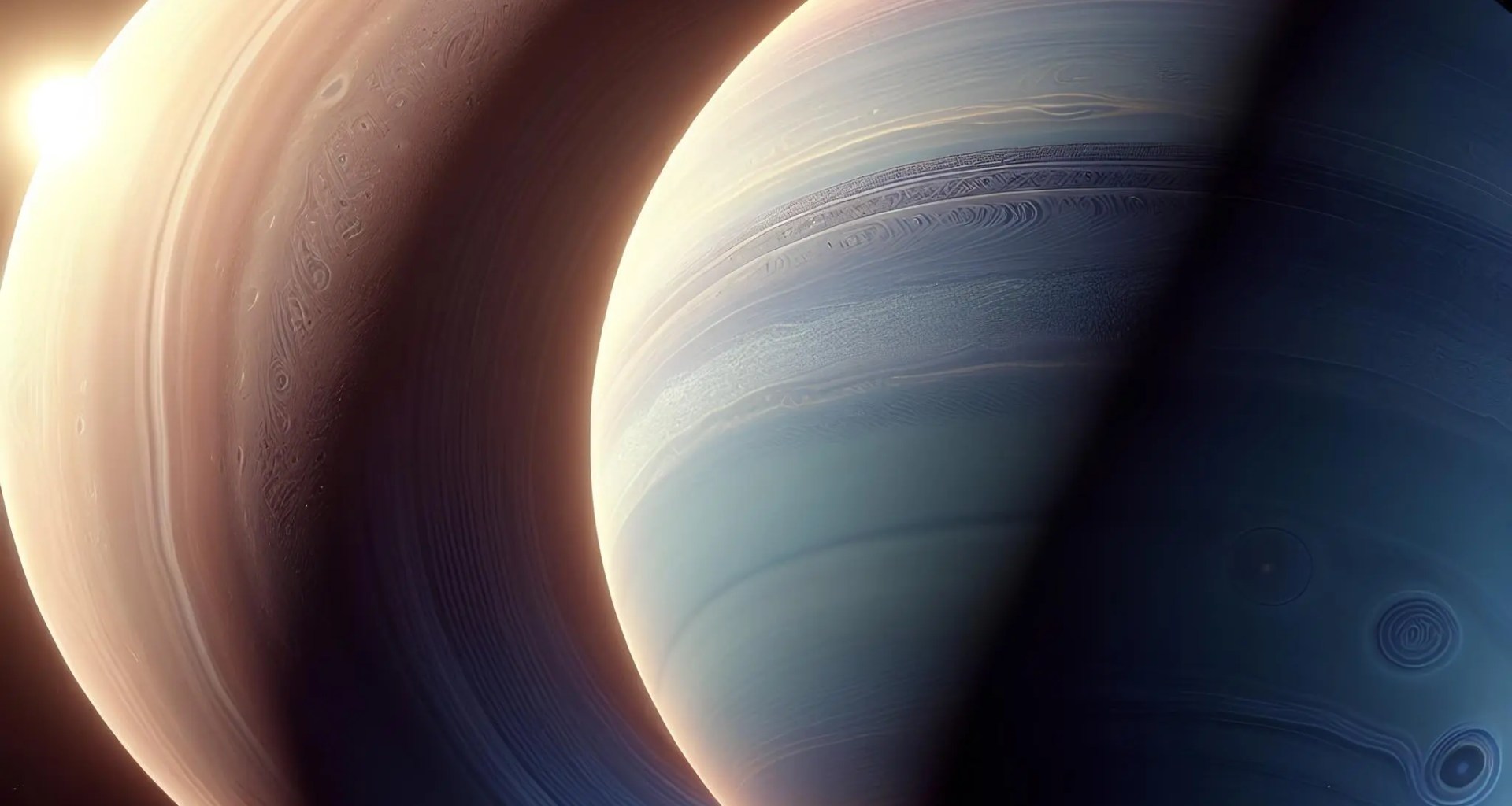
The renowned perception of Neptune as a resplendent blue orb and Uranus as a distinctively green celestial body has encountered a fascinating twist through a recent study led by Professor Patrick Irwin from the University of Oxford. Published in the Monthly Notices of the Royal Astronomical Society, this research challenges the traditional understanding of the ice giants’ colors, revealing a surprising similarity previously obscured by common misconceptions.
Contrary to the widely held belief that Neptune boasts a deep azure shade and Uranus exhibits a pale cyan appearance, Irwin and his team assert that both planets share a comparable hue of greenish blue. The accuracy of these newfound shades has been meticulously confirmed through their research, which sheds light on the often-misleading portrayals of the planets’ colors in modern imagery.
The study underscores the historical discrepancy in the depiction of Neptune and Uranus, elucidating that prevalent images, including those captured by NASA’s Voyager 2 mission—the sole spacecraft to journey past these ice giants—did not faithfully represent their true colors. The team’s meticulous analysis, leveraging advanced observational techniques and sophisticated instruments, seeks to rectify this oversight and present a more accurate portrayal of the ice giants’ celestial aesthetics.
As astronomers have long acknowledged, the misperception of Neptune as a rich blue and Uranus as predominantly green stems from images captured during the 20th century, utilizing separate color channels. The new revelations not only refine our understanding of the aesthetics of these distant planets but also emphasize the need for precise color analysis in planetary observations to dispel long-standing inaccuracies and provide a more faithful representation of the beauty inherent in our solar system’s celestial bodies.
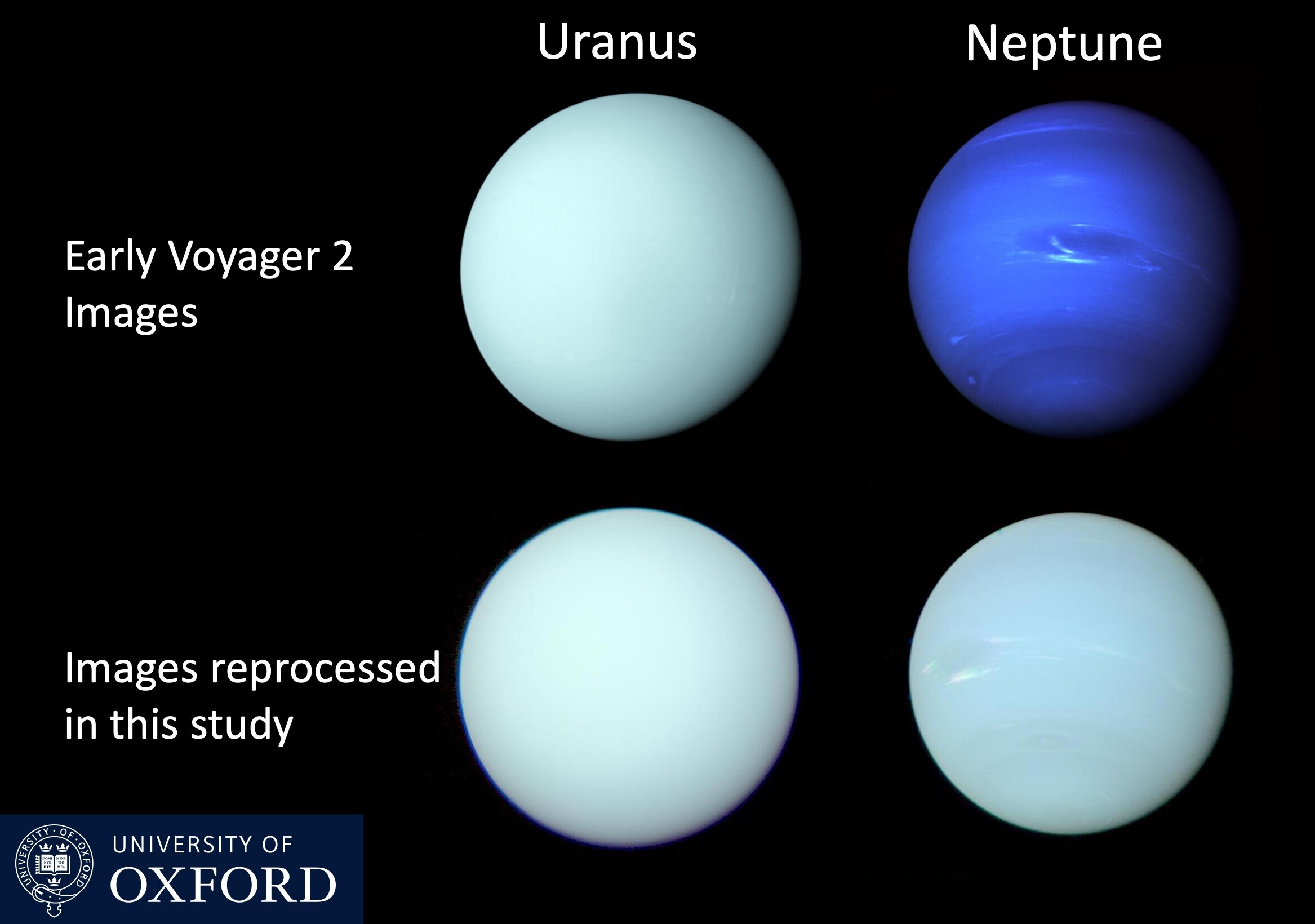
The accuracy of our perception of Uranus and Neptune’s colors has been called into question due to the processing techniques applied to the images from the Voyager 2 mission. Single-color images initially captured were later combined to create composite color images. However, these composite images, aimed at representing “true” colors, were not always meticulously balanced and, notably in Neptune’s case, were often skewed towards an excessively blue hue.
An additional layer of complexity arises from the contrast enhancement applied to early Neptune images. This enhancement, employed to reveal intricate details such as clouds, bands, and winds, inadvertently influenced our contemporary understanding of Neptune’s appearance. Professor Irwin, leading the recent study, remarked that while the Voyager 2 images of Uranus were published in a form closer to “true” color, those of Neptune underwent stretching and enhancement, resulting in an artificially intensified blue tone. Despite planetary scientists being aware of this color manipulation at the time of release—with captions explaining the alterations—the nuances had become obscured over the years.
In addressing this discrepancy, the research team applied a sophisticated model to the original data, aiming to restore the most accurate representation yet of the colors of both Neptune and Uranus. By revisiting the data and reconstituting the images with a more discerning approach, the study endeavors to present a truer depiction of the celestial hues of these distant ice giants, rectifying historical inaccuracies that have persisted in our visual understanding of these planets.

The latest study harnessed the robust data streams from the Hubble Space Telescope’s Space Telescope Imaging Spectrograph (STIS) and the Multi Unit Spectroscopic Explorer (MUSE) on the European Southern Observatory’s Very Large Telescope. Unlike traditional imaging methods, both STIS and MUSE utilize instruments where each pixel represents a continuous spectrum of colors.
This unique feature allows the researchers to process STIS and MUSE observations in an unambiguous manner, enabling the determination of the true apparent color of Uranus and Neptune. Leveraging these datasets, the research team embarked on a comprehensive effort to recalibrate the composite color images captured by both the Voyager 2 camera and the Hubble Space Telescope’s Wide Field Camera 3 (WFC3).
The outcomes of this recalibration were nothing short of revelatory. Contrary to conventional perceptions, Uranus and Neptune, when accurately assessed using the continuous spectrum data, exhibit a surprisingly similar shade of greenish blue. The subtlety in their color divergence is elucidated by the model, revealing that Neptune possesses a faint additional touch of blue. This nuanced difference is attributed to a thinner haze layer on Neptune, providing valuable insights into the atmospheric compositions of these distant ice giants.
By employing state-of-the-art observational instruments and leveraging the continuous spectrum data, this study not only challenges historical color misrepresentations but also advances our understanding of the intricate atmospheric nuances shaping the distinct appearances of Uranus and Neptune in our cosmic neighborhood.
This groundbreaking study not only unravels the mysteries surrounding the subtle color variations in Uranus but also sheds light on the long-standing enigma of why the ice giant’s color undergoes slight changes throughout its 84-year orbit around the sun. The researchers conducted a meticulous analysis, juxtaposing images of Uranus with extensive brightness measurements recorded by the Lowell Observatory in Arizona over a span from 1950 to 2016, specifically focusing on blue and green wavelengths.
Remarkably, the measurements unveiled a discernible pattern in Uranus’s coloration. During its solstices, marking summer and winter when either pole is inclined toward the sun, Uranus displays a distinctive greenish tint. Conversely, during its equinoxes, when the sun aligns with the equator, the planet takes on a somewhat bluer hue. This cyclical transformation in coloration is intricately linked to Uranus’s unconventional spin—almost perpendicular to its orbital plane.
The researchers recognized that this unique spin has significant implications. When either the north or south pole is nearly pointed directly at the sun and Earth during solstices, changes in the reflectivity of the polar regions have a substantial impact on Uranus’s overall brightness as observed from our planet. What remained unclear to astronomers was the precise mechanism driving these shifts in reflectivity.
To unravel this mystery, the researchers devised a model that compared the spectral characteristics of Uranus’s polar regions with those at the equator. The model revealed that the polar regions exhibit greater reflectivity at green and red wavelengths compared to blue wavelengths. The discrepancy in reflectivity arises in part due to the reduced abundance of methane, a compound that absorbs red light, near the poles compared to the equator.
This comprehensive investigation not only provides a compelling explanation for Uranus’s intriguing color variations but also deepens our understanding of the complex interplay between the planet’s unique spin, seasonal changes, and atmospheric composition. The findings contribute valuable insights into the dynamic and ever-evolving nature of distant celestial bodies within our solar system.
While the initial modeling efforts provided valuable insights into Uranus’s color changes during its orbit, researchers found that an additional factor was needed to fully account for the observed variations. To refine their understanding, they introduced a novel variable to the model—a “hood” of gradually thickening icy haze. This atmospheric feature had previously been observed over the sunlit pole of Uranus during the transition from equinox to solstice and is believed to consist of methane ice particles.
In the simulation, these ice particles played a crucial role in amplifying the reflection at green and red wavelengths around the poles. This addition to the model offered a compelling explanation for why Uranus appears greener during its solstices. Essentially, the reduction in methane abundance in the polar regions, coupled with an increased concentration of these brightly scattering methane ice particles, contributes to the observed shift in color.
Professor Irwin emphasized the significance of this study as the first to align a quantitative model with imaging data, providing a comprehensive explanation for the observed color changes in Uranus during its orbital journey. The findings underscore the complex interplay of atmospheric components that contribute to the distinct appearance of this ice giant.
Dr. Heidi Hammel, an expert on Neptune and Uranus who was not directly involved in the study, commended the research for addressing long-standing challenges in understanding the color dynamics of these distant planets. She expressed confidence that this comprehensive study would finally bring clarity to the misperceptions surrounding Neptune’s color and the intriguing color shifts observed on Uranus.
The enigmatic ice giants, Uranus and Neptune, continue to beckon as alluring destinations for future robotic exploration, a prospect that aims to build upon the pioneering legacy of the Voyager mission in the 1980s. While Voyager provided invaluable insights, the complexities of Uranus and Neptune’s peculiar seasonal atmospheres, intricate ring systems, and diverse moons have spurred a renewed interest in exploring these distant realms.
Professor Leigh Fletcher, a planetary scientist at the University of Leicester and co-author of the recent study, emphasizes the high priority that space agencies place on a mission dedicated to unraveling the mysteries of the Uranian system. The ambition extends beyond merely capturing images—future explorers aspire to delve into the peculiarities of Uranus, from its dynamic atmosphere, marked by bizarre seasonal changes, to its captivating assortment of rings and moons.
However, the unique orbital dynamics of Uranus pose a challenge. Even a long-term robotic explorer stationed in orbit around Uranus would only capture a brief snapshot of a Uranian year due to its lengthy orbital period. In this context, Earth-based studies, such as the one showcasing the changes in Uranus’s appearance and color over decades, become crucial. These studies serve as a temporal bridge, offering a comprehensive understanding of how Uranus evolves across its peculiar seasons and providing a valuable context for interpreting the findings of future missions.
Professor Fletcher underscores the significance of Earth-based research, emphasizing that insights gained from studies on Uranus’s changing characteristics over time will play a vital role in contextualizing the discoveries made by upcoming space missions. These endeavors collectively contribute to expanding our understanding of the ice giants, paving the way for a more nuanced exploration and appreciation of the unique features that characterize these distant members of our solar system.
Resources
- ONLINE NEWS University of Oxford. (2024, January 5). New images reveal what Neptune and Uranus really look like. Phys.org. [Phys.org]
- JOURNAL Pieres, A., Santiago, B. X., Drlica-Wagner, A., Bechtol, K., Van Der Marel, R. P., Besla, G., Martin, N. F., Belokurov, V., Gallart, C., Martinez-Delgado, D., Marshall, J., Noel, N. E. D., Majewski, S. R., Cioni, M. R. L., Li, T. S., Hartley, W., Luque, E., Conn, B. C., Walker, A. R., . . . Wester, W. (2016). A stellar over-density associated with the Small Magellanic Cloud. arXiv (Cornell University). [arXiv.org]
Cite this page:
APA 7: TWs Editor. (2024, January 6). How Uranus and Neptune Appear in New Images? PerEXP Teamworks. [News Link]


