



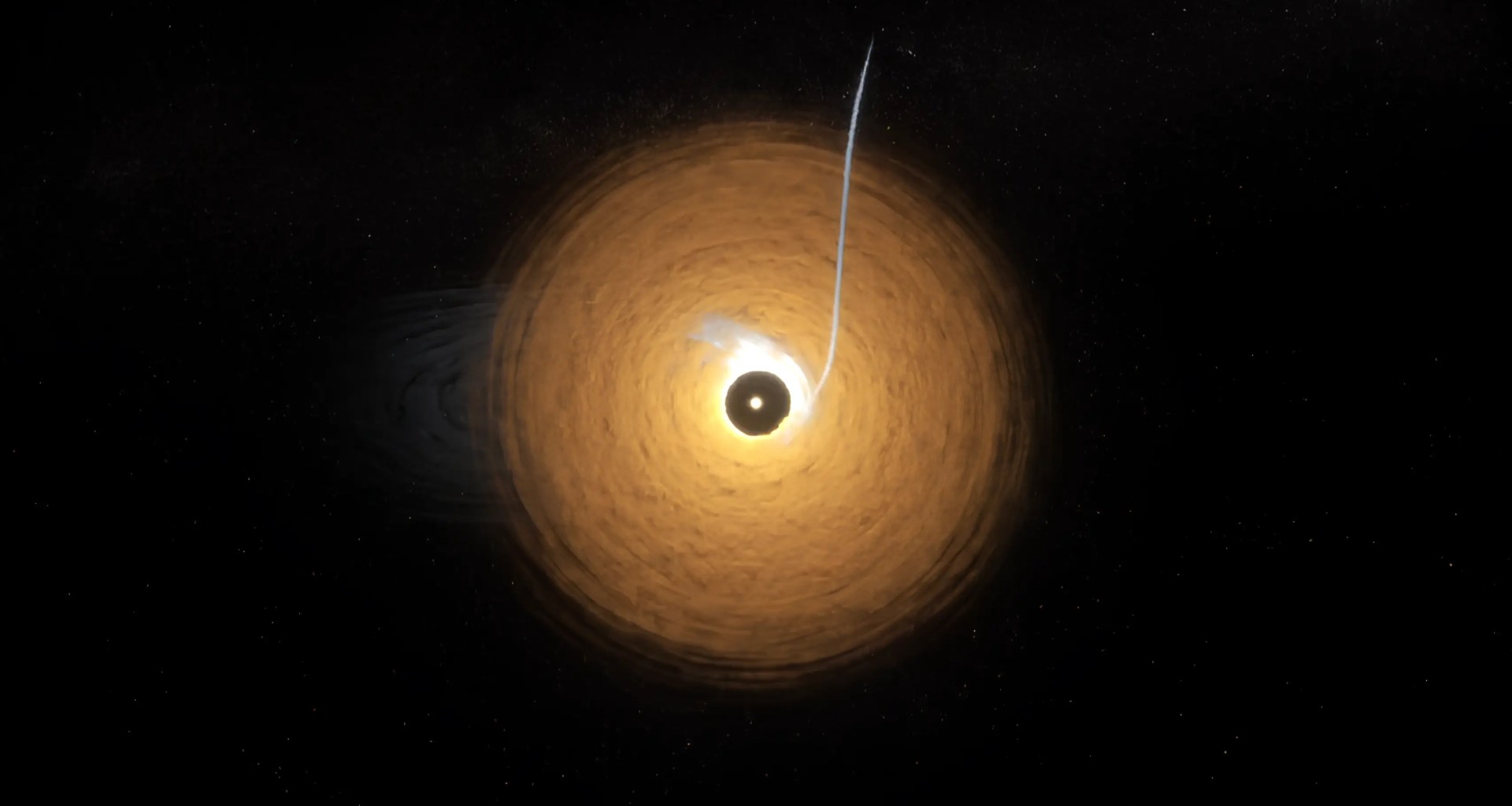
Beta Pictoris, a youthful planetary system positioned 63 light-years away, continues to captivate scientists with its intriguing features. Having been extensively studied for decades, this system boasts the distinction of hosting the first dust disk ever imaged around a star—a product of relentless collisions among asteroids, comets, and planetesimals.
Recent observations conducted with NASA’s James Webb Space Telescope have added a new layer of complexity to Beta Pictoris. Initially imaged by the Hubble Space Telescope, the system revealed a second debris disk, inclined in relation to the previously observed outer disk. The latest study, led by Isabel Rebollido of the Astrobiology Center in Spain, utilized Webb’s NIRCam (Near-Infrared Camera) and MIRI (Mid-Infrared Instrument) to delve into the composition of Beta Pictoris’ primary and secondary debris disks. The outcomes surpassed expectations, unveiling a distinct, sharply inclined structure resembling a cat’s tail, extending from the southwest section of the secondary debris disk.

Beta Pictoris, as Rebollido describes it, is the “debris disk that has it all.” Its unique attributes include a luminous, proximate star allowing for detailed examination, a complex circumstellar environment featuring a multi-component disk, exocomets, and two visually confirmed exoplanets. The utilization of Webb’s advanced capabilities, with enhanced sensitivity and spatial resolution, revealed this previously unseen feature, marking a significant advancement in our understanding of this remarkable planetary system.
Enhancing a star’s image through the lens of Webb Space Telescope
The capability of Webb, or JWST, to observe Beta Pictoris in the mid-infrared wavelength range proved instrumental in the detection of the elusive “cat’s tail,” a feature exclusively revealed in the MIRI data. Additionally, Webb’s mid-infrared observations disclosed temperature variations between Beta Pic’s primary and secondary disks, suggesting potential differences in composition.
Christopher Stark, a co-author from NASA’s Goddard Space Flight Center, highlighted the unexpected finding of two distinct material types around Beta Pictoris. The MIRI data demonstrated that the secondary disk and the cat’s tail exhibit higher temperatures than the main disk. Stark explained that the dark nature of the dust forming these structures makes them less visible in visible wavelengths but prominent in the mid-infrared, where they emit a glow.
The team proposes that the elevated temperatures may be attributed to the presence of highly porous “organic refractory material” in the dust, similar to the substances found on the surfaces of comets and asteroids within our solar system. Drawing parallels, the preliminary analysis of material retrieved from asteroid Bennu by NASA’s OSIRIS-REx mission indicates a dark, carbon-rich composition, aligning with the characteristics identified by MIRI in Beta Pictoris.
Intriguing origins of the tail and future exploration
Despite the strides made in understanding Beta Pictoris, a captivating mystery persists: the peculiar shape of the cat’s tail—a distinctive curve not observed in disks around other stars. The team, led by Isabel Rebollido, delved into modeling various scenarios to simulate and decipher the origins of this enigmatic feature. While further investigation is warranted, a compelling hypothesis emerges, suggesting that the cat’s tail may be the aftermath of a relatively recent dust production event, occurring just a century ago.
Marshall Perrin, a co-author from the Space Telescope Science Institute, describes this event as a collision or similar incident leading to a substantial release of dust. Initially aligned with the same orbital direction as its source, the dust gradually disperses. The radiation from the star propels smaller, fluffier dust particles away at a faster rate, creating an extended tendril-like structure, resembling a cat’s tail.
The highly unusual curvature of the cat’s tail poses a challenge for dynamical models, as Christopher Stark explains. Their model indicates the necessity for dust that can be swiftly expelled from the system, supporting the notion that it comprises organic refractory material. This insight sheds light on a captivating aspect of Beta Pictoris, unveiling the complex dynamics that contribute to the formation of its distinctive features.
The team’s favored model proposes an intriguing explanation for the perceived angle of the cat’s tail—a phenomenon they attribute to a visual illusion. The apparent sharp angle is considered an artifact of our viewpoint combined with the tail’s curved structure. In reality, the material of the tail deviates from the disk at a modest five-degree incline. The team estimates that the brightness of the cat’s tail corresponds to a considerable amount of dust, equivalent to the dispersion of a large main belt asteroid across a staggering 10 billion miles.
Furthermore, a recent event causing the release of dust within Beta Pictoris’s debris disks may account for several noteworthy observations. The asymmetric extension of the inclined inner disk, observed exclusively on the side opposite the cat’s tail in the MIRI data, aligns with the proposed model of recent dust production. This theory gains support from a previously detected clump of carbon monoxide (CO) near the cat’s tail by the Atacama Large Millimeter/submillimeter Array in 2014. The persistence of this CO concentration suggests that Beta Pictoris remains dynamically active, with the star’s radiation gradually breaking down CO over approximately a hundred years.
Christopher Stark underscores the significance of these findings, indicating that Beta Pictoris may exhibit greater activity and chaos than previously assumed. The discoveries made through JWST offer a new perspective on these planetary systems, revealing unexpected aspects of even the most extensively studied celestial objects. The unveiling of Beta Pictoris’s complexities adds to the ongoing surprises brought about by the capabilities of JWST in advancing our understanding of the cosmos.
Resources
- ONLINE NEWS NASA’s Goddard Space Flight Center. (2024, January 10). Webb discovers dusty “cat’s tail” in Beta Pictoris System. Phys.org. [Phys.org]
Cite this page:
APA 7: TWs Editor. (2024, January 11). Webb Stumbles Upon the Dusty “Cat’s Tail” in the Beta Pictoris System. PerEXP Teamworks. [News Link]


