



Zeus stands as a towering figure in Greek mythology, revered as the supreme ruler among the Greek gods and the master of Mount Olympus. His story intertwines with the very fabric of ancient Greek religion and culture, embodying both power and complexity.
Who is Zeus?
Zeus is the paramount figure in Greek mythology, reigning as the king of the gods from his throne on Mount Olympus. His authority extends over the heavens and earth, symbolized by his mastery of thunder and lightning. Zeus’s pivotal role in overthrowing the Titans solidified his position as the supreme deity, shaping the epic narratives of ancient Greece. Worshiped in grand temples like the Temple of Zeus at Olympia, and honored through festivals such as the Olympic Games, Zeus remains a central symbol of power and justice in Greek mythology.
Mythological origins of Zeus
Zeus, the pivotal figure in Greek mythology, emerges from a tale steeped in intrigue and divine conflict. His birth and subsequent rise to power form the cornerstone of his mythological origins, shaping the narrative of the Olympian gods.
Birth and parentage of Zeus
According to ancient Greek myth, Zeus is the son of Cronus, the ruling Titan, and Rhea, one of the Titans. Cronus, fearing a prophecy that his offspring would overthrow him, devoured each of his children immediately upon birth.
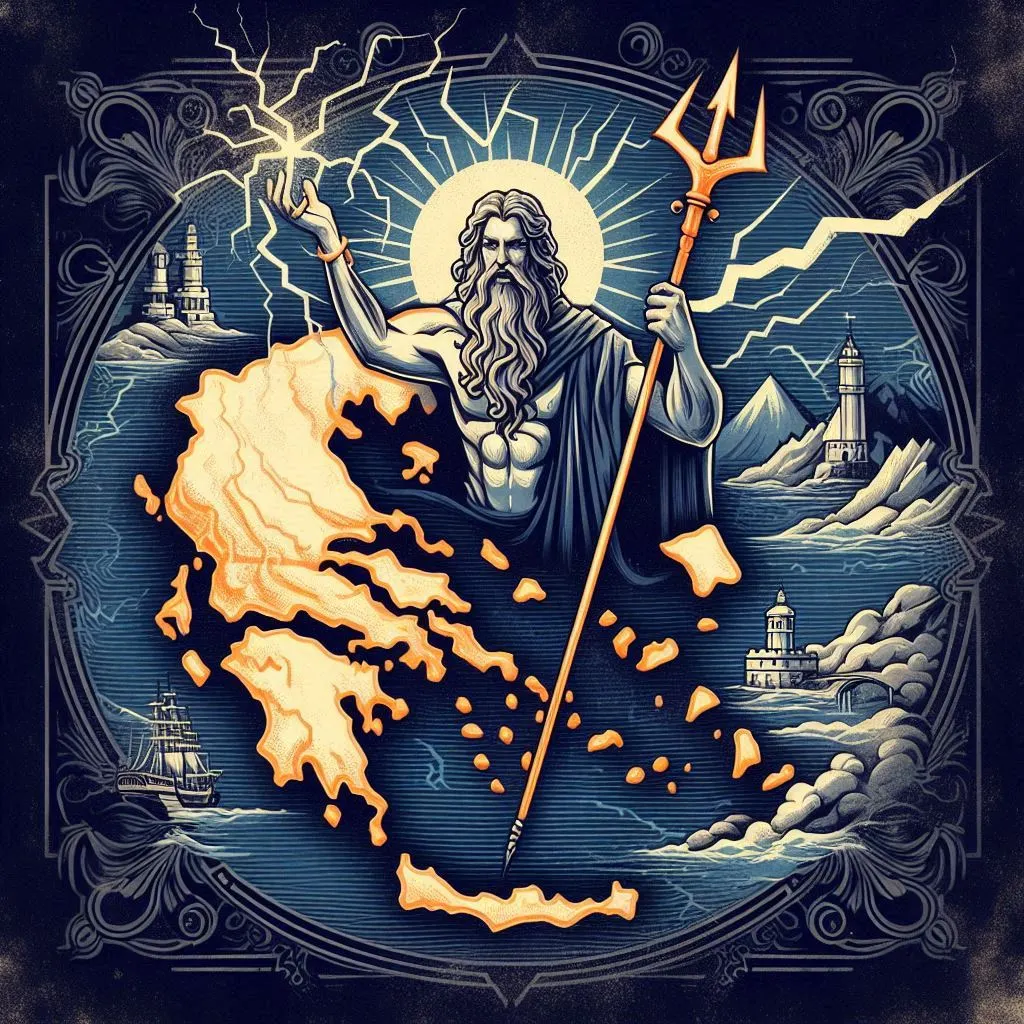
However, Rhea, distraught over the loss of her children, managed to save Zeus. She concealed him in a cave on Mount Ida in Crete, where he was raised secretly away from Cronus’s reach. To deceive Cronus, Rhea presented him with a stone wrapped in swaddling clothes, which he swallowed instead of Zeus.
As Zeus matured in secrecy, he became determined to challenge his father’s tyranny and free his siblings. With the help of Metis, the goddess of wisdom, Zeus orchestrated a plan to force Cronus to regurgitate his swallowed siblings—Poseidon, Hades, Hestia, Demeter, and Hera. Once reunited with his brothers and sisters, Zeus led them in a rebellion against Cronus and the Titans, known as the Titanomachy.
The Titanomachy (Titanomachia): Zeus’s role in overthrowing the titans
The Titanomachy was a monumental conflict that ensued between the Olympian gods, led by Zeus, and the Titans, led by Cronus. This epic battle spanned ten years and was characterized by ferocious clashes between the younger Olympian gods and the older Titans, who represented the old order of the cosmos.
Zeus, wielding his thunderbolt as a formidable weapon, played a decisive role in the overthrow of the Titans. His mastery over the skies and divine allies, such as Athena, Apollo, and Artemis, tipped the scales in favor of the Olympians. With each thunderous blow, Zeus asserted his authority and secured his place as the supreme ruler among the gods.
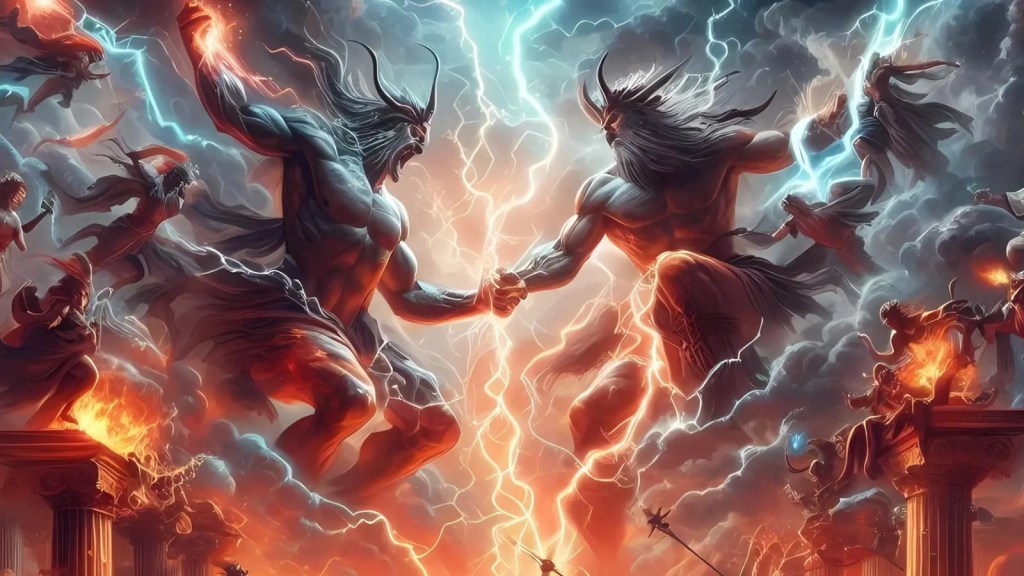
Ultimately, the Olympians emerged victorious, banishing the defeated Titans to Tartarus—a deep abyss within the underworld. Zeus, now undisputed king of the gods and ruler of Mount Olympus, established a new era of divine governance and cosmic order, marking the beginning of the Olympian reign and the dominance of Zeus in Greek mythology.
The mythological origins of Zeus—from his miraculous birth and cunning escape from Cronus’s wrath to his leadership in the Titanomachy—underscore his pivotal role in shaping the narrative of ancient Greek religion and culture. The enduring legacy of Zeus as the supreme deity and arbiter of justice continues to resonate through the ages, symbolizing the triumph of divine order over chaos in Greek mythology.
Attributes and symbols of Zeus
Zeus, the supreme deity of Greek mythology, is characterized by both his majestic appearance and powerful symbols that signify his dominion over the heavens and earth.
In art and literature, Zeus is often depicted as a mature and regal figure, embodying strength and authority. He is typically portrayed as a tall, robust man with a full beard, exuding an aura of wisdom and power befitting his status as king of the gods. His countenance reflects a combination of serene contemplation and formidable presence, resonating with his role as the ruler of Mount Olympus and arbiter of divine justice.
Zeus‘s physical appearance in ancient Greek art evolved over time, influenced by cultural interpretations and artistic conventions. He was often depicted wearing a majestic robe and sometimes adorned with a crown or wreath, symbolizing his sovereignty over both gods and mortals.

Central to Zeus‘s identity are powerful symbols that underscore his authority and mastery over the natural world:
- Thunderbolt: Perhaps the most iconic symbol associated with Zeus is the thunderbolt (or lightning bolt). Crafted by the Cyclopes, this divine weapon embodies Zeus’s control over thunder and lightning, enabling him to wield destructive power against his enemies and enforce cosmic order.
- Eagle: Another prominent symbol linked to Zeus is the eagle. Revered for its keen sight and soaring majesty, the eagle serves as Zeus‘s sacred animal and messenger. It is often depicted perched beside him or in flight, symbolizing vigilance, authority, and divine guidance.
These symbols—the thunderbolt and eagle—embody Zeus’s dual roles as the protector of Olympus and the enforcer of justice. They signify his ability to command the forces of nature and maintain cosmic balance, ensuring the order and stability of the universe.
Zeus’s physical appearance and symbols in Greek mythology reflect his commanding presence and divine authority. Through artistic representations and symbolic imagery, Zeus continues to captivate the imagination, embodying the enduring legacy of ancient Greek religion and culture. His symbols—especially the thunderbolt and eagle—serve as potent reminders of his role as the supreme deity and protector of the Olympian gods.
Role and responsibilities of Zeus
Zeus, as the king of the gods in Greek mythology, holds a multifaceted role that encompasses both divine governance and the stewardship of natural forces.
Leadership among the Olympian Gods
Zeus‘s foremost responsibility is his leadership among the Olympian gods. As the ruler of Mount Olympus, he presides over council meetings where decisions affecting both gods and mortals are deliberated and enacted. His authority is undisputed, and his decisions are final, reflecting his status as the supreme arbiter of divine justice.
Zeus’s leadership extends beyond mere governance; it embodies the ideals of wisdom, fairness, and order. He is revered not only for his power but also for his ability to maintain harmony among the often fractious Olympian deities. In times of crisis or conflict, Zeus‘s leadership ensures unity and collective action among the gods, reinforcing the divine hierarchy and cosmic balance.
Zeus’s domain over the sky, weather, and natural phenomena
Central to Zeus‘s divine portfolio is his dominion over the sky, weather, and natural phenomena. As the god of the sky, he commands the forces of nature, wielding lightning and thunder as manifestations of his power. The thunderbolt, crafted by the Cyclopes, symbolizes his ability to unleash storms and control the atmospheric elements, ensuring fertility and prosperity in the mortal world.
Zeus’s control over weather patterns and natural phenomena underscores his role as a benefactor and protector of both gods and mortals. He is invoked in prayers and rituals seeking favorable weather for crops, safe passage across seas, and protection from calamities. In ancient Greek society, offerings and sacrifices were made to Zeus to appease his wrath or gain his favor, highlighting his pivotal role in agricultural cycles and maritime activities.

In essence, Zeus‘s roles and responsibilities as king of the gods encompass leadership, governance, and divine stewardship over the sky, weather, and natural forces. His influence permeates every aspect of Greek mythology, shaping narratives of divine intervention, mortal heroism, and cosmic order.
Zeus’s enduring legacy as the supreme deity of Greek mythology epitomizes his dual roles as leader of the Olympian gods and master of the natural world. His authority and dominion over the heavens and earth exemplify the profound impact of divine governance on ancient Greek culture and belief systems.
Family and relationships of Zeus
Zeus, the paramount deity in Greek mythology, is renowned for his complex familial relationships and prolific offspring, which significantly influence the mythological narratives of ancient Greece.
Parents
Zeus is the youngest child of the Titans Cronus and Rhea in Greek mythology. Cronus, fearing a prophecy that one of his children would overthrow him, swallowed each of his offspring at birth. However, when Zeus was born, Rhea tricked Cronus by giving him a stone wrapped in swaddling clothes to swallow instead. She then hid Zeus in a cave on the island of Crete. Raised in secret, Zeus eventually grew strong enough to challenge and defeat Cronus, freeing his siblings and establishing himself as the king of the gods.
Spouses and consorts
- Hera: The most well-known wife of Zeus, Hera is the goddess of marriage and queen of Olympus. Their marriage, though often tumultuous due to Zeus’s infidelities, symbolizes the divine union and the institution of marriage. Hera is often depicted as a jealous and vengeful goddess, especially towards Zeus’s lovers and illegitimate children.
- Semele: A mortal princess, Semele bore Zeus a son, Dionysus, the god of wine, ecstasy, and theater. Semele perished upon seeing Zeus in his divine form, but Zeus saved their unborn child by sewing him into his thigh until he was ready to be born.
- Metis: An Oceanid and the first wife of Zeus, Metis was the goddess of wisdom and craft. According to prophecy, Metis was destined to bear children who would surpass Zeus in power. To prevent this, Zeus swallowed Metis, and later, their daughter Athena was born from his forehead, fully armed and grown.
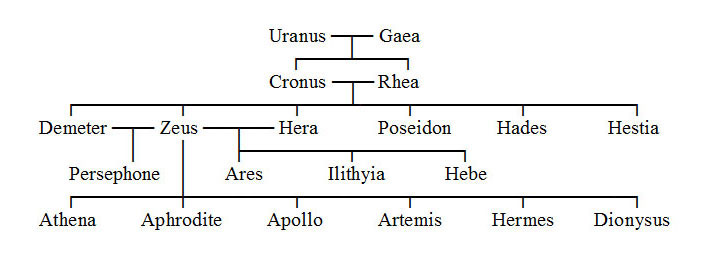
- Themis: The Titaness of divine law and order, Themis bore Zeus several children known as the Horae (the Hours) and the Moirai (the Fates), who are fundamental to the natural and moral order.
- Eurynome: Another Titaness, Eurynome and Zeus had the Charites (the Graces), who personify beauty, charm, and grace.
- Demeter: The goddess of agriculture and fertility, Demeter and Zeus had a daughter, Persephone, who became the queen of the underworld after her abduction by Hades.
- Mnemosyne: The Titaness of memory, Mnemosyne and Zeus had the nine Muses, who preside over the arts and sciences, inspiring creativity and knowledge.
- Leto: A Titaness and mother of the twin deities, Apollo and Artemis. Apollo is the god of the sun, music, and prophecy, while Artemis is the goddess of the moon and the hunt.
- Maia: One of the Pleiades, Maia and Zeus had a son, Hermes, the messenger god, who is also associated with commerce and thievery.
Children of Zeus and their roles in mythology
The progeny of Zeus are numerous and diverse, reflecting his interactions with both divine beings and mortals. Some of the most notable offspring include:
- Athena: Born from Zeus’s forehead, Athena is the goddess of wisdom, warfare, and strategy. She is a virgin goddess and one of the most respected deities in the Greek pantheon.
- Apollo: The god of the sun, music, and prophecy, Apollo is known for his oracular powers and artistic talents. He is often depicted with a lyre and associated with the Delphic Oracle.
- Artemis: The goddess of the hunt, wilderness, and childbirth, Artemis is a protector of the young and a virgin goddess, often depicted with a bow and arrows.
- Hermes: The messenger god, Hermes is also the god of commerce, thieves, and travel. Known for his speed and cunning, he is depicted with winged sandals and a caduceus.
- Dionysus: The god of wine, pleasure, and festivity, Dionysus represents the dual nature of wine—its capacity to bring both joy and madness. He is often depicted with grapevines and a thyrsus.
- Persephone: The daughter of Zeus and Demeter, Persephone is the queen of the underworld and a symbol of rebirth and the seasonal cycle, especially associated with springtime and growth.
- Heracles (Hercules): A demigod and hero, Heracles is renowned for his strength and for completing the Twelve Labors. He embodies the virtues of bravery and resilience.
- Ares: The god of war, Ares is the son of Zeus and Hera. He represents the brutal and chaotic aspects of warfare and is often depicted with armor and a spear.
- Hephaestus: The god of blacksmiths, fire, and craftsmanship, Hephaestus is the son of Zeus and Hera. Despite his physical imperfections, he is a master artisan.
These and other children of Zeus play crucial roles in Greek mythology, embodying virtues, talents, and flaws that reflect their divine parentage. They often interact with other gods and mortals, shaping epic tales of heroism, tragedy, and divine intervention.
Major myths and legends of Zeus
Zeus, as the central figure in Greek mythology, is associated with numerous compelling myths and legends that highlight his power, influence, and complex relationships with both mortals and other gods.
One of Zeus‘s notable exploits is his involvement in the Titanomachy, the epic battle where he led the Olympian gods in overthrowing the Titans, establishing his supremacy as king of the gods.
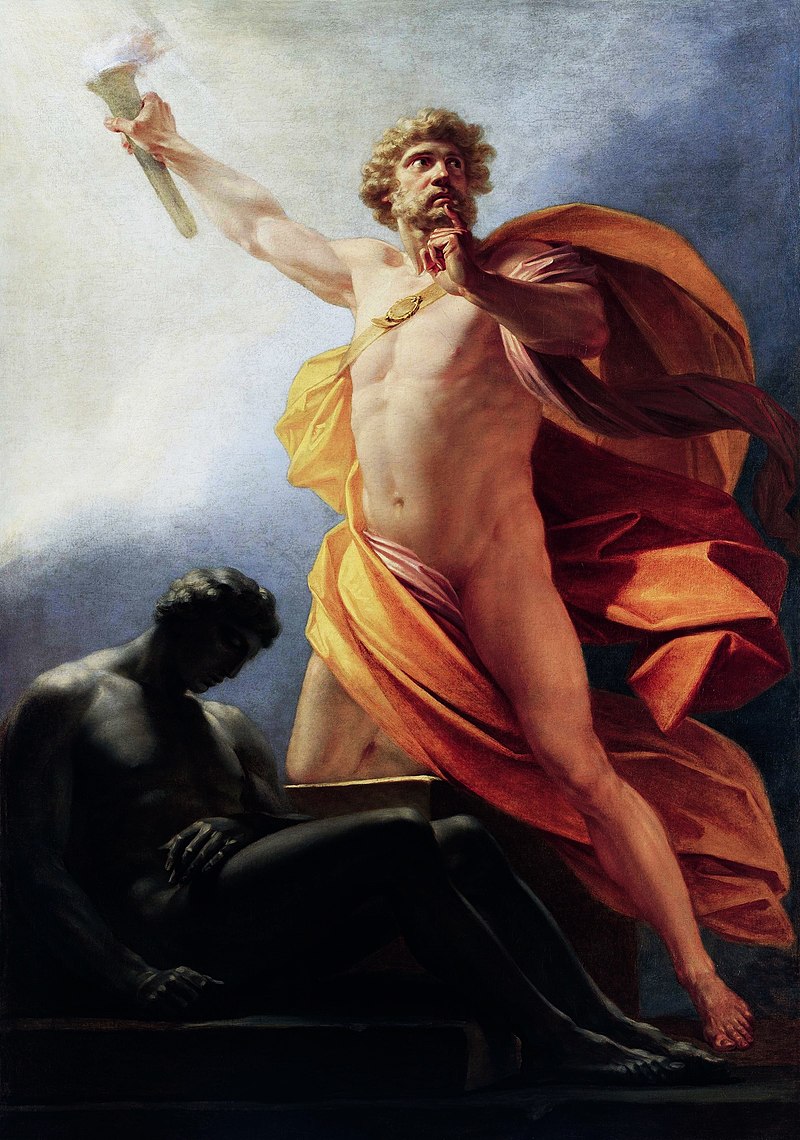
Prometheus figures prominently in Zeus’s myths, especially in the tale of how Prometheus stole fire from the gods to give to humanity. Zeus punished Prometheus harshly for this act of defiance, chaining him to a rock where an eagle would daily eat his liver, which regenerated every night due to his immortality.
Another compelling myth is the story of Semele, a mortal woman loved by Zeus. He appeared to her in his divine form, resulting in her request to see him in his full glory. Unable to withstand the brilliance of his true form, she perished, but Zeus rescued their unborn child, Dionysus, who became a god associated with wine, ecstasy, and theater.
Worship and festivals of Zeus
In ancient Greece, Zeus was revered as the supreme deity and king of the gods, with rituals, festivals, and temples dedicated to honoring his divine authority and benevolence.
Ancient Greek rituals and festivals dedicated to Zeus
Rituals honoring Zeus were integral to ancient Greek religious practices, emphasizing his role as the protector of justice and order. Offerings of food, wine, and animal sacrifices were made at altars dedicated to Zeus, seeking his favor and blessings for prosperity, fertility, and protection from natural calamities.
One of the most significant festivals dedicated to Zeus was the Olympic Games, held every four years at Olympia in honor of both Zeus and the spirit of athletic competition. Athletes from across the Greek world competed in various sports, viewing their participation as a form of devotion to Zeus and an opportunity to demonstrate physical prowess and honor the gods.
Temples and sanctuaries honoring Zeus across Ancient Greece
Throughout ancient Greece, Zeus was venerated in grand temples and sanctuaries that served as focal points for religious worship and civic pride. The most renowned of these was the Temple of Zeus at Olympia, one of the Seven Wonders of the Ancient World. This colossal temple housed a renowned statue of Zeus sculpted by Phidias, depicting him seated on a throne and holding a thunderbolt.
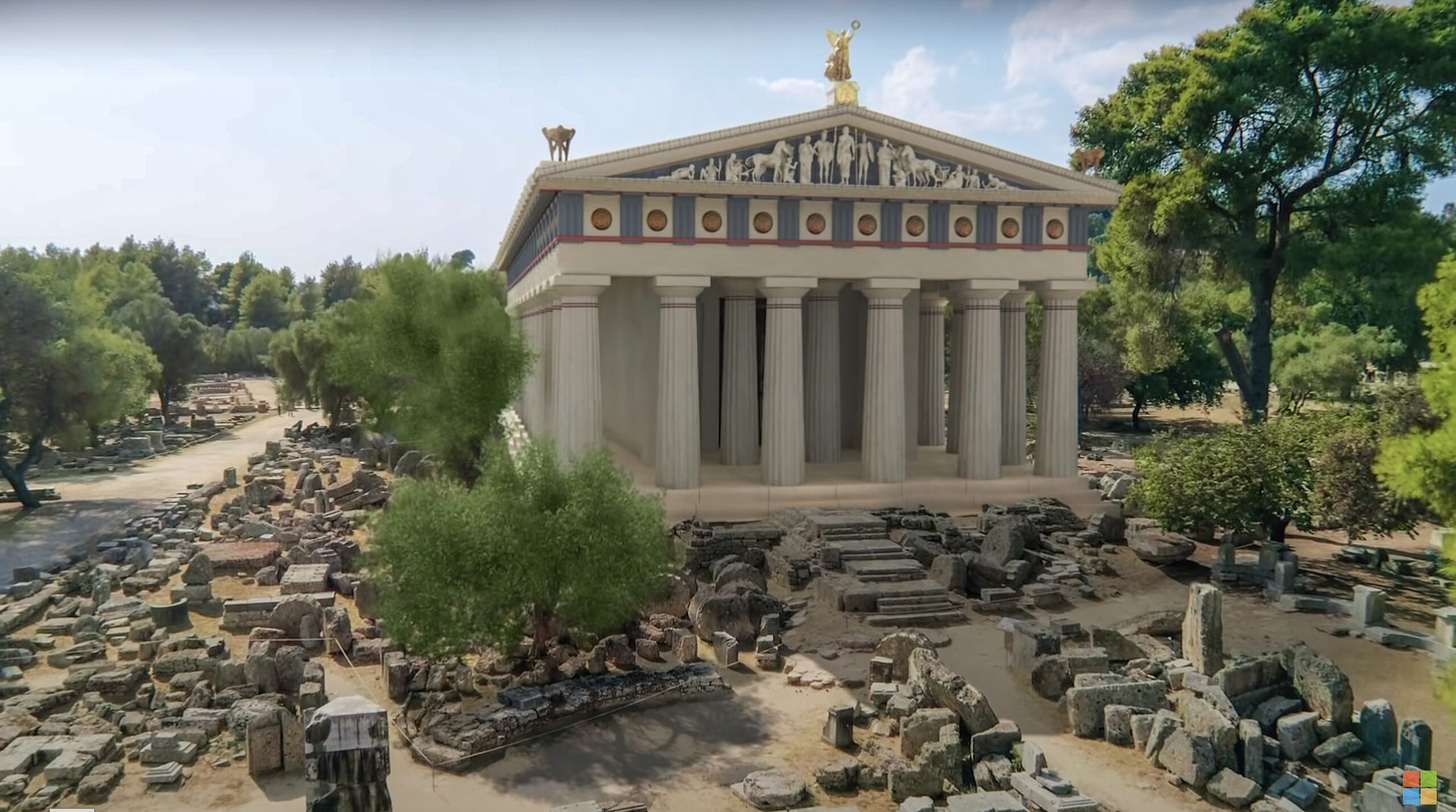
Other notable sanctuaries included the Temple of Zeus at Dodona, where an oracle interpreted the rustling of sacred oak trees as divine messages from Zeus, and the Temple of Zeus at Athens, symbolizing his importance as a protector of the city-state. In addition to formal temples, outdoor altars and shrines dedicated to Zeus were common throughout Greece, reflecting his ubiquitous presence in both urban centers and rural communities.
Legacy and influence of Zeus
The legacy of Zeus extends far beyond the confines of Greek mythology, influencing various cultures and religions throughout history. His transformation and adaptation in different contexts illustrate the enduring impact of his mythos and the universal appeal of his character.
Zeus in later cultures and religions
In Roman mythology, Zeus was assimilated as Jupiter, the king of the gods. Jupiter retained many of Zeus‘s characteristics, including his dominion over the sky and his role as the enforcer of justice and order. The worship of Jupiter paralleled that of Zeus, with temples and rituals dedicated to honoring his authority and seeking his divine favor. The Capitoline Temple in Rome, dedicated to Jupiter Optimus Maximus, was a central religious site, mirroring the grandeur of the Temple of Zeus at Olympia.
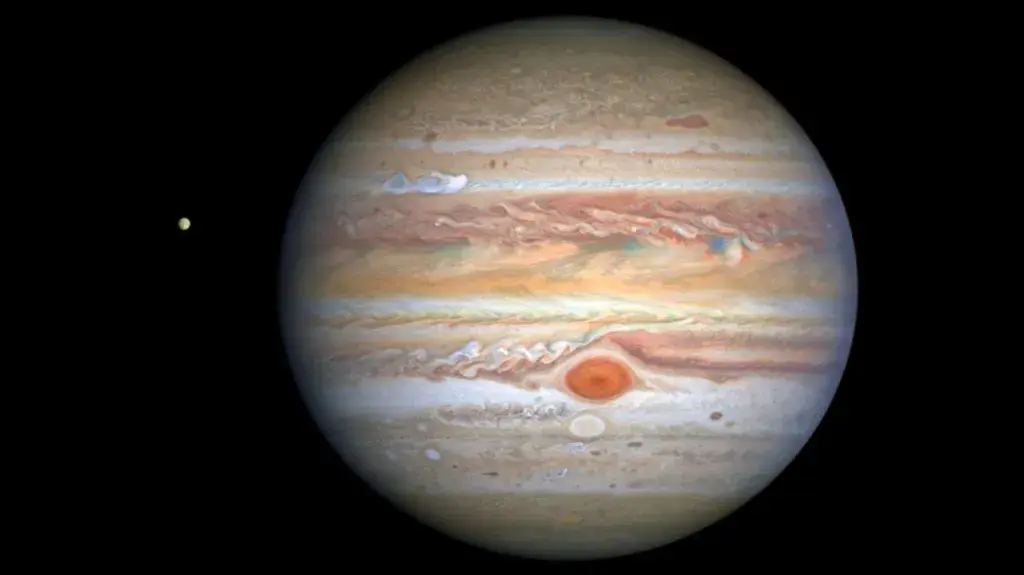
Beyond the Roman Empire, Zeus‘s influence can be seen in various aspects of Western culture, from Renaissance art to Enlightenment philosophy. His archetype as a powerful, yet fallible, ruler resonates with universal themes of authority, justice, and morality.
Literary and artistic representations of Zeus through history
Throughout history, Zeus has been a prolific subject in literature and art, symbolizing divine power and human aspiration. In ancient Greek literature, works like Homer’s “Iliad” and “Odyssey” depict Zeus as a central figure, orchestrating the fates of gods and mortals alike. These epic narratives underscore his complexity and multifaceted nature.
In classical art, Zeus was frequently depicted in statues, friezes, and vase paintings, showcasing his majestic presence and symbolic attributes, such as the thunderbolt and the eagle. The statue of Zeus at Olympia, created by Phidias, was a masterpiece of ancient sculpture, representing the pinnacle of artistic devotion to the god.
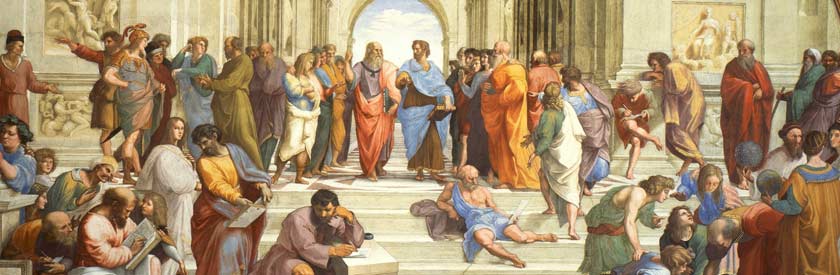
During the Renaissance, artists like Michelangelo and Raphael drew inspiration from classical depictions of Zeus to explore themes of power and divinity. Renaissance humanists saw in Zeus a reflection of their ideals, merging classical mythology with contemporary artistic and intellectual pursuits.
In modern times, Zeus continues to appear in various media, including literature, film, and popular culture. He symbolizes enduring themes of power, leadership, and the complexity of divine and human interactions. Contemporary interpretations often reimagine Zeus in ways that reflect current values and issues, demonstrating the timeless relevance of his mythology.
In conclusion, Zeus remains a quintessential figure in the pantheon of Greek gods and a symbol of divine authority and justice. His myths continue to captivate and resonate, reflecting timeless themes of power, love, and the interplay between gods and mortals. Through his enduring legacy, Zeus stands as a testament to the enduring allure and complexity of Greek mythology.
- DICTIONARY ENTRY Cartwright, M. (2013). Zeus. In World History Encyclopedia. [World History Encyclopedia]
- DICTIONARY ENTRY The Editors of Encyclopaedia Britannica. (n.d.). Zeus | Myths, Wife, Children, & Facts. In Encyclopedia Britannica. [Encyclopedia Britannica]
- WEBSITE Gill, N. (2019, October 29). What you need to know about the Greek God Zeus. ThoughtCo. [ThoughtCo]
- WEBSITE Hayward, L. (2024, January 10). Who is Zeus? The king of the Greek gods. TheCollector. [TheCollector]
- WEBSITE Abideen, Z. U. (2023, December 11). Zeus – The Supreme God of Greek Mythology. MythoHub. [MythoHub]
- WEBSITE Greek Mythology. (n.d.). ⚡ Zeus: Greek God of the Sky and Thunder, King of the Gods. Greek Mythology. [G. Mythology]
- WEBSITE Theoi Greek Mythology. (n.d.). ZEUS – Greek God of the sky, King of the Gods. Theoi Greek Mythology. [Theoi]
APA 7: TWs Editor. (2024, June 19). Zeus: The King of Greek Gods. PerEXP Teamworks. [Article Link]


