



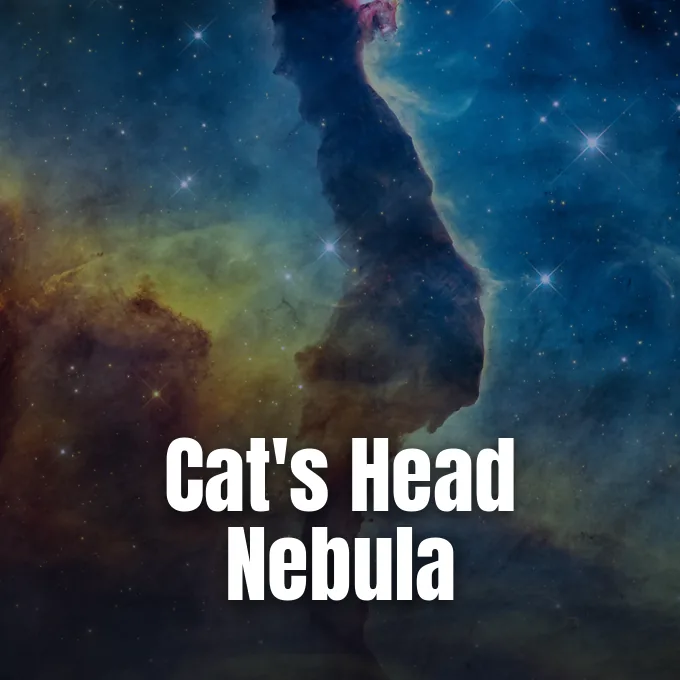
NASA and ESA have released new observations of a star-forming cloud nicknamed the Cat’s Head Nebula, located roughly 7,500 light-years from Earth within the Carina Nebula. Visible and infrared cameras aboard the Hubble Space Telescope and the James Webb Space Telescope recorded this cosmic scene from complementary vantage points [1]. Astronomers rely on these paired views to learn how powerful starlight and stellar winds sculpt cold molecular clouds into temporary shapes during star birth [2].
The Feline Silhouette in Carina
The Cat’s Head Nebula forms a small, select sector within the vast Carina Nebula, an expansive star-forming territory in the southern sky where giant stars live and die. When seen from ground and orbital observatories, the dense pillar takes on the uncanny appearance of a cat sitting with its back turned away from Earth while its head looks to the right. A single bright knot shines as the eye. Visual patterns in interstellar dust often inspire informal animal names, including research examining why the Giraffe Nebula looks like an animal in space. In the Carina cloud, dense dust knots happen to align into a silhouette that catches the eye, creating a sharp boundary where cold dust meets glowing ionized gas [1]. Astronomers observe Carina because cold dust and ionized gas interact along the pillar’s boundary.
The feline shape is only a temporary arrangement in the long life of the nebula. As massive stars inside Carina evolve and unleash powerful winds, their radiation will erode the gas until the entire feature breaks apart and disperses into interstellar space. Webb previously resolved unusual dust geometry when Webb observed the dusty Cat’s Tail in the Beta Pictoris system during separate exoplanet disk research. Yet Carina hosts an active stellar nursery [2].

Why Cat’s Head Nebula Resists Erosion
The Cat’s Head Nebula endures because different parts of the cloud respond unevenly to intense stellar feedback. Massive stars inside the Carina Nebula release fierce torrents of ultraviolet radiation and fast stellar winds. Outward radiation pressure blows away lighter gas. In contrast, the feline-shaped pillar continues to stand because its interior consists of much denser molecular gas and dust that can resist this harsh erosion, at least for now. Heavy dust stays anchored in place. NASA and ESA researchers find that such dense pillars protect newly forming stellar embryos nested deep inside their cores [1].
Constant ultraviolet bombardment triggers an erosion mechanism called photoevaporation. Energetic ultraviolet light from nearby hot stars in Carina impinges on the perimeter of the pillar, heating the cold gas until it literally boils away into surrounding space. A ridge of hazy yellow follows the right side of the dark filament, marking where ultraviolet rays illuminate and ionize the gas edge [3].
Hubble Visible Light Observations
The NASA and ESA Hubble Space Telescope surveyed the region in visible wavelengths using its WFC3 camera. The main filament looks like an opaque, dark brown pillar of cosmic dust that blocks background starlight. Fine dust grains absorb and scatter optical light waves. This creates a stark silhouette that stretches from the bottom of the field toward the top right corner against the luminous glow of surrounding gas. Hubble filtered incoming light to isolate emissions from ionized oxygen, hydrogen, and sulfur atoms under high-energy stellar illumination, painting the surrounding nebulosity in a vivid gradient of color [1].
Blue and cyan tones glow near the top of the frame where energized oxygen emits light under heavy radiation. Toward the bottom of the view, colors shift gradually into yellow, orange, and red as emissions from hydrogen and sulfur blend with starlight scattered by dust grains in Carina [2].
Hubble also spotted an intriguing feature right at the feline head. A glowing red eye shines near the upper tip of the dark pillar, hinting at a newborn star still wrapped inside a dense cocoon of dust. Optical wavelengths can’t pierce through thick dust blankets, so NASA and ESA observatories see only a faint reddish glimmer leaking out into space. By recording how light scatters along the pillar’s edges, astronomers at Goddard and STScI can estimate how deeply newborn stars sit inside their maternal dust clouds. Optical mapping confirms that star birth continues within the pillar despite intense external erosion [1].


Webb Infrared Views Through Dust
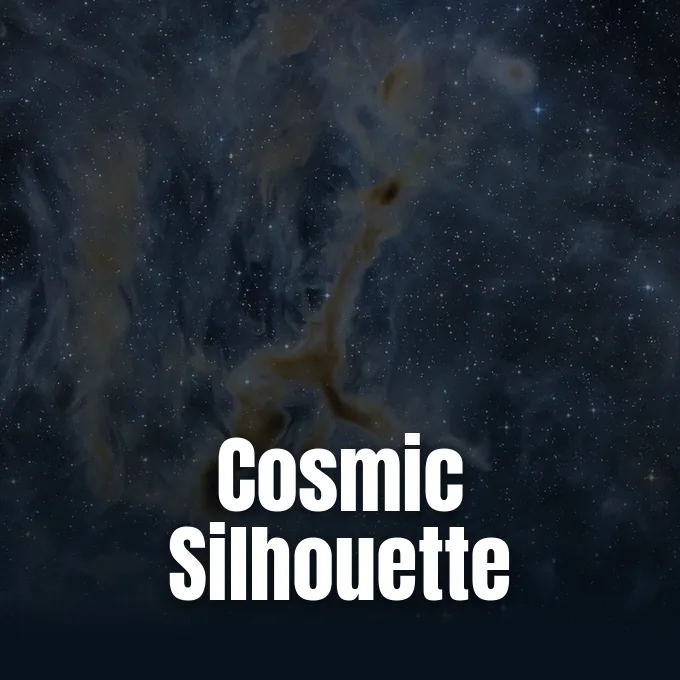
The James Webb Space Telescope observes the universe in deep infrared wavelengths. Its sensitive NIRCam detectors peer through the thick dust that blocked Hubble. Because infrared light waves are longer than optical waves, they pass through small dust particles without scattering, allowing astronomers to trace fine surface folds and interior density changes across the semi-transparent filament. Ghostly wisps drift along the cat’s left side. These delicate structures face stellar winds head-on. The near-infrared perspective from Webb reveals a dense field of stars that remained invisible in optical data, with blue and yellow stars crowding the cosmic background [1].
The cat’s glowing eye stays conspicuous in near-infrared light, confirming that an infant star sits inside the upper head. Near the cat’s belly, Webb detected a faint jet-like feature that suggests material is actively shooting outward from another newborn star buried nearby in the Carina dust [3].
Webb’s sharp NIRCam optics also captured several distant background galaxies peeking through thin gaps in the cosmic dust. Seeing remote galaxies through a star-forming cloud inside our own Milky Way shows the clarity of near-infrared instruments. These deep cosmic views provide two layers of discovery in one frame: detailed insights into local star birth inside Carina, paired with remarkable glimpses of ancient galaxies located billions of light-years behind the nebula. By comparing infrared star counts with optical maps, NASA and ESA astronomers determine how many stars are forming inside the pillar versus how many belong to the background Milky Way [1].

Cat’s Head Nebula Chemical Composition
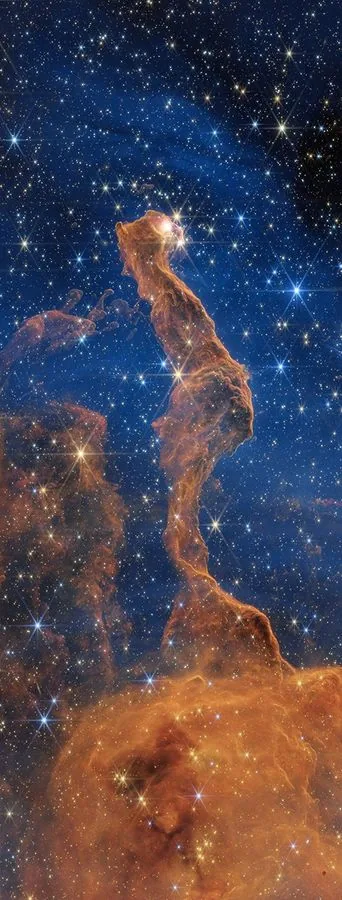
Webb’s Mid-Infrared Instrument (MIRI) maps a completely different layer of the Cat’s Head Nebula by tracking emission from warm dust and carbon compounds. While near-infrared light passes through cold dust to show stars, MIRI captures the gentle glow of dust grains warmed by nearby stellar radiation in Carina. Mid-infrared views bring out intricate globules, curled filaments, and wispy threads along the left side of the pillar that look completely dark in optical images. Changes in brightness and color reveal how conditions shift across different sectors of the nursery. The MIRI data isolates emissions from polycyclic aromatic hydrocarbons, known as PAHs [1].
These soot-like carbon molecules absorb starlight and re-emit energy in bluish and greenish bands. European Space Agency (ESA) researchers explained that color variations across the pillar do not merely trace temperature differences. Instead, these colors reflect shifts in PAH abundance, dust continuum emissions, and the strength of local starlight hitting different faces of the gas pillar in Carina [3].
To the right of the main pillar, mid-infrared observations by Webb spot a bright yellow point of light resting against an expansive background of reddish glowing gas. NASA and ESA astronomers interpret this bright source as an infant star embedded inside a dense mantle of dust. A narrow filament appears to cross right over the source, but current data can’t determine whether the filament and star are physically connected or merely aligned along the same sightline. By comparing MIRI data with Hubble visible-light frames, scientists can test star formation models against real stellar nurseries. The combined data reveals how chemical compounds and dust grains interact as newborn stars take shape in Carina [1].
International Teams Behind the Telescopes
Complementary Hubble and Webb observations show the power of long-term international scientific cooperation. The Hubble Space Telescope has operated for more than three decades, shaping our fundamental understanding of the cosmos. Hubble is a joint project between NASA and ESA. Flight operations are managed by NASA’s Goddard Space Flight Center in Greenbelt, Maryland, with ongoing day-to-day assistance from aerospace manufacturer Lockheed Martin Space. Scientific operations are conducted in Baltimore by the Space Telescope Science Institute (STScI), which the Association of Universities for Research in Astronomy (AURA) manages on NASA’s behalf [2].
The James Webb Space Telescope continues this collaborative heritage as a joint endeavor between NASA, ESA, and the Canadian Space Agency (CSA). ESA oversaw the telescope’s launch into space aboard an Ariane 5 rocket procured through Arianespace. Working with international partners, ESA was responsible for qualifying Ariane 5 adaptations for the flight. European teams built the NIRSpec spectrograph and supplied 50 percent of the Mid-Infrared Instrument (MIRI). A consortium of nationally funded European institutes designed MIRI in partnership with NASA’s Jet Propulsion Laboratory (JPL) and the University of Arizona [3].
- ONLINE NEWS NASA’s Goddard Space Flight Center. (2026). Ghostly Cat’s Head Nebula lurks within sight of NASA’s Hubble, Webb. Phys.org. [Article Link]
- PRESS RELEASE McCoy, M., NASA Hubble Mission Team, & NASA Webb Mission Team. (2026). Ghostly Cat’s Head Nebula Lurks Within Sight of NASA’s Hubble, Webb. NASA Science. [Article Link]
- PRESS RELEASE European Space Agency. (2026). Ghostly Cat’s Head Nebula lurks within sight of Hubble and Webb. ESA Science & Exploration. [Article Link]
APA 7: PerEXP Teamworks. (2026, October 30). Hubble and Webb Capture Ghostly Cat’s Head Nebula. PerEXP Teamworks. https://perexpteamworks.com/en/cats-head-nebula-hubble-webb/


