






NASA designed the Perseverance rover to explore Jezero Crater on Mars, investigate past habitability, and cache core samples for future laboratory study on Earth. Touchdown occurred on February 18, 2021, at 3:55 p.m. EST after a 203-day flight traversing 293 million miles (472 million kilometers) from Cape Canaveral Space Force Station in Florida [6]. Former acting NASA Administrator Steve Jurczyk noted that the arrival marked a major step for planetary science. The 2,263-pound (1,026-kilogram) robotic explorer builds upon earlier Mars rover design and origins while introducing an autonomous navigation coprocessor, a rotary percussive coring drill, and an internal sample handling system to store Martian rock cores inside sterile titanium canisters.
- How Nuclear Power Warms the Perseverance Rover
- Redesigned Wheels for the Perseverance Rover
- Dual Computers for AutoNav Autonomous Driving
- The Robotic Arm and Coring Turret
- How the Sample Caching System Works
- Perseverance Rover Cameras and Environmental Sensors
- Oxygen Production With the MOXIE Instrument
- Hardware Twins in the JPL Mars Yard
How Nuclear Power Warms the Perseverance Rover
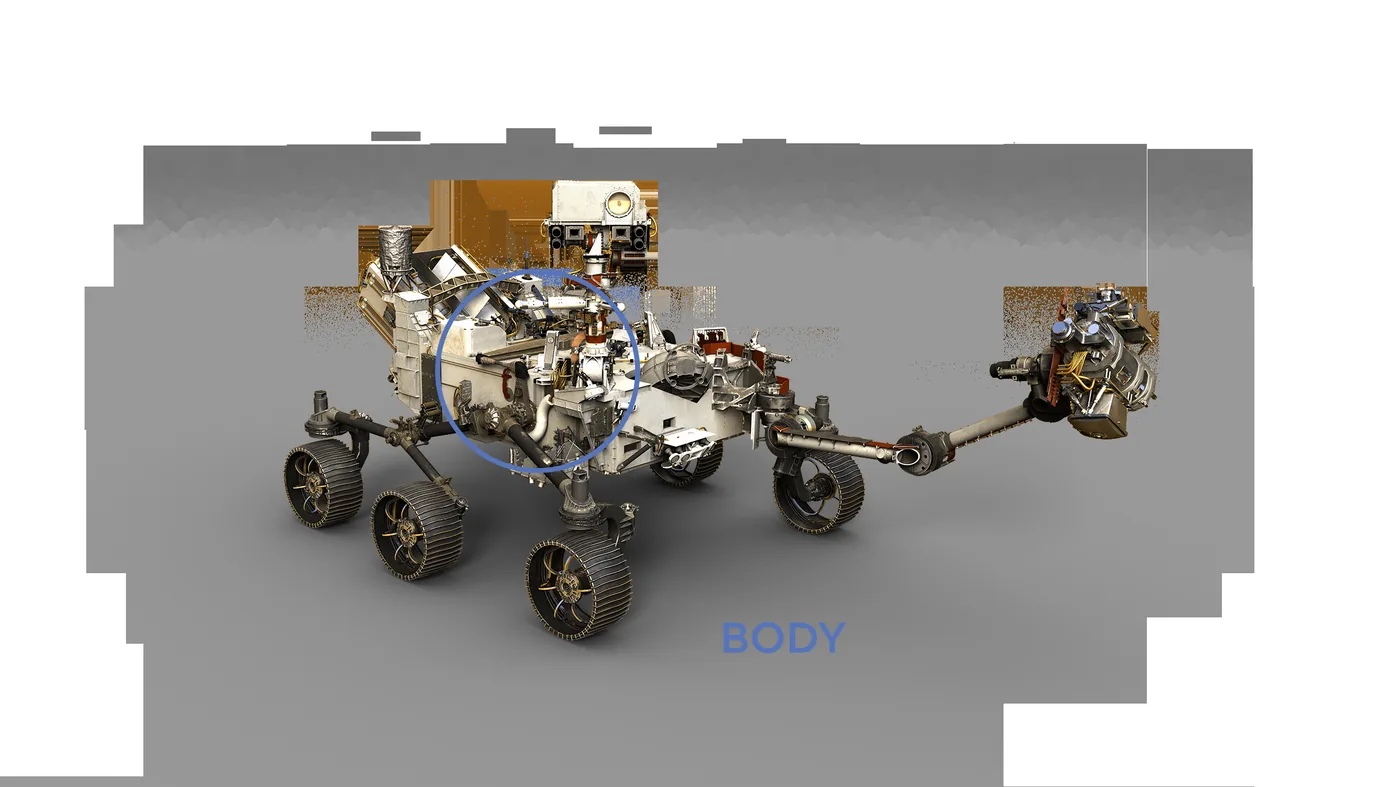
Electrical power and operational heating originate in a Multi-Mission Radioisotope Thermoelectric Generator, or MMRTG, provided by the U.S. Department of Energy. Mounted at the rear of the rover chassis, this 45-kilogram power source contains 4.8 kilograms of plutonium-238 oxide that produces steady decay heat while thermocouples generate approximately 110 watts of electrical power at launch [10]. That electrical current charges two 43-amp-hour lithium-ion batteries that supply peak current during drill cycles and traverse maneuvers. Plutonium-238 decays with an 87.7-year half-life. That steady output protects the vehicle from the dust accumulation that crippled older solar rovers during harsh Martian winters.
Electrical power represents only a fraction of the output because radioactive decay releases roughly 2,000 watts of thermal energy. Mars surface temperatures drop to -123 degrees Celsius during winter nights and climb to 38 degrees Celsius during summer days in Jezero Crater [1]. Sensitive electronics freeze without supplementary heating. The nuclear core provides that warmth.
Engineers at the Jet Propulsion Laboratory created the Mechanically Pumped Fluid Loop Rover Heat Rejection System, known as the RHRS, to distribute that thermal energy. Heat exchanger plates positioned near the MMRTG capture radiant heat and pump fluid through tubes inside the Warm Electronics Box, or WEB, keeping computers and science hardware between -40 degrees and 50 degrees Celsius [1]. When daytime skies warm the chassis, outer radiator panels vent surplus thermal energy into the atmosphere.
Redesigned Wheels for the Perseverance Rover
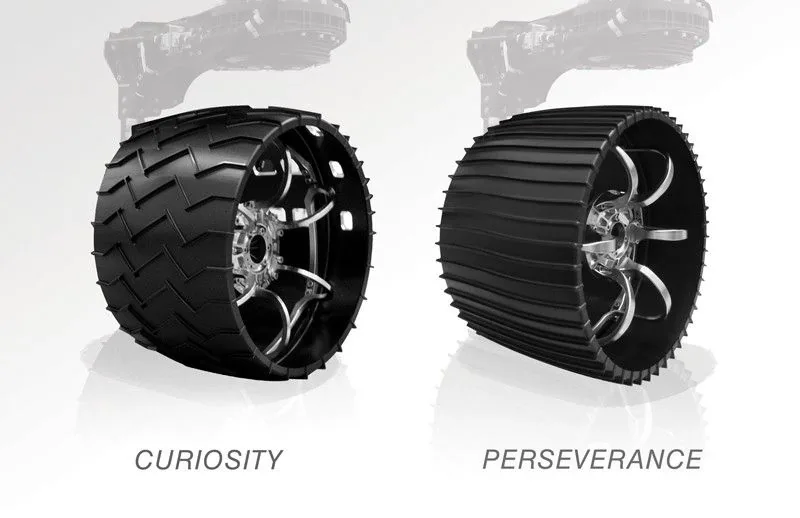
Traversing Jezero Crater requires wheels that can withstand sharp bedrock without puncturing. When the Curiosity rover explored Gale Crater, jagged ventifacts punched tears in its aluminum skins, prompting NASA and JPL engineers to redesign the mobility system for the Mars 2020 mission [11]. Perseverance rides on six flight wheels machined from solid blocks of flight-grade aluminum, measuring 20.7 inches (52.5 centimeters) in diameter. Each wheel skin is nearly a millimeter thicker than Curiosity hardware. The rims connect to central hubs through curved titanium spokes that flex over stones to absorb mechanical shock.
Surface traction relies on 48 gently curved cleats, or grousers, machined into the outer face of each wheel. These 48 curved treads replace the 24 chevron treads used on Curiosity, providing superior grip in soft sand and across slippery rock faces [11]. One wheel revolution moves the rover 65 inches (1.65 meters) across the ground. The maximum travel speed on flat ground reaches 0.1 miles per hour, or 152 meters per hour.
A rocker-bogie suspension system connects the running gear to the central chassis without springs. A differential pivot on the top deck connects the left and right rockers, allowing the vehicle to climb over rocks measuring 15.75 inches (40 centimeters) high while maintaining wheel contact on all six points [8]. Four steering motors on the corner wheels allow the vehicle to swerve, make arcing turns, or rotate in place a full 360 degrees.
Dual Computers for AutoNav Autonomous Driving
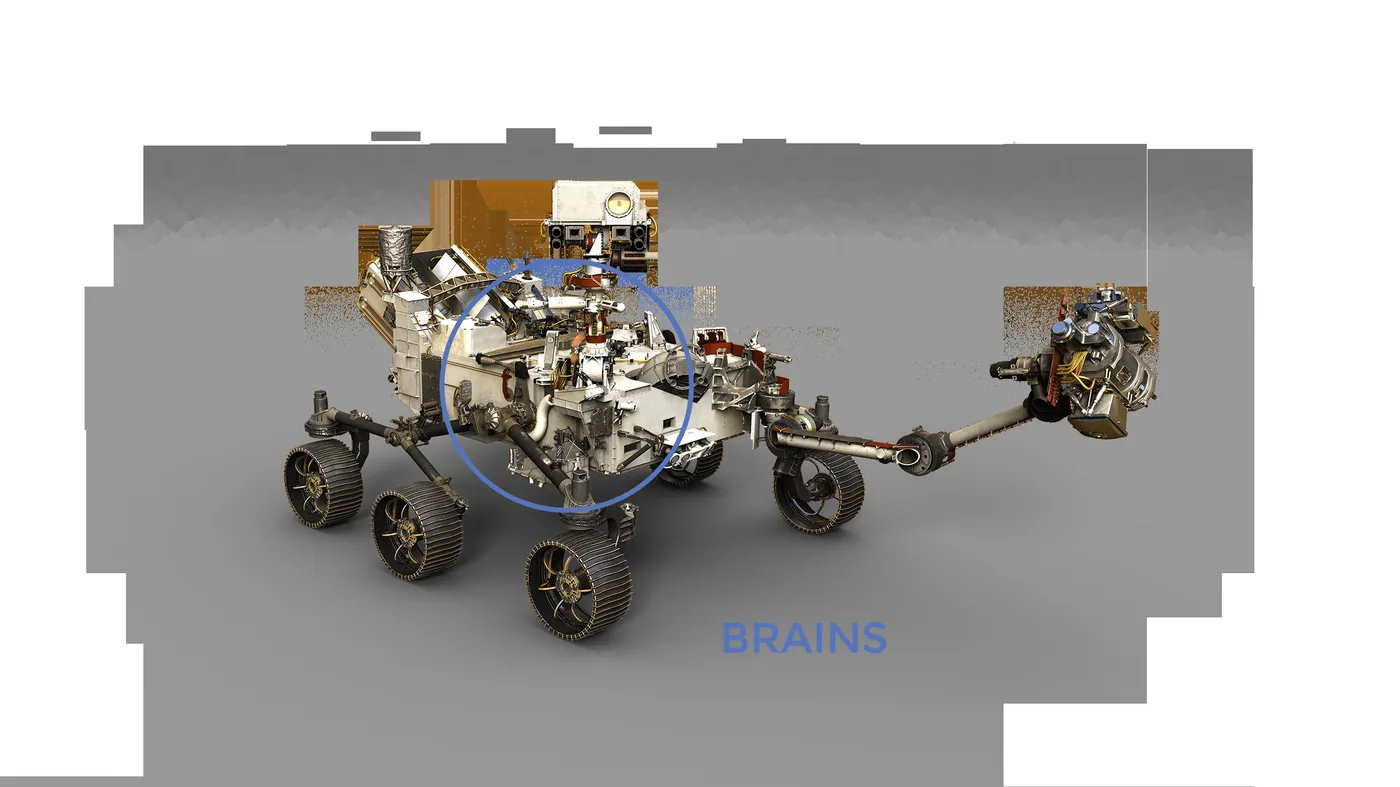
Computing tasks take place inside the Warm Electronics Box using the Rover Compute Element, or RCE. Processing relies on a radiation-hardened BAE Systems RAD750 processor based on PowerPC 750 architecture that runs at speeds up to 200 megahertz [8]. The computer uses 2 gigabytes of flash memory, 256 megabytes of dynamic RAM, and 256 kilobytes of EEPROM running the VxWorks operating system written in C. To guard against deep-space radiation upsets, JPL installed two identical RCE units side by side. One computer directs daily science operations while the redundant backup sleeps, ready to boot if primary hardware detects an anomaly.
An Inertial Measurement Unit, or IMU, provides 3-axis positional data to track pitch, roll, and yaw angles. The IMU estimates tilt angles so the vehicle avoids slopes steeper than 30 degrees, well below its 45-degree theoretical tipping limit [8]. This inertial sensor feeds data into navigation algorithms during autonomous drives.
Autonomous navigation software called AutoNav maps terrain in real time using 3D stereo imagery from mast cameras. AutoNav evaluated 88% of the 17.7 kilometers driven during the first Martian year, achieving a single-day run of 347.7 meters and driving 699.9 meters without human intervention [2]. On October 11, the rover’s odometer passed 28.10 miles (45.22 kilometers) in Jezero Crater, rolling past the previous planetary record of 28.06 miles (45.16 kilometers) established by NASA’s Opportunity rover between 2004 and 2018. That achievement set a new off-world driving distance record for any wheeled robotic vehicle.
The Robotic Arm and Coring Turret
A five-jointed robotic arm measuring 2.1 meters (6 feet 11 inches) extends from the front of the rover frame. The arm manipulates a 45-kilogram turret equipped with scientific sensors, inspection cameras, and a heavy rotary percussive coring drill designed to sample bedrock [10]. While Curiosity ground rocks into dust for onboard wet chemical analysis, Perseverance cuts intact cylindrical cores roughly the size of classroom chalk. The percussive drill hammers and rotates hollow bits into outcrops, collecting pristine rock cylinders while minimizing cross-contamination from Earth-derived organic residues.
The turret carries the Planetary Instrument for X-ray Lithochemistry, known as PIXL, which was developed under principal investigator Abigail C. Allwood. PIXL focuses an X-ray beam measuring 120 micrometers in diameter onto target rocks, identifying elemental chemistry on sand-sized grains in 10 seconds [5]. Over several hours of scanning, PIXL produces postage-stamp-sized elemental maps that geologists correlate with microscopic rock textures.
Mounted alongside PIXL is the SHERLOC instrument, which combines an ultraviolet laser with the WATSON color camera to detect organic molecules and mineral alterations. Before drilling, the arm uses a gas dust removal tool to clear loose debris from rock surfaces [8]. The drill then cores into the outcrop to secure a clean geological specimen.


How the Sample Caching System Works
Inside the front section of the rover belly rests the Sample Caching System, which functions as an interconnected robotic factory. While a traditional Swiss chronometer uses fewer than 400 components, this sample collection assembly contains more than 3,000 precision parts, including custom gearboxes, sensors, and actuators [9]. “For us to collect the first samples of Mars for return to Earth, in place of two astronauts we have three robots that have to work with the precision of a Swiss watch,” said JPL chief engineer Adam Steltzner. The rover stores 43 titanium sample tubes inside its chassis.
The sample collection process begins when the turret docks its drill chuck with a receiver cone on the bit carousel. Shaped like a saucer mounted on the front of the rover, the bit carousel transfers empty sample tubes to the drill and retrieves filled tubes for internal processing [9]. JPL test lead Kelly Palm confirmed that testing this transfer mechanism required drilling diverse rock types on Earth to prepare for unusual Martian geometries.
Inside the Adaptive Caching Assembly, a 0.5-meter robotic arm called the Sample Handling Assembly, or T. rex arm, grasps the filled tube. The small arm carries the tube to an optical imaging station, inserts a depth rod at the volume assessment station, and places the canister into a sealing mechanism that hermetically caps the container [9]. These sealed canisters safeguard lakebed core samples until a future joint NASA-ESA Mars Sample Return campaign can retrieve them from Jezero Crater.

Perseverance Rover Cameras and Environmental Sensors
Perseverance carries 19 cameras that produce panoramic imagery and guide daily traverse routes across Mars. Mounted on the Remote Sensing Mast two meters above the surface, the dual Mastcam-Z cameras provide stereoscopic 3D color imaging with a 4:1 optical zoom [4]. Mastcam-Z resolves fine rock textures measuring 0.7 millimeters from two meters away and detects 3.3-centimeter objects at 100 meters [3]. Beside Mastcam-Z, the SuperCam sensor fires a pulsed laser at rock targets up to seven meters away, reading chemical vapor with an infrared spectrometer and recording acoustic impact snaps with an onboard microphone.
Nine engineering cameras manage ground operations, including two mast Navcams and six chassis HazCams. Four forward HazCams and two rear HazCams provide a 136-degree field of view to spot trenches and sand dunes [4]. Inside the belly workspace, an engineering camera called Cachecam photographs rock cores inside sample tubes at a resolution of 12.5 microns per pixel.
Two microphones on the rover capture the acoustic profile of the Red Planet. One microphone sits on the SuperCam mast while another recorded sounds during entry, descent, and landing [4]. Acoustic analysis showed that sound velocity drops in the thin, cold carbon dioxide atmosphere compared to Earth, muffling high-frequency tones over short distances [10].
Oxygen Production With the MOXIE Instrument
Housed inside the right side of the rover chassis is the Mars Oxygen In-Situ Resource Utilization Experiment, known as MOXIE. Because the Martian atmosphere consists of 96% carbon dioxide, future human expeditions must produce oxygen locally to breathe and to fuel ascent vehicles [7]. Lifting four astronauts from Mars into orbit requires approximately 55,000 pounds (25 metric tons) of oxygen and 15,000 pounds (7 metric tons) of propellant. Transporting that quantity from Earth is impractical. MOXIE was developed by principal investigator Michael Hecht of the MIT Haystack Observatory to convert local atmospheric gas into pure oxygen.
The toaster-sized instrument draws in atmospheric gas, compresses it, and heats it to 800 degrees Celsius (1,470 degrees Fahrenheit) through solid oxide electrolysis [7]. The device uses 3D-printed nickel alloy manifolds, lightweight aerogel insulation, and an exterior gold coating that reflects infrared heat away from sensitive computers. The chemical reaction strips oxygen atoms from carbon dioxide molecules, exhausting carbon monoxide into the atmosphere.
During its first trial on April 20, 2021, MOXIE produced 5.37 grams of oxygen in one hour [10]. Across multiple runs through different seasons, the instrument generated 122 grams of oxygen, demonstrating a rate of up to 10 grams per hour [7]. Trudy Kortes, director of technology demonstrations within NASA’s Space Technology Mission Directorate, emphasized that producing oxygen locally proves key concepts for human exploration.
Hardware Twins in the JPL Mars Yard
Operating a robotic explorer millions of miles from Earth requires rigorous physical testing before commands are uplinked to Mars. At the Jet Propulsion Laboratory in Pasadena, California, engineers maintain an Earth-bound engineering twin named Optimism [13]. Optimism stands for Operational Perseverance Twin for Integration of Mechanisms and Instruments Sent to Mars. The full-scale test bed matches the mass, dimensions, computing boards, and rocker-bogie mobility of the flight rover. In the outdoor Mars Yard, drivers steer Optimism over rocky slopes to validate software patches before uploading flight sequences to Jezero Crater.
Thermal protection during interplanetary arrival required specialized flight hardware tested on Earth. The heat shield that protected Perseverance during its 12,000-mile-per-hour atmospheric entry was manufactured by Fiber Materials Inc., or FMI, in Biddeford, Maine [12]. Made from phenolic-impregnated carbon ablator, or PICA, the shield withstood extreme aerodynamic friction reaching 2,400 degrees Fahrenheit (1,320 degrees Celsius) [10].
“A lot of people were happy when it touched the ground, I was happy when the parachute came out,” said Mark Lippold, program manager at Fiber Materials Inc [12]. With its nuclear power system, autonomous driving algorithms, and sample caching hardware, Perseverance continues to explore Jezero Crater while setting engineering standards for future interplanetary missions.
- CONFERENCE PAPER Bhandari, P., Birur, G. C., Bame, D., Mastropietro, A. J., Karlmann, P., Liu, Y., & Miller, J. (2013). Performance Of The Mechanically Pumped Fluid Loop Rover Heat Rejection System Used For Thermal Control Of The Mars Science Laboratory Curiosity Rover On The Surface Of Mars. 43rd International Conference on Environmental Systems. [Article Link]
- ACADEMIC JOURNAL Verma, V., Maimone, M. W., Gaines, D. M., Francis, R., Estlin, T. A., Kuhn, S. R., Rabideau, G., Chien, S., McHenry, M., Graser, E., Rankin, A. L., & Thiel, E. R. (2023). Autonomous robotics is driving Perseverance rover’s progress on Mars. Science Robotics, 8(80), eadi3099. [Article Link]
- ACADEMIC JOURNAL Bell, J. F., Maki, J. N., Mehall, G. L., Ravine, M. A., Caplinger, M. A., Bailey, Z., Brylow, S. M., Schaffner, J. A., Kinch, K. M., Madsen, M. B., Winhold, A., Hayes, A. G., Corlies, P., Tate, C., Barrington, M., Cisneros, E., Jensen, E. H., Paris, K., Crawford, K.,. Deen, R. (2021). The Mars 2020 Perseverance Rover Mast Camera Zoom (Mastcam-Z) Multispectral, Stereoscopic Imaging Investigation. Space Science Reviews, 217(1), 24. [Article Link]
- ACADEMIC JOURNAL Maki, J. N., Gruel, D., McKinney, C., Ravine, M. A., Morales, M. J., Lee, D., Willson, R. G., Copley-Woods, D., Valvo, M., Goodsall, T. M., McGuire, J., Sellar, R. G., Schaffner, J. A., Caplinger, M. A., Shamah, J. M., Johnson, A., Ansari, H., Singh, K., Litwin, T. E.,. Basset, C. (2020). The Mars 2020 Engineering Cameras and Microphone on the Perseverance Rover: A Next-Generation Imaging System for Mars Exploration. Space Science Reviews, 216(8), 137. [Article Link]
- ACADEMIC JOURNAL Allwood, A. C., Wade, L. A., Foote, M. C., Elam, W. T., Hurowitz, J. A., Battel, S., Dawson, D. E., Denise, R. W., Ek, E. M., Gilbert, M. S., King, M. E., Liebe, C. C., Parker, T., Pedersen, D. A. K., Randall, D. P., Sharrow, R. F., Sondheim, M. E., Allen, G., Arnett, K.,. Zimmerman, B. (2020). PIXL: Planetary Instrument for X-Ray Lithochemistry. Space Science Reviews, 216(8), 134. [Article Link]
- PRESS RELEASE NASA. (2021). Touchdown! NASA’s Mars Perseverance Rover Safely Lands on Red Planet. NASA News Release. [Article Link]
- PRESS RELEASE NASA. (2021). NASA’s Perseverance Mars Rover Extracts First Oxygen from Red Planet. NASA News Release. [Article Link]
- WEBSITE Lindsey, L. (2024). Rover Components. NASA Science. [Article Link]
- WEBSITE Greicius, A. (2020). The Extraordinary Sample-Gathering System of NASA’s Perseverance Mars Rover. NASA. [Article Link]
- WEBSITE Wikipedia contributors. (2026). Perseverance (rover). Wikipedia, The Free Encyclopedia. [Article Link]
- ONLINE NEWS Wehner, M. (2020). NASA’s Perseverance Rover Got Some Sweet New Wheels. BGR. [Article Link]
- ONLINE NEWS Meyer, M. (2021). Biddeford company creates critical part for Mars rover ‘Perseverance’ to land safely. WGME. [Article Link]
- ONLINE NEWS Kooser, A. (2020). Meet the NASA Perseverance Mars rover’s Earth doppelgänger, Optimism. CNET. [Article Link]


