





Content delivery networks operate as distributed groups of proxy servers that store temporary file copies close to visitors, shrinking the travel path between client browsers and host machines. An origin server in the United Kingdom might host application data, while an edge node in the United States answers American visitors to avoid oceanic transit delays [4]. When web hosts charge companies for origin bandwidth, serving static files from edge caches cuts expenses and keeps host machines online during traffic surges.
- How Content Delivery Networks Distribute Edge Servers
- DNS Steering and Anycast Routing
- Cache Hits and Freshness Rules
- Why Page Speed Shapes Search Visibility
- Image Optimization Through Content Delivery Networks
- Free Infrastructure for Shared JavaScript Libraries
- Origin Protection Against Denial Attacks
- Why Interconnected CDNs Share Traffic
How Content Delivery Networks Distribute Edge Servers
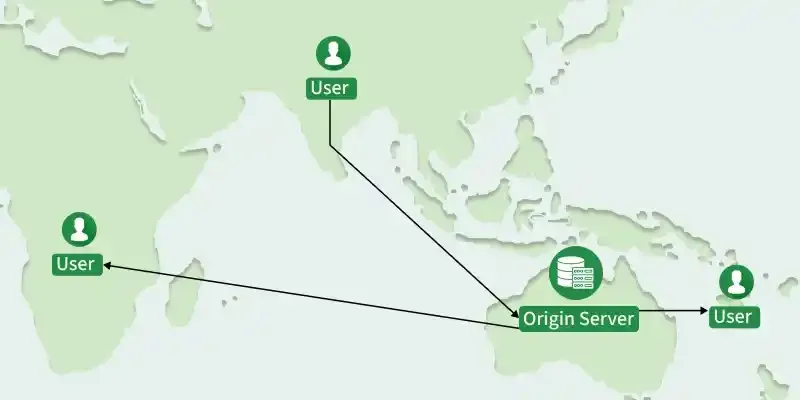
The architecture of a Content Delivery Network CDN separates the central origin host from distributed edge nodes. An origin server in the United States holds primary application files, codebases, and databases. When a user in India requests a video from an American platform, routing that request to a local Indian cache node avoids transatlantic round trips. The All-in-One Learning Portal GeeksforGeeks notes that a Point of Presence, or PoP, houses clusters of edge servers inside a target city data center. Edge locations PoPs store cached copies so users do not traverse international fiber paths. CDN DNS resolvers map incoming visitor queries to optimal PoPs based on network health and latency, so edge nodes answer common read requests to achieve reduced origin load [1].
When a user in Singapore loads assets from an origin server in Virginia, data packets travel 15,000 kilometers in each direction across undersea routes. Fiber lines transmit signals at roughly 200,000 km per second, producing 150 ms of pure travel latency over a 30,000-kilometer round trip [7].
Edge deployments emerged in the late 1990s as web adoption boomed and central host machines struggled with traffic spikes. Commercial network providers like Akamai Technologies pay telecom operators to place cache hardware inside carrier facilities and Internet Exchange Points (IXPs) to build a shared delivery layer for publishers [14]. Edge nodes do not replace origin hosting environments, because they only store temporary copies of files rather than running core database transactions.
DNS Steering and Anycast Routing
Guiding user traffic to the closest node depends on two core network routing technologies. Under standard DNS steering, a visitor queries an address like cdn.example.com, and an authoritative name server checks the client IP to return a nearby PoP address. If a visitor in London requests a file, the system returns a British node instead of an American server. However, recursive resolvers cache DNS responses according to a configured TTL, meaning routes cannot adapt instantly to live congestion, and queries from users with distant public resolvers may route to overseas facilities with higher round-trip delays [7].
Many providers now rely on Anycast routing to bypass DNS resolver limitations. With Anycast, hundreds of edge servers announce the same IP address through Border Gateway Protocol (BGP) routing tables, so core internet routers naturally direct packets along the shortest network path to the nearest available facility. If a single node experiences hardware failure, BGP routes automatically converge on the next closest available data center without requiring any manual client reconfiguration or software updates [6].
Placing edge hardware at Internet Exchange Points, or IXPs, cuts transit hops. At an IXP, network operators link switches to trade traffic without third-party fees. Edge servers on an IXP switch deliver cached data to consumer broadband networks in milliseconds [7].
Cache Hits and Freshness Rules
Every user interaction at the edge initiates a rapid storage lookup. When an edge server holds a valid asset, it logs a cache hit and delivers the file instantly without contacting the origin host, whereas a cache miss forces the node to fetch that resource across the network from the primary backend server. Static assets like CSS stylesheets, JavaScript bundles, vector icons, and web fonts make ideal caching candidates because their bytes remain identical between consecutive visitor sessions. Dynamic responses that contain private shopping carts or account balances bypass edge storage to protect personal user data [2]. Engineers configure caching policies on the control plane to specify which file extensions stay in memory and which routes require real-time origin authentication.
System efficiency hinges on the cache hit ratio, where well-architected web platforms strive to answer 95 percent or more of incoming requests from edge memory so that only a tiny fraction of requests ever reach origin hardware. Operators achieve high hit ratios by configuring normalized cache keys that strip irrelevant query parameters like utm_source from asset URLs [7]. Consequently, visitors requesting the same image with different tracking tags share one stored object rather than initiating duplicate origin downloads.

Freshness headers instruct edge nodes how long an object remains valid. Origins send HTTP headers like Cache-Control with max-age values, or use ETags for conditional If-None-Match checks [7]. To shield backends during cold misses, providers deploy origin shields where a central PoP consolidates requests before querying the host [5]. Fastly Instant Purge eliminates outdated files across edge servers within milliseconds.
Why Page Speed Shapes Search Visibility
Kevin Rowe reported in Search Engine Journal that e-commerce sites loading within two seconds achieve the highest sales conversion rates. Every extra second of loading latency between zero and five seconds drops conversion rates by an average of 4.42%. Bounce rates follow a similar steep curve: pages that load in one second average a 7% bounce rate, rising to 11% at three seconds and reaching 38% at five seconds [3]. Fast load times keep shoppers from abandoning retail carts. Brian Jackson from KeyCDN explains that canonical headers prevent duplicate content issues when search bots crawl edge copies. When retailers fail to optimize delivery latency, prospective buyers abandon product pages in favor of competing online stores.
Search engine ranking algorithms treat page responsiveness as a major quality signal. Google created Core Web Vitals to measure user experience, designating an optimal threshold for Largest Contentful Paint (LCP) at under 2.5 seconds. First Input Delay (FID) must stay below 100 milliseconds, and visual stability scores (CLS) must remain under 0.1 to avoid search visibility penalties [3]. Edge caching delivers HTML, stylesheet, and image bytes in tens of milliseconds, giving mobile browsers sufficient headroom to complete critical rendering milestones before timeouts hit.
Slow page response times erode customer loyalty. Fastly reported that sites taking five seconds to load suffer three times worse conversion rates than sites loading in one second [5]. A report from Cisco estimated that global caching networks would carry 72% of all internet traffic [3].
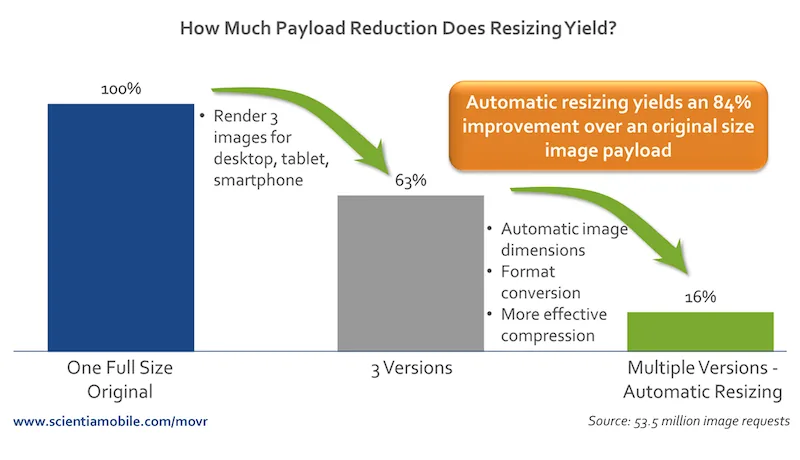


Image Optimization Through Content Delivery Networks
Research from Radware revealed that the average e-commerce page exceeds 1.3 MB, with pictures making up 64% of that total payload. Writing in Smashing Magazine, Jon Arne Sæterås observed that standard responsive breakpoints with three fixed sizes leave many mobile devices downloading oversized desktop graphics [9]. Inefficient media sizing consumes mobile bandwidth and slows down catalog pages that display dozens of product thumbnails. Hand-crafting multiple image resolutions at build time creates huge storage bloat for media teams. Automated edge networks compress graphics before delivery to eliminate manual maintenance overhead.
Mobile hardware variety makes fixed breakpoints obsolete. A ScientiaMobile experiment found that an image needs only eight user requests to exceed three predefined responsive breakpoints. Edge engines like ImageEngine resize graphics dynamically, cutting data payloads by up to 84% [9].
Automated media delivery at the edge removes friction for software engineers. Engineering teams can deploy self-managed open-source solutions like Thumbor, used by Square, 99designs, and Wikipedia, or use managed vendor APIs. web.dev contributors Jeremy Wagner, Katie Hempenius, and Barry Pollard explain that these systems evaluate User-Agent strings and Save-Data headers to return lightweight WebP or AVIF formats to compatible browsers while providing JPEG fallbacks to older clients [10]. Dynamic image conversion delivers 40% to 80% file size reductions without manual export workflows.

Free Infrastructure for Shared JavaScript Libraries
Open-source script networks provide acceleration for developers who do not operate proprietary caching fleets. Cody Arsenault detailed how public delivery services distribute frontend frameworks and CSS tools to global visitors without fees. The jsDelivr platform serves more than 2,100 open libraries across 110 PoP locations, utilizing capacity donated by Cloudflare, KeyCDN, and Stackpath [11]. Web authors insert a script tag pointing to the network address instead of storing common framework files on origin servers. When thousands of independent web properties reference the exact same script address, visitor browsers pull the compiled file from local disk cache, completely eliminating repeated network downloads. This shared caching architecture allows open-source projects to deliver high availability without paying expensive server bills.
The cdnjs platform catalogs over 2,900 open-source libraries for one million web properties. Google Hosted Libraries serves core frameworks like jQuery with Timing-Allow-Origin headers, while Microsoft Ajax CDN supplies legacy builds [11].
Data from W3Techs illustrates the scale of public script networks on the web. While 77% of surveyed sites host scripts on their own origin machines, cdnjs powers 11.0% of all websites, capturing 47.9% of the JavaScript delivery market. JsDelivr runs on 8.9% of websites with a 38.6% market share, while Google Hosted Libraries serves 6.8% of sites [12]. Delegating shared libraries to public edge servers eliminates billions of redundant asset requests from origin infrastructure each year.
Origin Protection Against Denial Attacks
Edge clusters function as an absorbing shield against volumetric online threats. Distributed Denial of Service (DDoS) floods attempt to overwhelm origin DNS resolvers or application servers with artificial traffic waves. Fastly reported that major denial of service incidents cost victim organizations an average of $408,000 per attack. Spreading incoming requests over hundreds of globally distributed edge nodes dilutes flood volume, letting edge firewalls drop bad packets before they reach core hosting hardware [5].
Loading scripts from third-party hosts creates supply chain security vulnerabilities. If an adversary compromises a remote storage bucket and alters a script file, client browsers will run that modified code inside visitor sessions. MDN Web Docs explains that Subresource Integrity, or SRI, neutralizes this vector by checking cryptographic hashes inside HTML tags using sha256, sha384, or sha512 algorithms [8]. Browsers compute the hash of the downloaded script and refuse to execute any file whose cryptographic digest fails to match the expected value.

Security architectures must balance privacy protections with threat mitigation. In an academic survey in IEEE Communications Surveys & Tutorials, M. Ghaznavi and colleagues documented how attackers manipulate proxy layers and exploit edge vulnerabilities [17]. Compliance constraints also define edge routing; for example, a German court ruled in 2021 that routing a university site through a US-headquartered edge provider breached GDPR rules by exposing visitor IP addresses [14]. Edge operators deploy Web Application Firewalls (WAF) and local data rules to keep sensitive traffic compliant.
Why Interconnected CDNs Share Traffic
Individual providers face physical constraints where establishing private facilities is cost-prohibitive. Content delivery network interconnection, or CDNI, establishes standardized interfaces that permit distinct platforms to exchange traffic on behalf of content providers. An authoritative upstream CDN (uCDN) redirects user requests to a downstream partner CDN (dCDN) that operates closer to the user equipment. Interconnected CDNs broaden geographic footprints, absorb sudden traffic surges without massive hardware expenditures, and guarantee consistent quality of experience for mobile users across different carrier networks [15].
Broadband telecommunications providers have deployed telco networks deep inside consumer access networks. Because telecommunications operators own the last-mile cables connected to customer homes, deep caching reduces data volumes across general transit lines. Enterprise platforms often configure dynamic multi-provider architectures that balance live traffic between Akamai Technologies, Cloudflare, Amazon CloudFront, Fastly, Google Cloud CDN, BunnyCDN, CDN77, EdgeNext, and Cisco Qwilt [14]. Multi-CDN switching ensures continuous uptime if one provider experiences an outage.
Academic research continues to explore edge placement algorithms as edge computing and cloud paradigms evolve. In a research survey published in ACM Computing Surveys, B. Zolfaghari and co-authors noted that commercial content delivery networks often move faster than academic formalization in lifecycle management and edge coordination. Emerging designs explore peer-assisted offloading where client nodes share file segments with edge servers, as well as virtualized nodes running on cloud hypervisors [16]. By pairing distributed edge caches, intelligent request routing, and dynamic media optimization, content delivery networks ensure that global web applications load quickly and reliably. These integrated technologies reduce origin strain while providing predictable response times to millions of concurrent internet users worldwide.
- WEBSITE GeeksforGeeks. (2020). Content Distribution Network (CDN). [Article Link]
- WEBSITE GeeksforGeeks. (2024). Content Delivery Network (CDN) in System Design. [Article Link]
- ONLINE NEWS Rowe, K. (2021). Content Delivery Network (CDN): What It Is & How It Works. Search Engine Journal. [Article Link]
- WEBSITE Susnjara, S., & Smalley, I. (2024). What Is a Content Delivery Network (CDN)? IBM. [Article Link]
- WEBSITE Fastly. (2025). How a content delivery network works. [Article Link]
- WEBSITE Sandwell, E. (2026). How Content Delivery Networks (CDNs) Actually Work. Digital Infrastructure Explained. [Article Link]
- WEBSITE Singh, A. (2026). CDN System Design: How Content Delivery Networks Work. Ajit Singh – Software Engineering Blog. [Article Link]
- WEBSITE MDN Web Docs. (2026). Subresource Integrity. [Article Link]
- ONLINE NEWS Sæterås, J. A. (2017). Let The Content Delivery Network Optimize Your Images. Smashing Magazine. [Article Link]
- WEBSITE Wagner, J., Hempenius, K., & Pollard, B. (2013). Use image CDNs to optimize images. web.dev. [Article Link]
- ONLINE NEWS Arsenault, C. (2017). Top 4 CDN services for hosting open source libraries. Opensource.com. [Article Link]
- WEBSITE W3Techs. (2026). Usage statistics and market shares of JavaScript content delivery networks. [Article Link]
- ONLINE NEWS Rubant, G. (2017). CDN: Was Sie über Content Delivery Networks wissen müssen. Computerwoche. [Article Link]
- WEBSITE Wikipedia. (n.d.). Content delivery network. [Article Link]
- WEBSITE Wikipedia. (n.d.). Content delivery network interconnection. [Article Link]
- ACADEMIC JOURNAL Zolfaghari, B., Srivastava, G., Roy, S., Nemati, H., Afghah, F., Koshiba, T., Razi, A., Bibak, K., Mitra, P., & Rai, B. K. (2020). Content Delivery Networks. ACM Computing Surveys, 53(2), 1-34. [Article Link]
- ACADEMIC JOURNAL Ghaznavi, M., Jalalpour, E., Salahuddin, M. A., Boutaba, R., Migault, D., & Preda, S. (2021). Content Delivery Network Security: A Survey. IEEE Communications Surveys & Tutorials, 23(4), 2166-2190. [Article Link]


