





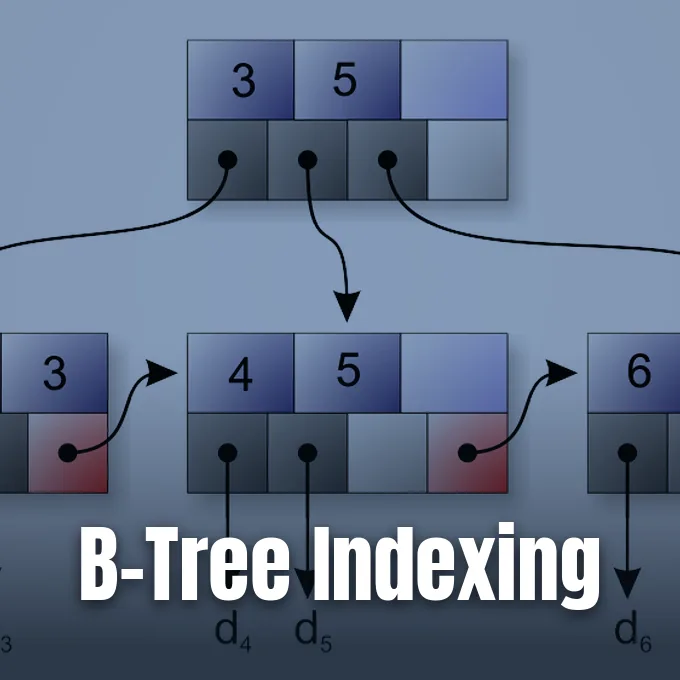
Database engines rely on multiway search trees to handle high volumes of records stored on block devices. When software engineers evaluate B-Tree vs B+ Tree architectures for high-throughput database engines, the core design choice centers on whether records sit inside interior nodes or stay confined entirely to leaf blocks. Standard B-trees store keys and record pointers inside every node. In contrast, B+ trees restrict all record storage to leaf nodes and connect those leaves in sequence, so range scans never need to climb back toward the root [7].
What Is a B-Tree?
Computer scientists Rudolf Bayer and Edward McCreight created the B-tree at Boeing Scientific Research Labs in July 1970. Their first report addressed an urgent bottleneck in managing large random-access index files. In 1972, Rudolf Bayer and Edward McCreight published their index structure in Acta Informatica, establishing a multiway search tree that balances logarithmic lookup speed with physical block constraints [9].
The letter B sparked debate. Douglas Comer wrote in Computing Surveys volume 11, issue 2, page 123 in June 1979 that the authors never officially explained what the letter means. Suggested names include balanced, broad, bushy, Boeing, and Bayer. McCreight said in an interview that he and Rudy Bayer discussed balance and Boeing at lunch, but Bayer was the senior author. Paul Black documented this origin at NIST [1].
Donald Knuth defined a B-tree of order m as a tree where each non-root node has at least ceil(m/2) children and at most m children (where m is the order). What made this multiway layout so practical for hardware engineers? Binary search trees branch only two ways at each comparison step, creating tall hierarchies that trigger frequent disk reads on secondary storage. In Scholarpedia, Rudolf Bayer described the UB-tree as a multidimensional extension of this concept. Because one disk read loads an entire node containing dozens or hundreds of keys into memory, the tree stays shallow and limits input operations during deep index searches in large enterprise datasets [8].
How B-Tree vs B+ Tree Node Layouts Differ
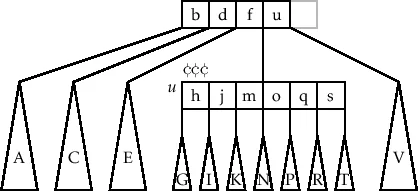
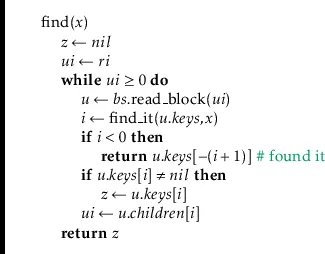
Node layout marks the main difference. In a standard B-tree, interior nodes hold search keys and direct pointers to data records. When an engine searches for value 4 and finds that key inside the root node, it retrieves the record at once without descending into lower child blocks [9].
A B+ tree adopts an alternate design by moving user records out of upper levels. Interior nodes store only separator keys (keys and child pointers) to guide search paths down the tree. Rudolf Bayer wrote in Scholarpedia that when a leaf node splits in a B+ tree, the middle element stays in the right sibling while its key value copies up into the parent node. Leaf nodes store all data records, so the bottom level holds the full dataset [7].
Connecting every leaf node in a linked list gives the B+ tree a major advantage. In a B-tree, non-leaf nodes separate subtrees, so reading consecutive items forces the engine to travel back up through parent nodes to find neighboring keys. The Open Data Structures project showed that leaf links let software walk from one sorted block to the next. Because leaf nodes form an unbroken chain, reading sequential records needs finding the first leaf through tree search and following sibling links through disk blocks without revisiting upper index levels [8].
Storage Capacity and Tree Height
Removing data payloads from non-leaf nodes expands the fan-out of each index page. A database block usually measures 4096 bytes on storage drives. When an interior node stores only four-byte integer keys and eight-byte child pointers, it packs hundreds of navigation entries into a single disk page [7].
Higher branching factors keep tree depth shallow. The Open Data Structures text showed that if an interior node holds two hundred child pointers, a tree of height three can index millions of distinct entries. In a standard B-tree, storing data records next to keys in upper nodes shrinks the number of child pointers per block. That smaller fan-out forces the tree to grow taller and triggers extra disk reads [8].
In Foundations and Trends in Databases, G. Graefe wrote that upper levels of a B+ tree fit easily into memory caches. Because interior nodes consume only a small fraction of the total index footprint, database engines pin root and first-level nodes into memory. Descending through three levels of routing keys touches cached memory pages almost exclusively, so only the target leaf block must come from disk or solid-state storage [10]. Even with billions of records, disk reads stay low.
Why Range Queries Favor B+ Trees
Relational query engines run range scans whenever a query requests data between two bounds. In a B+ tree, linked leaves streamline this workload. Once the search finds the lower bound leaf, the storage engine reads contiguous blocks by following next-pointers (from lowest to highest key) without ascending back up through interior nodes [7].
In a survey of database indexing, G. Graefe showed that B-tree range queries must perform an in-order tree walk. That traversal jumps between leaf pages and parent nodes to gather sequential records. This vertical movement increases CPU cache misses and generates scattered page requests on storage drives. Write-heavy database workloads often compare these multiway trees with LSM trees and write-heavy storage engines that turn random writes into sequential disk operations. For range filtering, the contiguous leaf chain of the B+ tree delivers faster throughput [10].
Sequential page reading also matches the hardware mechanics of storage drives and kernel page caches. Operating systems read blocks ahead when they detect linear address access patterns. Because B+ tree leaf chains group sibling nodes into neighboring physical sectors, disk controllers stream rows with minimal head movement on mechanical drives and maximum bus saturation on solid-state devices. A standard B-tree cannot match this streaming efficiency because its records stay scattered through non-leaf levels of the tree hierarchy [9].


B-Tree vs B+ Tree Operations in Real Workloads
Single-key lookups present a distinct trade-off when evaluating B-Tree vs B+ Tree performance. In a standard B-tree, point lookups can terminate early if the requested search key sits in the root or an upper node. A lookup for value 4 resolves in one disk read when that key sits in the root block [8].
In a B+ tree, every single-key lookup travels from the root down to the leaf level because interior nodes hold only separators. While this eliminates early search termination, it produces uniform response times across all read queries. Folk and Zoellick pointed out that consistent path lengths simplify performance modeling in database engines. Deletions also proceed with less friction in B+ trees because removing a record only alters leaf content. When an interior key serves as a separator, it can stay in place even after its exact data record is deleted, which avoids node rebalancing in parent nodes [9].
Node insertion follows similar balancing rules in both tree types, but the consequences of splitting differ. In both designs, inserting a key into a full node with 2k elements causes it to split into two sibling nodes holding k elements each (at least half full), pushing one key up to the parent. The Open Data Structures reference showed that an underflow during deletion requires borrowing keys from a sibling or merging two half-full nodes into a single block. G. Graefe observed that because B+ tree interior nodes store only compact routing values, cascading splits occur less often than in B-trees with bulky payload entries [10].

Concurrency and Node Locking
Concurrent multi-threaded access introduces synchronization overhead when reader and writer threads traverse the same index tree. On GitHub, the Btree-source-code project explored high-concurrency B-tree implementations in C, reducing page slots to 16 or 32 bits. The implementation used test-and-set latches in early pages and explored multi-root configurations to relieve thread contention at the root node during concurrent database transactions [3].
In ACM Transactions on Database Systems, G. Graefe, H. Kimura, and H. Kuno introduced Foster B-trees in 2012 to address concurrent scaling. Foster B-trees combine concurrency optimizations from B-link trees with flash memory architectures. By restructuring how split nodes adopt neighboring child ranges, Foster B-trees minimize concurrency control overhead without imposing restrictive transactional locking schemes on write workloads. Their design allows large writes on flash devices while preserving fast read performance and verified structural invariants [10].
Hardware shifts toward non-volatile main memory prompted further design innovations in B+ tree architectures. S. Chen and Q. Jin studied persistent memory indexing in the Proceedings of the VLDB Endowment in 2015, showing that traditional logging techniques incur severe CPU cache flush overhead. To solve this problem, they designed write-atomic B+ trees (wB+-trees) that employ small indirect slot arrays and bitmaps. This design allows thread updates without shifting keys inside leaf nodes, which cuts writes to non-volatile memory and keeps tree structures recoverable after sudden power failures [12].
Modern Variants Across Operating Systems
Kernel architects have adapted tree structures to solve memory management bottlenecks inside operating systems. In the Linux kernel, developers Liam Howlett and Matthew Wilcox designed the maple tree to replace red-black trees and linked lists for tracking virtual memory areas (VMAs). Liam Howlett submitted this major subsystem overhaul in a patch set containing 70 patches to remove lock contention around mmap_lock [4].
Marta Rybczynska reported in LWN.net that the maple tree is a range-based B-tree variant tailored for processor cache lines. Each node fits inside 256 bytes (with branching factors of 10 and 16), holding up to sixteen elements in leaf nodes and ten elements in non-leaf nodes. The tree offers a Normal API and an Advanced API, where a freshly initialized tree contains a NULL pointer for range 0 to ULONG_MAX. Kernel documentation from Liam Howlett explains that maple trees operate in read-copy-update (RCU) mode, allowing multiple readers to search ranges concurrently without blocking writer tasks. Kernel developer Davidlor supported the transition and said that academic research showed outstanding scalability for RCU-aware tree structures [5].
File system designers also rely heavily on balanced tree architectures to safeguard storage integrity. Developers O. Rodeh, J. Bacik, and C. Mason created BTRFS as a Linux filesystem centered on copy-on-write B-trees. In ACM Transactions on Storage, O. Rodeh described how copy-on-write trees maintain data integrity across solid-state drives and traditional platters by preventing in-place overwrites. Modern storage layers also combine balanced search indexes with Merkle trees for cryptographic data verification to detect block corruption on disks [11].
Choosing Between B-Tree vs B+ Tree Architectures
Software engineers match tree architectures to query patterns. A classic B-tree works best when memory is tight and queries focus primarily on individual random keys. In the PuTTY terminal client, developers implemented counted B-trees to support text editor buffers, which supports fast cursor movements and numeric index lookups in logarithmic time [2].
For relational databases and storage engines where range scans dominate daily workloads, the B+ tree is standard. Rudolf Bayer said that prefix compression in B+ trees reduces routing key sizes by storing only the shortest distinguishing prefixes in parent nodes. While prefix B-trees prune common key fragments within index pages, specialized systems often evaluate trie data structures for fast string storage and retrieval when searching variable-length text keys. In general database indexing, the combination of high fan-out and linked leaf nodes gives B+ trees an enduring speed advantage [7].
The balance between B-Tree vs B+ Tree designs reflects how hardware drives data organization. When Rudolf Bayer and Edward McCreight first sketched their multiway tree at Boeing in 1970, they recognized that minimizing disk input and output operations determined system responsiveness. Decades later, whether handling virtual memory areas in the Linux kernel or managing billions of rows in enterprise tables, these tree structures continue to anchor data management. Database developers match their index selection to access patterns, so they weigh single-key lookups against sequential range scans to build reliable storage engines [10].
- DICTIONARY ENTRY Black, P. E. (2024). B-tree. In P. E. Black (Ed.), Dictionary of Algorithms and Data Structures. National Institute of Standards and Technology. [Article Link]
- WEBSITE Counted B-Trees. (2017). Chiark Greenend. [Article Link]
- WEBSITE Malbrain, K. (2013). Btree-source-code: High-concurrency B-tree source code in C. GitHub. [Article Link]
- ONLINE NEWS Rybczynska, M. (2021). Introducing maple trees. LWN.net. [Article Link]
- WEBSITE Howlett, L. R. (2026). Maple Tree. Linux Kernel Organization. [Article Link]
- ONLINE NEWS Howlett, L. R. (2022). Introducing the Maple Tree. LWN.net. [Article Link]
- ACADEMIC JOURNAL Bayer, R. (2008). B-tree and UB-tree. Scholarpedia, 3(11), 7742. [Article Link]
- BOOK CHAPTER Morin, P. (2008). B-Trees. In Open Data Structures (Python ed.). [Article Link]
- WEBSITE Wikipedia contributors. (2026). B-tree. Wikipedia, The Free Encyclopedia. [Article Link]
- ACADEMIC JOURNAL Graefe, G. (2011). Modern B-Tree Techniques. Foundations and Trends in Databases, 3(4), 203-402. [Article Link]
- ACADEMIC JOURNAL Rodeh, O., Bacik, J., & Mason, C. (2013). BTRFS: The Linux B-Tree Filesystem. ACM Transactions on Storage, 9(3), 1-32. [Article Link]
- ACADEMIC JOURNAL Chen, S., & Jin, Q. (2015). Persistent B + -trees in non-volatile main memory. Proceedings of the VLDB Endowment, 8(7), 786-797. [Article Link]
Cover image: Wikimedia Commons, CC BY-SA 3.0


