



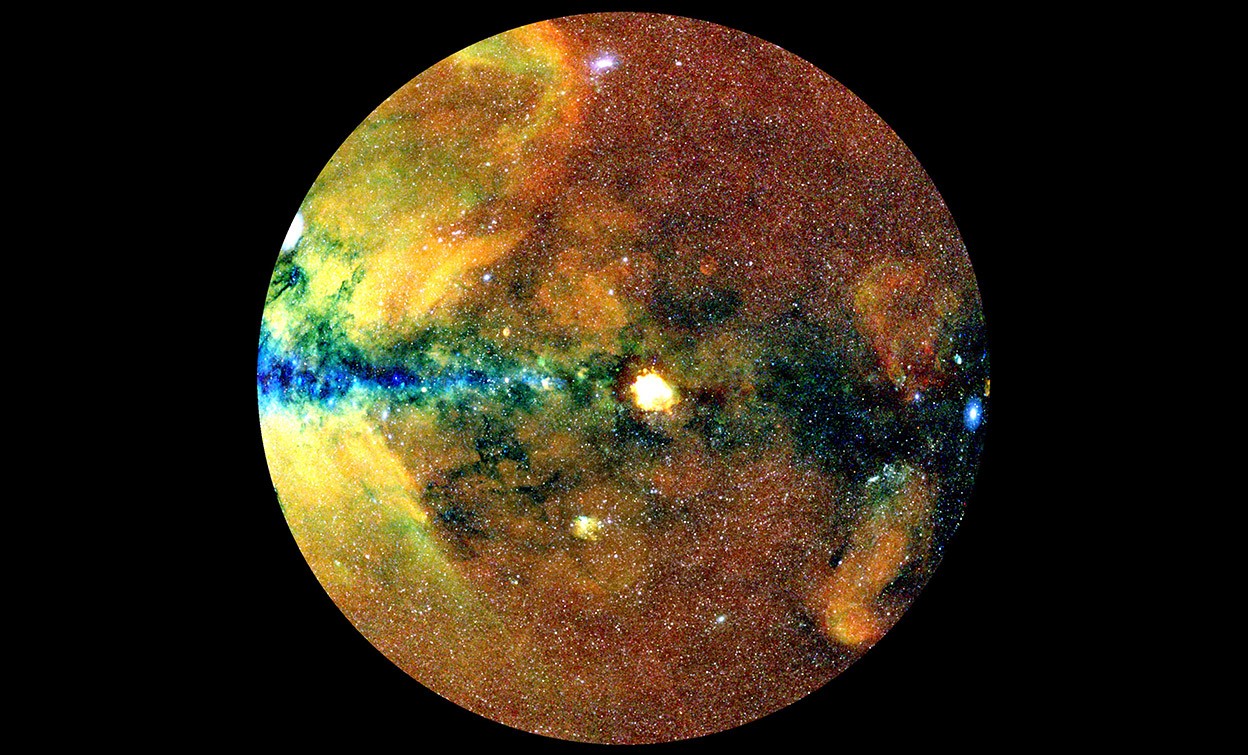
A team of astronomers, led by Esra Bulbul, a senior astrophysicist at the Max Planck Institute for Extraterrestrial Physics (MPE) in Garching, Germany, has utilized data from the eROSITA telescope to reconstruct nearly nine billion years of cosmic evolution. Their analysis, based on tracing the X-ray emissions of distant galaxy clusters, reaffirms the standard model of cosmology. According to this model, the gravitational influence of dark matter, an enigmatic substance, largely shapes the structure of the Universe.
Bulbul asserts that their findings align closely with the predictions of the standard cosmological model, indicating no significant deviations. The team’s results, outlined in a preprint released online on February 14, underscore the consistency of current cosmological theories.
The eROSITA telescope, part of the Extended Roentgen Survey with an Imaging Telescope Array (eROSITA), captured the most detailed X-ray image of the sky to date, unveiling approximately 900,000 X-ray sources ranging from black holes to remnants of supernova explosions. This groundbreaking image, a product of eROSITA’s first six months of operation since its launch aboard the Russian spacecraft SRG (Spectrum-Roentgen-Gamma) in July 2019, demonstrates the telescope’s capability to scan the cosmos comprehensively. eROSITA’s unique scanning method, which leverages the spacecraft’s rotation to collect data across wider angles, enables it to survey the entire sky every six months with unprecedented detail.

The eROSITA team operates under a unique arrangement, divided between a group based in Germany and another in Russia, each with exclusive access to data from only half of the sky. Originally slated to cover the sky eight times, the mission faced an abrupt halt when the German government suspended collaborations due to Russia’s full-scale invasion of Ukraine in 2022. Consequently, eROSITA was placed on stand-by after completing four full sky scans.
The data utilized by Bulbul and her colleagues stem from their half of the sky, gathered during the initial scan. Despite this limitation, their findings represent some of the most precise cosmological measurements to date. However, there remains uncertainty regarding the timing of when the Russia-based group will publish its data and analysis.
Cosmic structure: Mapping intergalactic gas haloes
By gazing across immense distances, telescopes like eROSITA provide a glimpse into the bygone stages of cosmic evolution. As the universe undergoes expansion, the intergalactic spaces widen, yet gravitational forces, fueled by both visible and dark matter, draw galaxies towards each other. This gravitational interplay leads to the formation and expansion of colossal cosmic voids, while matter aggregates into an intricate web of expansive galaxy clusters.
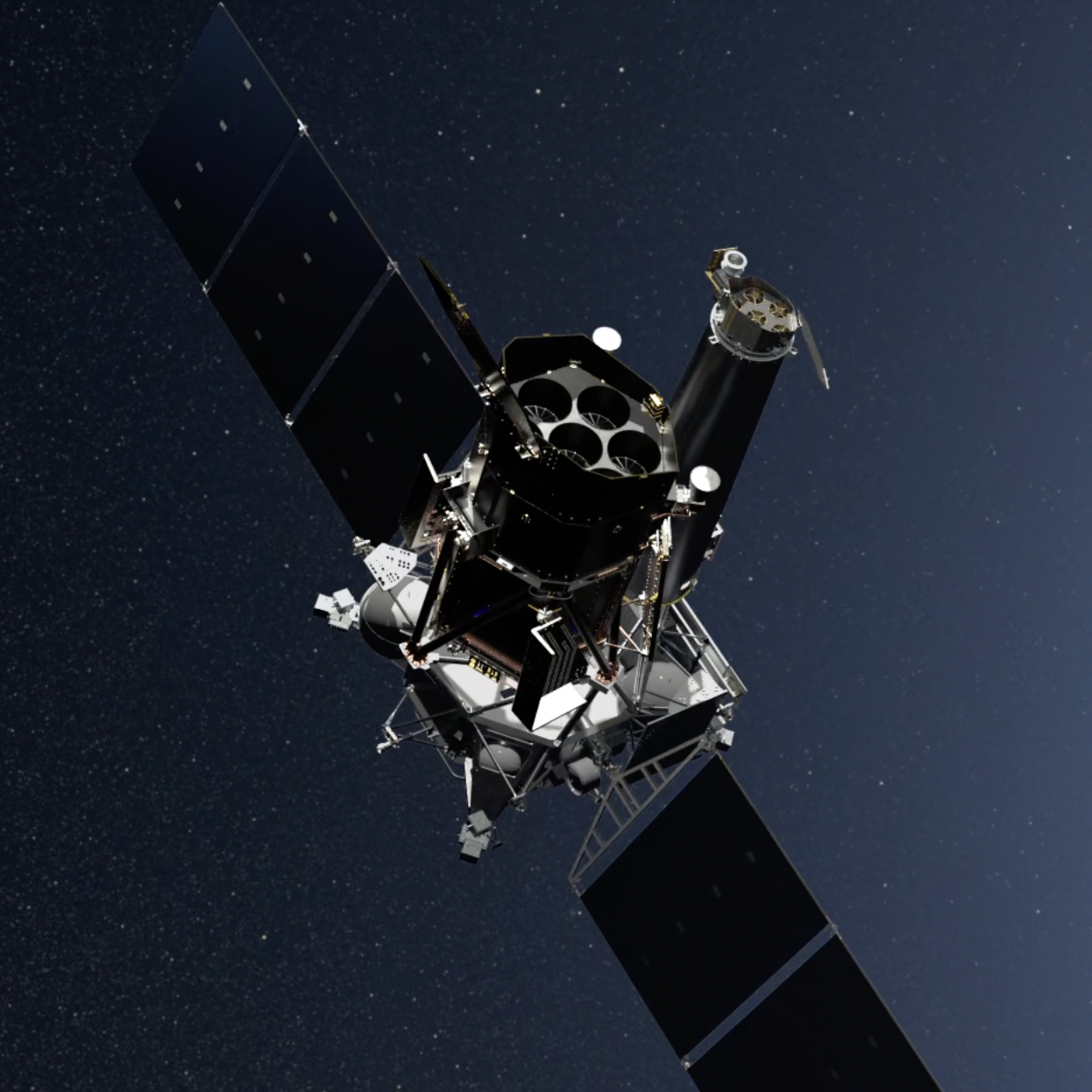
At the Max Planck Institute for Extraterrestrial Physics (MPE), astrophysicist Vittorio Ghirardini collaborated with Bulbul and other researchers to construct a 3D map of the haloes of intergalactic gas enveloping over 5,000 galaxy clusters. Leveraging the potent X-ray capabilities of eROSITA, combined with data from the Dark Energy Survey (DES) utilizing a telescope in Chile, the team achieved a comprehensive understanding of these cosmic structures. Ghirardini notes, “Since X-rays are very powerful at detecting haloes, we can be very certain that there is a very big structure there,”
Covering an expansive temporal and spatial domain of approximately nine billion years, the observations enabled the researchers to compute critical parameters of cosmic evolution, including the “lumpiness” – the extent to which the total mass of matter concentrates in the cosmic web at different epochs. A previous analysis in 2017, based solely on DES data, suggested a slower-than-expected development of lumpiness in the cosmic web, contrary to the standard model. However, the latest analysis has resolved this incongruity, aligning with results from other cosmological experiments that also affirm compatibility with the standard model and providing a more harmonious narrative of cosmic evolution.
Neutrino mysteries: Insights from galactic clusters
Moreover, through the analysis of galactic-cluster data, the team uncovered insights into the role of neutrinos in shaping the cosmic web. Neutrinos, elementary particles abundant since the Big Bang, possess low masses and minimal interaction with other particles, resembling characteristics of dark matter. This resemblance allows them to form haloes around galaxies. Astrophysicists inferred that neutrinos likely have masses not exceeding 0.22 electronvolts, a significantly stringent constraint compared to the upper limit of 0.8 eV determined by laboratory measurements on Earth.
Even in the absence of further observations from eROSITA, the team’s research remains ongoing. They continue to analyze a wealth of data, with plans to explore gas halos of varying sizes, faintness, and distances beyond those catalogued thus far, aiming to enhance the precision of their measurements.
Similar prospects extend to other types of X-ray sources mapped by eROSITA, including quasars, the luminous supermassive black holes situated at the cores of galaxies. Mara Salvato, an astrophysicist at the MPE and spokesperson for eROSITA, emphasizes that the analysis of this rich dataset has only just commenced. By the mission’s conclusion, they anticipate cataloging approximately three million objects, unveiling further insights into the cosmos.
Resources
- JOURNAL Castelvecchi, D. (2024). Most detailed X-ray sky map bolsters standard model of cosmology. Nature. [Nature]
- JOURNAL Ghirardini, V., Bulbul, E., Artis, E., Clerc, N., Garrel, C., Grandis, S., Kluge, M., Liu, A., Bahar, Y. E., Balzer, F., Chiu, I., Comparat, J., Gruen, D., Kleinebreil, F., Krippendorf, S., Merloni, A., Nandra, K., Okabe, N., Pacaud, F., . . . Stewart, I. M. (2024). The SRG/eROSITA All-Sky Survey: Cosmology Constraints from Cluster Abundances in the Western Galactic Hemisphere. arXiv (Cornell University). [arXiv.org]
- JOURNAL Abbott, T. M. C., Abdalla, F. B., Alarcón, A., Aleksić, J., Allam, S., Allen, S. W., Amara, A., Annis, J., Asorey, J., Ávila, S., Bacon, D., Balbinot, E., Banerji, M., Banik, N., Barkhouse, W. A., Baumer, M., Baxter, E. J., Bechtol, K., Becker, M. R., . . . Zuntz, J. (2018). Dark Energy Survey year 1 results: Cosmological constraints from galaxy clustering and weak lensing. Physical Review, 98(4). [Physical Review]
- JOURNAL Madhavacheril, M. S., Qu, F. J., Sherwin, B. D., MacCrann, N., Li, Y., Abril-Cabezas, I., … Zhang, K. (2023). The Atacama Cosmology Telescope: DR6 Gravitational Lensing Map and Cosmological Parameters. arXiv (Cornell University). [arXiv.org]
- JOURNAL The KATRIN Collaboration, Aker, M., Beglarian, A., Behrens, J., Berlëv, A. I., Besserer, U., Bieringer, B., Block, F., Bobien, S., Böttcher, M., Bornschein, B., Bornschein, L., Brunst, T., Caldwell, T. S., Carney, R. M. D., La Cascio, L., Chilingaryan, S., Choi, W., Debowski, K., . . . Zeller, G. P. (2022). Direct neutrino-mass measurement with sub-electronvolt sensitivity. Nature Physics, 18(2), 160–166. [Nature Physics] https://doi.org/10.1038/s41567-021-01463-1
Cite this page:
APA 7: TWs Editor. (2024, February 19). eROSITA Telescope Maps the Dark Matter Network of the Cosmos!. PerEXP Teamworks. [News Link]


