




Marvelous presented a playable build of Eternal Anima during Tokyo Game Show 2026, offering attendees a first look at the time-travel role-playing game ahead of its planned launch in March 2027. Directed by veteran developer Katsuhisa Higuchi, who served as lead programmer on Chrono Trigger, it blends classic turn-based structures with modern tactical mechanics. The story follows a fugitive named Wade through the ruins of lost continents, where his party manipulates action timelines in battle and uncovers forgotten history through multiple generations [1].
Hands-On with Eternal Anima at Tokyo Game Show
The Tokyo Game Show demo provided the first hands-on look at the game since its reveal during the September 2026 Nintendo Direct. Marvelous also hosted preview sessions at its Shinagawa headquarters [6]. Producer Makoto Shioda drafted the original concept over five years ago during remote pandemic work. Shioda waited to assemble an experienced team, partnering with Katsuhisa Higuchi because the director brings four decades of Japanese role-playing game experience dating back to the 8-bit era [2].
Higuchi reunited with former Square colleagues to assemble the creative staff. Scenario writer Kazushige Nojima, known for Final Fantasy VII and Final Fantasy X, joined to write the story, while Hitoshi Sakimoto composed the musical score. Keisuke Makino provided the original story draft, with Hironao Fukuda directing the scenario and Max Berthelot designing characters. When asked about his favorite time-travel works, Higuchi joked that he had to choose Chrono Trigger or risk angering Hironobu Sakaguchi, while Shioda cited Back to the Future and recalled waiting in a long Comic-Con line to photograph actor Christopher Lloyd [2].
While retro projects like the classic Lufia Sinistrals saga heading to modern consoles focus on reviving past formulas, Higuchi and Shioda wanted to push turn-based systems forward by testing how far older design conventions could evolve on newer platforms. Higuchi said: “My favorite aspect is the Future Sight Battle system. Personally, I think battles account for 70–80% of what makes a JRPG enjoyable.” Early visual prototypes used brighter, cuter character models before artists shifted to more grounded proportions. Shioda added that Wade stands apart from common teenage genre protagonists because the character carries the emotional composure of an adult [2].

Wade’s Escape from Floating Urvis Ael
The story opens inside Urvis Ael, a floating kingdom that serves as the final haven for humanity after rising seas submerged the world below. Urvis Ael floats alone. An absolute sovereign known as the Almighty rules the paradise through an inflexible law that bans all social progress [4].
The Almighty treats yearning for a better future as a capital crime. Wade questions this rigid doctrine, so authorities swiftly label him a heretic and force him into exile. He escapes into the perilous waters of the Forbidden Seas to search for lost truths about the planet’s forgotten civilizations [5]. Wade doesn’t travel alone, gathering allies from different lands who share ties to vanished eras. As the party journeys between past and present eras through four lost continents, Wade relies on an innate gift called Psychometry to read memories preserved inside ancient relics [3].
Psychometry links narrative discovery to character progression. Relics scattered through ruins contain memories from past heroes, letting Wade inherit their classes and combat skills. Party members don’t depend entirely on standard equipment upgrades; they combine these inherited traits into customized combat builds. That mechanism rewards players for inspecting forgotten landmarks, turning environmental curiosity into tangible party strength [4].


Timeline Manipulation in Future Sight Battles
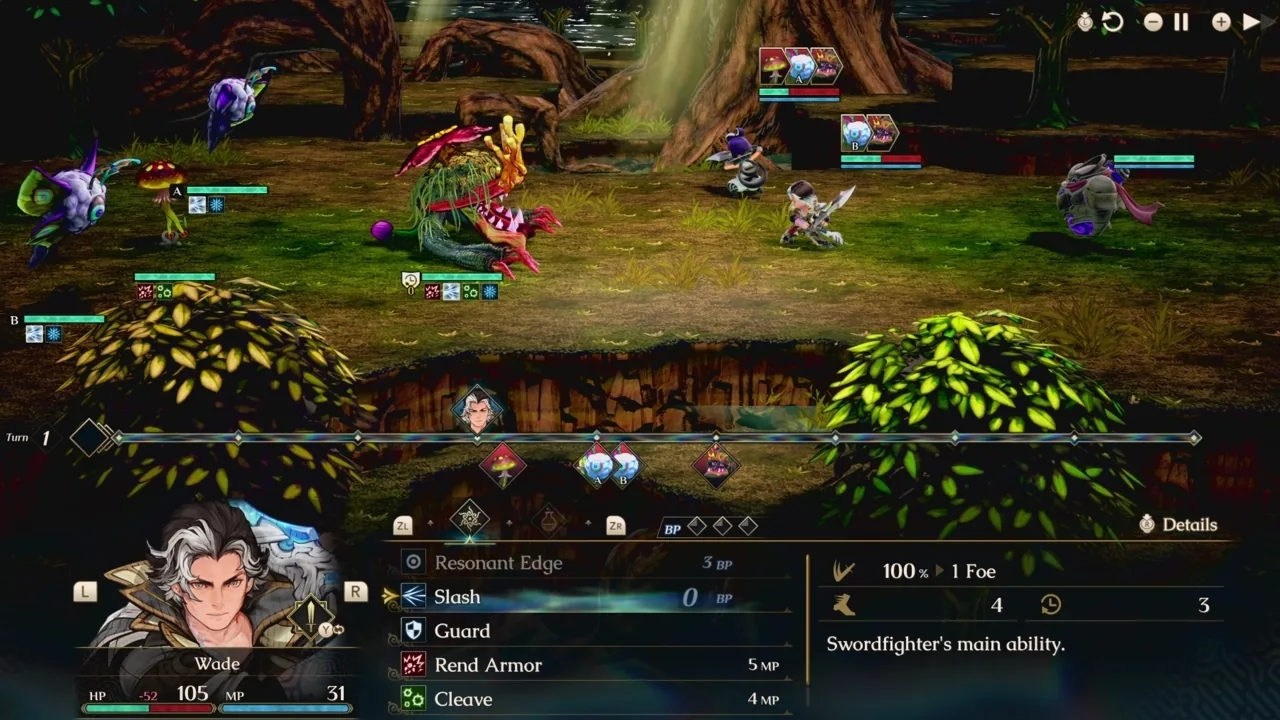
Encounters use a turn-based structure shaped by Wade’s Future Sight ability. A visible timeline displays upcoming enemy intentions and predicted damage before commands are finalized. Each action carries a specific activation speed that dictates exactly where a character’s move will land on the turn order [3].
Weakness strikes alter combat flow by delaying an enemy’s position along the timeline track. If the party coordinates attacks effectively and knocks an opponent completely off the turn bar, they trigger a break state that cancels that foe’s action for the entire round. Azario Lopez of Noisy Pixel previewed the system during Tokyo Game Show, praising how anticipating enemy attacks creates a satisfying rhythm. However, Lopez said that during a prolonged boss fight on Normal difficulty, relying on one dependable attack sequence felt repetitive before the battle ended. The encounter showed that while core timeline mechanics work smoothly, late-game bosses need to push players to adapt their strategies instead of cycling through a single attack pattern [3].
Difficulty balancing is a priority for Higuchi’s team as development continues. Long boss fights can’t rely on static attack loops if encounters are to remain engaging. Because Wade inherits hero abilities through Psychometry, future builds should provide wider tactical options to prevent players from relying on repetitive combinations [3].
PS1-Era Puzzles Inside Forest Ambulis
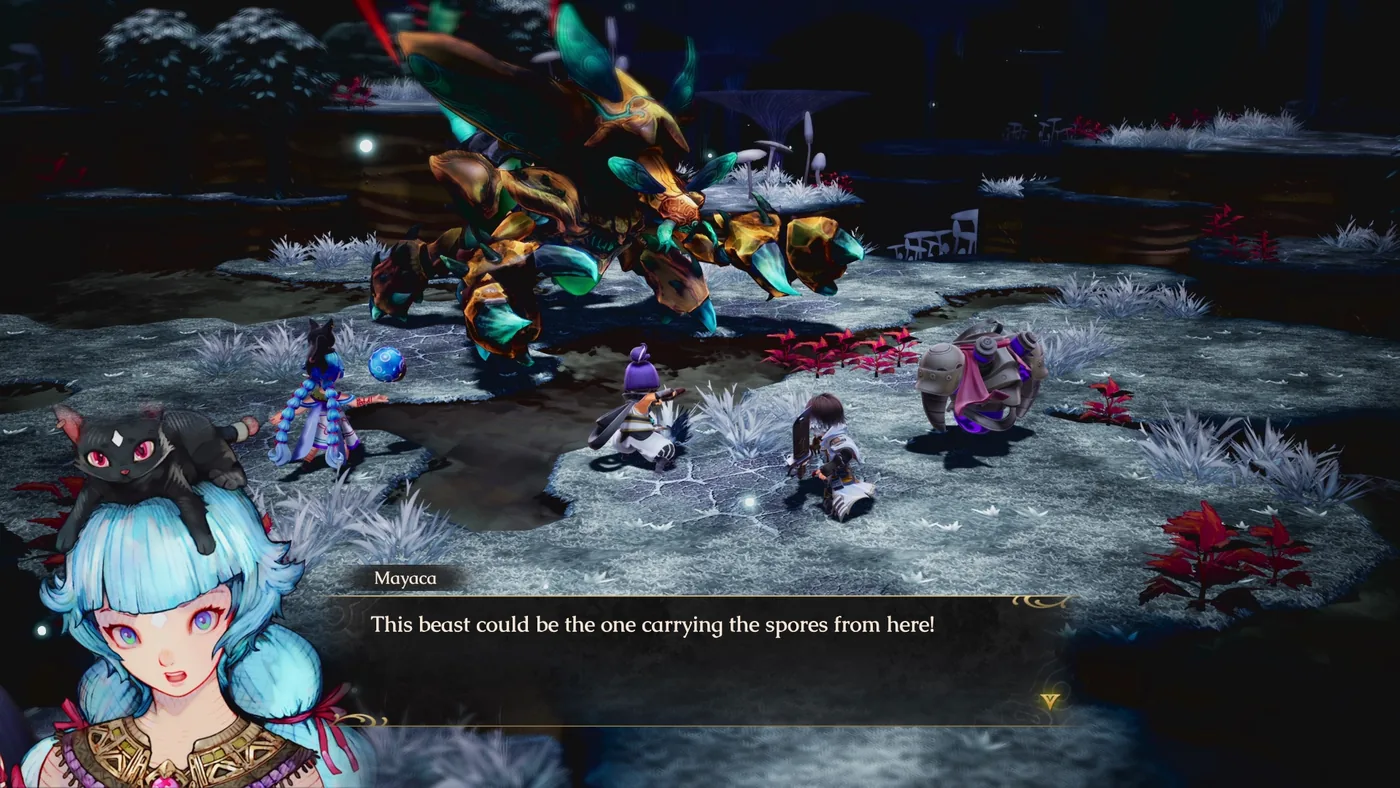
The playable demo featured past-era Ambulis, an ancient continent containing La Bosêt and the Cœur Vert Forest. These compact environments utilize fixed camera angles and detailed backdrops reminiscent of PlayStation-era role-playing games that relied on pre-rendered backgrounds [3].
Instead of wandering through empty fields, party members navigate tight pathways filled with environmental puzzles. These maze-like puzzles require studying the forest geography and manipulating switches to clear obstructed routes. The layout rewards thorough investigation, encouraging players to explore offshoot paths to locate forgotten memories and hidden chests rather than rushing to main objectives [3].
Higuchi adjusted the visual presentation so dense forest foliage wouldn’t obscure navigational paths. Journeys between time periods reveal how landscapes in Ambulis transformed over hundreds of years, connecting small historical landmarks in the past to altered geography in the present. Shioda said the central narrative theme is legacy, examining how wisdom survives between generations and how people inherit knowledge from ancestors who came before them [2].

Eternal Anima Platforms and Boxed Editions
Marvelous has scheduled Eternal Anima for a worldwide launch on March 4, 2027. The game will release for Nintendo Switch 2, PlayStation 5, Xbox Series X|S, and Windows PC through Steam. Steam’s digital storefront lists a March 3 date for specific Western regions due to time zone differences, but Marvelous confirmed March 4 as the official global release date in all territories [4].
Boxed copies will launch with digital storefront releases. Standard boxed editions are planned for Nintendo Switch 2, PlayStation 5, and Xbox Series X|S. Marvelous is also producing a premium limited edition for PlayStation 5 and Switch 2, containing a two-disc soundtrack, nine character art cards, and an art book [4].
The March 2027 arrival of Eternal Anima places the game in a competitive release window that includes titles such as Final Fantasy VII Revelation and Fire Emblem: Fortune’s Weave [5]. By blending classic turn-based structures with timeline manipulation and generational storytelling, Higuchi and Shioda seek to deliver a role-playing adventure that captures the spirit of 1990s classics while leveraging newer platform hardware [2].
- ONLINE NEWS Eisenbeis, R. (2026, October 16). Hands-on with Eternal Anima: A Classic JRPG for the Modern Era. Anime News Network. [Article Link]
- ONLINE NEWS Eisenbeis, R. (2026, October 16). Tokyo Game Show 2026 Interview: Chrono Trigger Lead Programmer on Directing His Own Time Travel JRPG, Eternal Anima. Anime News Network. [Article Link]
- ONLINE NEWS Lopez, A. (2026, October 15). Eternal Anima Preview: A Nostalgic JRPG Where A Little Foresight Goes A Long Way. Noisy Pixel. [Article Link]
- ONLINE NEWS Global Hunter Ideas. (2026, September 11). Eternal Anima: The New Time-Traveling JRPG That Could Be a Dream Come True for Classic RPG Fans. [Article Link]
- ONLINE NEWS Speer, J. (2026, September 10). Restore the Past in Time Travel JRPG Eternal Anima. Hey Poor Player. [Article Link]
- ONLINE NEWS Gematsu. (2026, October). Eternal Anima hands-on gameplay preview. [Article Link]


