





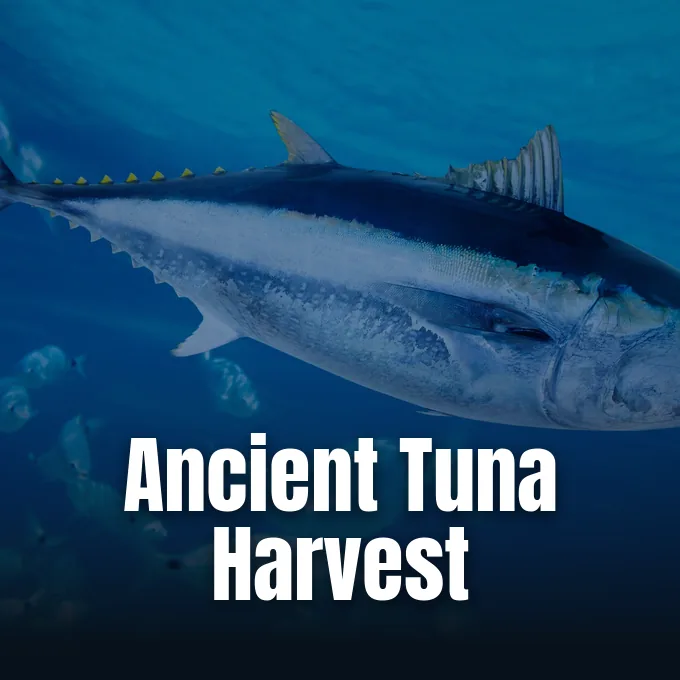
Tuna may seem like a creation of contemporary seafood markets and canning factories, but people have hunted these fast-swimming ocean predators for more than 44,000 years. Eight true tuna species in the genus Thunnus, along with skipjack tuna (Katsuwonus pelamis), support a global trade valued at roughly US$40 billion annually. However, long before industrial fleets swept the open sea, coastal communities developed clever tools to catch these large pelagic fish. Archaeological digs around the world show that ancient tuna fishing shaped human diets, coastal economies, and sea voyages over millennia [3].
- What Earliest Caves Reveal About Ancient Tuna Fishing?
- Deep-Water Hooks and Early Tuna Fishing Tools
- Pacific Coast Harpoons and Prehistoric Tuna Fishing Traditions
- Pacific Northwest Sites and California Pelagic Catches
- Mediterranean Traps and the Rise of Coastal Trade
- How Past Ocean Catches Compare With Present Harvests
What Earliest Caves Reveal About Ancient Tuna Fishing?
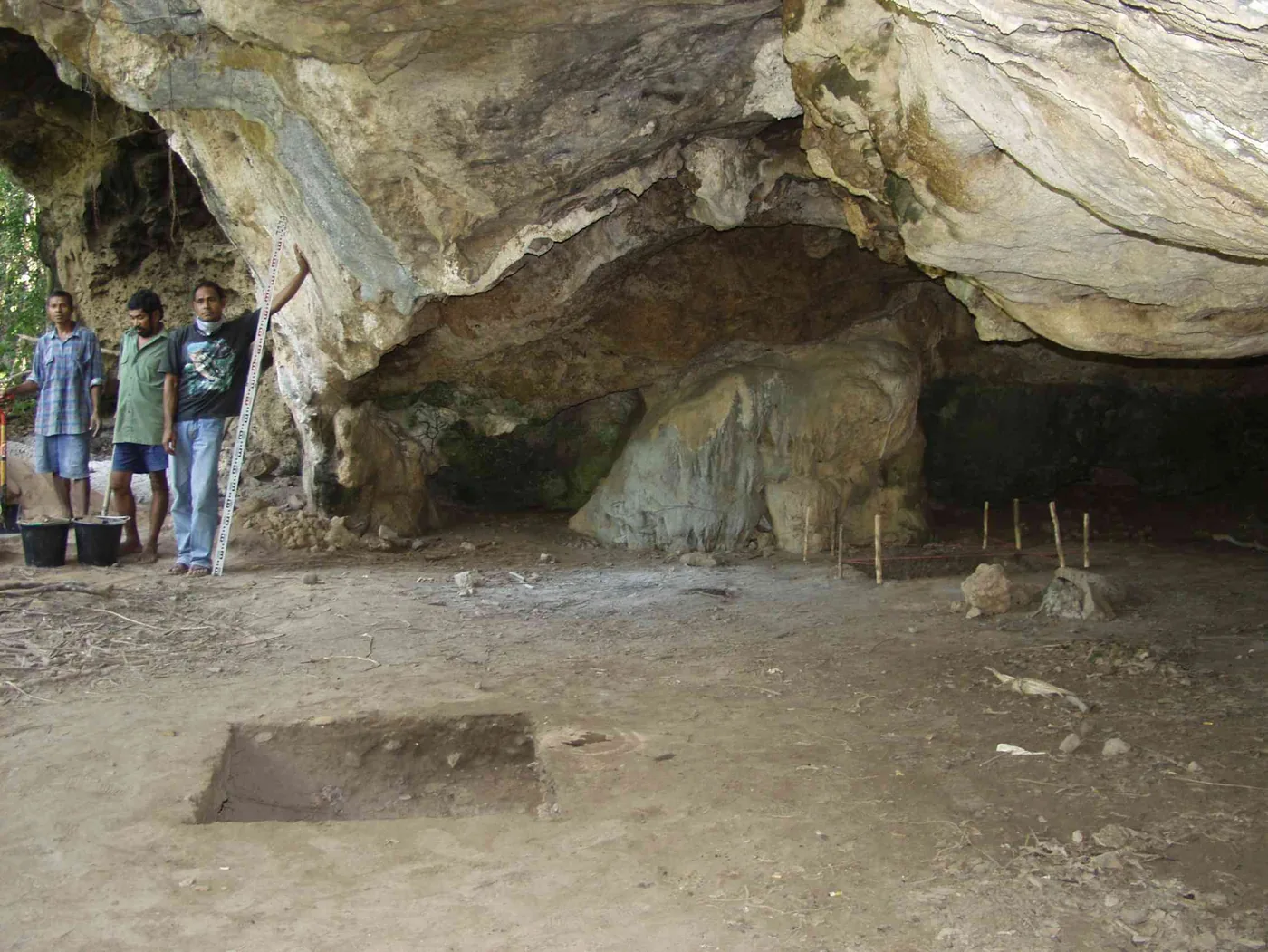
Excavations at Jerimalai cave in East Timor reveal that people caught fast-swimming pelagic fish as early as 44,000 years ago. This discovery set the oldest definitive timeline for oceanic angling [3]. East Timor sits beside deep oceanic drop-offs. Archaeologist Sue O’Connor from the Australian National University in Canberra and her team recovered 38,000 fish bones representing 23 different animal groups from the cave deposits. These skeletal elements included pelagic species such as skipjack tuna and deep-dwelling parrotfish [4]. These finds showed that Pleistocene foragers ventured beyond shallow reefs to target fast marine animals in open water [2].
In a recent study published as a preprint that has not yet undergone peer review, biologist Emma Elliott Smith and archaeologist Torben Rick gathered archaeological records from 18 researchers worldwide to trace these deep human-environment links [1]. Timor hosted few native large land mammals. Because terrestrial meat was scarce, early arrivals turned toward the ocean to secure protein for survival. “Necessity is the mother of invention,” Sue O’Connor said about this reliance on marine resources. O’Connor explained that “apart from bats and rats, there’s nothing to eat here” [4]. Deep ocean trenches close to the coast brought migrating tuna schools within paddling distance, and this bathymetry gave islanders accessible hunting grounds just off the beach [3].
Deep-Water Hooks and Early Tuna Fishing Tools
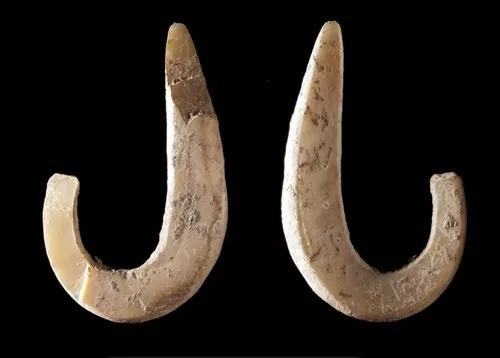
Landing large pelagic predators required sturdy gear capable of withstanding fast runs into deep water. Inside the Jerimalai shelter deposits, researchers uncovered a broken fish hook carved from shell that dates between 16,000 and 23,000 years ago. Sue O’Connor identified this artifact as the world’s oldest known manufactured fish hook, followed by a second shell hook made around 11,000 years ago. This younger tool proved long-term continuity in angling methods. Sandra Bowdler from the University of Western Australia in Perth said that people colonizing the island 42,000 years ago had “fully formed” fishing skills matching present-day human cognitive abilities [4].
Before the Jerimalai excavations, the earliest clear evidence for hook or spear fishing dated to approximately 12,000 years ago, whereas humans had collected coastal shellfish for 100,000 years. Ian McNiven from Monash University in Melbourne suggested that developed fishing skills enabled Pleistocene human populations to move quickly along ocean margins after expanding out of Africa around 70,000 years ago. “Humans appeared to move quite quickly along the coasts,” McNiven said when evaluating Pleistocene maritime routes. He observed that “developed fishing skills could have kept them moving”. Navigating open seas allowed humans to reach Australia by 50,000 years ago, suggesting that deep-water foraging supported broader Pleistocene journeys across the western Pacific [4].
Glacial water storage kept ocean depths roughly 60 to 70 metres below present-day waterlines during the Pleistocene. Former shorelines where early fishers lived now lie submerged. McNiven said that investigating drowned shelves could yield further proof of early human fishing, solidifying East Timor’s position as an early center for pelagic angling [4].
Pacific Coast Harpoons and Prehistoric Tuna Fishing Traditions
Pacific communities developed distinct ways to hunt tuna. For more than 5,000 years, Indigenous peoples in Nuu-chah-nulth territory along the northwest coast of North America pursued Pacific bluefin tuna (Thunnus orientalis) during warm-water events in late summer. Ethnographic accounts explain that crews paddled canoes into deep fjords illuminated by glowing bioluminescent plankton. Spotters watched from high cliffs to signal tuna schools below, allowing paddlers to ignite small fires in their canoes to attract fish near the surface before striking them with heavy harpoons [3].


Pacific Northwest Sites and California Pelagic Catches
Excavations in Nuu-chah-nulth territory have identified tuna vertebrae at 23 archaeological sites. Hunters routinely landed specimens measuring over 6 feet (2 meters) in length and weighing up to 640 pounds (290 kilograms). Around Santa Catalina Island, Indigenous fishers harvested Pacific bluefin, yellowfin, albacore, and skipjack tunas for over 6,000 years. Excavations in local shell middens contain thick layers of these bones. These coastal traditions offer valuable perspectives on prehistoric human impacts on large animals, showing that Indigenous fisheries coexisted with apex predators for thousands of years without causing collapses [3].
Mediterranean Traps and the Rise of Coastal Trade
The Mediterranean Sea contains extensive archaeological records of early tuna exploitation. A few tuna bones recovered from a Neanderthal cave site in Gibraltar suggest hominins may have scavenged stranded fish around 26,000 years ago. Deliberate harvesting emerged between 9,000 and 11,000 years ago, when Greek coastal fishers deposited thousands of Atlantic bluefin tuna bones inside a cave overlooking Kiladha Bay. After 8,000 years ago, sites containing bluefin bones multiplied in southern Europe as maritime communities learned to anticipate annual seasonal migrations through narrow straits and bays [3].
By 3,000 years ago, Mediterranean communities established organized trade networks centered on salted and dried Atlantic bluefin tuna. Ancient Greeks revered tuna as sacred food, sacrificing first catches to Poseidon and recording communal nets in classical texts and vase paintings. During the 16th and 17th centuries, coastal fishers deployed anchored net traps at Zahara de los Atunes in Spain, taking advantage of coastal topography to harvest tens of thousands of tons annually. Because migrating bluefin followed shorelines closely, fishers caught enormous volumes without ever embarking on dangerous open-ocean voyages [3].

How Past Ocean Catches Compare With Present Harvests
Historical catches were modest by today’s standards. Archaeological estimates suggest that even the largest ancient fisheries in the Mediterranean removed only thousands of tons over entire millennia. Today’s global fishing industry extracts millions of tons of tuna each year, placing heavy pressure on open-ocean ecosystems. Pacific bluefin tuna journey over 8,000 kilometers of northern Pacific waters within several months during seasonal foraging, yet industrial longlines and purse seines now track them through every basin [3].
Some tuna species live over 40 years. Reaching lengths exceeding 10 feet (3 meters), these apex predators exert top-down control over oceanic food webs. Related marine studies on deep-sea diving behavior in marine animals show that pelagic hunters rely on complex underwater structures to locate schooling fish in open waters. Today, three valuable species—southern bluefin, Pacific bluefin, and bigeye tuna—remain classified as endangered, vulnerable, or near threatened because extraction rates far exceed the replacement capacity of natural populations [3].
The 20th century transformed worldwide tuna consumption. Tuna surged in popularity during World War I and World War II, spurred by the growth of canning operations in Southern California. Japanese and Portuguese immigrant fishers introduced bait-boat and purse-seine methods that turned San Diego and Los Angeles into major canning hubs. By 1953, California canneries like Starkist processed huge shipments daily, fueling an expanding worldwide market that altered the pace of ocean exploitation [3].
Conservation measures show that binding catch caps, international monitoring, and coordinated regional policies can halt stock declines and allow depleted tuna populations to stabilize. Scientific stock assessments began around 1950. These post-1950 baselines provide management agencies with clear benchmarks, though they cannot reflect the true abundance of pre-industrial ocean ecosystems [3]. PACIFICAL and Pacific island organizations emphasize that sustainable tuna management protects food and economic security for future generations [5]. For 44,000 years, human innovation enabled people to track and harvest open-ocean predators; directing that same ingenuity toward global conservation can help tuna populations endure for millennia ahead [3].
- PREPRINT Smith, E., & Rick, T. (2026). Hooked on tuna: People have been harvesting these ocean predators for 44,000 years. [Article Link]
- ACADEMIC JOURNAL O’Connor, S., Ono, R., & Clarkson, C. (2011). Pelagic Fishing at 42,000 Years Before the Present and the Maritime Skills of Modern Humans. Science, 334(6059), 1117-1121. [Article Link]
- ONLINE NEWS Elliott Smith, E., & Rick, T. (2026, October 12). Hooked on tuna: People have been harvesting these ocean predators for 44,000 years. The Conversation. [Article Link]
- ONLINE NEWS Zukerman, W. (2011, November 24). Deep sea fishing for tuna began 42,000 years ago. New Scientist. [Article Link]
- WEBSITE Pacifical. (2011, November 29). People were already hooking tuna 42.000 years ago! [Article Link]
- ONLINE NEWS SAIndia Magazine. (2026, October 12). People have been harvesting these ocean predators for 44,000 years. SAIndia Magazine. [Article Link]
APA 7: TWs Editor. (2026, October 13). How Ancient Tuna Fishing Began in Open Waters 44,000 Years Ago. PerEXP Teamworks. https://perexpteamworks.com/en/ancient-tuna-fishing-deep-ocean-origins/


