






More than 100 climate activists broke into an Amsterdam data center site on Friday morning. They scaled cranes and cut fences to protest energy consumption by commercial server facilities. Police officers arrived with batons, arrested at least one person, and took an angle grinder and climbing ropes from people inside the perimeter [1]. The action targeted an unfinished campus in Sloterdijk, where Microsoft plans to serve as sole tenant for three 85-meter computing towers [4].
The Amsterdam Data Center in Sloterdijk
The facility sits on the western edge of Amsterdam in the industrial zone of Sloterdijk. British developer Pure Data Centres Group is managing the build. The completed campus will feature three towers reaching 85 meters in height [4]. It will provide cloud hosting for corporate systems and automated tools [1].
Once fully built, the installation will supply a planned electrical capacity of 78 megawatts, with Microsoft leasing the property as sole tenant for its cloud networks [1]. Construction continued despite municipal restrictions that stopped similar computing projects across the Dutch capital. The city of Amsterdam banned new data centers until 2030 after placing a temporary pause on approvals in late 2023. Pure Data Centres Group managed to proceed because early planning permissions for this specific site date back to 2016, well before local officials enacted limits on commercial facilities. That permit loophole let developers break ground and erect steel while newer applications faced rejection [4].
Electricity use remains the main source of tension between project leaders and local residents. Dutch activist group Fossil Free Netherlands pointed out that the complex will draw as much power as every household in Amsterdam combined. Campaigners say dedicating substation lines to server halls raises bills for ordinary families [1].
Climbing Cranes and Cutting Fences
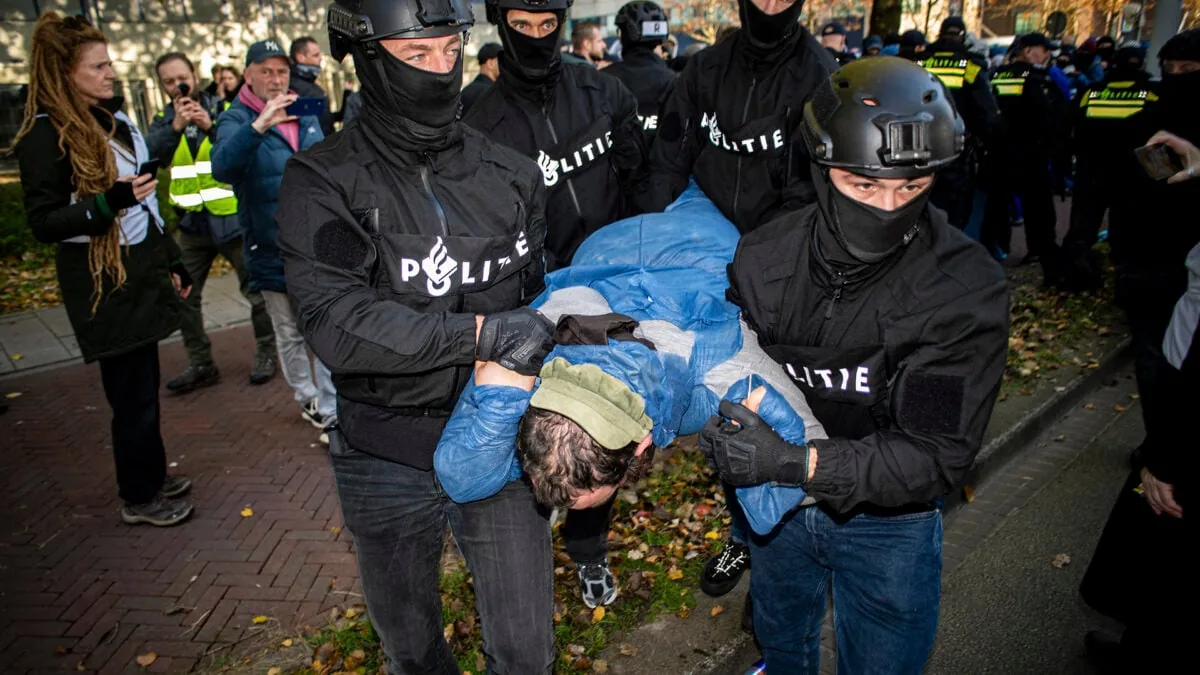
Protesters entered the site early Friday by cutting through an entrance gate. Demonstrators divided into two teams to enter the grounds, prompting police to deploy riot squads armed with batons. Officers confiscated an angle grinder and climbing ropes after detaining one person on the property [1].
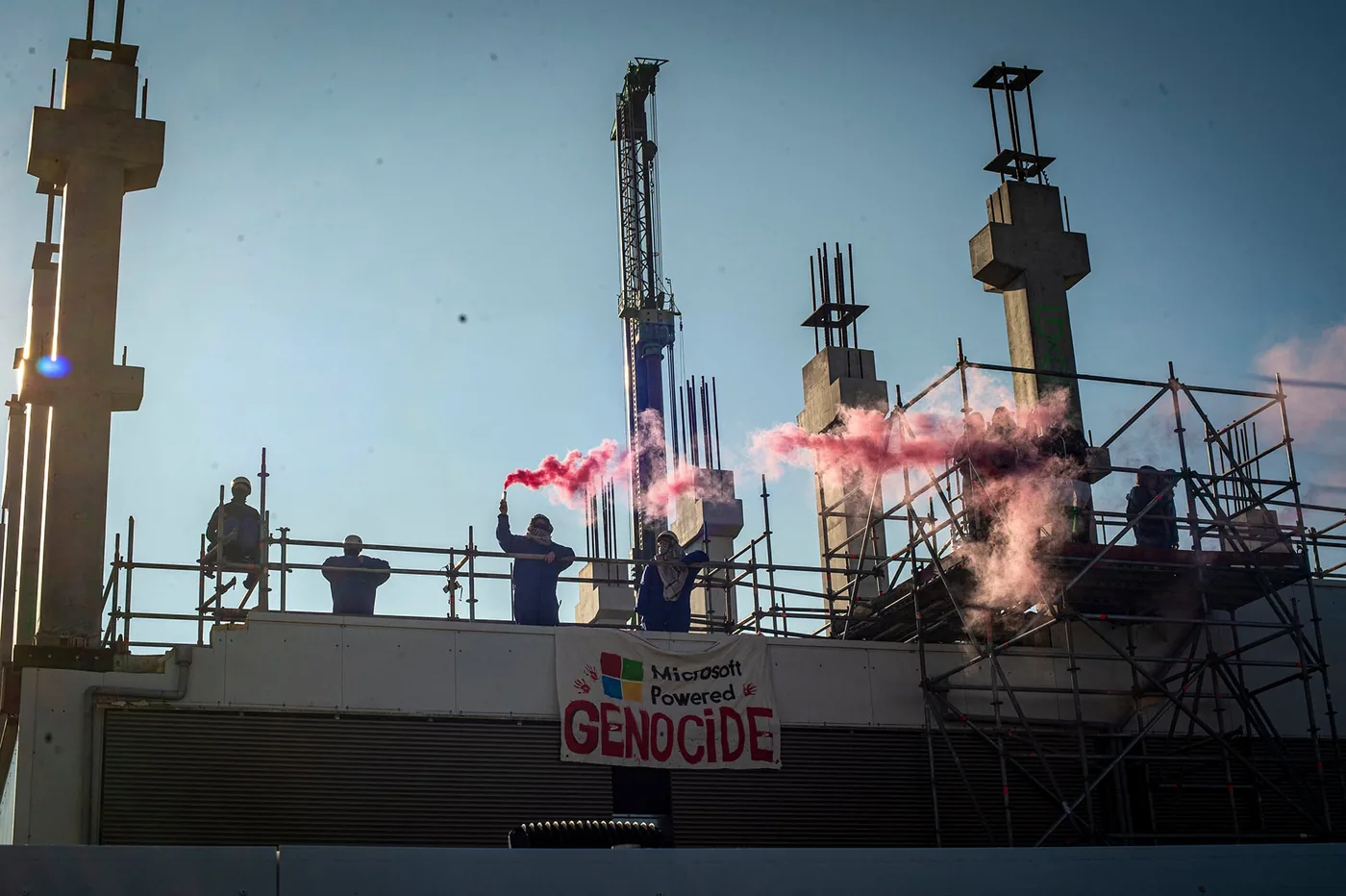
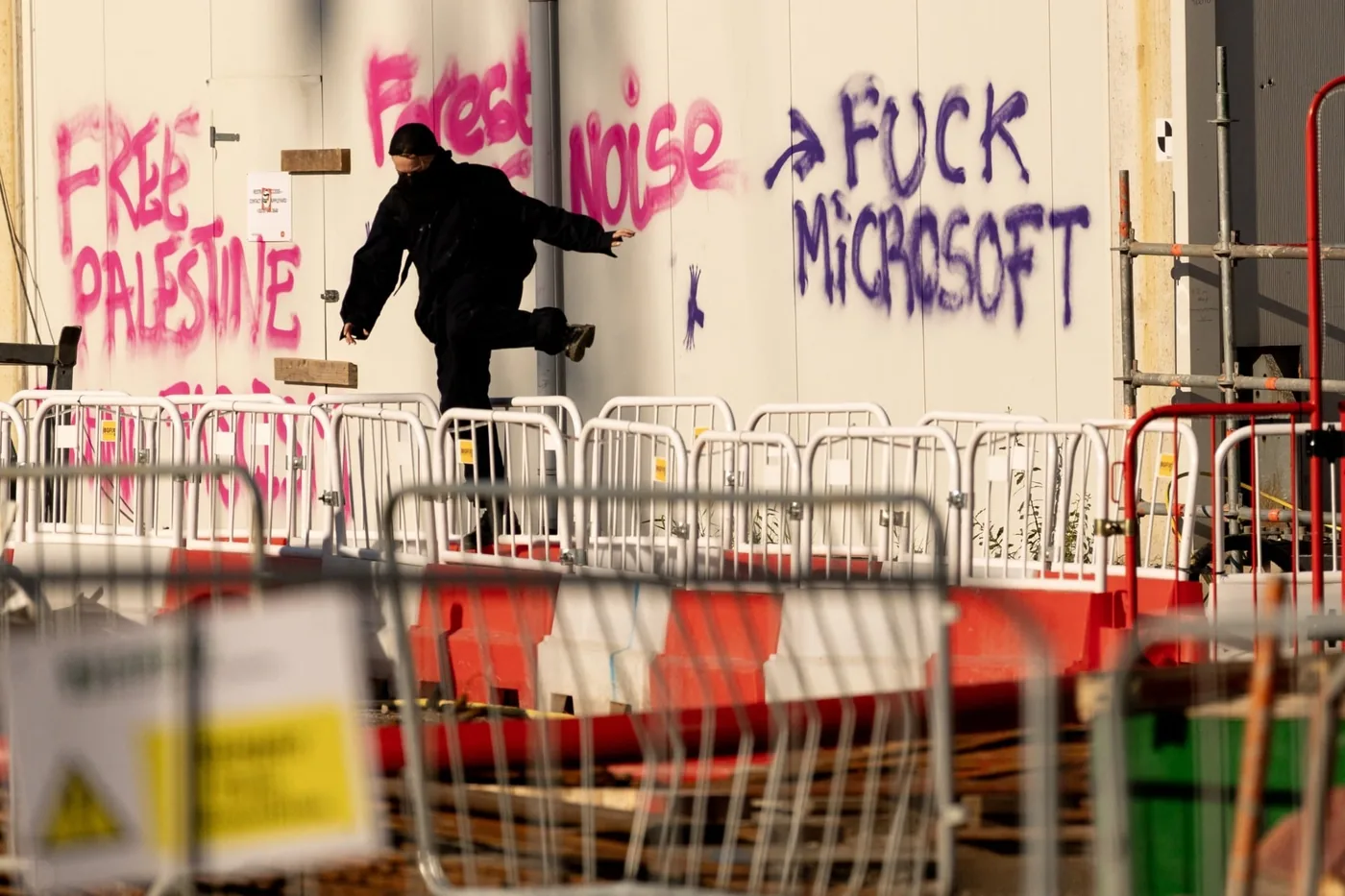
While about 100 people broke inside the fence, a campaigner with Fossil Free Netherlands told Bloomberg that an estimated 400 protesters joined the demonstration outside the property. Inside the perimeter, members of the Dutch action group Geef Tegengas climbed a tall construction crane to protest big tech expansion [1],. The direct action collective, based in Rotterdam, set off smoke bombs high above the site and hung a banner reading “fck AI” from the crane frame [2]. On the ground and across the roofs, demonstrators unfurled a separate banner declaring “Microsoft powers genocide” while crowds chanted “Microsoft has got to go” and “free Palestine” [4].
Group organizers linked their protest to military partnerships and resource consumption. In a statement to Business Insider, Geef Tegengas spokesperson Roos Molenaar condemned both the environmental impact of server complexes and corporate defense work. “We won’t accept Amsterdam being used for the creation of AI slop and the facilitation of genocide,” Molenaar said. “This data center is gulping up our drinking water to make the rich even richer” [2].


Stop Dirty Data Centres Moratorium Demands
Friday’s disruption was part of a broader European campaign coordinated by the coalition Stop Dirty Data Centres [1]. The alliance organized two days of demonstrations scheduled for November 6 and 7 in several European cities (including Dublin, Warsaw, and Amsterdam) [3]. Earlier in the week, activists staged a mock military checkpoint outside a Microsoft facility in Dublin to draw attention to defense ties [4].
A campaign map published on the group’s website listed planned actions at 85 locations in 16 countries, including Spain, France, Germany, Poland, Denmark, and the U.K. [3]. Organizers called for an immediate European moratorium on large server facilities until the public establishes democratic control over digital infrastructure. “Together we are calling on elected leaders to implement moratoria at local, national and European level that pause data centre construction until we, the people, have democratically decided what is needed to ensure AI and data centres serve people and the planet, not private greed,” the coalition stated on its website. Campaigners cited rising electricity bills, water depletion, climate damage, and military AI use as core concerns [1].
Both the site owner and Microsoft responded by urging peaceful engagement. Pure Data Centers issued a statement asking demonstrators to leave the grounds: “We respectfully ask those on site to leave safely and engage with us in dialogue about the development and any concerns they may have” [3]. Microsoft stated that it respects peaceful expression but does not condone unlawful acts or safety risks [1].

Energy Demands at the Amsterdam Data Center
Grid constraints have emerged as a growing obstacle for technology firms across Europe. Denmark recently halted new grid connection requests after applications surpassed 60 gigawatts (more than eight times the country’s peak electricity consumption). In Italy, a municipal council approved a 200% tax on data centers built on agricultural land to protect farming areas [3].
European leaders are attempting to reconcile computing investments with utility protections. EU tech chief Henna Virkkunen acknowledged the value of server infrastructure while warning against unchecked power consumption. “AI, of course, is a super important technology and we need to have our own capacity,” Virkkunen said in an interview. “But it’s very important for citizens that they can trust that their energy bills are not skyrocketing and there are not electricity blackouts because of data centers, or they are not destroying the environment with these projects” [3].
Environmental conflicts extend beyond electricity supply; in Finland, prosecutors opened a criminal investigation into Google subsidiary Tuike Finland Oy after the company allegedly cleared 816 acres of forest without a permit [3]. In Amsterdam, demonstrators raised similar alarms over water use, arguing that cooling hardware consumes valuable municipal drinking supplies. Activists from Extinction Rebellion previously protested tech expansion in the city by throwing balloons of acetic acid at Microsoft’s campus walls. Those ongoing disputes turned the Sloterdijk construction site into a focal point for European climate groups [2].
Backlash Across Europe and U.S. Elections
Internal workplace pushback has added to the external scrutiny surrounding Microsoft’s computing operations. Last month, Microsoft abandoned plans to build the U.K.’s largest data center after local power grid operators stated the facility could not receive electricity until the 2030s. The cancellation exposed growing utility bottlenecks facing technology firms in Northern Europe [4].
Company employees have also staged protests over military software contracts. During Microsoft’s 50th anniversary event, workers interrupted the gathering, with one attendee calling Microsoft AI CEO Mustafa Suleyman a “war profiteer”. Another employee disrupted the company’s Build developer conference by interrupting CEO Satya Nadella during his keynote speech. Following those demonstrations, Microsoft fired two employee protesters who staged a sit-in inside the company president’s office. The internal demonstrations show employee unease over how cloud tools are used in international conflicts [4].
Electoral pushback in the United States delivered additional setbacks for data center developers earlier in the week [4]. Ballotpedia reported that voters favored limits on data center projects in 40 of 41 local ballot contests on Tuesday, passing measures that ranged from development restrictions to outright moratoriums. In those elections, US voters defeated data center measures to protect farmland, reduce grid strains, and prevent rising utility rates. Incoming governors in Texas and Georgia also called for pausing new facilities, showing that community resistance against server hubs has become a worldwide challenge for the computing industry [1].
- ONLINE NEWS Gil, B. (2026, November 6). More Than 100 Protesters Storm a Microsoft Data Center Site in Amsterdam. Gizmodo. [Article Link]
- ONLINE NEWS Wilkins, J. (2026, November 6). Hundreds of Protestors Bust Into Construction Site to Stop Microsoft Data Center. Futurism. [Article Link]
- ONLINE NEWS Morales, J. (2026, November 6). Climate protestors storm Microsoft AI data center construction site — Amsterdam reportedly first of many targeted actions across Europe. Tom’s Hardware. [Article Link]
- ONLINE NEWS Warren, T. (2026, November 6). Protesters break into Microsoft data center site in Amsterdam. The Verge. [Article Link]


