





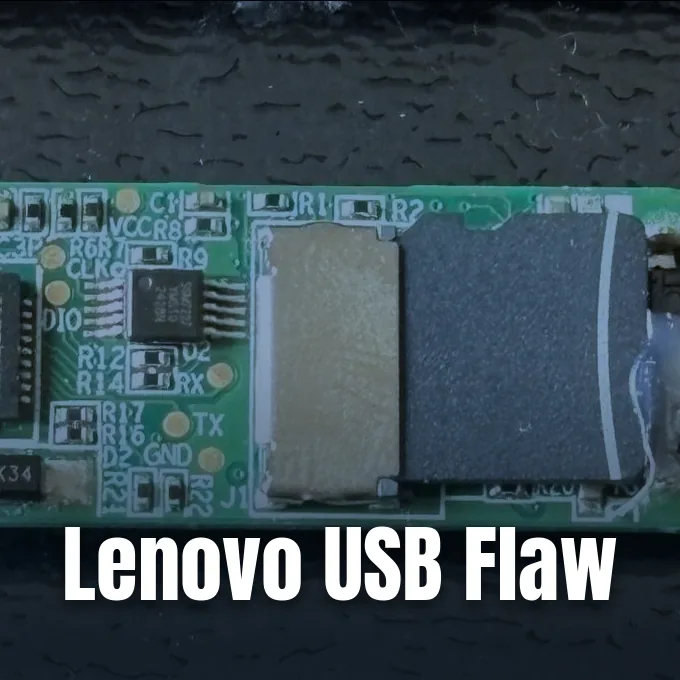
Security researcher Xusheng Li at Vector 35 discovered that Lenovo marketed its ThinkPlus FU100 storage stick as an AES-256 secure device, even though the hardware inside was just a plain microSD card [1]. The fingerprint sensor on the casing functioned solely as an electrical switch for host USB connections, leaving flash storage open to anyone holding the device [3]. By taking the plastic case apart, anyone can plug the card into a standard reader and copy files without entering passwords [5]. The disclosure shows how retail encrypted USB drives can swap data encryption for basic connection switches, giving buyers false trust [4].
Encrypted USB Drives with Plain Storage
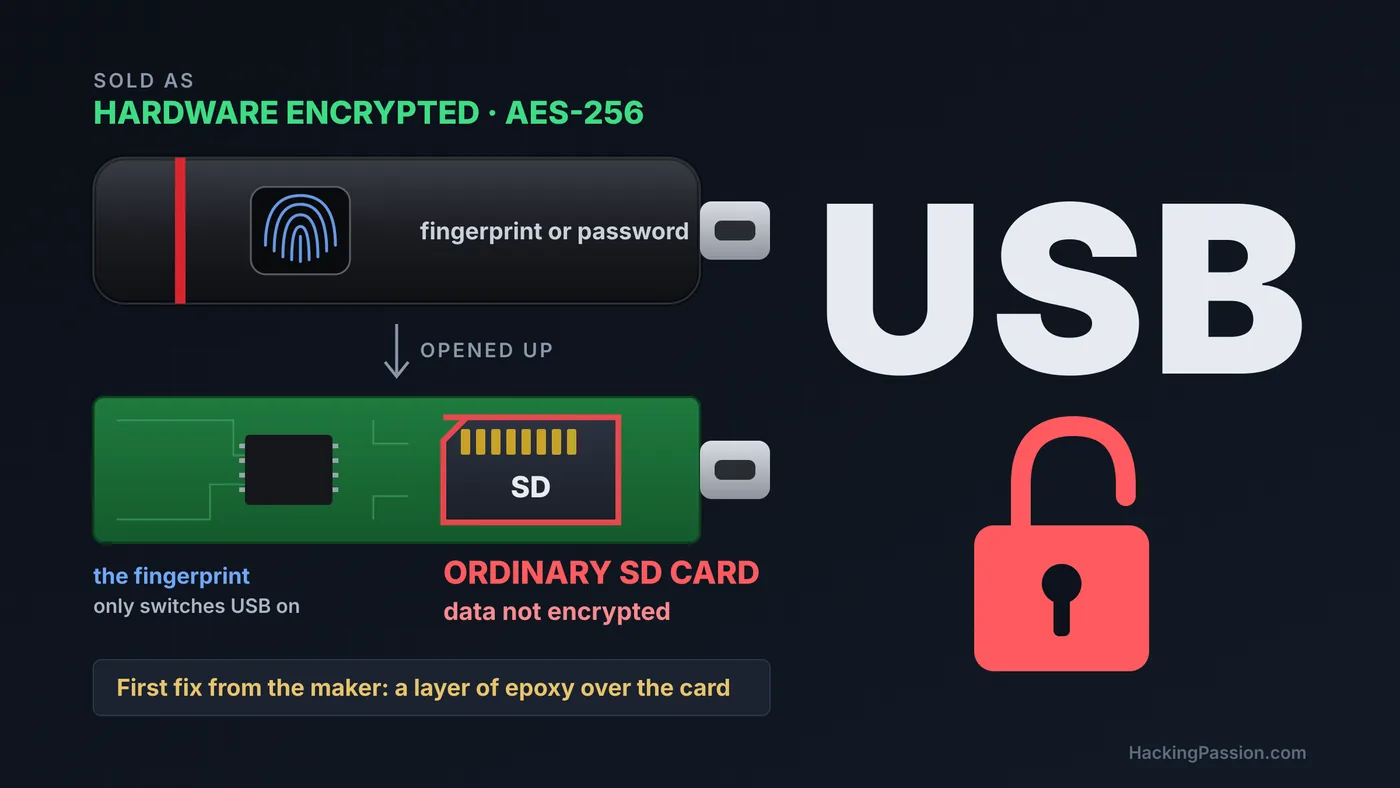
Vector 35 researcher Xusheng Li bought a Lenovo ThinkPlus FU100 in 2025 to test its advertised AES-256 hardware security [3]. When Li opened the black plastic case, he discovered a basic circuit board holding an ordinary microSD card, with no dedicated crypto chip installed to scramble data before writing it to storage cells [1]. The fingerprint reader merely switched on the USB connection [7]. Anyone holding the stick could pull the card and copy private files in seconds. Speaking at the RE//verse conference in March 2026, Li summarized the FU100 as “just an SD card in a fancy case,” warning that retail claims of hardware defense often amount to pure sales hype [1].
Li reported the flaw to Lenovo on August 2, 2025 [3]. Lenovo proposed an interim fix coating the microSD card in epoxy resin, but scraping the glue away still left raw storage readable in standard card readers [5]. Reddit and Hacker News teardowns soon confirmed that the ThinkPlus FU100 lacked an AES engine [4]. Unencrypted flash drives simply leave files open [7].
The Lenovo Advisory and Affected Models
Lenovo published security advisory LEN-210545 on January 13, 2026, assigning a high severity rating to four storage products sold as secure hardware. The advisory covered the ThinkPlus FU100, FU200, and TU800 flash sticks alongside the ThinkPlus TSD303 portable SSD, with CVE-2025-13453 documenting how anyone holding these encrypted USB drives can read files without entering a password [3]. Two companion software flaws followed [1]. CVE-2025-13454 leaked device details to local accounts, while CVE-2025-13455 allowed an unauthorized user to register a new fingerprint without the owner’s knowledge [3].
Fixing the flaws meant calling Lenovo’s service line in China to check serial numbers for unit replacements or on-site firmware work [3]. Lenovo told owners to back up and wipe all files before turning drives in. While flash sticks had no encryption, the ThinkPlus TSD303 SSD had a different bug [1]. The TSD303 encrypted files on its M.2 SSD module, but Lenovo’s PC app asked the drive for the right password and received it in plain text over the USB cable. Anyone watching USB traffic or app memory could capture the real password [5].
Lenovo tested an interim patch by wrapping password transmissions in an SM4 cipher. That fix failed because the app derived its key from a predictable timestamp, which in Li’s test setup was 2021012700000000 [5]. Because the app built that key locally, taking the software apart yielded the password [1]. Lenovo fixed the flaw in December 2025 by moving password checks onto the drive controller chip. Li showed that ten devices from other brands used that same software kit: six leaked plain passwords, two stored files on plain microSD cards, and two sent passwords with broken AES encryption [3].

AI Findings on Other Vendors
In October 2026, Li connected OpenAI Codex to Vector 35’s Binary Ninja reverse-engineering platform to analyze competing utilities, allowing Codex to inspect Netac’s NetacFileLock program and locate a static 32-byte AES-256 key baked into the executable in just seven minutes [3]. The Netac program also wrote plain user passwords into debug logs. Passwords were checked with raw MD5 hashes. In fast mode, the utility locked only small file slices over 1,024 bytes across PDF, ZIP, PNG, and JPEG formats, leaving the rest of each document readable. Li alerted Netac on October 19, 2025, but got no reply [5].
Li pointed the AI tool at copy-protection drives that let buyers view files without copying them. KakaSoft USB Copy Protection version 5.6.0.299 advertised Blowfish encryption. Its high mode scrambled only 16,385 bytes with a single-byte XOR key that left just 256 keys to test [5]. Its highest mode derived Blowfish keys from an internal MD5 seed that OpenAI Codex rebuilt in 26 minutes, unlocking protected files without the user password [1]. Nexcopy’s Copy Secure drive fell in ten minutes because its Triple-DES key was opened by a certificate hardcoded into the viewer app [3].
SecZure’s YutianDun copy-protected drive, which Li analyzed in Paged Out! in 2024, held two secret accounts that bypassed administrator passwords. An account named Buffer with the password 123456 gave up the file key, while an account named System used the fixed password SECZURE.COM [5]. Li called these accounts backdoors in code, adding that maker malice can’t be assumed. He gave no advance warning to KakaSoft, Nexcopy, or SecZure before publishing in October 2026, arguing that drives already sold can’t easily be recalled [1].
Earlier Encrypted USB Drives Shared Identical Bugs
Bugs in modern encrypted USB drives match flaws discovered more than ten years ago. In December 2009, German security firm SySS cracked SanDisk drives certified under FIPS 140-2 by finding that PC software checked passwords instead of the drive chip. Records from January 2010 showed that SanDisk Cruzer Enterprise drives and three Kingston DataTraveler models relied on fixed 256-bit keys inside desktop programs. Products tested sixteen years later copied those same shortcuts. In 2022, CVE-2021-46390 showed how South Korean researchers bypassed fingerprint checks on Lexar F35 sticks by modifying validation replies sent to host software [5].
Fingerprint sensors on USB sticks often create false safety when buyers confuse access checks with data encryption [4]. In February 2011, Lenovo and WinMagic released SecureDoc for Lenovo, pairing fingerprint readers with disk encryption on select ThinkPad laptops and ThinkCentre desktops. That product operated at the pre-boot level, protecting entire operating system drives rather than consumer storage dongles. Even so, biometric hardware still runs into integration bugs, as seen when advisory LEN-155804 fixed a bypass in Synaptics fingerprint sensors used by Windows Hello. Beyond retail computers like the Lenovo Yoga Slim 7X, accessory gear often cuts corners on basic security boundaries. Writing in The Brief, Martin Holloway noted that security failures rarely stem from the cipher named on the retail box, but rather from how makers wire parts together over data buses [2].

Real Hardware Encryption Standards
Real hardware encryption locks keys inside dedicated chips so neither the operating system nor a USB sniffer can ever read raw key bytes. On a genuine self-encrypting drive, a Media Encryption Key running AES-XTS encrypts every block written to flash memory. That key never leaves the controller chip. It is protected by a Key Encryption Key built from the user’s password or fingerprint secret. Erasing that second key triggers an instant cryptographic wipe in milliseconds, destroying file access without having to overwrite entire storage chips. The Trusted Computing Group defines this design in its TCG Opal standard to keep keys safe from host PCs [4].
Buyers can check for real hardware encryption before trusting any drive. On Linux, running hdparm inspects the ATA Security set for master password code 65534. A separate scan with sedutil-cli checks connected disks for TCG Opal compliance. High-assurance corporate and healthcare fleets require cryptographic modules validated by NIST under FIPS 140-2 or FIPS 140-3, such as certified hardware encrypted USB drives from Kingston IronKey, Apricorn Aegis Secure Key, or iStorage datAshur PRO. When a company distributes 500 unencrypted sticks to sales staff under the mistaken belief that biometric sensors provide legal compliance, losing a single drive can trigger statutory breach notices to thousands of affected clients [4]. For everyday portability, free software tools like VeraCrypt, LUKS, or BitLocker To Go derive keys from user passphrases, securing sensitive files on standard flash media [3].
- ONLINE NEWS Downing, S. (2026, November 1). Lenovo’s ‘encrypted’ fingerprint USB drive is just an unencrypted SD card in a fancy case. Tom’s Hardware. [Article Link]
- ONLINE NEWS Holloway, M. (2026, November 1). Lenovo Fingerprint USB Stick Sold as AES-256 Encrypted Held a Plain SD Card. The Brief. [Article Link]
- ONLINE NEWS KA. (2026, November 1). Lenovo’s ‘encrypted’ ThinkPlus USB stick held an unencrypted SD card. Tech Prolonged. [Article Link]
- ONLINE NEWS Morales, A. (2026, November 1). Hardware Encryption: How to Tell If a USB Drive Has It. El Solitario. [Article Link]
- ONLINE NEWS Bulls Eye. (2026, October 29). Lenovo ThinkPlus Fingerprint USB Drive Sold as Encrypted Was a Plain SD Card Inside. HackingPassion. [Article Link]
- WEBSITE PC Central. (2026, November 1). Lenovo ThinkPlus FU100 Fingerprint USB Drive Uses Unencrypted SD Card, Security Audit Reveals. [Article Link]
- WEBSITE O-Server. (2026, November 2). Lenovo’s ‘Encrypted’ Fingerprint USB Drive Lacks Actual Data Encryption. [Article Link]


