




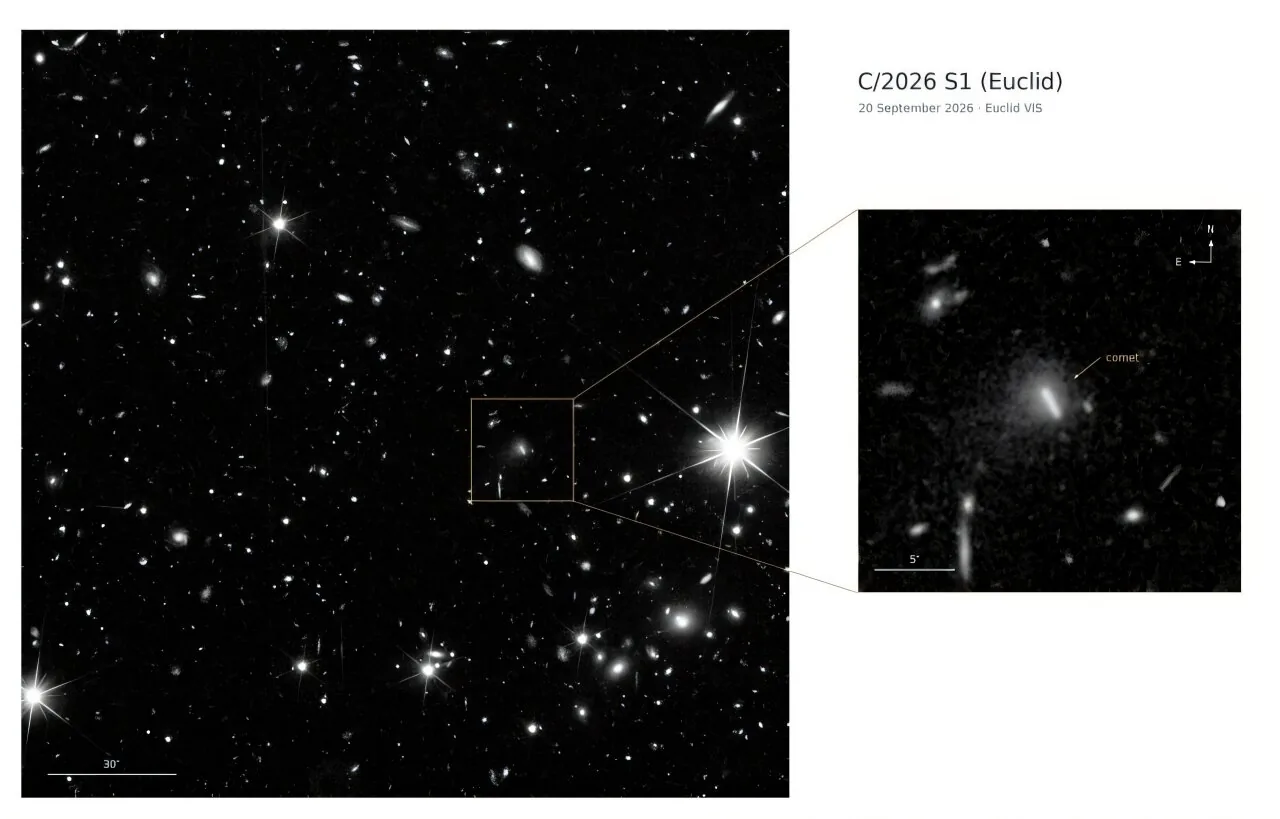
The European Space Agency’s Euclid space telescope has detected its first previously unknown comet while surveying regions far beyond the solar system. The Euclid comet, officially designated as C/2026 S1 (Euclid), appeared in survey images captured between September 16 and September 24, 2026 [2]. Located about 1.3 billion kilometers, or 810 million miles, from Earth, the distant body occupies an orbit between Jupiter and Saturn from the perspective of the Sun. While the observatory was designed to record billions of distant galaxies, automated detection code spotted the faint wanderer as it swept through background star fields [1].
How Software Flagged the Euclid Comet
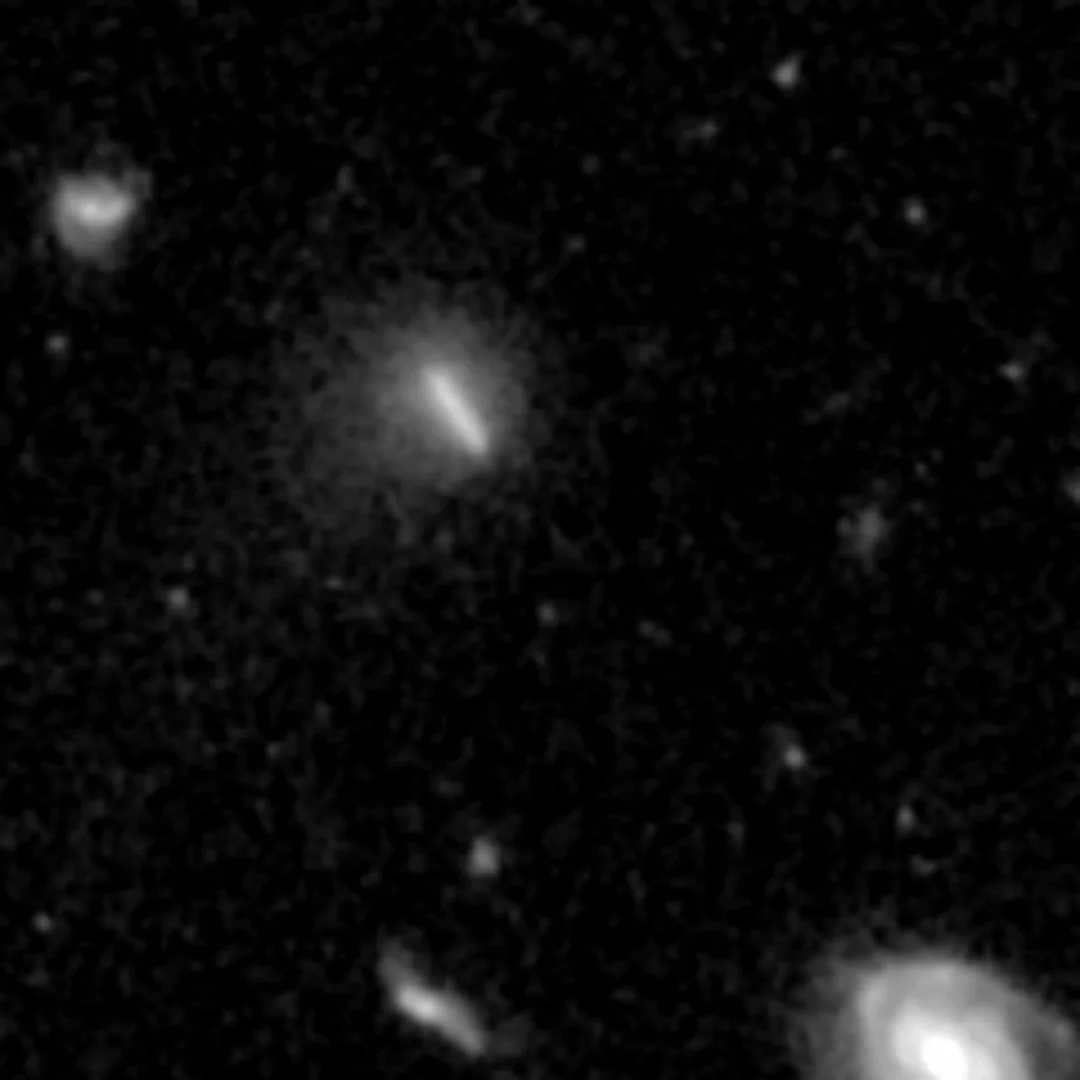
Mikko Pöntinen, a doctoral student at the University of Helsinki, found the moving streak while testing search algorithms on European Space Agency mission images. Pöntinen wrote the code for the Solar System Objects Science Working Group within the Euclid Consortium to track small bodies moving in front of distant stars [2]. “I was excited to see my software flag a ‘streak’ smeared across several images—the result of a fast-moving object,” Pöntinen said. “By predicting its position, I could identify it in other images, in total finding it in five image sets,” he added. Further checks revealed a fuzzy cloud around the nucleus, showing that gas and dust were shedding from an active surface [1].
The detection occurred in a sky zone called the Euclid Deep Field North. Over several days of scanning, the telescope imaged the object across five fields of view, taking between two and four exposures per field to produce 16 exposures in total. An uncataloged body in that quiet corner surprised the team because the survey field was picked for deep extragalactic studies rather than solar system tracking [2].
Eight scientists from the working group assisted in verifying the coordinates against sky maps. The team included M. Pöntinen, A. A. Nucita, A. Franco, M. Granvik, B. Altieri, S. Kruk, B. Y. Irureta-Goyena, and B. Carry [2]. As reported by scientific editor Swati Mestri and senior editor Robert Egan for Phys.org, the discovery exposures were recorded between Sept. 16 and 24, 2026 [1]. Their automated software flagged the movement of the Euclid comet across five visual frames without confusing it with detector flaws [2].
Confirming an Unknown Icy Traveler
Pöntinen and his colleagues compared the new coordinates with orbital catalogs maintained for known comets and asteroids, finding no matches in any global database to confirm that the object was unknown to planetary science. Pöntinen reported the observations to the Minor Planet Center, which operates under the International Astronomical Union [1]. The Minor Planet Center serves as the world clearing house for small bodies, verifying new finds and computing initial orbits [2].
The alert enabled ground astronomers to aim their telescopes at the predicted path and gather confirmation frames. On October 8, the Minor Planet Center officially confirmed the object as a comet and gave it the designation C/2026 S1 (Euclid) [1]. Earlier images taken by Euclid had captured comets, but all of them were previously cataloged objects [2]. This detection was the first brand-new comet discovered by the telescope. Solar heat evaporating surface ice created a visible coma of gas and dust as the body traveled [1]. Primordial remnants like this help researchers trace planetary origins, much like how early dust barrier models near Jupiter explain the distribution of primitive grains [2].
The Euclid Comet Arcs Over the Solar System
The Euclid comet currently drifts roughly 1.3 billion kilometers from Earth, which works out to about 810 million miles. That places the object at a solar distance comparable to the vast gulf between Jupiter and Saturn. It does not share the orbital plane where Earth and other planets travel [1]. From the Sun’s vantage point, the comet sits almost straight up, arching high over the solar system along an orbit that takes thousands of years to finish one journey [2].
Comets are icy, dusty leftovers from the birth of the solar system about 4.6 billion years ago. Most comets originate in the distant Kuiper Belt or the far Oort Cloud beyond the outer planets. Interstellar comets drift in from other star systems, but C/2026 S1 belongs to our Sun. Because solar system comets have changed little since they coalesced, analyzing them gives scientists clues about the raw materials that built planets. They also carry clues about where Earth’s water and organic building blocks originated [2].
Ground observatories will track C/2026 S1 across upcoming seasons to refine its orbital period and measure how its coma behaves as it moves. A steep incline helps planetary researchers understand orbital dynamics in the deep solar system, much as tracking orbital cycles in the Martian year provides a steady timeline for mapping atmospheric shifts on Mars. The Minor Planet Center will update orbital estimates as more observatories submit data points [2].


Why Euclid Avoids the Planetary Plane
Comet hunting was never the goal of the Euclid mission [1]. The spacecraft uses a step-and-stare survey approach to observe the shapes and motions of billions of galaxies out to 10 billion light-years for the European Space Agency and NASA. Over its six-year mission, it seeks to map the influence of dark matter and dark energy across cosmic history [2]. To obtain sharp views of faint, distant galaxies, the telescope points away from the dusty band of sky that lines the planetary plane. Sunlight bouncing off interplanetary dust grains produces unwanted glare that obscures deep cosmic structures [1].
Why does an extragalactic observatory care about solar system objects? Because moving objects streak through images, scientists must detect them to remove optical noise from galaxy maps [2]. In addition, the telescope’s step-and-stare mode visits each sky patch only once, so astronomers cannot return to a comet on demand. That makes capturing the Euclid comet a fortunate event. “Very few comets are expected to be discovered by Euclid, so it was a happy coincidence that the combination of the comet’s orbit and Euclid’s scanning over those days captured the object in multiple images,” Bruno Altieri, Euclid archive scientist at the European Space Agency, said [1].
Testing Ground for Comet Interceptor
The speed of the discovery provides a proving ground for planetary defense and exploration concepts. The European Space Agency is preparing the Comet Interceptor mission, which will park a spacecraft at a stable Lagrange point to wait for an incoming pristine comet from the outer solar system. Early target detection while objects stay far from the Sun gives flight controllers time to calculate an intercept path before ice sublimates. Even though C/2026 S1 will not serve as a target for Comet Interceptor, the exercise tested how data moves from detection to orbital validation [1].
Valeria Pettorino, Euclid project scientist at the European Space Agency, pointed out the value of the detection for planetary teams. “While this particular comet is not a suitable candidate for Comet Interceptor, the process of discovery and alert gives us a real test case for how our two mission teams will coordinate in the future,” Pettorino said. “And we are of course happy to have discovered a previously unknown comet for the solar system community to follow up on,” she added. Ground observatories will use those coordinates to monitor how gas production changes as the Euclid comet moves along its path [1].
Euclid Mission Architecture and Science Goals
An observatory capable of capturing both distant galaxies and faint moving comets took a wide international collaboration. Euclid is a European mission built and operated by ESA, with contributions from its Member States and NASA. ESA selected Thales Alenia Space as the prime contractor to construct the satellite and service module, while Airbus Defence and Space developed the payload module housing the telescope and visual optical systems. NASA provided the near-infrared detectors for the Near-Infrared Spectrometer and Photometer, known as NISP [2].
Scientific leadership and instrument design rest with the Euclid Consortium, which brings together more than 2,000 scientists from 300 institutes across 15 European countries, the United States, Canada, and Japan. The spacecraft operates as a medium-class mission within ESA’s Cosmic Vision Programme. By measuring the subtle bending of light caused by mass across cosmic time, the observatory creates a 3D map spanning billions of light-years. That map will help cosmologists examine how the invisible components of the universe dictate the growth of cosmic structure [2].
While cosmology stands as the main driver for the mission, accidental solar system finds show the flexibility of deep sky sensors. Observations of high-inclination icy bodies help astronomers refine models of outer solar system architecture, where researchers investigate potential orbits such as hypothetical orbits proposed for Planet Nine. As Euclid continues its six-year sky survey, automated pipelines will keep monitoring every image set for moving streaks. Each new detection gives astronomers another chance to inspect ancient icy material before it plunges into the warm inner solar system [2].
- ONLINE NEWS Mestri, S., & Egan, R. (2026, October 19). Euclid discovers its first new comet 810 million miles from Earth. Phys.org. [Article Link]
- PRESS RELEASE European Space Agency. (2026, October 19). Euclid discovers new comet. ESA Science & Exploration. [Article Link]
APA 7: PerEXP Teamworks. (2026, October 20). Euclid Space Telescope Discovers Its First New Comet.


