





Can a pinch of cosmic gravel reshape what scientists know about the birth of our planetary system? When NASA delivered the pristine asteroid Bennu sample to ground laboratories, geochemists anticipated finding a simple relic from the icy fringes of deep space. Instead, isotopic analysis of the dark rubble from asteroid (101955) Bennu revealed a chemical puzzle that points to the orbital influence of young Jupiter. The findings indicate that Bennu grew near an ancient water-ice boundary where inner and outer solar system dust mixed together [1].
Pristine Grains from Asteroid Bennu Sample
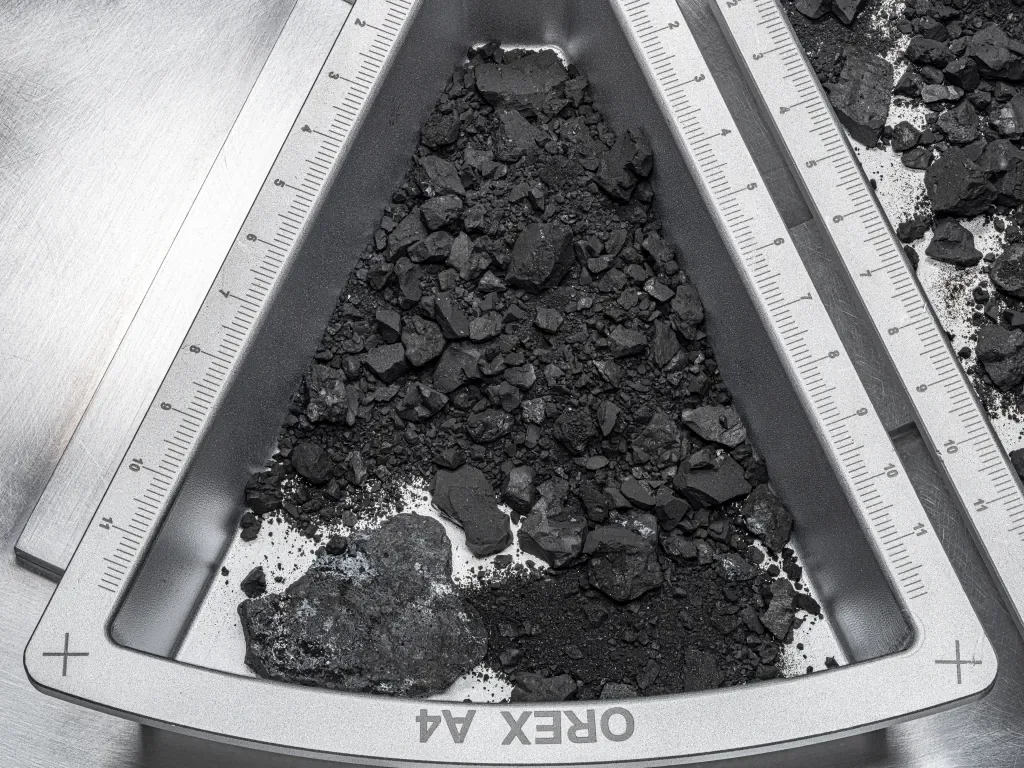
The retrieval of this ancient material began in October 2020 when NASA’s OSIRIS-REx spacecraft touched down on the surface of asteroid Bennu. After securing the dust, the robotic explorer traveled millions of miles through interplanetary space until its sample capsule safely touched down in Utah on September 24, 2023 [3]. Ground teams quickly found that the recovery effort yielded 121.6 grams of material (more than twice the required target). Because these dark grains avoided the blistering heat of atmospheric entry that melts conventional meteorites, they survived completely unheated to give researchers an uncontaminated window into planetary beginnings [2].
Curators distributed tiny pinches of the dark asteroid Bennu dust to research institutions worldwide. At ETH Zurich, a team directed by Professor Maria Schönbächler received half a gram to examine nucleosynthetic isotopes [1]. Schönbächler said that even this modest pinch of dust contained millions of individual mineral grains, each carrying untouched chemical fingerprints from the earliest moments of the solar nebula [2]. Her laboratory prepared the dust for high-precision mass spectrometry to check whether Bennu matched other carbonaceous space rocks [1].
Working with researchers from Lawrence Livermore National Laboratory, the Zurich team published their results in the journal Science Advances. Their work gave planetary scientists a clean look at nebular matter. The dust grains revealed a startling mixed chemical signature [1].
Why Is the Asteroid Bennu Sample Important?
The asteroid Bennu sample is important because it provides pristine, unbaked planetary building blocks that formed 4.6 billion years ago without suffering atmospheric melting or chemical contamination on Earth [2]. Most meteorites that strike Earth undergo intense heating, which burns away volatile compounds and alters delicate minerals. While previous analyses of asteroid dust recovered from terrestrial collection sites struggled with atmospheric alteration, pristine material brought back by the OSIRIS-REx mission offers an uncontaminated baseline. Because the spacecraft capsule protected the rocks in deep space, geologists can evaluate raw nebular chemistry in its original state [3].
Before the mission retrieved actual samples, scientists classified Bennu as a CI chondrite (a rare subgroup of carbonaceous asteroids) rich in water and volatile elements. These space rocks are exceedingly rare on Earth. Scientists have cataloged only 10 CI meteorites in history, representing less than 0.0127% of all cataloged meteorite falls because fragile carbonaceous bodies almost always disintegrate into fiery shooting stars during atmospheric descent. Pristine research material remained virtually nonexistent before Bennu’s return [2].
Pristine fragments from Bennu gave geochemists their very first opportunity to test whether CI chondrites truly originated in the cold outer solar system [2]. Researchers expected a complete match with outer disk bodies. But laboratory instruments showed that Bennu carried markers from both sides of the asteroid belt [1].
Bennu Sample Findings Reveal Split Chemical Identity
Isotopic signatures act like fingerprints that reveal where planetary ingredients condensed in the young solar system [2]. During the formation of our newborn Sun 4.6 billion years ago, circulating clouds of gas and dust failed to stir in an even pattern. This patchy distribution left distinct orbital regions with unique isotopic proportions of iron, titanium, and chromium [1]. Over time, space rocks divided into two separate families: Non-Carbonaceous rocks born in the warm inner solar system near Earth, and Carbonaceous bodies that gathered in the freezing outer system [2].
When the team tested the asteroid Bennu sample, the titanium and chromium isotopes matched what was expected for Carbonaceous bodies from the outer solar system. But iron told a contrasting story. For iron, Bennu looked like rocks that formed closer to the Sun [2]. Rather than fitting neatly into a single orbital category, Bennu possessed a startling split identity that blended ingredients from both sides of the young solar system [1].
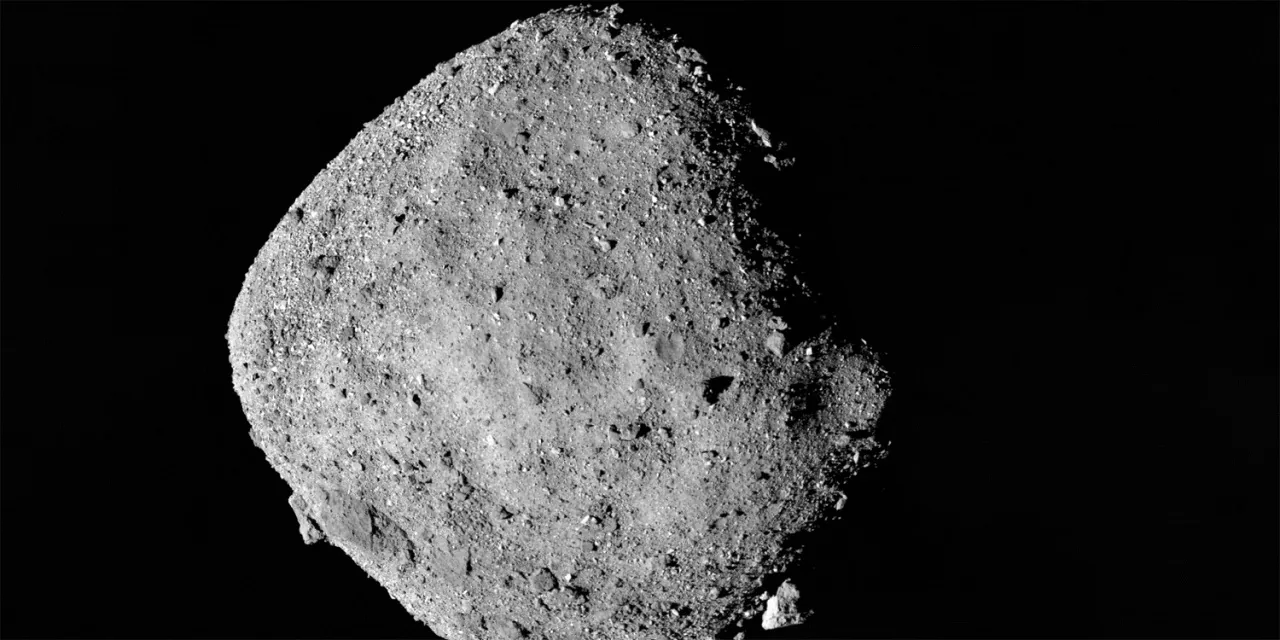
High-precision laboratory comparisons revealed that iron and titanium proportions in Bennu aligned closely with measurements from asteroid Ryugu as well as CI meteorites. That chemical alignment suggests that their parent bodies formed from the same reservoir of cosmic dust [3]. But why would a single dust reservoir hold iron from the inner disk while retaining chromium from the outer disk? Finding the answer needed the team to calculate when Bennu began to grow [2].


Why Is Asteroid Bennu Considered a Time Capsule?
Asteroid Bennu is considered a time capsule because it preserves unaltered dust grains that assembled about 2 million years after the first solid rocks formed in the solar system. Geochemists dated the material using the radioactive decay of manganese-53, which decays over time into chromium. The rapid assembly date places Bennu in the earliest chapters of solar system history. In the distant outer solar system, assembling a sizeable asteroid would have required far longer than 2 million years because planetary building blocks were distributed too sparsely across space to coalesce quickly [2].
Elemental ratios in the sample also challenged an origin in the deep outer fringes of the planetary system. Comets born in distant orbits carry elevated ratios of heavy hydrogen and heavy nitrogen. Bennu lacks these heavy volatile signatures, providing clear confirmation that it did not coalesce in comet-forming zones far from the Sun. Planetary scientist Jamie Molaro, who examined Bennu during the OSIRIS-REx mission, said that pristine boulders on the asteroid preserve an untouched record of early conditions [2]. Furthermore, the returned dust holds abundant water locked inside hydrous clay minerals, confirming that ice was present when the parent body formed in the cold protoplanetary nebula [3].
Geochemists faced a puzzle that demanded a fresh explanation. Bennu needed to coalesce rapidly in an orbital zone cold enough for water to freeze into ice, yet close enough to the young Sun to gather abundant inner disk iron [1]. To explain how these contrasting materials merged into one body, researchers turned to the orbital influence of Jupiter [2].
How Growing Jupiter Filtered Early Cosmic Dust
As the young solar system took shape, the swift gravitational growth of Jupiter completely changed the distribution of gas and dust circling around the newborn Sun [1]. When Bennu began forming, Jupiter had reached twenty three times Earth’s mass [2]. Its orbital motion carved a wide swath through the protoplanetary disk, establishing prominent pressure ridges inside and outside its orbit that served as a natural filter in the protoplanetary cloud [3].
Jupiter’s gravitational barrier affected particles based on particle size. Millimeter-sized molten droplets called chondrules (molten droplets that condensed in the nebula) became trapped in pressure gaps outside Jupiter’s orbit, which stopped them from continuing their inward journey to the newborn Sun [2]. In contrast, fine dust grains drifted inward past Jupiter’s orbit with minimal resistance, mixing directly with native nebular dust that was already orbiting in the inner solar system [1].
Earlier discussions examining whether Jupiter acts as a protective shield against cosmic catastrophes focus on its role in deflecting comets, but new isotopic data shows how early Jupiter divided dust reservoirs. By stopping coarse pebbles while letting fine dust filter through, Jupiter created conditions for unique mixing. The giant planet effectively determined the specific dust recipe that built Bennu’s parent body [1].
Water-Ice Line Traffic Jams and Inward Migration
Jupiter’s pressure ridges lined up with another important feature: the water-ice line [1]. Just inside Jupiter’s orbit, temperatures in the young nebula dropped low enough for water vapour to freeze into ice [3]. When drifting cosmic dust encountered this water-ice line alongside the planet’s gravitational pressure ridges, the rapid deceleration caused particles to accumulate in immense concentrations and collapse inward under their own collective gravity [2]. Ice helped these fine particles stick together, acting like glue to build asteroid seeds [3].
As the asteroid seeds grew, dust continued streaming in from the outer solar system. These incoming grains settled onto Bennu like cosmic sedimentary layers, blending outer disk chromium and titanium with inner disk ingredients already present in the parent body [2]. This sequence explains why the asteroid Bennu sample carries so much water while preserving its split isotopic chemistry [1]. Bennu captured water ice from the local freeze line while gathering dust from both sides of Jupiter [3].
After forming near the water-ice line, the parent body did not stay in place. Over billions of years, millions of collisional shoves and gravitational nudges shifted the asteroid’s orbit inward until it became a Near Earth Asteroid [2]. Schönbächler said that while this formation model cleanly accounts for the chemical data, planetary scientists must examine additional asteroids to establish the full extent of Jupiter’s gravitational influence. The returned dust has opened an extraordinary window into planetary beginnings, yet many cosmic secrets remain hidden inside the rubble [3].
- ACADEMIC JOURNAL Schönbächler, M., Ek, M., Fehr, M. A., Liszewska, K. M., Meyer, L. A. E., Rüfenacht, M., Ball, J. M. J., Frossard, P., Render, J., Shollenberger, Q. R., Brennecka, G. A., Kruijer, T. S., Wimpenny, J., Bizzarro, M., Barnes, J. J., & Nguyen, A. N. (2026). Nucleosynthetic constraints on the origin of Bennu and CI-like asteroids. Science Advances, 12(39). [Article Link]
- ONLINE NEWS Tomaswick, A. (2026, October 2). Asteroid Bennu Has an Identity Crisis, and Jupiter Might Be to Blame. Universe Today. [Article Link]
- WEBSITE Knowridge Science Report. (2026, October 3). How Ice and Jupiter Helped Build Asteroid Bennu. Knowridge. [Article Link]
APA 7: TWs Editor. (2026, October 4). Asteroid Bennu Sample Uncovers Jupiter’s Early Dust Barrier. PerEXP Teamworks.


