






A limestone Roman sarcophagus unearthed at Westminster Abbey in London bears an inscription for a Roman citizen, yet tests show the skeleton inside belonged to an early medieval monk who died centuries later. The stone coffin was carved during Roman rule, but the man buried inside passed away around the year 1000 and served as an abbot of Westminster [1]. Monastic archives at Westminster Abbey left his identity unconfirmed for generations after Victorian workers dug the coffin out of church grounds [2]. New scientific analysis of the bones and a radiocarbon test conducted for Westminster Abbey show that the occupant was a high-ranking church leader from the late Anglo-Saxon era [1].
A Fourth-Century Coffin in a Saxon Abbey
Stoneworkers carved the coffin in the fourth century from a single block of limestone quarried in south Oxfordshire. An inscription cut into its side explains that two sons, named Valerius Superventor and Valerius Marcellus, ordered the stone chest for their father, Valerius Amandinus [1]. Historians know nothing else about Amandinus, though the neat lettering suggests that he was a wealthy individual who held high status in Roman London [2].
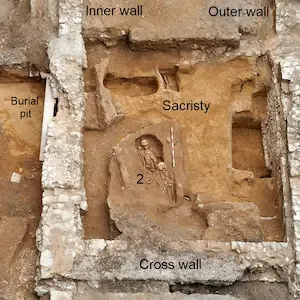
Prof Warwick Rodwell, consultant archaeologist at Westminster Abbey, said the coffin was likely housed in the wall recess of a mausoleum [2]. No other Roman graves have ever turned up anywhere in the immediate vicinity of Westminster Abbey. Centuries later, Anglo-Saxon Christians chose the ancient container for a new burial. The lid carried a Latin cross nearly 6 feet (1.8 meters) long that ran along its upper surface. Stone samples taken in 2008 showed that the lid and the lower box came from the same geological bed, proving that Anglo-Saxon craftsmen modified the original Roman lid instead of carving a replacement [1]. As Rodwell wrote in the Journal of the British Archaeological Association, the cross matches tenth-century Christian designs [2].
Early Encounters and the 1820 Discovery
Official histories long stated that the coffin came to light in 1869, when the abbey mason Henry Poole dug it out from a yard north of the nave at Westminster Abbey [2]. But a pencil sketch in the abbey archives, overlooked until 2009, recorded an earlier discovery. On Easter Monday in 1820, parish gravediggers hit the heavy Roman sarcophagus underground while digging near the parish church. They broke the lid into six pieces [1].
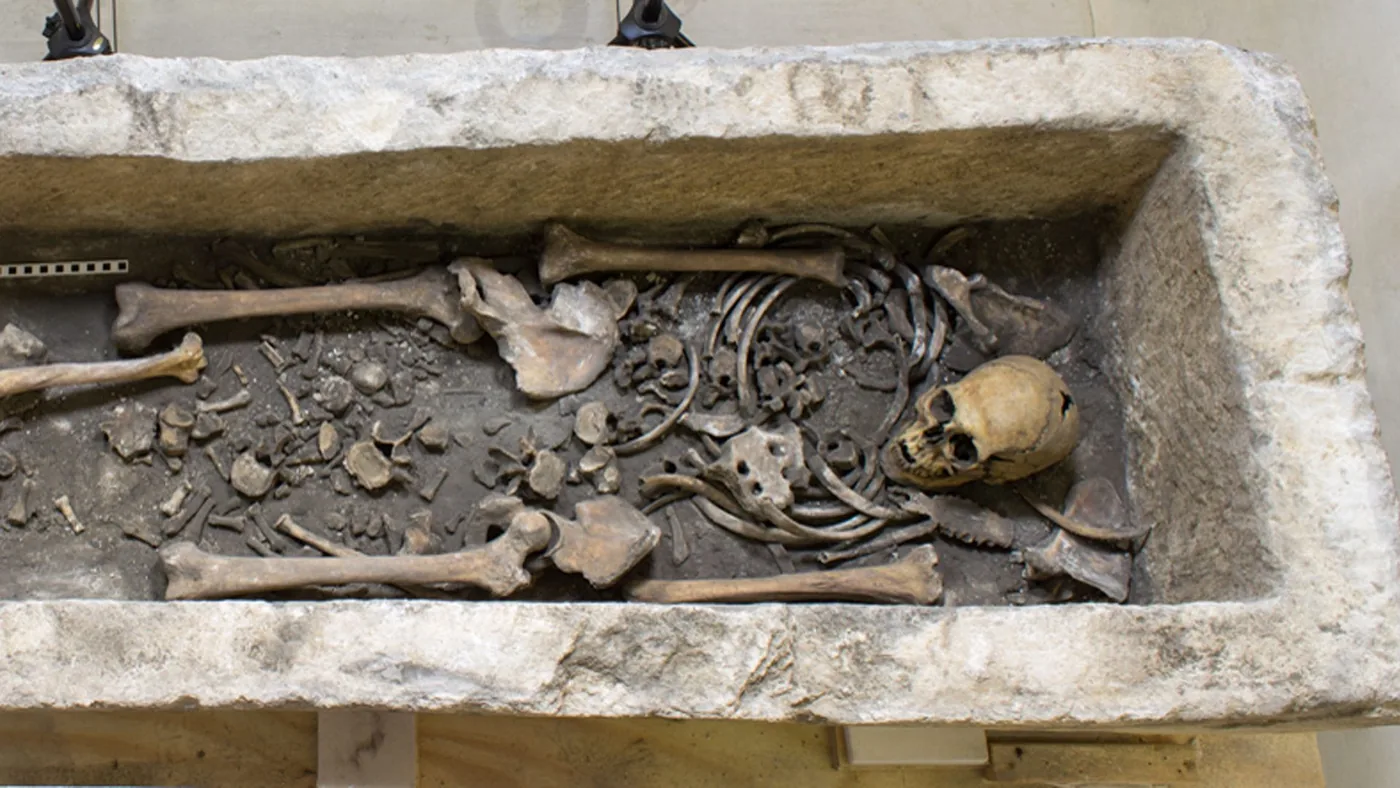
When Poole reopened the site in 1869, the skull lay shattered down near the foot end of the coffin. Drawings created by artist George Scharf recorded the scattered bones where they lay, and the National Portrait Gallery later acquired his original sketchbook. Biologist Thomas Huxley examined the bones with a colleague and judged that they belonged to a robust young man of no more than 30. Workers at Westminster Abbey glued the broken skull back together, wired the pieces in place, and returned the skeleton to the stone box. Then, in an 1873 letter, the abbey architect declared the skeleton “unquestionably lost,” and researchers accepted his claim for the next 143 years [1].
The Roman Sarcophagus in 2016
The lost bones were never missing. In 2016, conservators took off the lid while cleaning the stone box in a studio before placing it on display [1]. As part of plans to show the coffin in the Queen Diamond Jubilee Galleries, archaeologists from Pre-Construct Archaeology opened the chest and found the skeleton still resting inside. “And there, inside it, was the skeleton,” Prof Warwick Rodwell said [2]. It was 90 percent complete, although earlier handlers had placed two shin bones where the arms belonged [1].
James Langthorne, a bone specialist at Pre-Construct Archaeology, carried out a thorough study of the skeleton. Langthorne found that the man was between 35 and 49 years old when he died, making him at least five years older than Huxley’s Victorian estimate. The man stood about 5 feet 9 inches (1.75 meters) tall, which was two inches taller than Huxley believed. His teeth were complete and showed no decay. The skeleton showed arthritis in the shoulders, spine, right wrist, and left big toe, with two healed rib fractures and an infection in his lower right leg, though nothing on the bones revealed how he died [1].

Traces of Lime and a Wooden Coffin
Cleaning the floor of the chest turned up a sharp white rectangle that sat 3 to 4 inches (8 to 10 centimeters) in from the limestone walls. Victorian observers had seen that same residue as a paste on the bones. “The biggest surprise was discovering deposits of lime adhering to some of the bones,” Rodwell said. “This immediately told us that the corpse had been surrounded by powdered lime” [1].
The white outline showed that workers had placed a timber coffin inside the stone sarcophagus. Clergy filled the wooden box with powdered lime before burying their dead leader, a careful ritual that preserved the outline of the timber container long after the boards rotted away [1]. Prof Warwick Rodwell explained that such preparation pointed to an ecclesiastic of very high rank. “Nobody of lower rank would have been buried in anything like that,” Rodwell said. “The Latin cross again points to a major ecclesiastic,” Rodwell said, explaining that such prestige belonged to an Anglo-Saxon abbot [2].
Which Abbot Lay Inside the Roman Sarcophagus?
To test whether the skeleton dated from Roman antiquity or the early medieval period, researchers sent a bone sample to the Scottish Universities Environmental Research Centre. Radiocarbon dating yielded a calendar span between 987 and 1052 AD. “The result was conclusive,” Rodwell said. Three men led the Westminster monastery as abbot between 988 and 1049, but Wulfsige was ruled out because he left Westminster to become bishop of Sherborne [1].
Which abbot was laid to rest inside the repurposed coffin? That left two viable contenders: Abbot Ælfwig, who led the Westminster community from 993 to about 1020, and his successor Wulfnoth, who died in 1049. “We have two viable contenders for the occupant of the sarcophagus,” Rodwell said. “We do not know the date of birth of either. But either would fit equally well if we assume the Abbot was in his early twenties when the appointment was made and close to fifty when he died” [1]. According to Prof Warwick Rodwell, Ælfwig appears the stronger candidate because he had already lived as a Westminster monk before spending roughly 27 years leading the abbey [2]. Neither radiocarbon dating nor DNA can choose between the two men because no independent genetic lineage exists for comparison, and diggers found no staff, ring, or plaque inside the grave [1].

A Relocated Coffin Under Henry III
Burial evidence indicates that monks placed the coffin in the Anglo-Saxon abbey church before Edward the Confessor rebuilt the sanctuary in the 1050s [1]. The stone chest sat in the floor of the eastern arm of the church at Westminster Abbey, where the carved lid served as a grave slab [2]. About two centuries of foot traffic gradually wore down the raised cross. Nobody else was buried beside it [1].
When King Henry III began pulling down the old church in 1245, stonemasons moved prominent burials as construction advanced. Workers finished Henry III’s new sacristy around 1258 and reburied the coffin in the yard, hiding it at least 2.5 feet (75 centimeters) beneath the medieval ground level. The Roman sarcophagus remained buried there until laborers struck the lid on Easter Monday in 1820 [1]. For Rodwell, the long investigation showed how an ancient object gained a fresh purpose through a thousand years of English history at Westminster Abbey. “It’s like so much in archaeology,” Rodwell said. “There’s a lot more complication than one initially sees” [2].
- ONLINE NEWS Arrais, L., & Ralls, E. (2026, October 21). Archaeologists solve part of a 1,000-year-old Westminster Abbey mystery. Earth.com. [Article Link]
- ONLINE NEWS Davis, N. (2026, October 21). Mystery of Roman sarcophagus unearthed at Westminster Abbey solved at last, expert says. The Guardian. [Article Link]
APA 7: PerEXP Teamworks. (2026, October 22). Westminster Roman Sarcophagus Held an Anglo-Saxon Abbot. PerEXP Teamworks. https://perexpteamworks.com/en/roman-sarcophagus-westminster-abbey/


