




The number of researchers producing over 60 papers a year has surged, with up to four times more individuals engaging in such prolific publication compared to less than a decade ago, according to a preprint posted on bioRxiv on November 24. Notably, Saudi Arabia and Thailand experienced the most significant increase in the prevalence of these highly productive scientists in recent years. The rise in the number of these ‘extremely productive’ authors raises concerns about potential questionable methods employed to generate additional papers.
John Ioannidis, a study co-author and a physician specializing in metascience at Stanford University in California, suspects that some of the extreme publication behaviors may be linked to questionable research practices and fraud. The researchers conducted an analysis of articles, reviews, and conference papers indexed in the Scopus database from 2000 to 2022, excluding physics authors due to distinct authorship practices in that field. They observed changes in extremely productive authorship over time across various countries and fields.
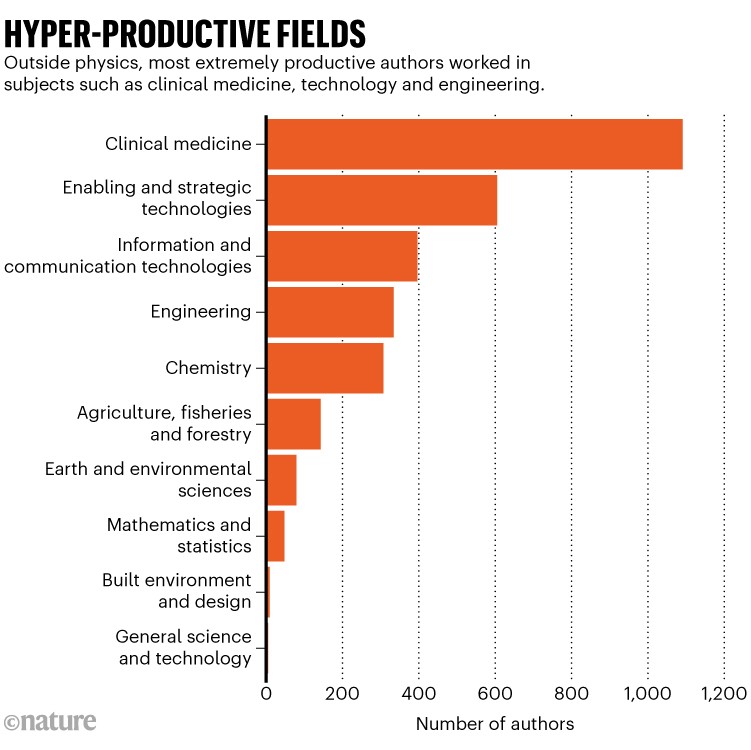
Clinical medicine emerged as the field with the highest number of extremely productive authors outside physics, with nearly 700 such researchers in 2022. Agriculture, fisheries, and forestry witnessed the most rapid growth in extremely productive researchers, increasing by 14.6 times between 2016 and 2022, followed by biology, and mathematics and statistics.
In 2022 alone, 1,266 non-physics authors published the equivalent of one paper every 5 days, including weekends, compared to 387 in 2016. This unexpected acceleration since 2016 is noteworthy, as an earlier analysis indicated a plateau in extreme productivity around 2014. Ioannidis emphasizes the urgency of addressing these issues across all scientific disciplines based on their data findings.
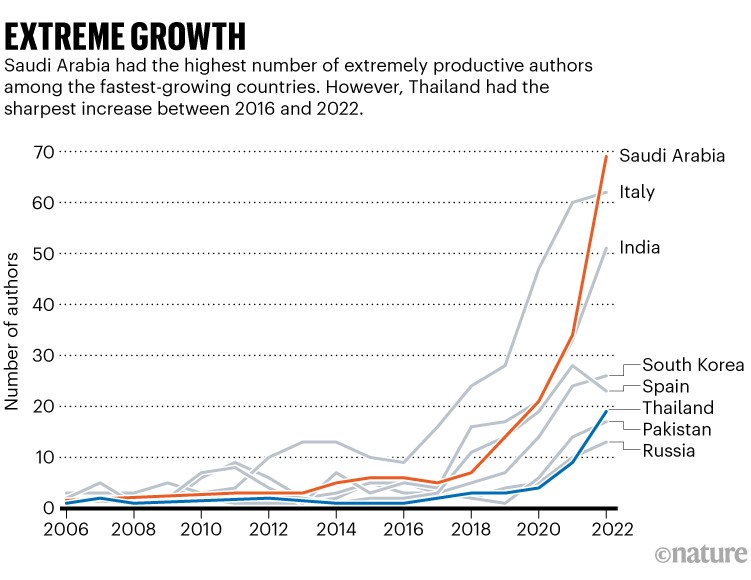
Between 2016 and 2022, the majority of countries witnessed a more than twofold increase in the number of extremely productive authors outside the field of physics, with some nations experiencing even more substantial jumps (refer to ‘Extreme growth’). Thailand displayed the most significant relative increase, surging from 1 extremely productive author in 2016 to 19 in 2022. On the other hand, Saudi Arabia recorded the largest growth in absolute terms, escalating from 6 to 69 extremely productive authors during the same period.
Tirayut Vilaivan, a member of the Office of Academic and Research Integrity at Chulalongkorn University in Bangkok, which is responsible for developing research policies and standards, expresses concern over Thailand’s sudden increase in extreme productivity. While acknowledging that Thailand has only a small number of authors producing high volumes of papers annually, Vilaivan emphasizes the need to address this issue, stating, “We cannot ignore that.”
The factors
The increase in extremely productive authors in Thailand may be influenced, in part, by changes in the country’s research-funding system. This shift favors larger interdisciplinary teams over smaller groups, providing researchers with greater opportunities to contribute to more papers. David Harding, a chemist at Suranaree University of Technology in Nakhon Ratchasima, Thailand, notes that Thailand has undergone a substantial transformation of its research ecosystem to enhance productivity.
Additionally, the emphasis on university rankings in Thailand contributes to the rise in publication numbers. University rankings often rely on metrics such as publication counts, leading to incentives for researchers to publish more. Tirayut Vilaivan highlights that cash incentives, sometimes amounting to up to 1 million Baht (US$28,000) per year, are offered by many Thai universities to encourage researchers to publish in prestigious journals. This approach creates a dynamic where researchers, aiming to optimize incentives, may contribute to the observed surge in extreme productivity.
The convergence of an escalating ‘publish or perish’ culture and a monetary reward system establishes a conducive environment for unscrupulous actors to thrive, emphasizes Tirayut Vilaivan. He notes that amid the pandemic, there has been an emergence of paper mills in Thailand, illicit enterprises that engage in selling fake papers to researchers.
The questionable practices and the crackdown on them
Thailand has initiated investigations into researchers exhibiting an unusually high number of published papers. In January, the Ministry of Higher Education, Science, Research and Innovation conducted a probe to examine potential misconduct at Thai universities. The investigation targeted researchers with remarkably prolific publication records or numerous papers outside their expertise. The findings revealed that 33 researchers across 8 universities had engaged in paid authorship, and numerous others were suspected of falsely claiming authorship on papers they had purchased.
John Ioannidis suggests that to curb the increasing prevalence of extremely productive authors, research institutions and funding agencies should shift their focus from the quantity to the quality of a researcher’s work. He argues that evaluating scientists based on the quality of their work rather than the volume of papers would discourage the practice of cutting corners. Ioannidis emphasizes that the number of papers should not be considered inherently positive or negative in assessing a researcher’s contributions.
Resources
- JOURNAL Conroy, G. (2023). Surge in number of ‘extremely productive’ authors concerns scientists. Nature. [Nature]
- JOURNAL Ioannidis, J. P. A., Collins, T. R., & Baas, J. (2023). Evolving patterns of extremely productive publishing behavior across science. bioRxiv (Cold Spring Harbor Laboratory). [bioRxiv (Cold Spring Harbor Laboratory)]
- JOURNAL Ioannidis, J. P. A., Klavans, R., & Boyack, K. W. (2018). Thousands of scientists publish a paper every five days. Nature, 561(7722), 167–169. [Nature]
Cite this page:
APA 7: TWs Editor. (2023, December 12). Scientists Worry About the Rise of ‘Extremely Productive’ Authors. PerEXP Teamworks. [News Link]