






Frozen shoulder can leave an adult unable to reach into an overhead kitchen cupboard or put on a heavy winter coat without experiencing sharp, lasting joint pain. The condition often develops without an obvious mechanical trigger as ordinary daily arm motions turn into ongoing challenges. Recent research examining blood sugar patterns and human genetic data now explains how glucose health shapes joint mobility over time [3].
Frozen Shoulder Symptoms and Clinical Signs
Joint pain often begins quietly before stiffness sets in, turning simple arm motions awkward and painful over several months as the shoulder loses its normal range of motion. Pain is often the first symptom to appear, and it tends to grow worse at night when people lie in bed. The flexible tissue surrounding the joint, known as the shoulder capsule, gradually “thickens and tightens” until normal arm rotation fades away [2].
Physicians and physical therapists look for distinct diagnostic clues during clinical exams of joint tightness, especially when tight capsule tissue halts outward arm rotation during passive movement tests. Epidemiological records estimate that frozen shoulder impacts between 2% to 5% of adults across their lifespans. The disorder surfaces mostly among people between ages 40 and 60, with health surveys showing a higher frequency in female patients [3].
Joint stiffness can follow an injury or surgical procedure that keeps a person from moving the arm normally for weeks. In many cases, however, stiffness arises on its own without any past trauma. Although recovery often needs months or even years, clinical records confirm that capsule flexibility tends to improve gradually over prolonged healing as joint tissues recover [2].
Diabetes Rates in Joint Restriction
Metabolic health shapes how joint tissues heal, leaving people who live with diabetes at an elevated risk of developing painful immobility across their upper limbs over time. In type 1 diabetes, the pancreas stops making insulin, the hormone that clears sugar from the bloodstream. In type 2 diabetes, cells either resist insulin signals or the pancreas fails to release enough hormone to maintain healthy balance. Both forms leave sugar levels high in blood over long spans [3].
Long-standing diabetes frequently impairs upper limb mobility. In a 2014 observational survey, nearly a third of participants who had managed type 1 diabetes for an average of 31 years reported a prior diagnosis of frozen shoulder. Separate genetic analyses completed in 2021 reinforced that finding by confirming that inherited vulnerabilities tied to type 1 diabetes heighten the risk of chronic joint tightness [2].
Broader systematic reviews reinforce these clinical observations across international cohorts. In 2023, lead investigator B. P. Dyer, along with co-authors T. Rathod-Mistry, C. Burton, D. van der Windt, and M. Bucknall, published a detailed meta-analysis in BMJ Open. Their research team searched major medical databases including MEDLINE, Embase, CINAHL, AMED, PsycINFO, and Web of Science Core Collection, as well as registries like Epistemonikos, Trip, and PEDro, evaluating six case-control studies covering 5,388 people. Dyer and colleagues applied the Quality In Prognosis Studies tool to calculate that individuals with diabetes faced 3.69 times the odds of developing capsular contracture compared to non-diabetic peers (95% CI 2.99 to 4.56) [1]. Science authors Harry Green and Jonathan Peter Evans said in Medical Xpress that this statistical link shows how chronic glucose regulation impacts peripheral joint structures [2].
How Blood Sugar Stiffens Collagen
How does circulating sugar alter joint tissues? Scientists focus on collagen, the strong protein matrix in the shoulder capsule that loses its natural elasticity when circulating blood sugars react chemically with adjacent protein fibers. These chemical reactions form intermediate molecular cross-links that bind neighboring collagen strands together. That bonding leaves the capsule rigid and limits normal arm rotation [3].
Laboratory tests of surgical biopsies provide physical proof for this stiffening mechanism. In a targeted clinical study, scientists analyzed capsule biopsies taken during joint surgery, detecting higher concentrations of sugar-modified protein bonds in stiff shoulders relative to control patients treated for other shoulder problems. Surgeons preserved these comparative samples during routine joint procedures. The analysis shows that persistent glucose circulation alters capsule fibers over extended periods [2].

Researchers state that more work is needed to determine whether these sugar compounds help cause the initial stiffness. Because scientists evaluated tissue taken after the shoulder had already grown stiff, they cannot yet confirm whether the substances build up before mobility begins to fade. A clear timeline will help determine whether collagen bonding is a root cause or a secondary consequence [3].

UK Biobank Evidence for Metabolic Risk
Researchers Harry Green and Jonathan Peter Evans wrote in The Conversation that large population biobanks provide unique opportunities to evaluate metabolic risk factors [3]. A 2024 investigation analyzed health records from nearly 380,000 UK Biobank participants to test whether persistent glucose elevation accounts for capsular tightness. Specific inherited variations in human DNA predispose certain individuals to higher circulating glucose levels throughout their lives. Because these genetic variants remain permanent from infancy onward, epidemiologists utilize them as an objective “natural experiment” to assess long-term metabolic exposure over many decades. Standard clinical blood draws only reflect short-term glucose levels, but inherited DNA variants track lifelong metabolic tendencies [2].
The UK Biobank study found clear evidence that persistently higher blood sugar makes frozen shoulder more likely over time. Population records connect glucose regulation to tissue health across large groups. The genetic evidence indicates that long-term blood sugar tendencies actively promote capsule tightening [3].

Genetic analysis helps rule out many outside factors that often confuse observational studies. Lifestyle habits and diet can alter blood sugar temporarily, but inherited DNA stays constant from birth to older age, proving that prolonged glucose exposure plays an active biological role in joint tightness [2].
Genetic Variants in Frozen Shoulder Fibrosis
DNA markers also influence joint tissue behavior. A 2021 genome-wide investigation identified five stretches of DNA that correlate with frozen shoulder, with the strongest biological signal mapped directly near a gene designated as WNT7B [2]. This gene coordinates chemical messages between cells, guiding normal tissue maintenance and repair [3].
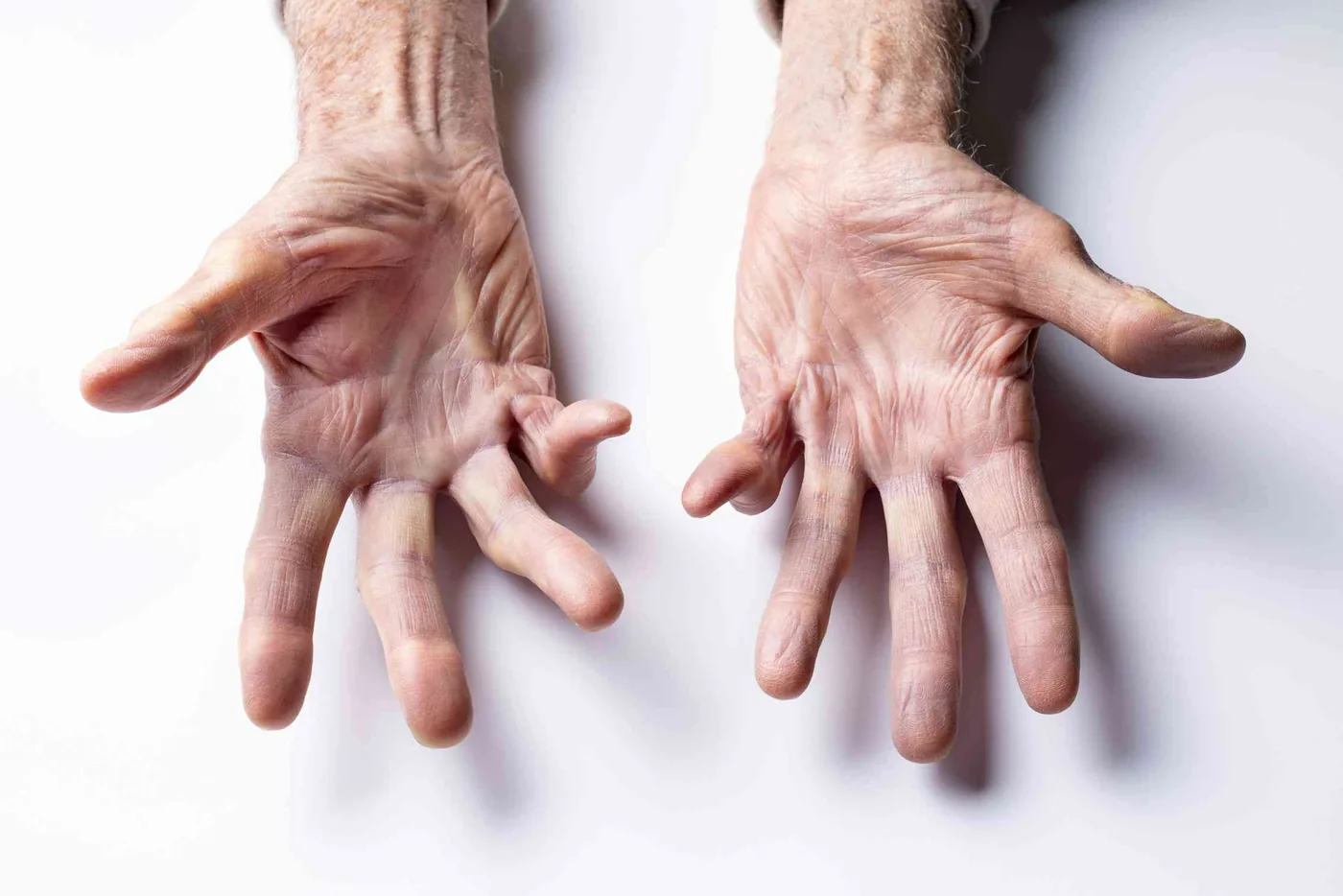
Remarkably, the genetic region surrounding WNT7B also displays strong associations with Dupuytren disease, a fibrotic hand disorder where tissue in the palm thickens and flexes the fingers inward toward the palm. This genetic crossover suggests that the two conditions share biological pathways that cause tissues to tighten and shorten. Patients with Dupuytren disease experience progressive contracture in their hands, just as shoulder patients experience restricted capsule rotation. Both conditions involve tissue changes that slowly limit daily manual dexterity and physical function. The shared genetic signal indicates that both disorders share a common underlying vulnerability in connective tissue regulation [2].

The UK Biobank blood-sugar study uncovered yet another connection between these two joint conditions. Sustained glucose elevation similarly increased the observed incidence of Dupuytren disease within the same genetic cohort. Researchers observed that higher glucose and shared genetic markers work together across distinct anatomical sites, so deep tissues in both the hand and the shoulder tighten over decades of metabolic exposure [3].
Routine Health Checks for Patient Care
People living with diabetes should discuss ongoing shoulder limitations during regular clinical appointments, particularly when nighttime pain or restricted mobility begins to interfere with sleep, driving, or dressing. An early medical consultation allows for prompt physical evaluation before joint immobility becomes more restrictive [3].
Clinicians frequently overlook restricted mobility during routine checkups. Healthcare practitioners benefit from monitoring musculoskeletal mobility alongside standard diagnostic assessments for diabetic retinopathy and renal impairment. A quick clinical test of outward arm rotation takes only moments during routine checkups and can identify tight capsular tissue before substantial joint motion disappears. Early detection helps therapists introduce gentle stretching routines before daily tasks become difficult [2].
Medical scientists still investigate if stricter glycemic management protects against frozen shoulder or speeds clinical recovery after capsular tightness and limited range of motion have already taken hold. Researchers have not yet conducted randomized trials to prove whether lowering blood sugar unbinds collagen fibers in human capsules. For now, maintaining balanced glucose habits and working with therapists on guided arm exercises offer practical help for individuals coping with mobility loss [3].
- ACADEMIC JOURNAL Dyer, B. P., Rathod-Mistry, T., Burton, C., van der Windt, D., & Bucknall, M. (2023). Diabetes as a risk factor for the onset of frozen shoulder: a systematic review and meta-analysis. BMJ Open, 13(1), e062377. [Article Link]
- ONLINE NEWS Green, H., & Evans, J. P. (2026). Got a frozen shoulder? It could be due to your blood sugar and genes. Medical Xpress. [Article Link]
- WEBSITE Green, H., & Evans, J. P. (2026). Got a frozen shoulder? It could be down to your blood sugar and genes. The Conversation. [Article Link]
APA 7: PerEXP Teamworks. (2026, November 28). Blood Sugar and Inherited DNA Influence Frozen Shoulder Risk. PerEXP Teamworks. https://perexpteamworks.com/en/frozen-shoulder-blood-sugar-genes/


