





APA 7: TWs Editor. (2023, November 24). How Scientists Removed Defects to Grow Dolomite Crystals in the Lab? PerEXP Teamworks. [News Link]
Their achievement brings closure to a persistent geological enigma known as the “Dolomite Problem.” Dolomite, a pivotal mineral found in prominent geological formations such as the Dolomite mountains in Italy, Niagara Falls, the White Cliffs of Dover, and Utah’s Hoodoos, exhibits a significant presence in rocks older than 100 million years but becomes notably scarce in formations of more recent origin.
The statement suggests that comprehending the natural growth process of dolomite could offer insights into developing novel approaches for encouraging the crystalline growth of contemporary technological materials. Wenhao Sun, the Dow Early Career Professor of Materials Science and Engineering at U-M and the corresponding author of the paper published in Science, expressed this perspective.
The breakthrough in successfully cultivating dolomite in a laboratory setting involved eliminating defects within the mineral structure during its growth. Typically, when minerals precipitate in water, atoms adhere in an orderly fashion to the edges of the developing crystal surface. In the case of dolomite, however, the growth edge is characterized by alternating rows of calcium and magnesium.
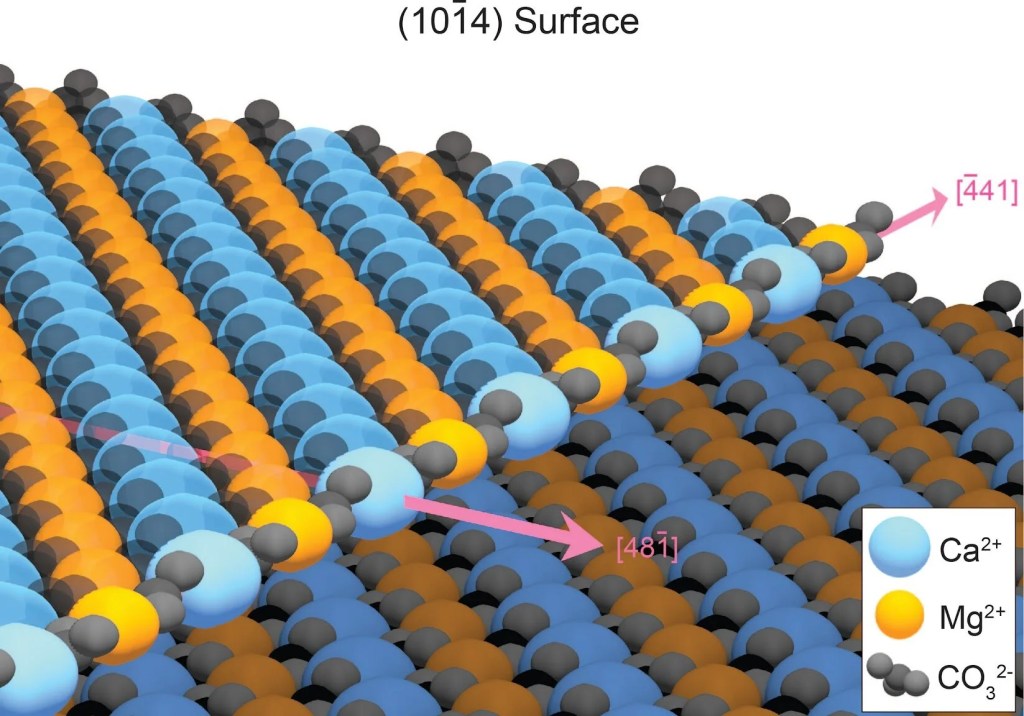
When dolomite crystals form in water, calcium and magnesium tend to attach randomly to the growing crystal. This random attachment often leads to the incorporation of atoms into incorrect positions, resulting in defects. These defects hinder the formation of additional layers of dolomite, causing the growth process to become extremely slow. Under such conditions, it would take approximately 10 million years to produce just one layer of well-ordered dolomite.
Fortunately, the defects in dolomite crystals are not permanent. The atoms in incorrect positions are less stable than those in the correct arrangement, making them prone to dissolution when the mineral is exposed to water. Regularly washing the mineral with water, such as through rain or tidal cycles, leads to the removal of these defects. This process allows a layer of dolomite to form in a relatively short time span, on the order of years. Over geological time, the accumulation of dolomite layers can give rise to dolomite mountains.
Accurately simulating the growth of dolomite required precise calculations of the strength of interactions between atoms and an existing dolomite surface. The most accurate simulations involve considering the energy of each interaction between electrons and atoms within the growing crystal. Typically, such comprehensive calculations demand substantial computing power. However, researchers at the University of Michigan’s Predictive Structure Materials Science (PRISMS) Center developed software that provided a more efficient solution.
The software developed by the researchers calculates the energy for certain atomic arrangements and then uses extrapolation to predict energies for other arrangements. This extrapolation is based on the symmetry of the crystal structure. Brian Puchala, one of the lead developers of the software and an associate research scientist in U-M’s Department of Materials Science and Engineering, explained this approach.
This approach made it possible to simulate the growth of dolomite over extended geologic periods.
The quoted statement highlights a significant reduction in the computational time required for each atomic step in the simulation—from over 5,000 CPU hours on a supercomputer to just 2 milliseconds on a desktop.
The new theory proposed by Sun and Kim, suggesting that dolomite forms in areas that intermittently flood and dry out, found additional support through experimentation. Yuki Kimura, a materials science professor from Hokkaido University, and Tomoya Yamazaki, a postdoctoral researcher in Kimura’s lab, conducted tests using a unique feature of transmission electron microscopes.
Kimura explained the unconventional use of electron beams in transmission electron microscopes. While these microscopes are typically employed for imaging samples using electron beams, the beam’s ability to split water and create acid that dissolves crystals was harnessed for their specific experimental purpose, which was to observe the dissolution of crystals.
Kimura and Yamazaki conducted an experiment involving a small dolomite crystal placed in a calcium and magnesium solution. They applied a gentle electron beam pulse 4,000 times over two hours, deliberately dissolving the defects. Post-pulses, they observed the growth of dolomite at approximately 100 nanometers, equivalent to around 250,000 times smaller than an inch. Notably, this experiment marked a significant achievement as, prior to this, no more than five layers of dolomite had ever been successfully grown in a laboratory setting.
Insights gained from solving the Dolomite Problem can guide engineers in producing superior-quality materials applicable to various technologies, including semiconductors, solar panels, batteries, and more.
Sun suggests that the conventional approach to producing defect-free materials involved slow growth. However, the newly developed theory proposes a more efficient method: rapid growth achieved by periodically dissolving defects during the growth process.
Resources
- ONLINE NEWS University of Michigan. (2023, November 23). Scientists finally succeed in growing dolomite in the lab by dissolving structural defects during growth. Phys.org. [Phys.org]
- JOURNAL Kim, J., Kimura, Y., Puchala, B., Yamazaki, T., Becker, U., & Sun, W. (2023). Dissolution enables dolomite crystal growth near ambient conditions. Science, 382(6673), 915–920. [Science]


