






Staff for the new live-action television series based on Hisaya Nakajo’s manga announced the project’s theme songs and a preview video on Friday. The eight-episode adaptation will debut on Nippon TV in December, returning the high school story to domestic television screens. The new Hana-Kimi drama pairs a fresh ensemble cast with contemporary musical acts, reviving a story that first captivated readers in the late 1990s [1].
Theme Songs for the Hana-Kimi Drama
The opening theme song is a cover of the 2007 pop track “CHE.R.RY” by singer-songwriter YUI, performed by the ten-member Japanese girl group CIRRA. E-girls second-generation leader Harumi Sato produced CIRRA after forming the group through the audition program GIRLS BATTLE AUDITION. The unit recently issued their third EP, titled Snow Dress / I like it, in November 2026. FAST LANE arranged the track. Sony Music Labels handles distribution, while YUI retains writing and composition credits. A fifteen-second teaser video published by the production team gives viewers an early listen over brief scenes introducing the student cast [1].
For the ending theme, seven-member musical group Ryūgūjō performs “Suki Dakara”, which translates as “Because I Like You”. Ray wrote the lyrics for the ending track, KEIGO composed the music, and Taka Perry handled arrangement under Sony Music Labels. Ryūgūjō formed through the Nippon TV school-style audition program 0 Nen 0 Kumi – Avu-chan no Kyōshitsu as an alternative vocal and dance group. They don’t just provide music. Band members Keigo Itō and Yūki Tomita also join the acting roster as regular academy students. The musical outfit is preparing for live concert dates at Keio Arena TOKYO in February 2027, right around the time the broadcast run concludes. The selection of theme songs connects the new Hana-Kimi drama to both past pop culture and modern performance styles [1].
Broadcast Schedule and Production Staff
The television adaptation will air as a half-hour program running for eight episodes on Nippon TV starting December 5, 2026, at 2:30 p.m. local Japanese time. Viewers in Japan can stream episodes on TVer following each broadcast. Hulu also offers standard streaming alongside an exclusive “director’s cut” [1].
Keisuke Shibata and Nippon TV director Shiori Ueno share directing duties. Screenplays come from writers Fumie Koga, Yuka Arai, and Kazumi Ōki, working with series composition by Yōko Tamura. Veteran composer Kōji Endō is scoring the background music for the series, bringing decades of experience from earlier live-action film and television projects such as Blade of the Immortal, Terraformars, and Nyaight of the Living Cat [1].


Ensemble Cast and Stage Play
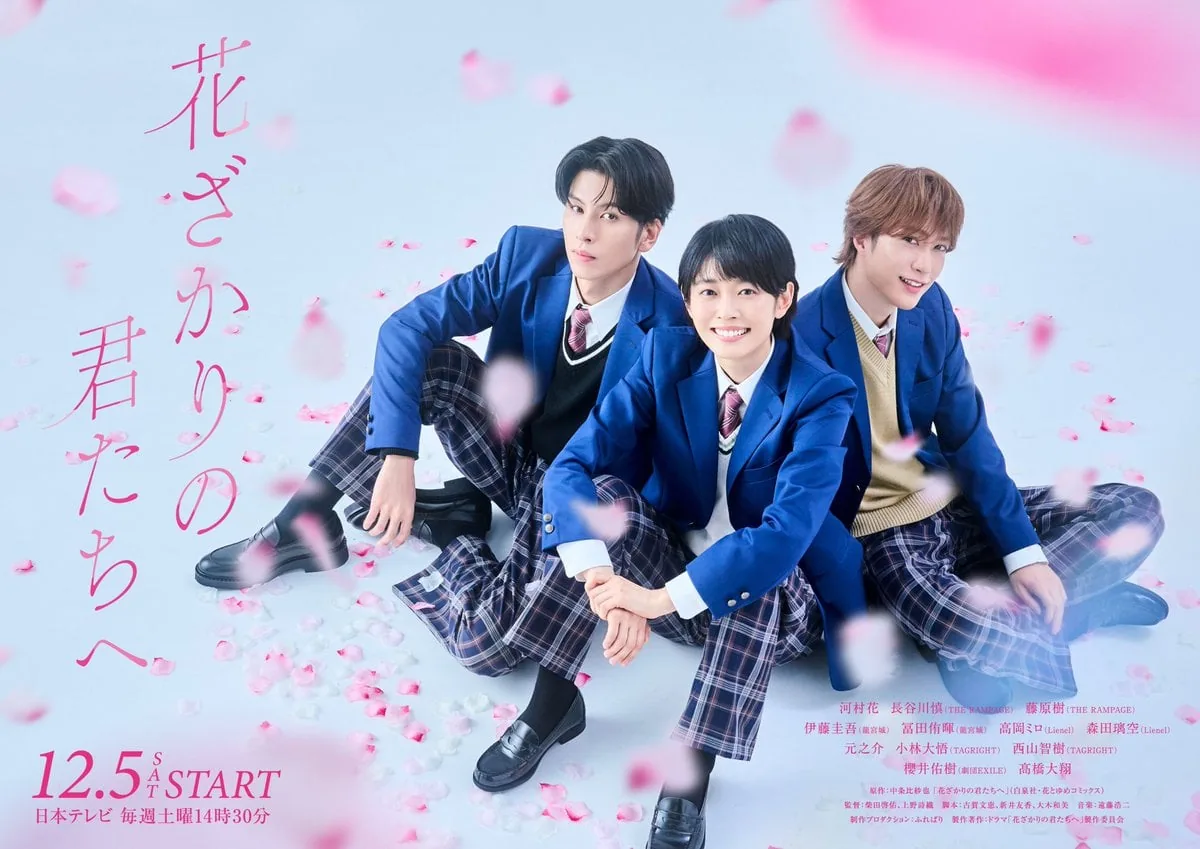
Hana Kawamura leads the cast as protagonist Mizuki Ashiya, stepping into a role previously tackled by established pop stars in earlier Japanese screen adaptations. Two members of the dance and vocal group The Rampage join the project: Makoto Hasegawa plays high jumper Izumi Sano, and Itsuki Fujiwara appears as second dormitory student Shūichi Nakatsu. Supporting cast members include Miro Takaoka and Riku Morita from the musical unit Lienel, who play Taiki Kayashima and Senri Nakao, as well as Daigo Kobayashi and Tomoki Nishiyama from Tagright portraying second dormitory leader Minami Nanba and fellow resident Masao Himejima. Genosuke appears as Megumi Tennōji, Gekidan Exile member Yūki Sakurai portrays Itsuki Kujō, and Hiroto Takahashi plays rival athlete Makoto Kagurazaka [1].
The production extends into live theater shortly after the television broadcast concludes. A companion stage play featuring most of the television cast will open on February 13, 2027, running through February 15 in Osaka before traveling to Aichi from February 18 to 19 and Tokyo from March 13 to 22. Shintarō Sugano is directing and writing the theatrical production. Advance lottery ticket applications for fans remain open until November 23 [1].
Story Setting in the Hana-Kimi Drama
The core narrative follows Mizuki Ashiya, a Japanese girl raised in the United States who discovers a passion for track and field after watching high jump athlete Izumi Sano on television. When Sano stops competing for personal reasons, Mizuki decides to help him regain his sporting ambitions. She cuts off her long hair, disguises herself as a young man, and travels to Japan to enroll at Osaka Gakuen, the all-boys boarding school where Sano studies. Her parents permit her journey without realizing that Osaka High does not admit female students [2].
Life at Osaka Gakuen revolves around three separate dormitories, each fostering its own subculture and rival pride. First Dorm houses athletes who entered Osaka High on sports scholarships, while Third Dorm gathers students recognized for artistic talents and academic intelligence. Second Dorm, headed by dorm leader Minami Nanba, mixes scholar-athletes with general scholarship students. These three houses clash regularly during seasonal school events, especially when the annual cultural festival fuels dorm rivalries. The all-boys academy also maintains close social ties with St. Blossoms, an affiliated all-girls high school located nearby [2].
Mizuki’s secret unravels early in the story through an accident that reveals her biological sex to school physician Hokuto Umeda and to Sano himself. Sano chooses to keep his discovery quiet, quietly protecting Mizuki as she stumbles through dormitory life and athletic drills without blowing her cover. Meanwhile, second dorm classmate Shūichi Nakatsu develops genuine feelings for Mizuki while remaining unaware of her true gender, causing his peers to question his romantic orientation. The students face constant campus confusion while Mizuki struggles to maintain her male disguise [2].
Adaptation History Across Three Decades
Hisaya Nakajo created Hana-Kimi under the full Japanese title Hana Zakari no Kimi-tachi e, serializing the manga in Hakusensha’s semi-monthly magazine Hana to Yume from September 1996 to August 2004. Hakusensha published the serialized chapters. Viz Media handled English localization for North American audiences, releasing the final translated volume in April 2008 [2]. Taiwan launched a live-action television version in 2006, followed by a popular 2007 Japanese television drama and a South Korean television adaptation. Japan produced a second domestic television drama in 2011 starring AKB48 idol member Atsuko Maeda [1].
The franchise entered the anime sphere decades after the original manga serialization ended, when animation studio Signal.MD produced an adaptation that held its world premiere for episode one during the Anime NYC convention on August 23, 2025. The anime formally began broadcasting in Japan on January 4, 2026, on Tokyo MX, BS11, MBS, CBC TV, and RKB Mainichi Broadcasting. Crunchyroll streamed the animated episodes globally with English subtitles and same-day dubs to international audiences in the Americas, Europe, and Asia. The first broadcast run concluded in March 2026, and Signal.MD followed with a second season that premiered on July 1, 2026 [1].
Production committees continue to bring classic manga to the screen. Recent anime coverage also followed theatrical adaptation schedules, such as the Takopi’s Original Sin film trailer and its planned release window. With television broadcasts starting on December 5 and theatrical performances opening in February, the new Hana-Kimi drama shows how classic shōjo storytelling finds fresh life on Japanese screens [1].
- ONLINE NEWS Hodgkins, C. (2026, November 21). New Hana-Kimi Live-Action Series Reveals Theme Songs, Short Video. Anime News Network. [Article Link]
- WEBSITE Hana-Kimi. (n.d.). In Wikipedia. [Article Link]


