






Inside a dark room dressed like a bar, the iPhone 18 Pro turned overhead lights into increasingly pointed flares as Engadget’s Cherlynn Low changed its camera aperture. Apple unveiled the phone with a mechanical iris (an adjustable opening that controls incoming light) and its new A20 Pro chip. Low could see the camera blades move. The change in background focus was harder to spot, an early indication that the new controls will matter differently from scene to scene. [1]
iPhone 18 Pro Opens Its Iris
Apple puts the adjustable aperture in the main camera of both the Pro and Pro Max, giving photographers four settings: f/1.48, f/1.8, f/2.8 and f/4. Six blades form the opening. TechRadar’s Timothy Coleman describes them as polymer composite components thinner than a human hair, a physical mechanism that changes the light reaching the sensor before software processes the photograph. This is the first mechanical aperture in an iPhone. [2]
Low found the controls at the top of the camera viewfinder during her Apple Park demonstration, where an Apple representative switched settings while she watched the lens. Shutter speed, white balance and ISO were also adjustable. One-handed operation proved slightly awkward. The Verge’s Antonio G Di Benedetto reports manual focusing, too, bringing controls previously associated with specialist apps such as Halide into Apple’s native camera app. Automatic aperture selection remains available. [1, 3]
Apple is entering established photographic territory. Coleman points to Huawei’s Pura 80 Ultra, whose main camera already offers an adjustable f/1.6–4.0 aperture. The underlying relationship between lens opening, light and focus is part of how cameras work; the practical question is how much control a small phone sensor can make visible. Apple’s four settings give photographers something new to change, but the photographs must show where changing it helps. [2]
What Changes in the Photograph?
A wider opening admits more light and can reduce depth of field (the distance range that appears in focus), helping separate a subject from its background. Closing the opening admits less light and brings more of the scene into focus. Coleman identifies bright-light video as a useful application: reducing incoming light allows slower shutter speeds, which help produce smoother-looking motion. Apple also adds shutter-speed adjustment during video recording, giving the two controls a practical reason to work together. [2]
Di Benedetto is more interested in the widest f/1.48 setting. He expects it to help in low light and produce somewhat more background blur than the previous Pro camera. He also cautions that small smartphone sensors already keep much of a scene sharp, particularly beyond close range. Closing the aperture could help with nearby subjects or a brightly lit group whose members stand at different distances. It cannot guarantee dramatic changes in every shot. [3]
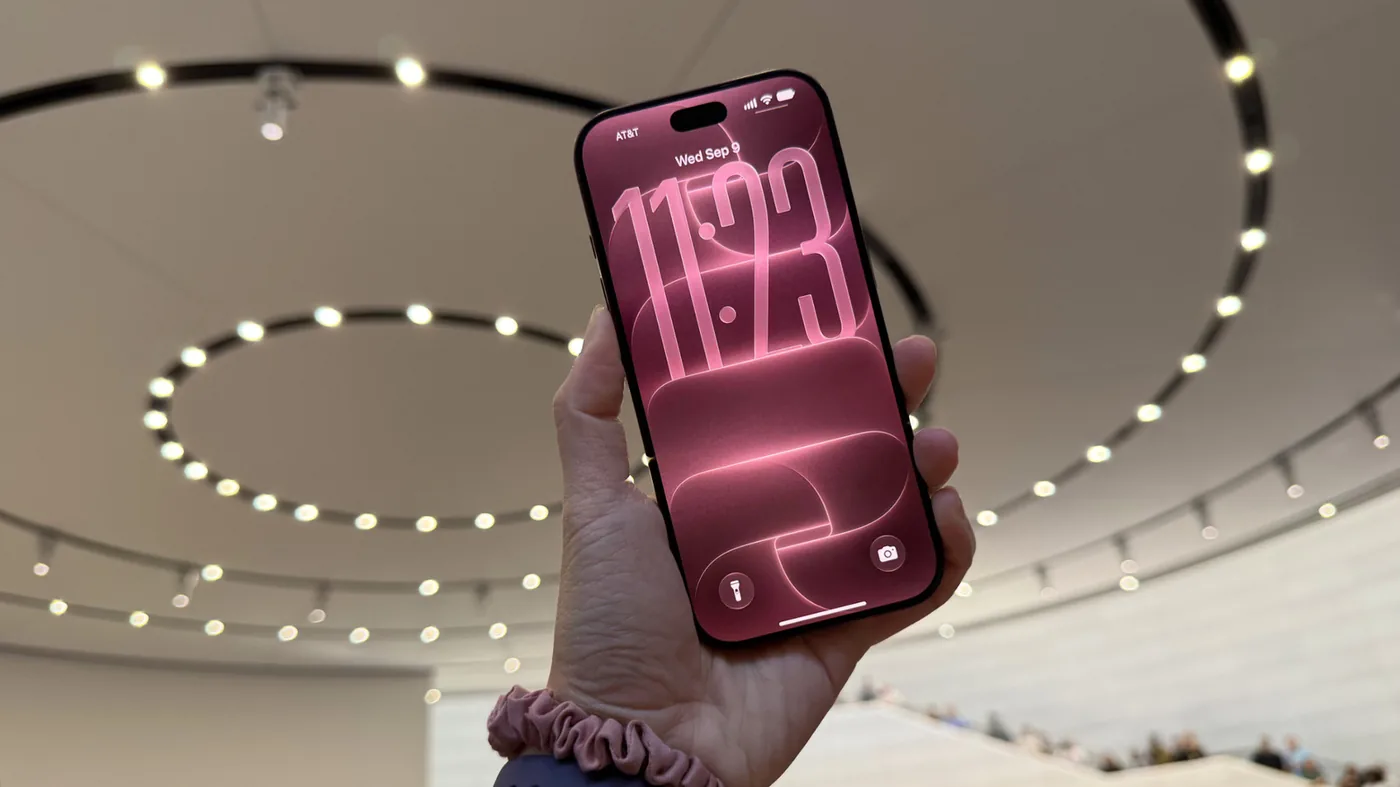
Could f/4 actually reduce sharpness? Di Benedetto raises diffraction (light spreading through a small opening) as a reason it might, while Coleman emphasizes the potential benefit of using the lens’s central area. Neither account supplies a controlled comparison settling that tradeoff for this phone. Low’s bar-like demonstration produced clearer changes in light flares than in background focus. Her experience offers an early observation, leaving the broader image-quality judgment for photographs taken outside Apple’s demonstration rooms. [1–3]


More Ways to Shape Images
Apple also expands Photographic Styles. Low tried labels including Amber + Glow and Cozy + Film, plus Texture controls for skin softness, grain and a film effect. These adjustments sit with familiar color, brightness and contrast options. She took a selfie and found the result realistic and pleasant, although that remains one reviewer’s impression from a preview. The iPhone 18 Pro now offers more decisions both before capture and during the processing that gives the final picture its appearance. [1]
Video gets texture styles and cinematic effects at up to 60 frames per second, according to Daniel Sims’s launch report for TechSpot, while time-lapse gains 4K and Dolby Vision HDR recording. Software still handles much of the look. Coleman expects computational photography to deliver more obvious creative and technical improvements than the aperture alone, citing Portrait mode’s background blur and Night mode’s combination of exposure and processing. The mechanical iris adds another tool to that existing camera system. [2, 4]
Apple’s editing options lead into a separate problem: keeping track of what the camera originally captured. The company introduced Apple Reference Image to address it. [1, 4]

A Reference Before the Edits
Apple Reference Image requires activation before taking a photograph. Low reports that Apple describes a sensor able to “sign every pixel it sees” and create an unalterable reference that can appear beside the edited picture in Photos. Sims describes cloud processing of signed sensor data and an API (an interface for other software) that lets third-party apps access reference images. In Apple’s proposed workflow, comparing the normal copy against its reference would help reveal subsequent changes. [1, 4]
Apple’s authentication claims remain untested in these reports. Low could not try the feature, and Sims explicitly leaves its resilience against evolving AI tools unresolved. The supplied reporting does not independently verify that the system prevents alteration or reliably withstands attempts to defeat it. For now, the iPhone 18 Pro introduces a proposed way to preserve a comparison image; the launch coverage supplies no adversarial test showing how well that protection survives outside Apple’s environment. [1, 4]
Apple connects its broader AI pitch to the phone’s access to personal context, including calendars and daily habits, Samuel Axon reports for Ars Technica. Privacy featured in the presentation. Underneath those features, Apple has changed the processor that supports both photography and machine learning. [5]
A20 Pro Awaits Longer Tests
The A20 Pro brings the iPhone to a 2-nanometer manufacturing process. TSMC makes the chip. Axon reports a six-core CPU with two super-cores and four efficiency cores, plus a seven-core GPU. Apple claims the super-cores run up to 20 percent faster and graphics performance improves by up to 40 percent. Sims also reports a 50 percent increase in memory bandwidth over the A19 Pro. Apple describes the machine-learning hardware as effectively two Neural Engines on one chip, supporting the camera and AI features that occupied much of its presentation. Those performance gains are launch claims, not results from independent benchmarks in the supplied coverage. [4, 5]
Low did verify a smaller Dynamic Island displaying three activities during a demonstration: timers, Apple Music playback and a trip in Flighty. All three fitted at once. She also examined the Burgundy and Glacier finishes, but could not properly test thermal management, overall performance or faster wired charging. Those omissions matter when assessing the iPhone 18 Pro beyond its camera interface: a brief demonstration cannot establish how the phone behaves during sustained use. [1]
The camera blades already move on command. Low saw that herself. What remains open is whether changing aperture consistently produces a useful difference in ordinary photographs, and whether Apple’s new chip sustains its claimed gains once longer testing begins. [1, 5]
- ONLINE NEWS Low, C. (2026, September 9). iPhone 18 Pro hands-on: Variable aperture and stunning new colors. Engadget. [Article Link]
- ONLINE NEWS Coleman, T. (2026, September 9). As a pro photographer, the iPhone 18 Pro’s variable aperture is the camera upgrade I’m most interested in — here’s what you need to know about it. TechRadar. [Article Link]
- ONLINE NEWS Di Benedetto, A. G. (2026, September 10). The variable aperture isn’t the cool part of the iPhone 18 Pro’s camera. The Verge. [Article Link]
- ONLINE NEWS Sims, D. (2026, September 9). Apple iPhone 18 Pro and 18 Pro Max launch with a familiar design, new A20 Pro SoC, and aperture-controlled camera. TechSpot. [Article Link]
- ONLINE NEWS Axon, S. (2026, September 9). Apple’s iPhone 18 Pro adds variable camera aperture and a more powerful chip. Ars Technica. [Article Link]


