



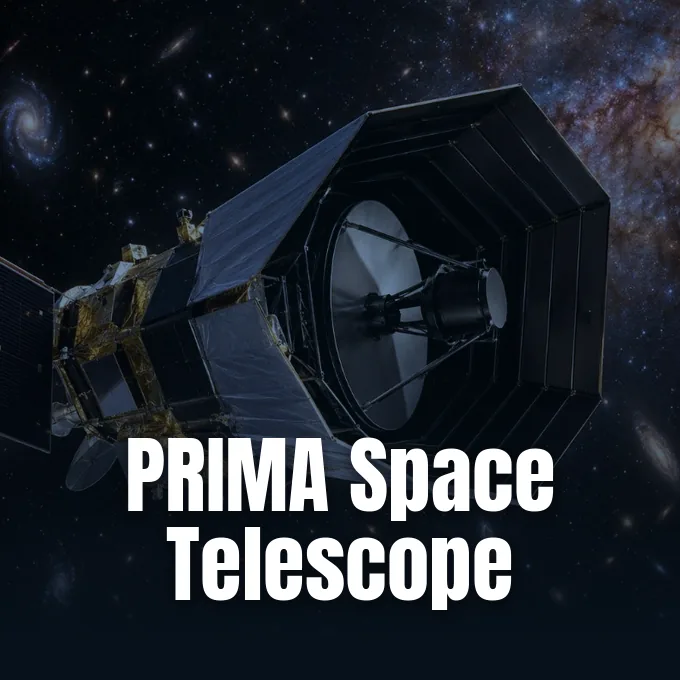
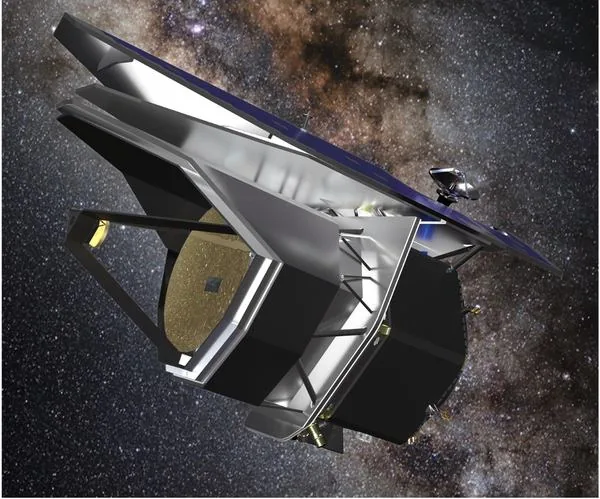
NASA has officially approved the Probe far-Infrared Mission for Astrophysics, known as PRIMA, to advance into preliminary design as the agency’s next major astrophysics undertaking for deep space exploration. Designed to investigate cosmic origins across billions of years, the new NASA space telescope represents the inaugural selection in a novel mission category called Probe Explorers recommended by the scientific community. The observatory features a cryogenically cooled 1.8-meter telescope engineered to observe celestial phenomena at far-infrared wavelengths that remain inaccessible to existing optical and infrared facilities. NASA targeted the mission for launch in 2033 following formal Phase B clearance [1].
Why Is the PRIMA Space Telescope Crucial?
As a new NASA space telescope, PRIMA fills a vital observational void between the near-infrared vision of the James Webb Space Telescope and terrestrial radio observatories. While earlier surveys revealed how small galaxies host dominant massive black holes in the early universe, optical and infrared instruments cannot penetrate the dense dust that conceals their central engines. Vast reservoirs of cold gas radiate energy exclusively across far-infrared wavelengths. Dense interstellar clouds absorb ultraviolet light from young stars and reradiate thermal energy across bands from 24 micrometers to 235 micrometers. Nicky Fox, associate administrator for NASA’s Science Mission Directorate, emphasized that PRIMA will unveil the obscure across cosmic time to illuminate how planets, stars, black holes, and planetary water reserves originated [1].
Astronomers cannot conduct sensitive far-infrared observations from ground level because Earth’s atmosphere absorbs these delicate wavelengths. High-altitude observatories and balloon experiments provided fleeting glimpses of the far-infrared sky, but full understanding requires a dedicated orbital platform operating far above atmospheric water vapor. By observing above Earth’s veil, PRIMA will provide sensitivity gains roughly a factor of one thousand greater than past missions. That dramatic leap allows researchers to track cold chemical compounds across distant protoplanetary systems [8].
NASA designed the Explorer framework to bridge scientific capabilities across decades. Shawn Domagal-Goldman, director of the Astrophysics Division at NASA Headquarters, noted that NASA established a steady launch rhythm with the Webb and Roman space observatories. PRIMA continues that cadence into the next decade [1].
What Will the New NASA Space Telescope Reveal?
The new NASA space telescope will reveal how chemical elements and molecular gas drive the co-evolution of galaxies and supermassive black holes over cosmic history. Throughout cosmic time, galaxies grow through gas accretion and monumental galactic mergers that trigger explosive starburst episodes. During these energetic epochs, central black holes ignite and propel massive molecular outflows that regulate further stellar birth. IPAC science operations lead and mission co-investigator Lee Armus highlighted this dynamic evolution, observing that “galaxies do not live sedentary lives” but undergo episodes where stellar birth accelerates up to one hundred times beyond typical rates [8].
Earlier studies using the European Space Agency’s Herschel Space Observatory identified molecular outflows in only a handful of nearby galactic systems. PRIMA will expand that observational catalog from dozens of local targets to thousands of distant galaxies across deep space. Tracking these outflows helps astronomers determine whether black hole feedback quenches star formation or redistributes essential heavy elements throughout the intergalactic medium. The observatory will also examine debris disks around young stars to measure the volatile gas reserves that build planetary atmospheres [8].
Two primary science instruments comprise the payload. The first is PRIMAger, an imaging polarimeter built to map vast expanses of sky while tracing magnetic fields in interstellar gas clouds. The second instrument is FIRESS, a high-resolution spectrometer configured for multimode spectroscopy across far-infrared bands. Together, these tools trace cosmic matter from diffuse gas to newborn solar systems [8].
Superconducting Detectors Born at Caltech and JPL
Extreme sensitivity requires sensors operating near absolute zero. PRIMA relies on superconducting microwave kinetic inductance detectors, commonly abbreviated as MKIDs, which detect individual far-infrared photons with minimal background thermal noise. Jonas Zmuidzinas, the Merle Kingsley Professor of Physics at Caltech, and Jet Propulsion Laboratory engineer Rick LeDuc conceived the foundational concept in 1999 during informal discussions at a coffee shop near the Pasadena campus. They developed superconducting resonators that shift electrical resonant frequency whenever absorbing radiant infrared energy [8].
Experimental verification followed on the ground in 2007 at the Caltech Submillimeter Observatory near the summit of Maunakea in Hawai’i. Ground testing proved kinetic inductance architecture could withstand demanding operational cycles, complementing astronomical calibration programs such as telescope proposals at the NASA IRTF on the same volcanic ridge. Over subsequent years, engineers at JPL’s Microdevices Laboratory refined the arrays to endure the mechanical vibrations of rocket launches and the rigorous radiation environment of deep space. In January 2026, the National Academy of Sciences awarded Zmuidzinas the James Craig Watson Medal in recognition of these detector innovations [8].
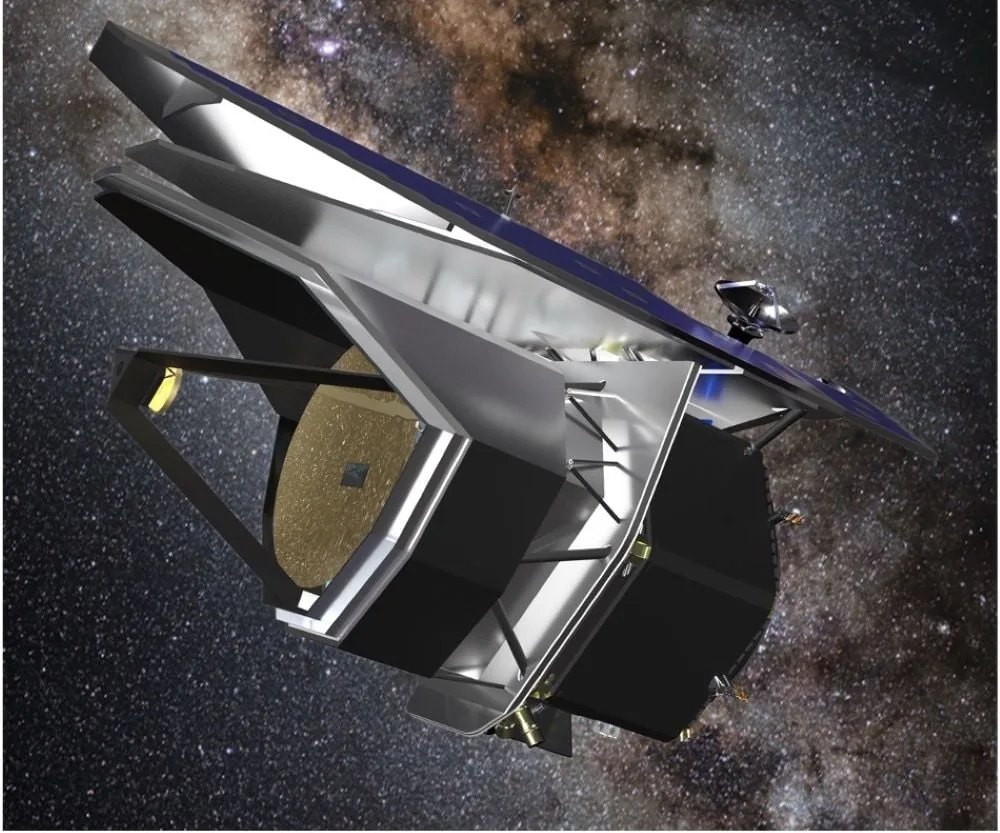
Cryogenic engineering chills detectors near absolute zero. This extreme cooling suppresses thermal noise so faint cosmic signals register clearly [8].


Scientific Operations and Wide Community Access at IPAC
Caltech’s IPAC center in Pasadena will direct science operations, telescope scheduling, and data dissemination for the mission. Raw telemetry transmitted across deep space will enter the Infrared Science Archive, designated as IRSA, which curates data for more than twenty NASA astrophysics missions. Rachel Akeson, deputy director of IPAC, emphasized that PRIMA builds on four decades of institutional heritage extending from the Infrared Astronomical Satellite in the 1980s through the Spitzer Space Telescope, which operated from 2003 until 2020. Lessons from the Caltech-led SPHEREx mission launched in March 2025 will also inform processing pipelines [8].
Access to the observatory will not remain confined to the core design teams. Once operational verification concludes, NASA will allocate approximately seventy-five percent of observing time to the global astronomical community through open, peer-reviewed proposals. Community engagement began well before hardware construction started. Science working groups have already cataloged nearly two hundred potential observing programs submitted by more than four hundred independent astronomers worldwide. Ray Jayawardhana, president of Caltech and professor of astronomy, described PRIMA as a vital leap providing scientists everywhere with new tools to inspect cosmic splendors [8].
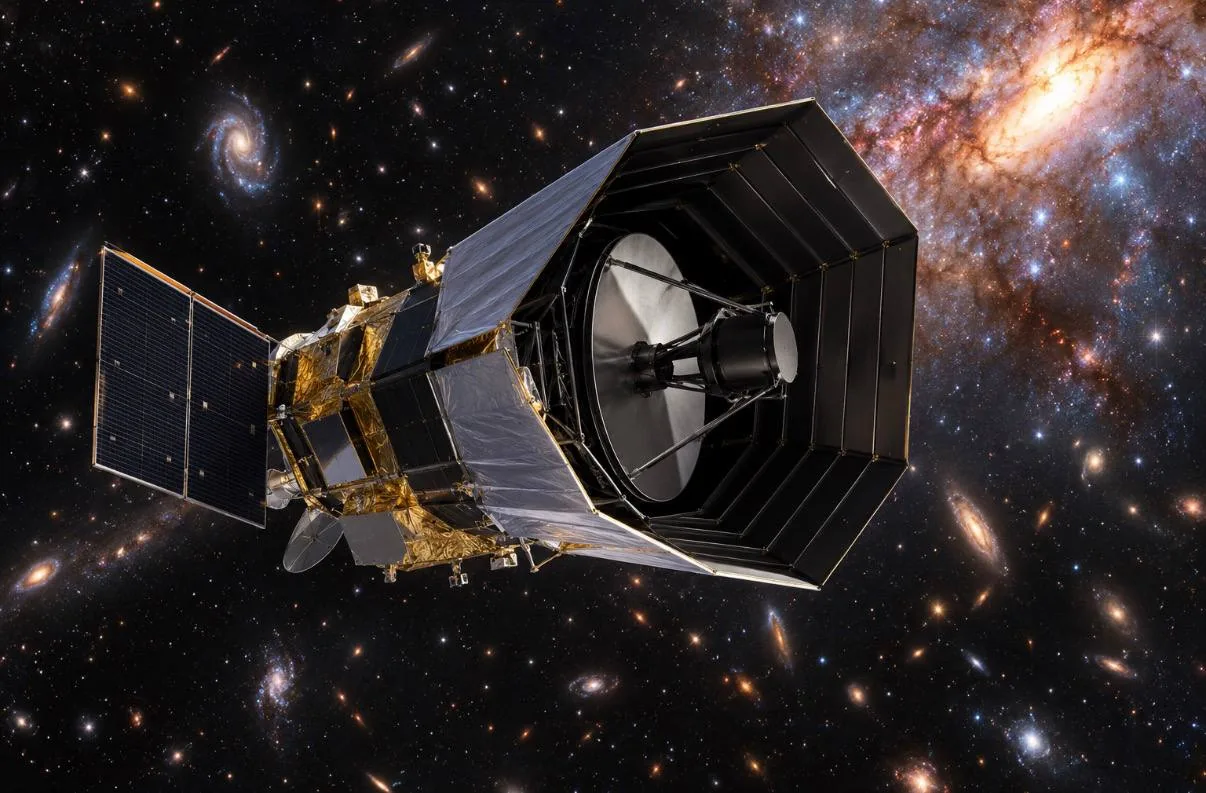
Caltech manages JPL for NASA. This institutional alignment connects academic instrumentation laboratories directly to spacecraft fabrication facilities. That collaboration accelerates pipeline development across multidisciplinary research groups [8].
How the Far-Infrared Space Telescope Was Selected
The selection of the far-infrared space telescope culminates a structured competitive evaluation initiated by the 2020 Astrophysics Decadal Survey. Titled Pathways to Discovery in Astronomy and Astrophysics for the 2020s and chaired by Caltech physicist Fiona Harrison, the decadal report urged NASA to establish Probe Explorers. This new category bridges the financial and architectural gulf separating moderate Explorer missions from multi-billion-dollar flagships. Guided by these recommendations, NASA opened a formal competition to target either high-energy X-ray astrophysics or far-infrared observation [2, 8].
In October 2024, NASA selected two finalist concepts for twelve-month mission studies, granting each team $5 million to mature preliminary engineering concepts. The competing proposal was the Advanced X-ray Imaging Satellite, led by principal investigator Christopher Reynolds of the University of Maryland, College Park, and managed by Goddard Space Flight Center. The PRIMA proposal, guided by principal investigator Jason Glenn at NASA Goddard with project management at JPL, focused on bridging the infrared gap. Both studies addressed high-priority science objectives identified in NASA Cosmic Origins space observatory planning [2, 3, 4].
That initial grant was $5 million. After reviewing technical readiness, schedule feasibility, and risk assessments, NASA officials confirmed PRIMA as the winning architecture to advance into formulation. While AXIS presented compelling X-ray capabilities, PRIMA demonstrated superior synergy with existing infrared and submillimeter ground arrays [1, 7].
International Partners and the Path Toward Launch
NASA capped project costs at $1.2 billion. This ceiling applies to development phases and excludes launch services or foreign hardware contributions. Moving into Phase B allows engineering teams to refine subsystem requirements, construct structural prototypes, and finalize optical coatings. The mission must pass a rigorous confirmation review evaluating technical and budgetary performance before NASA authorizes formal hardware implementation in Phase C. NASA’s Jet Propulsion Laboratory manages the flight project, with critical support from NASA’s Goddard Space Flight Center and Marshall Space Flight Center [1, 6].
Global space agencies are providing critical components and scientific expertise to ensure the success of the new NASA space telescope. International contributions include hardware and analysis from France’s CNES, Italy’s ASI, Germany’s DLR, the Canadian Space Agency, the Korea Astronomy and Space Science Institute, the Japan Aerospace Exploration Agency, and the UK Space Agency. These partnerships distribute developmental responsibilities while broadening international access to calibration pipelines and observational datasets. Coordinating these diverse aerospace institutions demands rigorous systems engineering throughout preliminary integration [1, 5].
PRIMA extends an enduring scientific lineage managed by NASA Goddard for the Science Mission Directorate since the launch of Explorer 1 in 1958. Technical priorities detailed in an emerging astrophysics mission preprint, which has not yet undergone formal peer review, emphasize how cryocooled far-infrared platforms fulfill decadal recommendations to explore obscured cosmic epochs [9]. Previous Explorer achievements include discovering Earth’s radiation belts as well as the landmark Uhuru and Cosmic Background Explorer missions, both earning Nobel prizes for their principal investigators. NASA scheduled the five-year orbital mission for launch in 2033 [1].
- PRESS RELEASE Taveau, J. (2026, September 23). NASA selects far-infrared telescope as first in new mission class. NASA Headquarters. [Article Link]
- PRESS RELEASE Taveau, J. (2024, October 3). NASA establishes new class of astrophysics missions, selects studies. NASA Headquarters. [Article Link]
- WEBSITE Tyler, P. (2024, October 7). NASA selects AXIS and PRIMA for astrophysics probe explorers studies. NASA Science Physics of the Cosmos. [Article Link]
- WEBSITE Tyler, P., & Cosmic Origins Team. (2024, October 4). NASA establishes new class of astrophysics missions: Probe Explorers (AXIS & PRIMA). NASA Science Cosmic Origins. [Article Link]
- ONLINE NEWS PressBee Editorial Team. (2026, September 23). NASA selects far-infrared telescope as first in new mission class. PressBee Middle East. [Article Link]
- ONLINE NEWS OST Staff. (2026, September 23). NASA advances PRIMA far-infrared telescope, first mission in new Probe Explorers class. Outer Space Today. [Article Link]
- ONLINE NEWS Klotz, I. (2026, September 23). NASA selects far-infrared telescope for next phase of development. Aviation Week Network. [Article Link]
- PRESS RELEASE California Institute of Technology. (2026, September 23). NASA selects PRIMA mission; key roles for Caltech, JPL, and IPAC. Caltech News. [Article Link]
- PREPRINT Astrophysics Technology Workshop Collaborators. (2026). Emerging technologies for astrophysics missions: Workshop summary report. arXiv. [Article Link]
APA 7: Editor. (2026, September 24). The New NASA Space Telescope PRIMA Unlocks the Deep Cosmos. PerEXP.


