





Hardware wallet maker Ledger asked Southeast Asian reseller CryptoBilis to pause sales and shipments on October 9, 2026, after users reported drained crypto accounts [2]. The Ledger wallet hack probe began when onchain researchers flagged millions of dollars leaving compromised devices across multiple blockchain networks. Company officials said their central systems weren’t breached, but one customer unit examined by technicians contained an unauthorized hardware implant [1]. Buyers who purchased devices from CryptoBilis in the past 90 days are now being urged to keep uninitialized hardware boxed [3].
Reseller Sales Paused Amid Ledger Wallet Hack Reports
The warning surfaced when customers in Indonesia, Malaysia, and the Philippines noticed unexpected transfers emptying their accounts, prompting Ledger to open an active inquiry into distributor CryptoBilis and review recent product shipments across Southeast Asia [2]. Ledger announced the halt on X on October 9 [6]. The advisory specifically targeted buyers who received hardware during the last 90 days, warning that anyone who hasn’t opened the package or initialized the device should leave it boxed until technical evaluations conclude [2].
Customers who already completed setup face urgent security decisions [3]. Ledger advised those users to transfer their digital coins to a replacement signer running a fresh recovery phrase, warning that keeping assets on suspect hardware creates continuous risk for account holders holding valuable cryptocurrency [2]. Paris-based Ledger, which was founded in 2014 and has sold more than 7 million hardware wallets worldwide, stated that devices shipped straight from its direct manufacturing facilities in France remain secure [3].
Third-party resellers distribute hardware to buyers throughout international markets [3]. CryptoBilis was an authorized distributor serving Southeast Asian buyers [2]. Ledger clarified that the probe doesn’t indicate a flaw in its central operating system, but investigators are examining whether third parties altered devices somewhere along the supply chain before customer delivery took place [3].
Evidence Points to Suspected Ledger Wallet Tampering
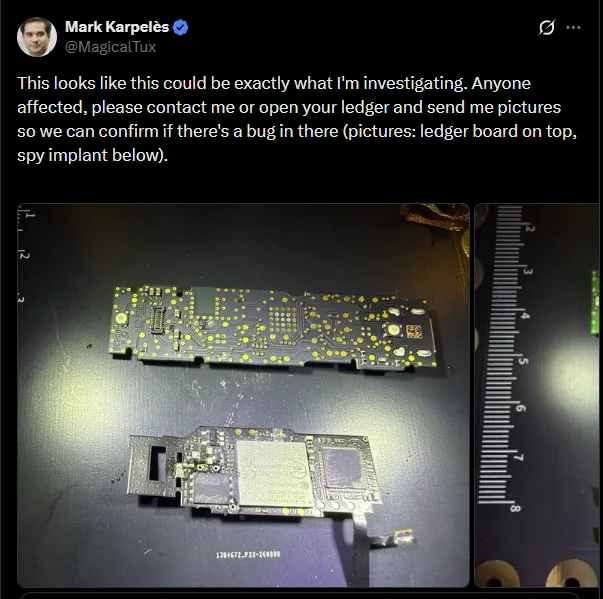
The alarm over potential hardware tampering spread quickly after device owners shared teardown clips on X and Threads showing modified internal components tucked inside suspect signers. Several users opened devices to see why deposits vanished. The clips showed a small extra circuit board wedged beneath the screen assembly, acting like a spy tool by capturing whatever appears on the display during the initial configuration steps before users complete device setup [1]. That setup phase exposes the secret 24-word recovery seed [2].
Inspection reports suggest the rogue circuit board contains an embedded SIM card that connects to cellular networks without alerting the owner or leaving any software trace on the device during normal operations. Once the unit displays the recovery phrase on its screen, the spy board copies the letters and transmits that data straight back to attackers over mobile cellular signals [1]. Former Mt Gox CEO Mark Karpelès examined suspect units [2]. Karpelès called for a thorough technical review, and Ledger later stated that “one of the impacted users’ devices contained an unauthorized hardware implant” that altered the interior of at least one delivered hardware unit [1].
Binance founder Changpeng Zhao, known as CZ, also commented on the situation as discussions grew across crypto communities. Zhao stated on X that the breach “seemed to be isolated” and suggested that “a small number of people probably bought fake (or tampered) Ledgers” through the vendor during recent order fulfillment cycles. Zhao added that BNB ecosystem participants would help tracking [7].

Onchain Analysts Track Missing Crypto Assets
While Ledger hasn’t released an official balance sheet of user losses, onchain analysts have pieced together large transaction trails. Pseudonymous researcher Specter examined reports from affected device owners on X and Reddit, identifying inflows to suspect wallet addresses on Bitcoin, Ethereum, and TRON networks as funds moved between accounts [3]. Specter estimated that the Ledger wallet hack drained approximately $86.96 million across 98 flagged addresses that received deposits from hundreds of victim wallets [5].
Security researcher tanuki42 calculated that losses exceeded $72 million [5]. Data tracked by Arkham Intelligence recorded nearly $87 million across suspect addresses, with holdings including $17.6 million in Bitcoin alongside $42 million in Ethereum assets and $16.5 million in Tether stablecoin tokens [4]. Seeing the flagged addresses on public ledgers, stablecoin issuer Tether froze approximately $10 million in USDT to prevent attackers from cashing out that portion of the stolen funds [2].

Company filings tied to CryptoBilis also drew scrutiny. Crypto Briefing reported that the distributor recently underwent an ownership change connected to an individual from China, though investigators haven’t tied that ownership transfer to any wrongdoing or malicious conduct. Overall loss estimates from tracking groups range from $72 million to $93 million, yet Ledger itself hasn’t formally verified any dollar totals [2].
How Can Buyers Recover From a Compromised Device?
The incident shows why hardware wallet device integrity matters [3]. A standard hardware signer stores cryptographic keys inside a secure chip so secret data never touches internet-connected computers, keeping private credentials isolated from online malware threats that infect desktop and mobile systems. But the entire security model relies on the 24-word recovery phrase generated when a user first boots the unit and configures their offline wallet storage. If someone else sees those words, they can simply type the seed phrase into any compatible software or hardware wallet to transfer funds without touching the physical signer [5].
Ledger staff will never ask users for recovery phrases. Coinpedia noted that users who configure an optional secondary passphrase gain an extra protective barrier because thieves need both the seed phrase and the passphrase to unlock funds stored within the protected accounts [5]. That’s why Ledger’s guidance for CryptoBilis customers is straightforward: don’t use the existing keys, leave uninitialized units unpowered, and never import suspect phrases onto replacement signers [2].

Owners who suspect their signer is compromised should obtain a verified device through official company channels and generate a fresh recovery phrase on clean hardware. Once the new seed is secured offline, remaining assets can be transferred from the old wallet to the new address [2]. Users shouldn’t trust unverified third-party fund recovery services [5].
Mounting Losses Across the Crypto Ecosystem
The theft reports add to an already painful year for digital asset security across global markets. Just weeks before the Ledger wallet hack probe made headlines, crypto exchange Bitget suffered a cyberattack that resulted in more than $350 million in stolen tokens following months of unauthorized system infiltration [3]. The Bitget wallet hack blamed on North Korea showed how attackers plan coordinated strikes against centralized trading platforms [4]. Bitget CEO Gracy Chen stated that roughly $387.5 million in total assets were taken, with only $1.1 million frozen by authorities [6].
Other decentralized protocols faced heavy losses during September [3]. In September, self-described white-hat hackers withdrew about $320 million in Bitcoin from Blockstream’s Liquid sidechain before entering negotiations to return the majority of assets back to protocol developers. Decentralized finance platforms Drift and Kelp suffered exploits of $285 million and $293 million respectively, with investigators tying the Drift intrusion to North Korean operatives [3, 4]. Operatives spent six months infiltrating the Solana exchange [4].
Government reports indicate that digital currency thefts are becoming a central component of global cybercrime. In August, a presidential order on cybercrime stated that over $20.8 billion was lost to online schemes in 2025, with cryptocurrency theft accounting for roughly a third of that damage across reported fraud cases [6]. Further reporting from Live Bitcoin News revealed that North Korean malware rings compromised 30,000 devices while targeting 7,000 crypto wallets [7]. The suspected Ledger wallet tampering incident shows that supply chain attacks can bypass software defenses when hardware is modified before delivery [1].
- ONLINE NEWS O’Brien, T. (2026, October 10). Ledger wallet tampering suspected after reports of crypto thefts. The Verge. [Article Link]
- ONLINE NEWS Chen, J. (2026, October 10). Ledger investigates wallet tampering tied to tens of millions in crypto thefts. Crypto Briefing. [Article Link]
- ONLINE NEWS Sandor, K. (2026, October 9). Ledger investigates potential wallet tampering after reports of $86 million in crypto stolen. CoinDesk. [Article Link]
- ONLINE NEWS Decrypt. (2026, October 9). Ledger probes potential theft of $87M in user funds tied to crypto wallet reseller. Yahoo! Finance. [Article Link]
- ONLINE NEWS Naik, Z. (2026, October 9). Ledger hack: $86.9 million reportedly drained across 98 wallet addresses. Coinpedia Fintech News. [Article Link]
- ONLINE NEWS Kirimi, A. (2026, October 9). Ledger wallet hack probe intensifies after $86M in suspected crypto theft. The Coin Republic. [Article Link]
- ONLINE NEWS Hassan, B. (2026, October 9). Ledger investigates crypto wallet theft after $86 million loss estimate. Live Bitcoin News. [Article Link]


