






OpenAI launched Live Dictation in ChatGPT on November 18, 2026, converting spoken words into editable text in real time instead of asking people to wait for audio files to process after speaking. Stevie Bonifield of The Verge reported that the speech tool rolled out globally for the web interface, desktop clients, and mobile apps on Apple iOS and Google Android. Along with live speech input, OpenAI dropped its older 10-minute cap on voice capture. Users can now run long voice sessions without automatic cutoffs [1].
Real-Time Text Streaming in the Prompt Box
Before this update arrived, voice typing in ChatGPT worked as a slow batch system. Users tapped the microphone icon, spoke their thoughts into a blank field without seeing text on screen, and waited for cloud servers to return a transcript once recording stopped. Shimon Das of Digital Trends reported that the new engine types words straight into the prompt bar as speech occurs [4].
Real-time visibility changes how people draft prompts on a computer or phone. Digital Trends reported that watching spoken words land on screen helps writers, software engineers, and researchers catch misheard terms right away or tweak phrasing mid-thought during long dictation sessions. In release notes on X, OpenAI said, “With Live Dictation, your speech turns into text as you talk, so you spend less time waiting for your message to finish transcribing.” Zac Hall of 9to5Mac reported that Atty Eleti from the OpenAI voice team confirmed that lifting the 10-minute cap formed a key piece of the upgrade. Hall also pointed to recent OpenAI updates for Codex, GPT-6.2 Astra, and Sol models [2].
Access to the live speech engine is open to all accounts. OpenAI launched the feature for free users as well as Plus, Business, Edu, Enterprise, and Pro workspaces on supported devices. The web browser build and standalone desktop software share the same features as mobile apps. But server rollout pacing may vary by region as individual accounts update over several days [5].
Interface Controls and Live Dictation Behavior
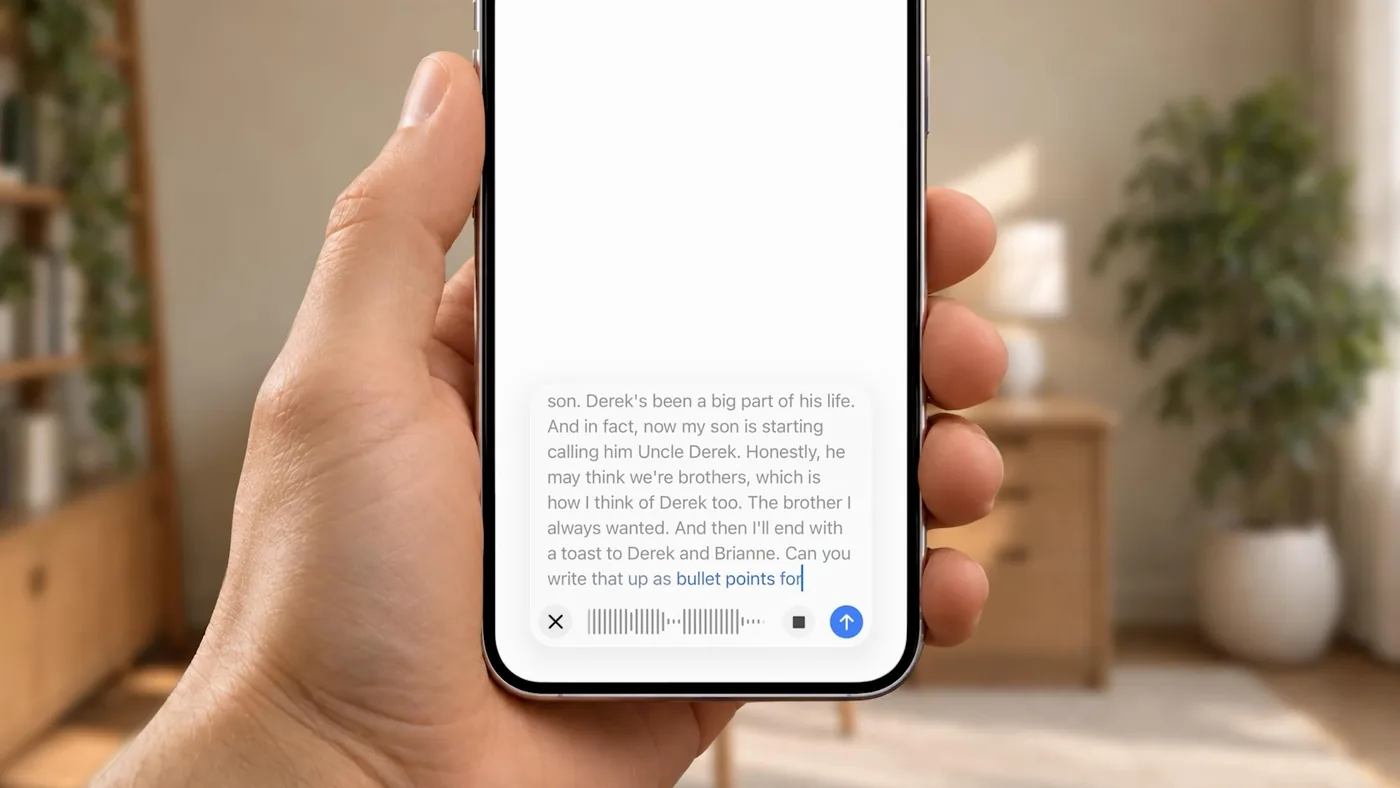
The updated layout puts an interactive audio waveform inside the prompt bar when microphone recording starts. Tapping or clicking that waveform toggles the running text on or off during speech. That switch helps people who find moving words annoying while talking, so they can keep their focus on spoken ideas without losing the Live Dictation feed [1].
Words typed by Live Dictation stay in the prompt box and do not travel to the OpenAI model until the user taps send. This gives speakers room to fix typos, add punctuation, or wipe out rambling lines before sending a prompt. Phone and computer operating systems already supply native speech tools, but Live Dictation runs inside ChatGPT, which tightens the loop between speaking, checking text, and sending prompts [4]. Stevie Bonifield of The Verge reported that users can also ask the tool to turn raw voice notes into clean bullet lists. That option lets people dictate unstructured memos and shape them into clear instructions before submitting [1].
OpenAI called the new speech setup faster and more reliable than the older dictation tool. But the company gave no concrete latency numbers or accuracy scores with the launch. Superpower Daily pointed out that this omission leaves speed and error rate claims untested by outside labs [5].


Removal of the Ten-Minute Recording Cap
The removal of the old 10-minute cap changes how people use voice input in ChatGPT. Under the previous rule, speech capture stopped dead at ten minutes, cutting off long memos, research drafts, or product plans. Dropping that ceiling allows open-ended speech entry on desktop machines and mobile devices without forcing users to restart recording sessions [4].
OpenAI did not set a new top time limit after dropping the ten-minute mark. Superpower Daily reported that without a clear upper limit, users cannot treat voice sessions as guaranteed to run forever without a break. Long recordings may still run into device memory limits or network drops during extended sessions [5].
The longer voice sessions arrive as OpenAI updates other parts of its catalog. The company set GPT-5.5 Instant as the default model for free accounts. Ron Patel of Startup Fortune reported that GPT-5.5 Instant cut hallucination rates by 52.5% and improved reasoning steps amid sharp competition from Google Gemini and Anthropic Claude. Patel also pointed to a new Mac plugin for Apple Messages that handles iMessage, SMS, and RCS texts after users grant Full Disk Access permissions. That add-on shows OpenAI pushing speech and text tools into daily desktop communication, helping users draft messages quickly [3].
How Live Dictation Differs from Voice Mode
Live Dictation does a different job than conversational audio tools in ChatGPT. In two-way conversational voice mode, the bot talks back aloud with synthetic speech, but dictation merely replaces keyboard entry. Spoken words sit quietly in the text field until the user sends them. Users retain full manual control over what enters their chat history [6].
The feature also stays apart from the team record mode built for meetings. That tool transcribes multi-person calls and writes summary bullet lists after meetings wrap up, but it stays in beta testing for ChatGPT Pro subscription tiers, Plus, and Enterprise plans [1].
By keeping dictation focused on text entry, the app avoids the delays of conversational voice mode. Abbas Jaffar Ali of Tbreak Media UAE said the tool sticks to drafting prompts, leaving spoken back-and-forth talk to voice mode. Outside ChatGPT, users can find speech tools in other apps: Microsoft SwiftKey offers AI voice typing on Android, Google provides offline voice typing via its Eloquent app on Apple iPhone, and Meta AI supports dictation in its Mac desktop app [6].
Audio Privacy Settings and Competing Tools
Privacy controls for voice dictation sit in ChatGPT account settings. Users who handle sensitive business deals, patient data, or trade secrets covered by legal pacts can turn off audio sharing for model training. Shimon Das of Digital Trends reported that users can also stop audio recordings from being stored on remote servers, giving teams direct control over speech data retention [4].
Free speech-to-text transcription brings fresh pressure for independent voice software makers. Products like Wispr Flow, Superwhisper, and Otter sell paid plans built around speech tools. But those third-party apps keep a clear edge because they work in external software like Slack, Gmail, and code editors, while ChatGPT only types into its own prompt box. Ron Patel of Startup Fortune observed that Otter also focuses on multi-speaker meeting transcripts and searchable audio archives, which makes it less vulnerable to prompt box speech updates than simple desktop dictation tools that lack wide platform support [3].
As voice entry turns into a built-in tool in AI chat software, user reliance on default phone and computer keyboards may drop. By keeping voice drafting inside its own application window, OpenAI makes prompt writing faster and keeps users active inside its ecosystem instead of turning to rival dictation software [3].
- ONLINE NEWS Bonifield, S. (2026, November 19). ChatGPT can transcribe as you speak now with Live Dictation. The Verge. [Article Link]
- ONLINE NEWS Hall, Z. (2026, November 18). ChatGPT app gains enhanced Live Dictation streaming without 10-minute limit. 9to5Mac. [Article Link]
- ONLINE NEWS Patel, R. (2026, November 20). ChatGPT adds Live Dictation for all plans, free users included. Startup Fortune. [Article Link]
- ONLINE NEWS Das, S. (2026, November 19). ChatGPT now supports live dictation, and the 10-minute recording limit is gone as well. Digital Trends. [Article Link]
- ONLINE NEWS Superpower Daily Editorial Desk. (2026, November 19). OpenAI adds live transcription to ChatGPT and removes its 10-minute dictation limit. Superpower Daily. [Article Link]
- ONLINE NEWS Ali, A. J. (2026, November 19). ChatGPT Live Dictation types your prompts as you speak. Tbreak Media UAE. [Article Link]


