






The Folio Society published an illustrated hardback edition of Japanese Ghost Stories, collecting twenty traditional folktales recorded by 19th-century author Lafcadio Hearn. Anime News Network reviewer Rebecca Silverman evaluated the volume on November 22, 2026, awarding it high marks for its physical craftsmanship and textual fidelity. The release gathers supernatural legends from several early 20th-century anthologies into a single slipcased volume featuring modern artwork and bilingual calligraphy. It pairs Hearn’s unedited English translations with archival commentary to preserve the eerie atmosphere of classical folklore [1].
Folktales in Japanese Ghost Stories
Unlike many Western travelers who exoticized foreign cultures during the late 19th century, Lafcadio Hearn immersed himself in Japanese society after moving there in 1890. He married Koizumi Setsu, adopted the Japanese name Yakumo Koizumi, and spent years recording local oral ghost stories. Novelist Yōko Ogawa notes in her introductory essay that Hearn succeeded because he respected original folk traditions rather than rewriting them for European audiences of his era [1].
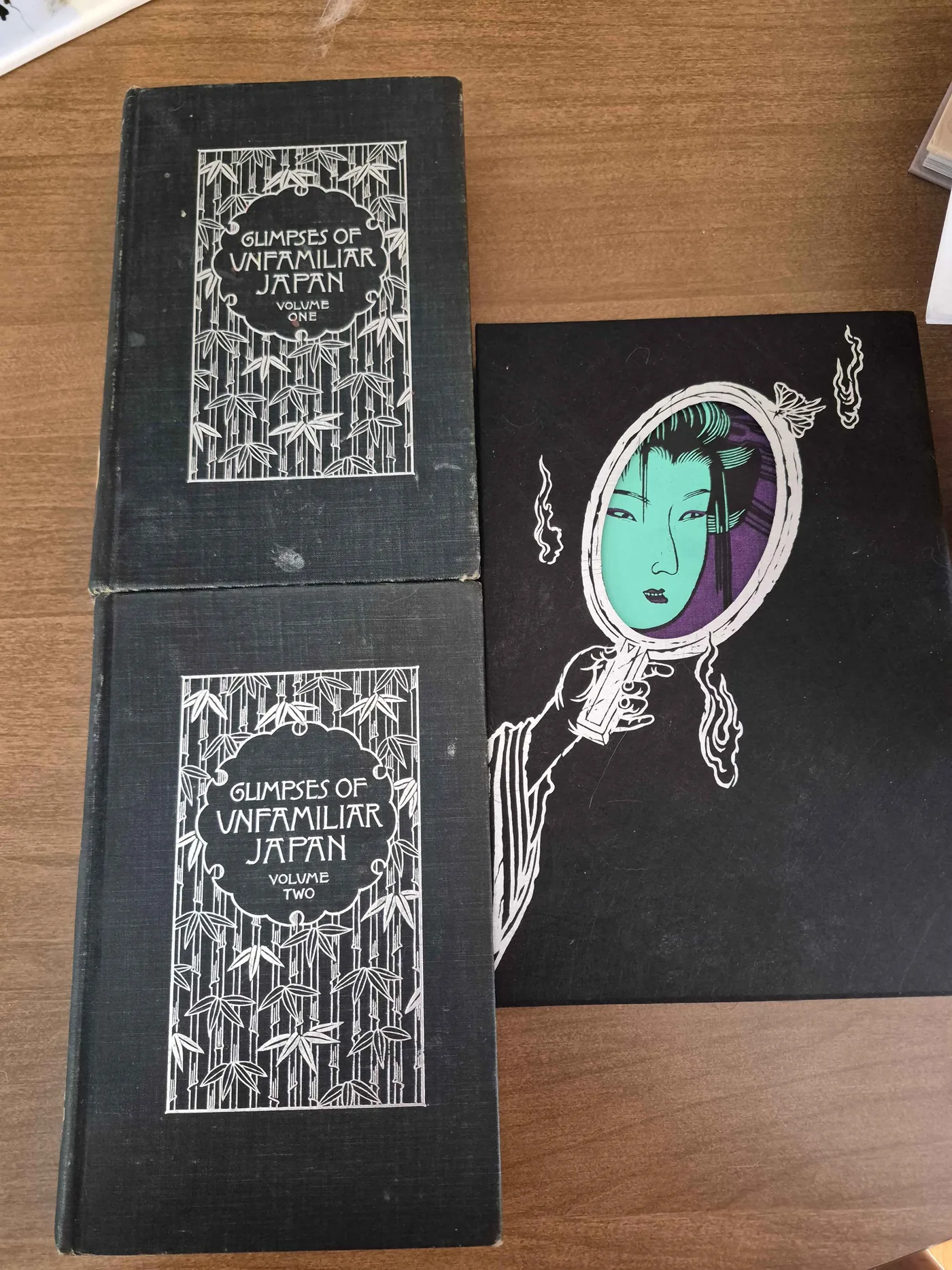
Traditional Japanese supernatural tales are broadly known as kaidan, a term that Hearn used in his 1904 anthology Kwaidan: Stories and Studies of Strange Things. Most selections in Japanese Ghost Stories originate from that 1904 book, while other pieces come from collections he published between 1901 and 1905. These narratives feature widely recognized entities such as the snow woman in “Yuki-Onna,” the blind biwa lutenist in “The Story of Mimi-Nashi-Hoichi,” and the detached head in “Rokuro-Kubi.” Hearn added explanatory footnotes detailing cultural customs, linguistic puns, and religious lore, matching the analytical method he used in his 1894 book Glimpses of Unfamiliar Japan [1].
Hearn’s discipline sets these retellings apart from the work of European peers like Jakob and Wilhelm Grimm, who published their fairy tales in 1811. While the Grimms altered German tales to fit contemporary social values, Hearn preserved Japanese ghost lore without moralizing revisions. His version of “Yuki-Onna” aligns with the ancient animal bride motif categorized under ATU402, leaning into tragic romance instead of standard horror conventions. His description of the rokuro-kubi shares striking anatomical traits with the penanggalan found in Malay folklore. These classic archetypes continue to inspire serialized media, appearing in modern animated works like the 2021 television series The Heike Story, as well as paranormal manga adventures like Yasuki Tanaka’s Ghost Fixers manga [1].
Physical Craft and Book Design
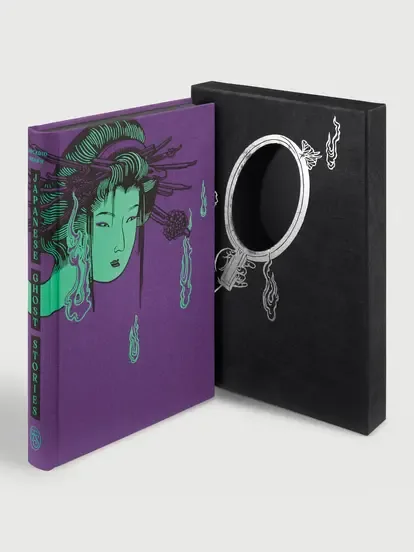
The Folio Society packaged the volume inside a sturdy slipcase that conceals an ingenious visual secret. When readers slide the book from its casing, the woman depicted looking into a mirror reveals herself as a rokuro-kubi, whose elongated neck stretches across the cloth spine to a body printed on the rear cover. The volume is bound in textured woven cloth with gold foil stamping, and the spine opens flat without resistance [1].
Inside the volume, heavy cream-colored paper stock provides generous margins that frame the crisp typography. A built-in ribbon bookmark lets readers keep their place without creasing page corners or folding paper edges. Silverman gave the overall book an A grade in her review, praising its fingerprint-resistant cloth exterior and sturdy binding structure [1].
The volume sells for USD $110 directly through the Folio Society website. While that price tag places it beyond casual paperback purchases, it represents the entry-level price bracket for fine press hardbacks produced by the London publisher [1].

Illustrations for Japanese Ghost Stories
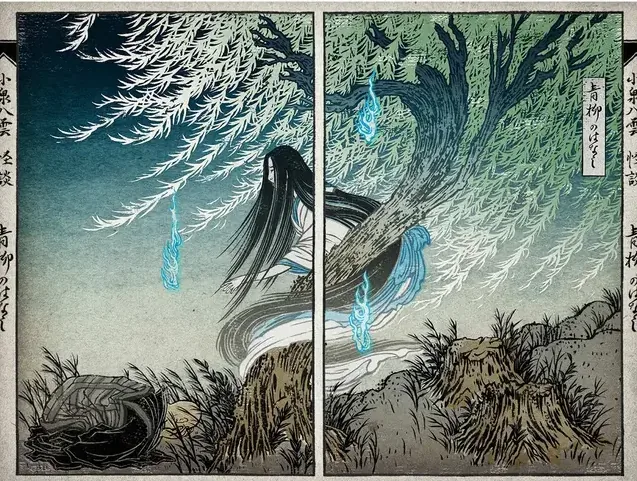
The edition includes five full-page illustrations created by Japanese artist Yūko Shimizu, accompanied by traditional calligraphy rendered by Ai Tatebayashi. Shimizu’s ink drawings blend contemporary line work with the woodblock aesthetic popular during the Meiji period. Tatebayashi’s hand-lettered kanji characters appear on chapter headings and endpapers, reinforcing the antique look of Hearn’s prose. Silverman awarded the artwork an A+ score, saying the illustrations look like authentic period pieces despite being newly created [1].
To achieve its intended quality, the publisher relies on specialized bookmaking workshops rather than standard commercial print facilities. Folio prints its books on archival acid-free paper so pages do not discolor or turn brittle with age. Production is coordinated through artisan binderies such as Ludlow Bookbinders in Shropshire, Smith Settle in Yorkshire, and specialist printer Phil Abel in London, with overseas partners like L.E.G.O. in Italy [2].
Binding design serves as a central part of the company’s identity. Veteran cover artist Neil Gower has created more than 100 individual bindings for the firm throughout his career. Other recognized illustrators and designers who have shaped the publisher’s catalog include Neil Packer, Jeff Clements, and David Eccles [2].
The Folio Society Publishing History
Publisher Charles Ede founded the Folio Society in London in 1947 with partners Christopher Sandford of Golden Cockerel Press and Alan Bott of Pan Books. The young firm operated out of shared offices on Poland Street until 1955 before expanding its operations. It later relocated to 44 Eagle Street in Holborn in 1994, eventually moving to its current headquarters at 4 Maguire Street near the River Thames in 2017 [2].
The business underwent major structural changes during the late 20th century. John Letts and Halfdan Lynner bought the company when it was formally incorporated in 1971. British publisher Lord Gavron served as chairman and majority owner from 1982 until 2015, when his widow Lady Gavron stepped into leadership. In 2021, the firm converted into an employee ownership trust, giving staff direct control over ongoing publishing operations [2].
For decades, the company functioned as a traditional subscription club where members pledged to buy four volumes annually. Anyone could purchase individual books without a subscription starting in 2011, and the membership model ended permanently on September 1, 2016. Today the house releases about 50 titles each year, including deluxe limited runs of science fiction classics like William Gibson’s Neuromancer and George Orwell’s Nineteen Eighty-Four [2].
Editorial Reception and Archival Standards
Long-form book reviews provide evaluative depth that standard bibliographic records can’t match. The intellectual tradition of reviewing literature dates back to 9th-century Constantinople, where Byzantine scholar Photios I compiled the Bibliotheca to summarize and critique classical manuscripts. Modern reviews continue that evaluative role by helping readers navigate specialized editions and niche collector items [3].
Preserving printed volumes and archival review media requires meticulous environmental controls. Archival science recommends storing fragile paper below 18°C (64°F) with relative humidity maintained between 35% and 45% to prevent lignin oxidation and acid hydrolysis. By printing on heavyweight acid-free stock, the Folio Society helps volumes like Japanese Ghost Stories resist the chemical degradation that commonly destroys mass-market pulp books [3].
Commercial newspaper retrenchment has diminished traditional book coverage in mainstream media. The Associated Press announced in 2025 that it would stop syndicating standalone book reviews, ending a century-old reporting custom. That shift leaves specialized cultural platforms like Anime News Network to examine illustrated folktale releases, ensuring that thorough evaluative writing survives in digital bibliographies [3].
- ONLINE NEWS Rebecca Silverman. (2026, November 22). Japanese Ghost Stories Folio Society Edition Book Review. Anime News Network. [Article Link]
- WEBSITE Folio Society. (n.d.). In Wikipedia. [Article Link]
- WEBSITE Book review. (n.d.). In Wikipedia. [Article Link]


