



Every second, thunderclouds around the globe produce an average of 60 lightning flashes that arc through the atmosphere, with some channels extending for more than 800 kilometers. Each flash can release up to seven gigajoules of energy, an amount equal to exploding 1.67 tonnes of TNT. That sudden surge briefly heats the surrounding air channel to roughly 30,000 degrees Celsius, which is five times hotter than the surface of the Sun. Atmospheric scientists estimate that about a quarter of a million people are struck every year, leading to roughly 24,000 deaths worldwide. Yet as greenhouse gases trap heat and add moisture to the lower atmosphere, the global distribution of lightning strikes is beginning to shift, and this shift alters wildfire hazards in vulnerable regions [1].
Energy and Atmospheric Role
Human cultures have long observed the immense power of electrical storms. In northern Australia, rock art in Kakadu National Park depicts Namarrkon, a creation ancestor who splits storm clouds with stone axes mounted on his joints to release rain during seasonal buildup. In ancient Mesopotamia, the priestess Enheduanna wrote that her goddess possessed a “glance like striking lightning,” while traditions in North America revered the Thunderbird as a protector of human communities. Beyond cultural stories, electrical discharges perform work that keeps the planetary system balanced. Flashes crack open stubborn nitrogen molecules in the air, converting them into forms that plants can absorb into soil. The energy also aids ozone creation and helps break down greenhouse gases like methane, while igniting natural fire regimes that shape savannas and forests [1].
That cultural awe extends into modern music and applied conservation. Australian hard rock band AC/DC drew on electrical storm power for their 1990 single “Thunderstruck” from the album The Razors Edge, which sold over 15 million units globally. In 2010, the track topped Triple M Melbourne’s Ultimate 500 Rock Countdown in Australia, and it later served as the Australian goal song during the 2026 FIFA World Cup. In 2025, officials at the US Department of Agriculture in Oregon even deployed drones broadcasting the track to deter wolves from attacking livestock [5].
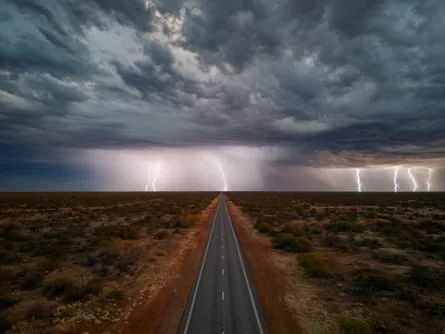
When storm patterns turn violent, the toll on human communities can climb with startling speed. Last summer, nearly 30,000 lightning discharges hit south-east England in a single day during an intense heatwave. In Australia, lightning kills five to ten people each year and injures about 100 others. Over in North America during July, more than 48,000 lightning strikes ignited blazes across Canada and the north-west United States, destroying homes and blanketing cities in smoke. These events show that even small shifts in thunderstorm frequency can carry severe social costs [1].
How Ice Collisions Create Lightning Strikes
The basic electrical nature of storms took centuries to uncover. In the 18th century, Benjamin Franklin showed that lightning was an electrical discharge, though he pictured electricity as an invisible fluid that flowed between objects. Today, atmospheric physicists know the process relies on the movement of ice inside rising thunderheads. Warm, moist air climbs into freezing cloud layers, where water vapor condenses into tiny ice crystals. These light crystals collide with soft pellets of hail known as graupel. During these collisions, electrons jump from the crystals to the graupel. The lighter, positively charged crystals then float upward on updrafts, while the heavier, negatively charged graupel fall toward the lower cloud base. As the two opposite charge pools pull apart, an electrical field builds between them until it snaps in a flash [1].
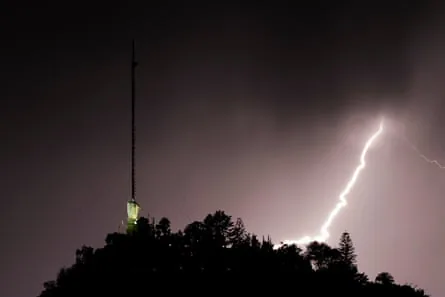
How does the final spark actually trigger inside a storm cloud? The electrical fields measured inside most thunderclouds are only about a tenth as strong as the field needed to break down air and generate a spark. Some scientists think incoming cosmic rays from space provide the trigger, while others point to ionised air streamers that build up runaway charges. To measure how lightning strikes discharge stored electrical energy, researchers Maggio, Marshall, and Stolzenburg studied 40 lightning flashes in four New Mexico mountain thunderstorms using ground meters, balloon sensors, and a lightning mapping array. Their team found that mature intracloud (IC) flashes spread horizontally and transfer an average of 17.6 coulombs of charge, while cloud-to-ground strikes lower an average of 8.7 coulombs to Earth [1, 2].
Geographic Hotspots Across Continents
Lightning does not fall evenly over Earth. More than 80 percent of all discharges hit land rather than oceans, concentrated in central Africa, parts of South America, and along the slopes of the Himalayas. The single most active spot in the world sits at Lake Maracaibo in Venezuela, in an area the local Bari people call Catatumbo, meaning the House of the Thunder. There, moist winds blowing off the lake crash into ridges of the Andes mountains, creating storms on 140 to 160 nights every year. By contrast, polar regions see very few flashes because cold air holds little water vapor. But maritime storms can sometimes reach astonishing flash densities when conditions align. During one storm over the Indian Ocean in 1998, flashes erupted eight times every second, illuminating the night sky in what seemed like an unbroken glow [1].
Human travel on the open sea also leaves a clear mark on cloud electricity. Scientists have observed that lightning density jumps along major commercial shipping lanes. Cargo vessels burn fuel that releases dense plumes of exhaust aerosol particles into the marine boundary layer. These particles act as cloud condensation nuclei, altering cloud droplet sizes and invigorating updrafts over water. As ships pass below, their emissions boost convective intensity, showing that human activity can alter storm physics far from populated shores [1].

Climate Warming Projections
As greenhouse gas emissions trap more heat, a warmer atmosphere holds more water vapor and supplies more energy for deep storm convection. Yet predicting how lightning will respond to higher temperatures remains complicated. A peer-reviewed review of global climate models found projections ranging from an 11 percent decrease to a 44 percent increase in global flashes for every degree Celsius of planetary warming. Across all models, the mean projection pointed to an increase of 7.5 percent per degree. Researchers generally agree that high-latitude areas will experience more frequent storms, but tropical regions show wide variation between different climate simulations [1].
Observational limits have added to that uncertainty. Satellites only began tracking lightning from orbit in the 1990s, meaning scientists previously relied on scattered ground stations and regional radar networks. Andrew Dowdy, an associate professor in climate science at the University of Melbourne, said that “it’s clear that in a warmer world, some of the conditions that are conducive to thunderstorms and lightning can be enhanced,” but emphasized that large modeling gaps persist. To trace long-term trends, Dowdy worked with colleagues Catto and Wang to analyze compound weather systems combining cyclones, fronts, and thunderstorms between 1979 and 2020. Their reanalysis showed that storm systems have increased along the eastern coasts of continents, with thunderstorm compound events peaking near 35 degrees south and 35 degrees north [1, 3].
Dry Lightning Strikes Behind Wildfires
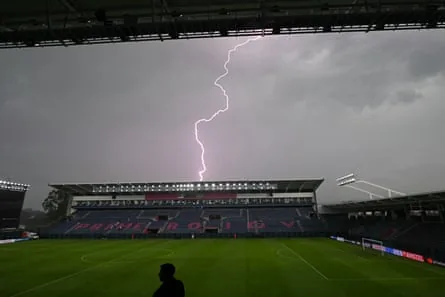
Storms do not always bring soaking rain to douse the sparks they unleash. In dry summer landscapes, raindrops often evaporate in parched air beneath the cloud base before reaching the ground, producing what meteorologists call dry lightning. When these rainless bolts hit brittle vegetation, they trigger fires that can spread undetected throughout remote terrain. In Australia, a report from the advocacy group Emergency Leaders for Climate Change revealed that forests in south-eastern Australia recorded 50 percent more dry lightning strikes between 2000 and 2016 than in the preceding two decades. Dowdy said that “lightning is the natural ignition source of fires,” adding that “lightning fires tend to burn larger areas on average compared to fires that are ignited by humans” [1].
This threat is growing as heatwaves dry out forest soils earlier in the season. In north-western Tasmania during 2025, a single storm generated more than 1,200 ground strikes in less than 24 hours, sparking blazes over drought-stressed terrain. Similar fire weather patterns have emerged in the western United States. In 2020, thousands of dry strikes ignited California’s August Complex blaze, which charred more than 4,000 square kilometers of forest. When vegetation is parched and winds blow hard, even a brief thunderstorm can turn into an ecological catastrophe [1].
Pyrocumulonimbus Clouds in Firestorm Loops
When wildfires burn with extreme heat, they can alter the local atmosphere and generate their own weather. Intense heat and rising moisture from burning trees create giant convective thunderheads known as pyrocumulonimbus (pyroCb) clouds. Sucking air upward into the stratosphere at speeds exceeding 200 kilometers per hour, these fire clouds freeze moisture at high altitudes, producing fresh electrical charges. Jason Evans, a professor at the Climate Change Research Centre at the University of New South Wales, said Australia has seen a “massive increase” in pyroCb formations. During the 2019–2020 Black Summer blazes, researchers recorded almost as many pyroCb events as in the entire previous four decades combined [1].
These fire-generated storms can create hazardous feedback loops. In February 2009, during Australia’s Black Saturday fires, researchers studied three distinct pyroCb formations that emerged from six major fire complexes. Dowdy and co-authors Fromm and McCarthy documented that the largest storm plume punched 15 kilometers into the atmosphere, generating hundreds of lightning strikes that began five hours after initial ignition. One nocturnal storm formed close to midnight, triggering additional spot fires that accelerated the spread of the front. As global warming drives longer fire seasons, understanding how lightning and flames feed each other has become an urgent scientific priority [1, 4].
- ONLINE NEWS Bradley, J. (2026, November 7). Thunderstruck: what does the future hold for lightning? The Guardian. [Article Link]
- ACADEMIC JOURNAL Maggio, C. R., Marshall, T. C., & Stolzenburg, M. (2009). Estimations of charge transferred and energy released by lightning flashes. Journal of Geophysical Research: Atmospheres, 114(D14). [Article Link]
- ACADEMIC JOURNAL Dowdy, A. J., Catto, J. L., & Wang, H. (2025). Compound weather systems of cyclones, fronts and thunderstorms in global reanalysis. Environmental Research Letters, 20(12), 124085. [Article Link]
- ACADEMIC JOURNAL Dowdy, A. J., Fromm, M. D., & McCarthy, N. (2017). Pyrocumulonimbus lightning and fire ignition on Black Saturday in southeast Australia. Journal of Geophysical Research: Atmospheres, 122(14), 7342-7354. [Article Link]
- WEBSITE Wikimedia Foundation, Inc. (2026). Thunderstruck. Wikipedia. [Article Link]
Cover image: Ayorinde Ogundele / Wikimedia Commons, CC BY-SA 4.0
APA 7: PerEXP Teamworks. (2026, November 8). Atmospheric Warming Reshapes Where Lightning Strikes Hit. PerEXP Teamworks. https://perexpteamworks.com/en/lightning-strikes-wildfire-climate-risk/


