





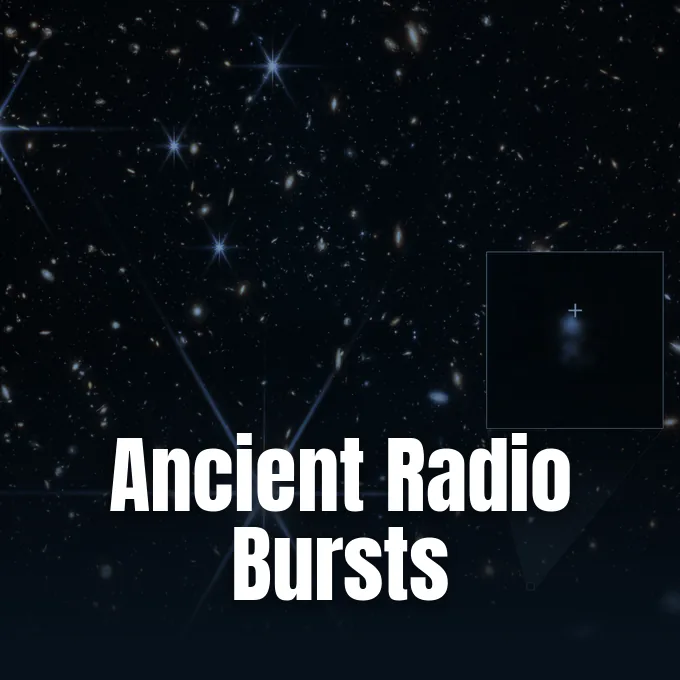
How do millisecond flashes of radio waves travel through deep space without losing their distinct physical signatures? In new research published in Science, astronomers using the MeerKAT array in South Africa and the James Webb Space Telescope tracked a fast radio burst back to its birthplace. The signal emerged more than 10 billion years ago [3]. At that ancient epoch, the cosmos had reached only a fifth of its present age, providing a rare window into early cosmic structures that complements neutral hydrogen observations mapped by the CHIME telescope near Penticton [1].
What Is a Fast Radio Burst?
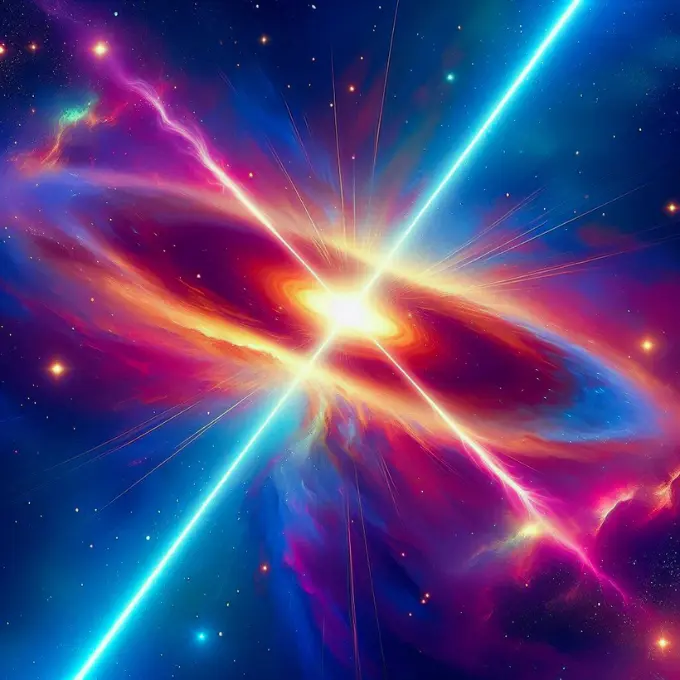
A fast radio burst is a bright flash of radio emission lasting only milliseconds yet releasing energy across vast cosmological distances. Discovered almost 20 years ago, these fast transients puzzled astrophysicists because their physical engines remained difficult to isolate. The signal vanished within milliseconds. When radio waves travel across cosmic space, free electrons in ionized gas slow down lower frequencies more than higher frequencies, creating a measurable delay that astronomers call dispersion (the separation of radio frequencies across time). Measuring that delay lets researchers calculate how much charged matter the pulse encountered during its journey, proving that the burst originated far beyond our home galaxy [3].
Measuring how dispersed light arrives at Earth connects directly to fundamental physics and experiments measuring the speed of light, since radio waves travel at light speed while interacting with intergalactic plasma. Many astronomers think that young neutron stars called magnetars produce these millisecond events. Yet fast radio bursts come in different shapes and sizes, so researchers caution that several distinct processes might generate them. Observations show that bursts were already occurring around 3 billion years after the Big Bang, during an epoch when early galaxies formed stars rapidly [3].
Small stellar remnants packed with strong magnetic fields could trigger sudden flare events that generate coherent radio emission. These brief outbursts act like cosmic flashlights. Each pulse picks up subtle imprints from magnetic fields, gas clouds, and turbulent pockets encountered during its journey across the cosmos. Tracking their origins identifies which galactic environments favor their creation [3].

How MeerKAT Pinpointed the Fast Radio Burst Origin
Astronomers caught the fleeting signal designated FRB 20240304B using the MeerKAT radio array in South Africa through an automated system called MeerTRAP. The MeerTRAP backend catches transient radio signals in real time, alerting observers the instant a high-dispersion pulse sweeps past the dishes [4]. Because the signal displayed large dispersion, the team knew it came from a great distance. Ground telescopes saw nothing. Instruments like the Keck Telescopes found no host galaxy because the source was too faint for ground optics [3].
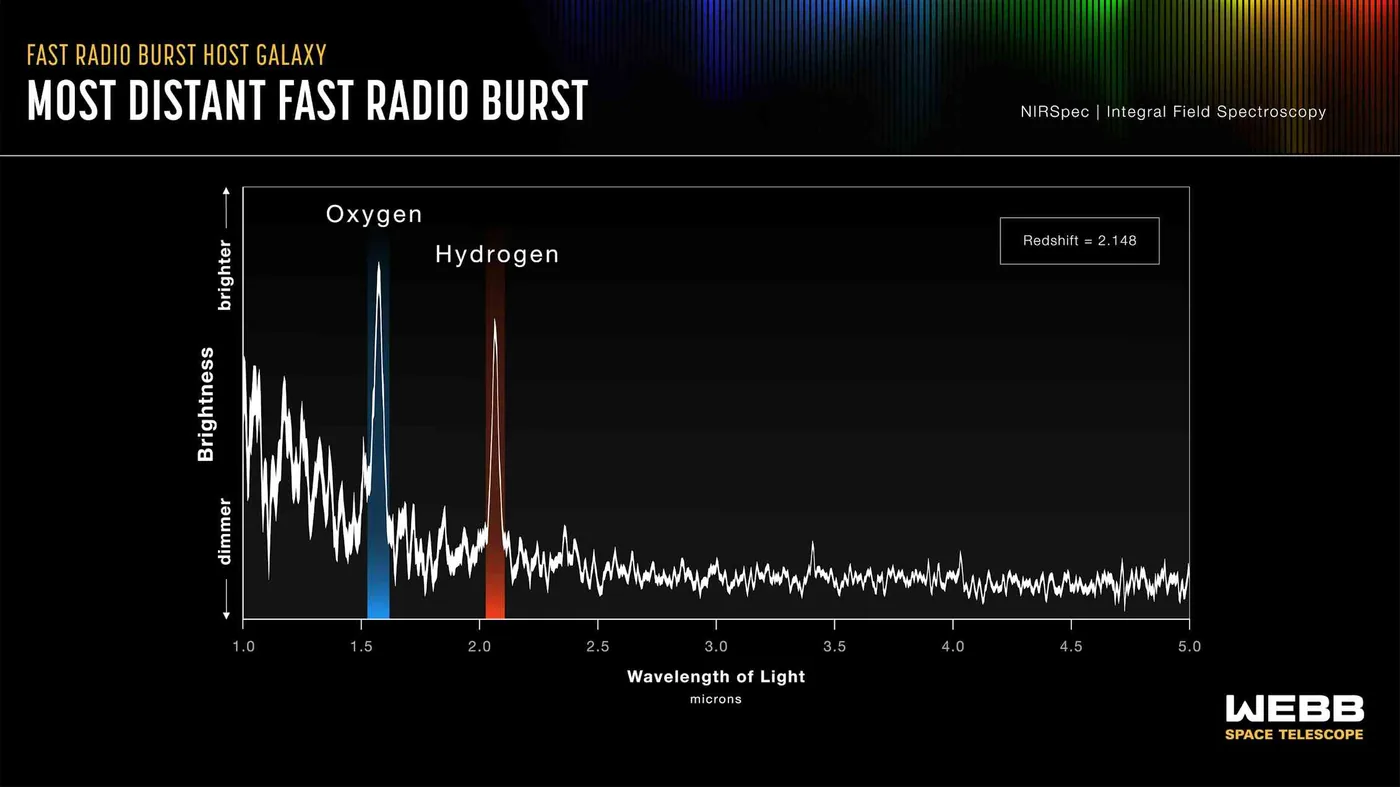
The researchers turned to the James Webb Space Telescope to inspect the sky coordinates. Infrared cameras revealed a tiny galaxy close to the position of the fast radio burst. By using the NIRSpec instrument (a near-infrared spectrometer) on board the space telescope, astronomers dispersed the incoming light into an optical spectrum whose emission peaks revealed oxygen and hydrogen signatures moving away with cosmic expansion. Spectral lines proved that the light left the host galaxy 10.6 billion years ago [3].
A separate summary by Themiya Nanayakkara and Manisha Caleb was published as a preprint that has not yet undergone formal peer review, detailing the observatory coordination [5]. The host galaxy surprised researchers. Stellar measurements reveal a mass around 10 million times that of our Sun, which represents a tiny fraction of our Milky Way. It is a young galaxy with low metal content, still forming stars in the early universe. That finding supports theories that early dwarf galaxies produce magnetars driving bright radio bursts [3].
Mapping Cosmic Hydrogen with CHIME Telescopes
While individual bursts illuminate narrow lines of sight, the Canadian Hydrogen Intensity Mapping Experiment maps broader structures by detecting diffuse neutral hydrogen gas. Located near Penticton in British Columbia (a key radio observatory in western Canada) and hosted by the National Research Council of Canada, the CHIME radio telescope surveys the northern sky daily. “Hydrogen is the most common element in the universe and the raw material from which stars form,” said Dr Arnab Chakraborty from the University of Toronto [1].
CHIME measures the combined 21-centimeter radio glow emitted by hydrogen gas without resolving individual distant stars. Traditional surveys cost millions of dollars more and map only regions dense enough to form stars. In two companion papers published in The Astrophysical Journal, the CHIME collaboration showed that its dishes could isolate this faint hydrogen signal using only its own radio observations. “This is a completely new technique for probing the cosmos, delivered by an instrument that was conceived, built and funded by Canadians,” said co-author Dr Mark Halpern, professor at the University of British Columbia and CHIME principal investigator [1].
Understanding hydrogen distribution offers an empirical benchmark for cosmologists studying debates surrounding Einstein’s alternative gravity theories and Hubble tension, where competing cosmological models attempt to explain cosmic expansion rates. Analyzing the 21-centimeter signal allows researchers to trace how neutral gas clustered when the universe was about five billion years old [1]. “Our data indicate that roughly two per cent of the hydrogen in the universe was in neutral atomic form at this time, broadly consistent with other measurements,” said co-author Dr Shabbir Shaikh, postdoctoral fellow at Arizona State University [2].

Extracting Faint Cosmological Signals from Cosmic Noise
Pulling a subtle cosmological signal from raw data took years of computational work. The hydrogen emission detected by CHIME was buried beneath noise from the Milky Way, human technology, and telescope electronics. The research team spent more than a year testing their algorithms to verify that the pattern was genuine. “We worked very hard to convince ourselves that this wasn’t a false alarm,” said Dr Chakraborty [1].
Analysis showed that the faint glow came from hydrogen in the distant universe nine billion years ago. That detection relied on 94 nights of observations collected during 2019. The universe was five billion years old [1]. MeerKAT scientists faced a similar challenge when isolating FRB 20240304B from transient radio noise in South Africa, relying on automated real-time algorithms in MeerTRAP to verify pulse dispersion curves before ground interference could corrupt the data [4].

The CHIME detection represents a small slice of archival data gathered since operations began. Astronomers possess nearly seven years of observations waiting for analysis, giving them ample data to refine their maps. “For a long time, astrophysicists have believed there is great potential in this hydrogen mapping technique with this kind of telescope. By actually showing that the technique works in practice, we’ve opened up a whole new window on the universe,” said co-author Dr Simon Foreman, assistant professor at Arizona State University. Researchers are now working to extend analysis back to when the universe was three billion years old [1].
Why Distant Fast Radio Bursts Illuminate Cosmic History
Finding a fast radio burst from 10.6 billion years ago matters because the signal illuminates space between galaxies. When low-frequency radio waves travel across immense cosmological distances, interactions with free electrons in intergalactic plasma delay their arrival time compared to higher frequencies, producing a measurable dispersion that directly reveals the intervening matter. Magnetic fields twist the polarization angle of radio waves through Faraday rotation (the rotation of polarization angles by magnetic fields). Measuring that rotational twist lets astronomers map the strength and structure of magnetic fields across vast cosmic regions [3].
The burst designated FRB 20240304B shows that fast radio transients were active around three billion years after the Big Bang. This was the peak era of cosmic star formation, when young galaxies assembled stellar populations. The signal provides a rare empirical probe of ionized matter across 80% of cosmic history. Finding such distant bursts is difficult because both the flashes and their host galaxies are faint [3].
Dwarf galaxies with low metallicities might provide ideal conditions for forming massive stars that collapse into magnetars. The host contains only 10 million solar masses. That tiny mass contrasts sharply with mature galaxies where astronomers found most nearby bursts. Comparing bursts from young dwarf galaxies with those from older systems helps astronomers determine whether magnetar production changed over cosmic time [3].
What Ancient Radio Signals Reveal About Early Galaxies
Ancient radio signals reveal how the building blocks of early galaxies formed and distributed matter throughout the expanding universe. The identification of FRB 20240304B in a low-mass galaxy proves that intense magnetic transients could ignite even in fragile stellar nurseries during the cosmic morning [3]. At the same time, CHIME’s detection demonstrates that neutral hydrogen gas can be mapped across billions of light-years using autocorrelation techniques without relying on expensive optical catalogues [1].
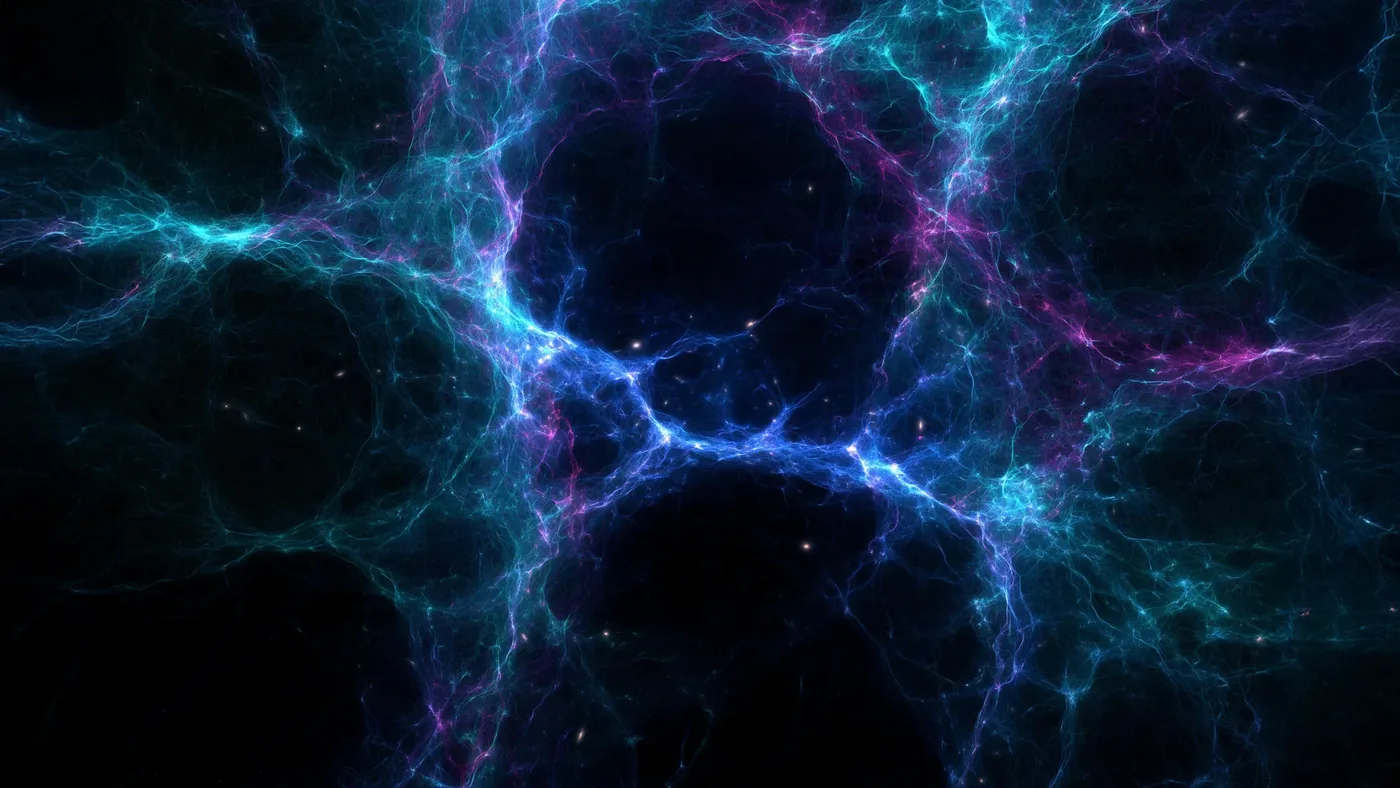
These complementary methods give astronomers distinct views of the ancient cosmos [1]. Fast radio bursts offer pin-sharp lines of sight through the intergalactic web, while hydrogen intensity mapping provides three-dimensional volumes showing where gas accumulated [2]. By combining both tools, cosmologists can test whether dark energy accelerated cosmic expansion at a constant rate or evolved across epochs. With seven years of CHIME data awaiting analysis and new radio arrays joining the search, astronomers turn fleeting millisecond flashes into lasting maps of cosmic evolution [1].
- ACADEMIC JOURNAL Amiri, M., Bandura, K., Chakraborty, A., Cliche, J., Dobbs, M., Foreman, S., Gray, L., Halpern, M., Hill, A. S., Hinshaw, G., Höfer, C., Joseph, A., Kruger, N., Landecker, T. L., van Lieshout, R., MacEachern, J., Masui, K. W., Mena-Parra, J.,. Pen, U. (2026). Detection of the Cosmological 21 cm Signal in Autocorrelation at z ∼ 1 with the Canadian Hydrogen Intensity Mapping Experiment. The Astrophysical Journal, 1009(2), 159. [Article Link]
- ACADEMIC JOURNAL Amiri, M., Bandura, K., Chakraborty, A., Chu, Z. Y. B., Dobbs, M., Foreman, S., Gray, L., Halpern, M., Hinshaw, G., Joseph, A., Kruger, N., MacEachern, J., Masui, K. W., Mena-Parra, J., Newburgh, L., Pinsonneault-Marotte, T., Reda, A., Shaikh, S., Siegel, S. R.,. Wulf, D. (2026). Interpretation of 21 cm Autopower Spectrum Measurement at z ∼ 1 by the Canadian Hydrogen Intensity Mapping Experiment. The Astrophysical Journal, 1009(2), 160. [Article Link]
- ACADEMIC JOURNAL Caleb, M., Nanayakkara, T., Stappers, B. W., Pastor-Marazuela, I., Khrykin, I. S., Glazebrook, K., Tejos, N., Prochaska, J. X., Rajwade, K., Mas-Ribas, L., Driessen, L. N., Fong, W., Gordon, A. C., Hoffmann, J. L., James, C. W., Jankowski, F., Kahinga, L., Kramer, M., Simha, S.,. Martin, C. D. (2026). A fast radio burst at redshift 2, three billion years after the Big Bang. Science. [Article Link]
- ACADEMIC JOURNAL Rajwade, K. M., Bezuidenhout, M. C., Caleb, M., Driessen, L. N., Jankowski, F., Malenta, M., Morello, V., Sanidas, S., Stappers, B. W., Surnis, M. P., Barr, E. D., Chen, W., Kramer, M., Wu, J., Buchner, S., Serylak, M., Combes, F., Fong, W., Gupta, N.,. Prochaska, J. X. (2022). First discoveries and localizations of Fast Radio Bursts with MeerTRAP: real-time, commensal MeerKAT survey. Monthly Notices of the Royal Astronomical Society, 514(2), 1961-1974. [Article Link]
- PREPRINT Nanayakkara, T., & Caleb, M. (2026). Astronomers pinpoint the origin of a 10 billion-year-old millisecond signal from space. [Article Link]
APA 7: TWs Editor. (2026, October 10). Astronomers Pinpoint a 10 Billion-Year-Old Fast Radio Burst. PerEXP Teamworks. https://perexpteamworks.com/en/fast-radio-burst-origin-detected/


