



A recently discovered dinosaur species may not have been tasked with the mythical mischief of Loki, but it did possess a remarkable set of horns reminiscent of the helmet attributed to the Norse trickster god.
Paleontologist Mark Loewen and his team unearthed fossils of the new species, named Lokiceratops rangiformis, in the badlands of Montana. This horned dinosaur roamed approximately 78 million years ago, thriving in what is now an arid region that was once a swampy floodplain adjacent to a vast seaway in western North America. According to their study published in PeerJ on June 20, the name “Lokiceratops rangiformis” signifies “Loki’s horned face resembling a caribou.”
The defining characteristic of Lokiceratops is its pair of large, blade-like horns projecting forward and outward from between its eyes. These horns, reminiscent of those seen on modern caribou or reindeer, vary in length. Unique among horned dinosaurs from the same era and region, Lokiceratops also boasts distinctive ornamentation along the edge of its bony neck frill at the rear of its head, setting it apart from its contemporaries, as detailed by the scientists.
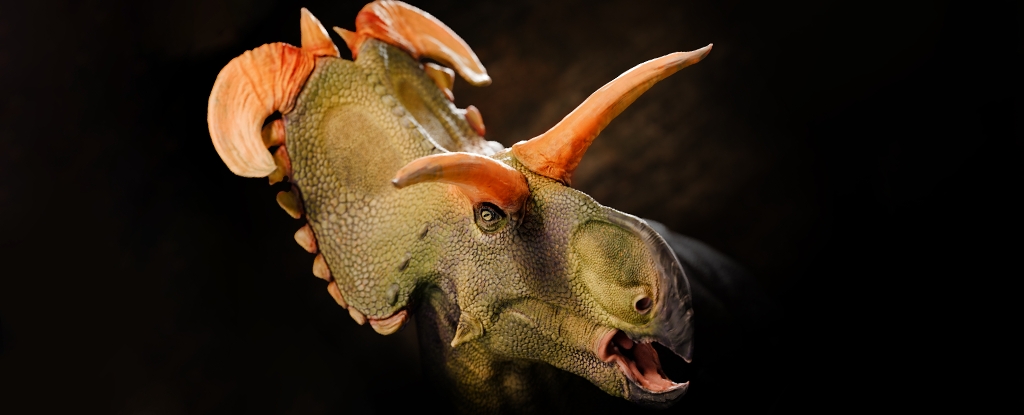
According to Mark Loewen from the University of Utah in Salt Lake City, there is a growing understanding that horned dinosaurs utilized their distinctive bony features as displays, either to attract mates or to intimidate rivals of the same species. He suggests that such extravagant ornamentation typically evolves under conditions akin to those on isolated islands, similar to the vibrant and varied plumage seen in birds.
The recent research indicates that this diversity among horned dinosaurs may be a result of the relative isolation of the ancient swampland, which was geographically cut off from other mainland areas by a seaway. Loewen identifies Lokiceratops as the fifth species of large horned dinosaur discovered in the Kennedy Coulee, a dry gorge stretching across modern-day northern Montana and southern Alberta, Canada. Other ceratopsid species found there include close relatives like Medusaceratops, Wendiceratops, Albertaceratops, and a smaller species named Avaceratops lammersii. According to Loewen, this area boasts the highest known diversity of ceratopsians in a single location.
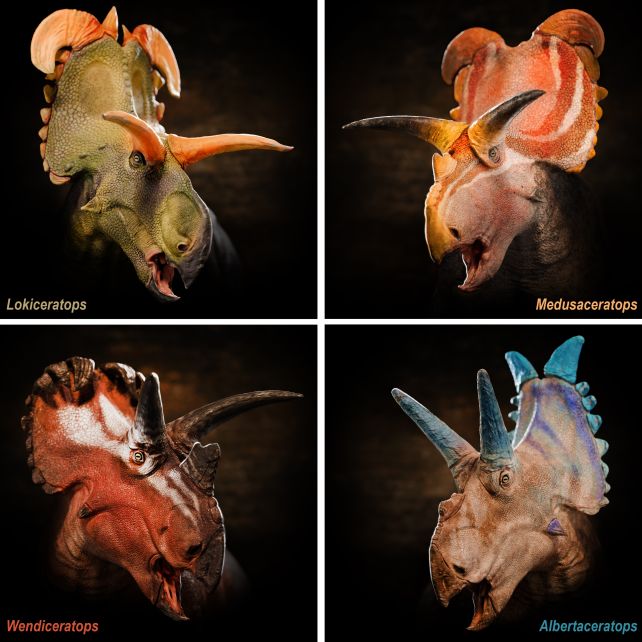
However, not all researchers are convinced that Lokiceratops should be classified as a distinct species. Paleontologist Denver Fowler suggests an alternative view: the differences in bony ornamentation observed between Lokiceratops, Albertaceratops, and Medusaceratops may not necessarily indicate separate species but rather evolving ornamentations within a single species.
Denver Fowler from the Dickinson Museum Center in North Dakota suggests that the differences observed among individuals of Lokiceratops may actually reflect age-related changes. He describes the Lokiceratops specimen as a particularly large and mature individual, noting that research on other ceratopsids, such as Triceratops, has shown significant morphological transformations as these animals grow. Fowler points out that the hollowed-out bladelike brow horns seen in Lokiceratops are similar to those found in the largest and oldest Triceratops specimens, which contrasts with the more solid horns seen in younger individuals.
Shawn DeNarie, a ceratopsid specialist at George Washington University, notes that Lokiceratops appears closely related to Albertaceratops and Medusaceratops based on the arrangement of bony ornamentation on their frills. However, DeNarie suggests that the orientations of the frill horns differ sufficiently to indicate they may indeed represent distinct species. He underscores that while the orientations of these features suggest differentiation, he was not directly involved in the recent study.
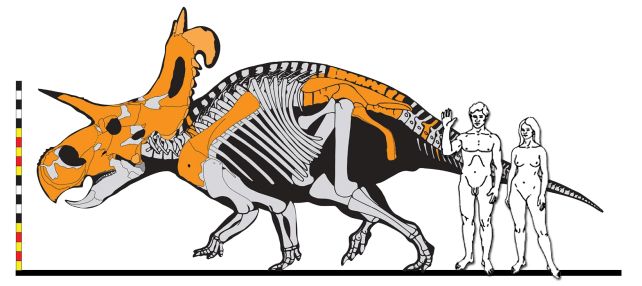
The debate over whether closely related ceratopsid specimens constitute separate species or different developmental stages echoes past controversies, such as the distinction between Triceratops and Torosaurus. Similar discussions have questioned whether Albertaceratops and Medusaceratops might actually be variations of the same species.
Fowler emphasizes the necessity of highlighting differing viewpoints in scientific discourse, stating that as more data emerges, researchers will approach a clearer understanding of the truth. He humorously muses that such scientific debates might intrigue a god of mischief like Loki, suggesting a whimsical connection to the creature’s name.
- ONLINE NEWS Gramling, C. (2024, June 20). Meet Lokiceratops, a newly discovered species of horned dinosaur. Science News. [Science News]
- JOURNAL Loewen, M. A., Sertich, J. J. W., Sampson, S., O’Connor, J. K., Carpenter, S., Sisson, B., Øhlenschlæger, A., Farke, A. A., Makovicky, P. J., Longrich, N., & Evans, D. C. (2024). Lokiceratops rangiformis gen. et sp. nov. (Ceratopsidae: Centrosaurinae) from the Campanian Judith River Formation of Montana reveals rapid regional radiations and extreme endemism within centrosaurine dinosaurs. PeerJ, 12, e17224. [PeerJ]
- ONLINE NEWS Elbein, A. (2024, June 20). Lokiceratops, a Horned Dinosaur, May Be a New Species. The New York Times. [The New York Times]
- ONLINE NEWS Starr, M. (2024, June 20). Newly found dinosaur lokiceratops had insane horns unlike any other . ScienceAlert. [ScienceAlert]
APA 7: TWs Editor. (2024, June 21). Lokiceratops: Newly Found Species of Horned Dinosaur. PerEXP Teamworks. [Online News Link]


