



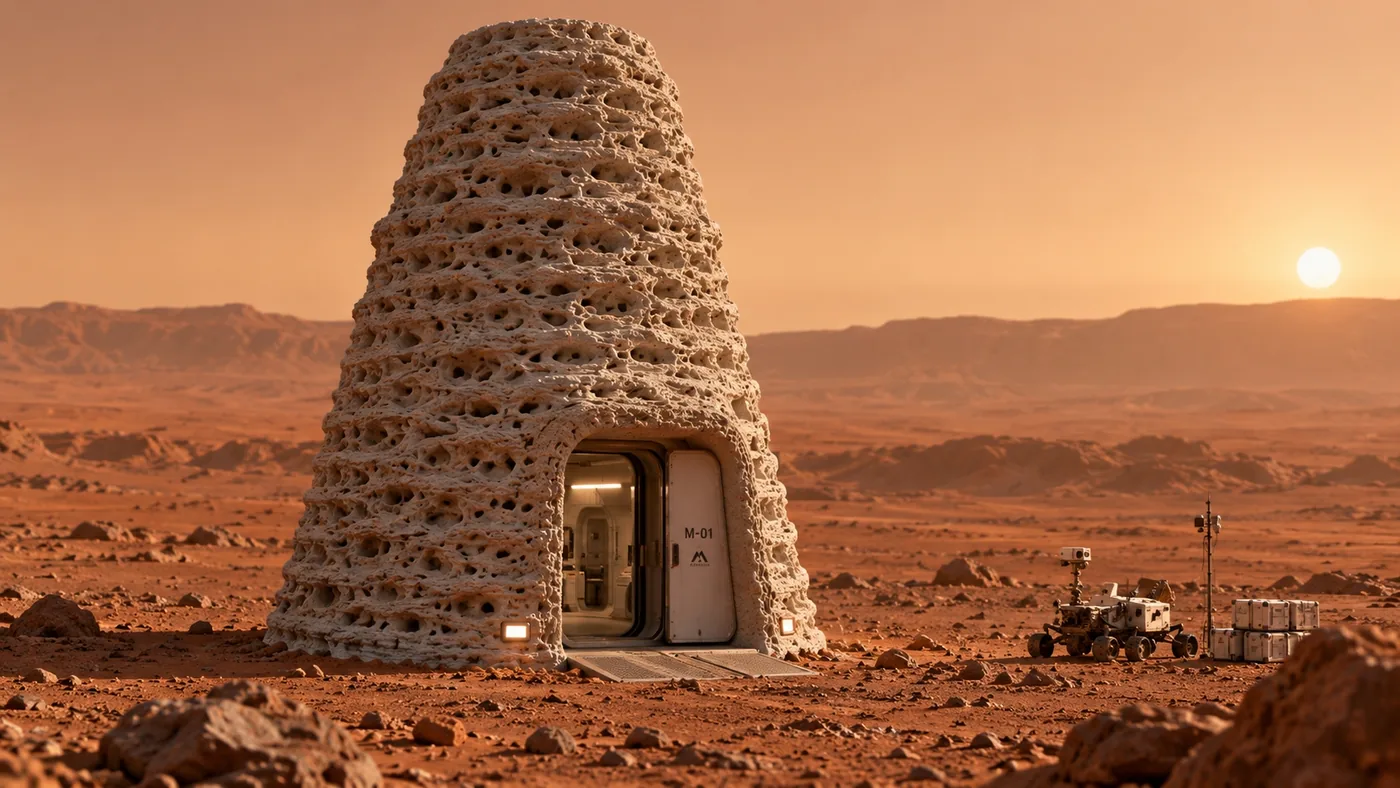
Mars habitats could one day owe part of their structure to yeast (Saccharomyces cerevisiae). In Engineered living building material for low-energy construction on Mars, Liu and colleagues describe a binder combining engineered cells with gelatin to hold mineral grains together. Their proposed Martian shelters would harden through freezing and water loss under low pressure. Laboratory tests reached about 12 megapascals of compressive strength, although the printed demonstration used natural sand and stood just 45 millimeters tall. [1, 2]
Mars Habitats From Living Materials
Researchers designing Mars habitats face a supply problem before construction even begins. A settlement would initially lack the industrial infrastructure needed to manufacture conventional building materials, while shipping the raw ingredients for whole buildings would compete for rocket capacity with other necessities. Qiu’s group proposes using local regolith (the loose surface material) as the bulk ingredient. The team calls its composite Martian living building material, or MLBM. Yeast and gelatin provide the binder that connects those grains. [2]
The yeast cells carry proteins on their surfaces that help strengthen microscopic contacts within the mixture. Gelatin contributes to the binding system, and the mineral grains supply the material around which the structure forms. The strongest formulation still uses porcine gelatin supplied from Earth. The team also made a version without gelatin, but it had lower strength, according to Tudor Tarita’s reporting for ZME Science. An ingredient that improves performance in the laboratory can also create a continuing supply requirement for a distant settlement. [2]
NASA has explored local construction through its 3D-Printed Habitat Challenge and research into fungal mycelium. Yeast offers another biological route. A 2020 PLOS ONE paper by Shiwei, Dritsas, and Fernandez investigated Martian biolith, which combined simulated regolith with chitosan. Each approach links mineral resources to a different binder; the earlier biolith work does not establish how the newer yeast formulation would perform on Mars. [2, 3]
How Would the Printing Work?
Qiu’s team envisions growing the binder inside a bioreactor (a vessel that maintains conditions for biological production). The vessel would need pressure and insulation, with locally extracted water feeding the process. Robots would then combine the binder with regolith and push the resulting paste through a printer, probably within a temporary enclosure that keeps it warm enough to flow. The living ingredients would start their work inside controlled equipment before the printed shell encountered the Martian environment. [2]
Mars would supply cold and low pressure for the next stage. Water in the fresh mixture would freeze; the ice would then undergo sublimation (a direct transition from solid to vapor), leaving a porous scaffold behind. Water loss helps the structure harden. The proposal uses conditions that Mars already offers, but the printer and bioreactor would still need their own operating environments. Qiu’s group has yet to demonstrate that complete construction sequence at the size of an actual building. [2]
The published design includes a three-story building 12 meters tall, with 102 square meters of floor area and 93 cubic meters of MLBM. It remains a design. The researchers estimate that its binder alone would require about 1.86 metric tons of material from Earth; those figures describe a proposed construction scenario rather than a habitat they have already printed. [2]
What Did the Tests Establish?
The researchers printed a small beacon measuring 45 millimeters tall and 30 millimeters wide. They used natural sand. Their reported compressive strength of roughly 12 megapascals describes resistance to crushing, providing evidence that the recipe can form a mechanically useful solid under laboratory conditions. It does not establish that a complete shell could withstand every load or exposure associated with inhabited Mars habitats. The experiment also leaves open how actual Martian minerals and salts would affect the yeast and its binding performance. [2]
Qiu questioned how faithfully a regolith simulant would represent the real material, telling ZME Science, “we don’t really know how authentic the ‘simulant’ is”. His group has not tested the effects of real Martian salts and minerals on the yeast. No Martian soil went into the demonstration. PerEXP Teamworks’ coverage of Perseverance’s samples from an ancient Martian lake concerns the scientific search for evidence about Mars; using surface material in a construction process raises an additional set of biological and engineering questions. The yeast study needs material testing that addresses those questions before its proposed local ingredient becomes an established feedstock. [2]
Qiu considers radiation another major biological concern. His team also needs to establish how printing behaves under Mars’s lower gravity. [2]


What Would Make a Shell Livable?
An MLBM dome would need an internal membrane to retain air. Qiu suggests a high-strength polymeric fabric closely attached to the inner surface as one possible solution. The porous shell cannot hold an atmosphere by itself. Insulation, thermal control, radiation shielding, and life-support equipment would also have to become part of the finished habitat. A strong construction sample answers a materials question, while a home must support those additional systems throughout operation. [2]
Water creates a further engineering conflict: how much should builders remove? Qiu proposes that retaining more water could improve protection against charged particles, including protons and alpha particles, even though the curing method relies on water leaving the printed mixture. He also suggests thicker walls containing dense local regolith to improve protection from gamma rays and neutron radiation. His comments describe potential protective measures; the supplied account does not establish a tested radiation-shielding specification for the proposed building. [2]
The team has considered capturing the escaping vapor for reuse. Qiu says recovery would become essential for a lunar adaptation without a continuing local water supply. For Mars, that recovery system lies outside the current plan, leaving water handling among the unfinished parts of turning the material into a working construction process. [2]
Would the Yeast Stay Active?
The team reports recycling the material four times without a substantial loss of strength or yeast viability. Living yeast remained viable through those trials. The results support reuse within the tested sequence, but the researchers have not quantified long-term nutrient needs, replacement water, or material losses across repeated recycling. Four recycling rounds do not establish an indefinitely renewable supply. Mars habitats would need a production plan that accounts for what the living component consumes as well as what it makes. [2]
Engineered Saccharomyces cerevisiae belongs to a broader field of yeast biotechnology, which also includes research into constructing synthetic yeast chromosome XI. In the building proposal, Qiu hopes other engineered microorganisms could eventually convert methane and carbon dioxide into nutrients and raw materials for protein production. That supporting system remains prospective. Until then, microbes that reproduce locally would still need a dependable food supply, potentially shipped from Earth, and the strongest mixture would retain its dependence on imported gelatin. [2]
How Much Energy Could It Save?
The study estimates lower material-processing energy than high-temperature regolith sintering (binding grains through heating). Its calculation has a limited boundary. According to ZME Science, it does not yet include the full burden of growing microbes, running bioreactors, controlling temperatures, pumping material, or recovering water. A lower curing requirement is only part of the energy budget. Assessing Mars habitats built this way would require those supporting operations in the comparison, together with the equipment and supplies needed to sustain them. [2]
Qiu wants a larger testing environment with low temperature, low pressure, a full-size printer and controller, and a full-size bioreactor. Reduced-gravity testing presents another challenge. Before the proposed three-story structure can move beyond a design, the team needs to investigate how a larger print behaves while its biological production equipment operates under the conditions the construction process requires. [2]
- ACADEMIC JOURNAL Liu, N., Huang, W., Lam, S. C., Yi, Q., Dou, C., Tang, Y., Qin, S., Weng, Y., Sun, F., & Qiu, J. (2026). Engineered living building material for low-energy construction on Mars. Chem Circularity, 100120. [Article Link]
- ONLINE NEWS Tarita, T. (2026, September 10). Could yeast help build 3D-printed habitats on Mars? Scientists are testing the recipe. ZME Science. [Article Link]
- ACADEMIC JOURNAL Shiwei, N., Dritsas, S., & Fernandez, J. G. (2020). Martian biolith: A bioinspired regolith composite for closed-loop extraterrestrial manufacturing. PLOS ONE, 15(9), e0238606. [Article Link]
APA 7: TWs Editor. (2026, September 11). Could Mars habitats take shape with engineered yeast? PerEXP Teamworks. https://perexpteamworks.com/en/mars-habitats-engineered-yeast/


