





Meta’s Superintelligence Lab released Muse Wonder on Monday, marking the company’s first release of a frontier artificial intelligence model [2]. The launch includes two variants, Muse Wonder and Muse Wonder Full, designed to narrow the performance gap with leading systems developed by OpenAI and Anthropic. Both models feature an expansive one-million-token context window that accepts text, images, video, and audio inputs, giving developers the capacity to feed vast document collections or lengthy recordings into a single prompt without fragmenting context [1]. Instead of prioritizing low latency like the earlier Muse Spark release, these systems focus on complex reasoning and autonomous software development to solve multi-step engineering challenges without requiring constant human intervention during iterative coding loops [2]. While Meta previously struggled with its open Llama models, this launch brings the team back into direct competition with the industry’s most capable systems [4].
How Muse Wonder Compares on Key Benchmarks
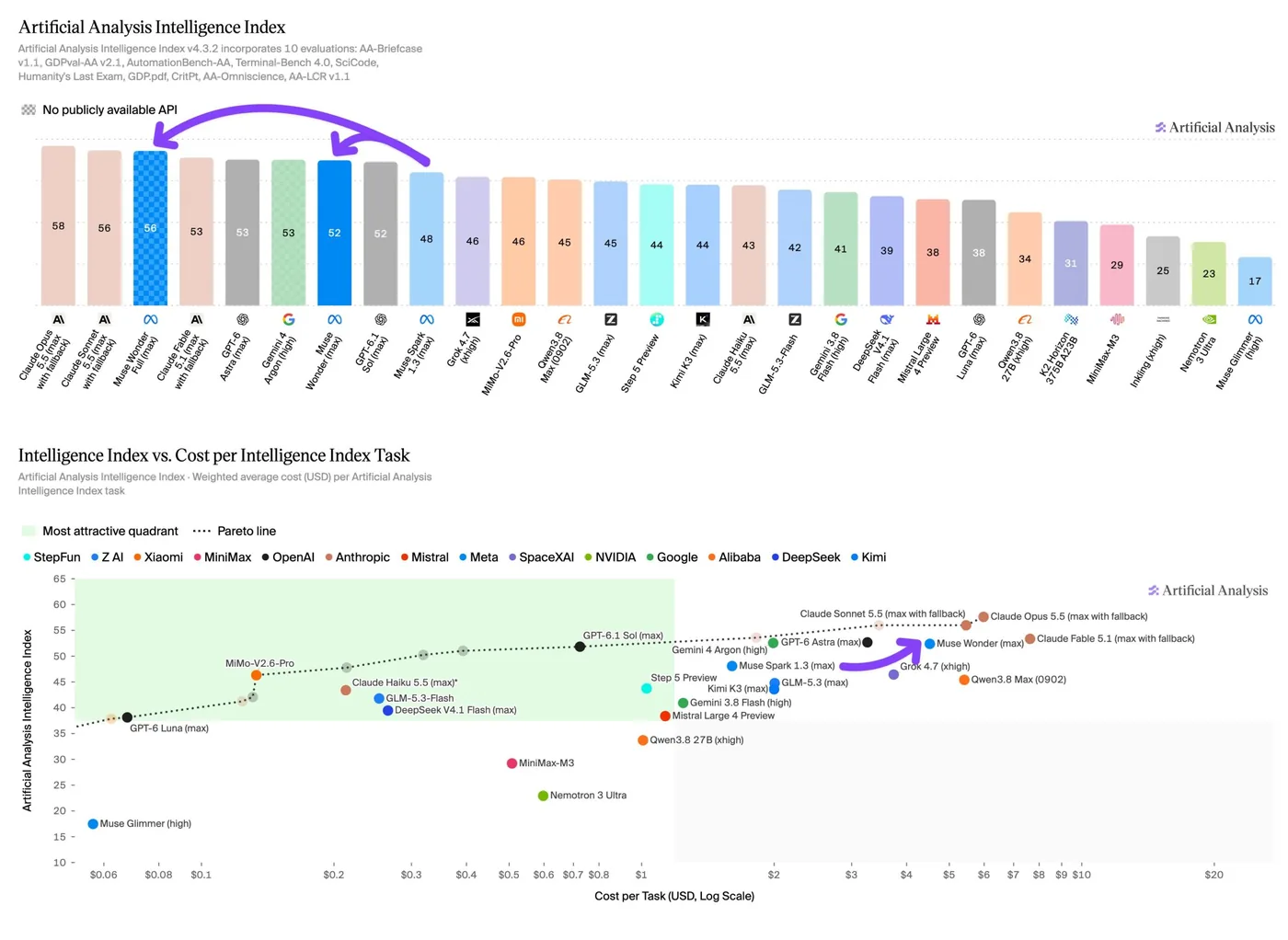
Independent evaluations show that the flagship model achieved competitive standings on several major performance ladders. On the Artificial Analysis Intelligence Index v4.3, Muse Wonder Full scored 56 points and Muse Wonder reached 52 points, outperforming predecessor Muse Spark 1.3 to place the company’s frontier architecture within striking distance of the highest-ranking industry benchmarks. Its predecessor sat at 48 points. Muse Wonder Full earned a spot in the top three on six out of ten evaluations on the index. On the Vals AI Index, the larger variant debuted in fifth place, finishing ahead of all OpenAI models and trailing only current Anthropic releases. Only Anthropic scored higher overall [1].
The sharpest performance gains surfaced in coding evaluations and mathematical problem-solving tasks. Muse Wonder Full scored 68 points on the Coding Agents Index, matching the benchmark record set by Claude Code with Sonnet 5.5, while Muse Wonder climbed to 63 points. On the ProofBench mathematics test, Muse Wonder Full solved 94 out of 100 problems, rising sharply from the 58 problems solved by Muse Spark 1.3 during comparative testing. ProofBench scores doubled over Muse Spark. On Terminal-Bench 4.0, the model doubled its score from 33 percent to 57 percent while using 30 percent fewer output tokens [1].
Factual recall benchmarks revealed clear limits in the network base. On the AA-Omniscience test, Muse Wonder Full scored 30 points and Muse Wonder managed 25, trailing Claude Opus 5.5 at 46 points and GPT-6 Astra at 43 points. That performance gap suggests the Wonder models rely on a smaller base network than competing frontier releases. Even so, Muse Wonder Full cut its hallucination rate from 33 percent to 23 percent, trailing only Gemini 4 Argon at 15 percent [1].
Active Memory and Focus for Autonomous Agents
To support persistent task execution, Meta introduced two core agent features called Active Memory and Active Focus. Active Memory lets the system store key user details between sessions and recall them when needed, while Active Focus helps the model pursue multi-step goals without getting derailed by complex prompts or compounding errors during lengthy interactive sessions [1, 4]. The company designed both features to support personal assistants that manage calendars, messages, and document libraries [1]. “We put a tremendous amount of effort into making sure your model can remember what’s important to you over days, weeks, months, and beyond,” said research scientist Kavya Kopparapu [2].
Meta highlighted results from MemoryBench to demonstrate how well the architecture retains information over extended task cycles [2]. MemoryBench is an evaluation framework described in an unreviewed preprint paper by Q. Ai and colleagues that tests continual learning and memory construction without peer review [5]. According to Meta’s published benchmark reports, Muse Wonder achieved higher recall scores on MemoryBench than rival models such as Claude Fable 5.1, Claude Opus 5.5, and GPT-6 Astra [2]. The lab explained that maintaining stable memory helps agents avoid compound errors when tackling extended coding projects [4].
These capabilities build on Meta’s earlier efforts to deploy agent tools in consumer software. PerEXP Teamworks documented earlier how Meta Muse shopping tools and personal assistant features raised questions about privacy when accessing personal data. Meta CEO Mark Zuckerberg stated on X last month that the company delayed releasing its Muse models to finish safety audits. Even so, Meta didn’t reveal whether the new models exhibited harmful behavior during red-teaming trials [4].


High Compute Costs and API Token Pricing
Accessing the new frontier models requires a larger financial commitment than running lighter versions. Artificial Analysis calculated that Muse Wonder runs at $4.52 per task on the Intelligence Index, nearly triple the $1.60 per task cost of Muse Spark 1.3. Through the Meta Model API, developers pay $4 for every million input tokens and $20 per million generated output tokens, compared to earlier baseline rates of $1.25 and $4.25 on Muse Spark, while inference uses 28 percent more input tokens per query [1, 2]. Input tokens represent 76 percent of total query costs. Each new model generates around 10 percent fewer completion tokens than Muse Spark [1].
The new pricing puts Muse Wonder below Claude Fable 5.1 at $7.63 and Claude Opus 5.5 at $5.98 per task, but above GPT-6 Astra at $3.26 and Gemini 4 Argon at $1.99. Meta hasn’t published token pricing for Muse Wonder Full because the larger version stays restricted to Muse Code subscribers and isn’t offered through the API. No token pricing exists for Wonder Full [1, 2]. The company plans to roll out Muse Wonder to paid subscribers of the Muse app before creating lighter specialized versions for wider audiences [1]. These cloud-based services will also complement hardware initiatives like the Meta Muse Charm pocket device scheduled to arrive in December [2].

Training the models demanded heavy computing resources in central Ohio. The company handled training runs at its Prometheus data center, a gigawatt-scale facility that came online earlier this year [1, 2]. Running high-end models at scale is an expensive bet, but the company’s computing investments show it won’t concede the frontier tier to rivals [4].
How Meta Muse Wonder Reshapes Team Strategy
The debut of Muse Wonder reflects an intensive reorganization of Meta’s artificial intelligence leadership over the past year. CEO Mark Zuckerberg spent fourteen months revamping the division after previous Llama releases failed to match advances from Anthropic and Google, pouring billions into computing infrastructure to rebuild momentum [3, 4]. Zuckerberg also paid $14B for an equity stake in Scale AI to recruit Alexandr Wang as chief AI officer [3]. Wang restructured the newly formed Meta Superintelligence Labs in August of last year, shifting the group’s direction toward frontier research [2, 4].
The release met the company’s planned schedule, arriving in October under the code name Watermelon, which had been reported by The Information in August. Watermelon arrived right on schedule. Shares rose as much as 4.7%. Alexandr Wang told Bloomberg that the model claims performance parity with ChatGPT and Claude on programming benchmarks as well as corporate legal workflows. When asked about skeptics who doubt benchmark figures, Wang said people should “try it and judge for themselves”. It’s the third time this year Meta has claimed frontier capabilities, but this launch arrives with broader third-party validation [3].
Open Weights Questions Under the EU AI Act
Meta hasn’t clarified whether it will release model weights for Muse Wonder, leaving its open-source intentions uncertain. The company’s recent releases have split by size, publishing weights for smaller distilled models like the 30B release and Muse Glimmer while keeping flagship models proprietary [3, 4]. Under Article 53 of the EU AI Act, a truly open model that provides weights, architecture specifications, and usage documentation can escape certain reporting burdens enforced by the AI Office [3].
That regulatory exemption doesn’t apply to every release because models posing systemic risk face comprehensive oversight regardless of their licensing model under current European guidelines. Meta previously declined to sign the European code of practice designed to put those rules into operation. Speed has created problems for the company before: Meta shut down Muse Image just three days after launch when default controls opted public user accounts into data collection. European regulators haven’t granted exemptions yet. For now, European regulators and developers will watch whether Meta keeps its frontier systems closed or returns to the open distribution model that first defined its Llama series [3, 4].
- ONLINE NEWS Bastian, M. (2026, October 12). Meta’s new frontier model Muse Wonder Full breaks into the AI top tier. The Decoder. [Article Link]
- ONLINE NEWS Brandom, R. (2026, October 12). Meta releases its first frontier model, Muse Wonder. TechCrunch. [Article Link]
- ONLINE NEWS Constantin, A. M. (2026, October 12). Meta says its new Muse model has reached the AI frontier. The Next Web. [Article Link]
- ONLINE NEWS Knight, W. (2026, October 12). Muse Wonder Puts Meta Back at the AI Frontier. Wired. [Article Link]
- PREPRINT Ai, Q., Tang, Y., Wang, C., Long, J., Su, W., & Liu, Y. (2025). MemoryBench: A benchmark for memory and continual learning in LLM systems. arXiv. [Article Link]


