





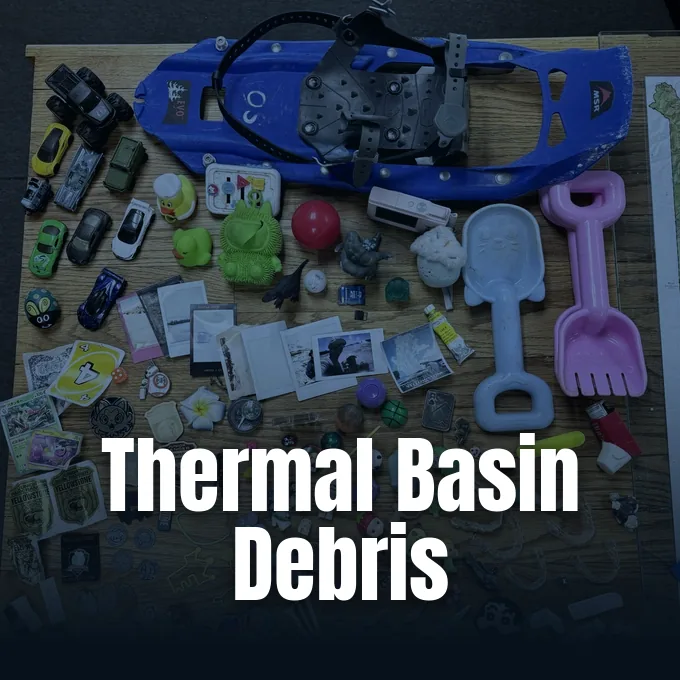
Staff inspecting Yellowstone hydrothermal areas this summer recovered more than 20,100 pieces of human debris, 5,600 rocks and sticks, and 280 discarded hats from delicate thermal basins. Why do thousands of personal items end up submerged in superheated alkaline springs and acid geysers every visitor season? Strong seasonal gusts, accidental slips along crowded wooden boardwalks, and an enduring human urge to treat steaming pools like wishing wells continually funnel unnatural objects into these geothermal features. Yellowstone National Park officials reported that specialized cleanup operations recovered over $18 in international currency and hundreds of clothing items before autumn closures began in September 2026. [2, 3]
Debris Across Yellowstone Hydrothermal Areas
Yellowstone National Park attracts more than 4.5 million visitors each year, drawing travelers eager to witness geysers, thermal springs, and volcanic features (subsurface channels circulating superheated groundwater through volcanic rock). Heavy foot traffic brings unexpected mechanical burdens to fragile geological structures. Yellowstone Volcano Observatory scientists and National Park Service personnel documented a record-setting cleanup campaign across multiple thermal basins in September 2026. [3, 5]
Field crews working with the Yellowstone Geology Program retrieved 54 camera lens caps, 47 hair ties, 42 pencils, and 36 pairs of sunglasses dropped near thermal margins. Human litter rapidly accumulates along primary viewing corridors. Workers collected 20 hotel key cards, 17 pacifiers, and five wireless earbuds from thermal runoff channels. [4, 5] Careless handling explains several losses.
The Yellowstone Geology Program team sorted every piece of retrieved detritus by hand. [3] Every single item required careful removal.
Wind Gusts and Lost Headwear
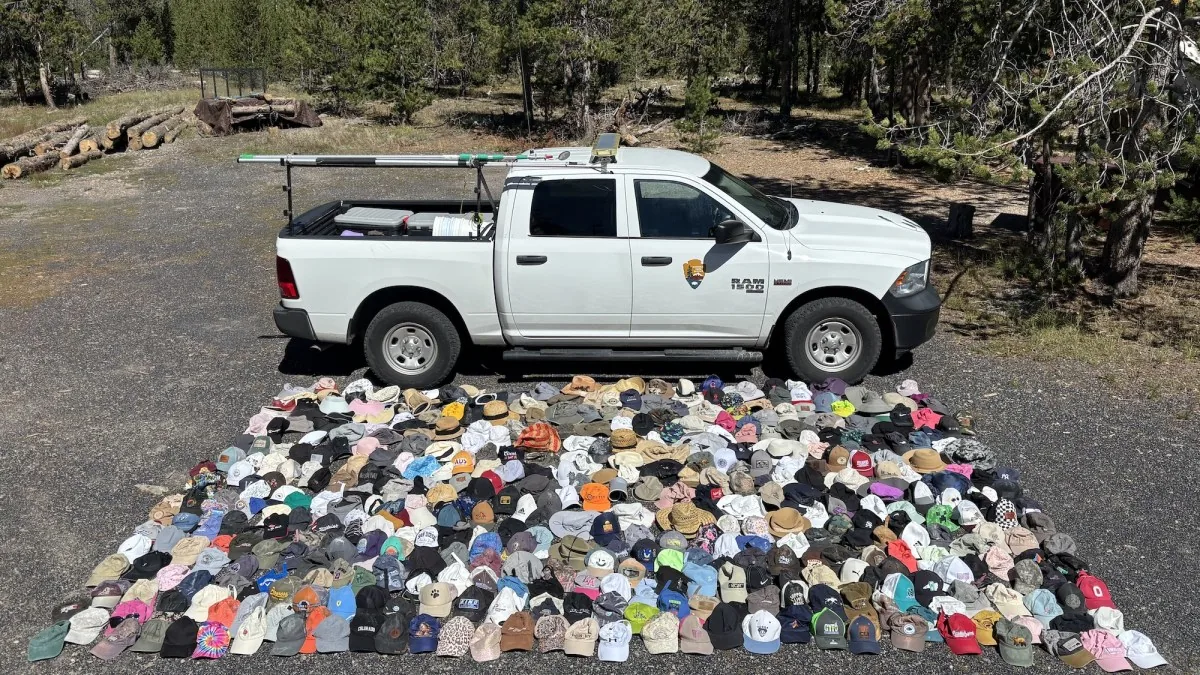
Sudden mountain winds regularly snatch loose headwear from visitors standing near boiling springs. During summer patrols, park workers recovered more than 280 hats that were blown across Yellowstone hydrothermal areas. Gusty winds transform ordinary baseball caps into airborne hazards across open geothermal flats. Notable recoveries cited by Andrew Paul included a FIFA 2026 Men’s World Cup souvenir and a cap bearing the phrase Cowboy Hat. [2] Wind gusts strike without warning.
Park officials announced that usable headwear will be cleaned and donated to local clothing organizations once seasonal cleanup concludes. Boardwalk infrastructure (elevated wooden walkways designed to isolate foot traffic from fragile ground) keeps sightseers away from scalding thermal springs, yet elevated decks cannot prevent strong mountain winds from carrying headwear into distant hydrothermal vents. National Park Service rangers recommend removing headwear during intense gusts to prevent sudden losses into boiling hydrothermal vents. [2, 3]
Reporting in Popular Science emphasized the official park reminder urging visitors to stash their trash securely inside zipped packs. Lightweight items such as park maps, plastic wrappers, and foam visors easily escape open pockets. Securing personal gear prevents accidental contamination. Yellowstone National Park staff maintain that simple personal precautions protect vulnerable hydrothermal features throughout high visitation months. [2]

Wishing Wells and Chemical Shifts
Visitors often treat steaming pools as wishing wells, tossing pocket change into clear thermal water without considering environmental consequences. Field teams collected more than $18 in coins, finding U.S. currency mingled with Canadian dollars, euros, pesos, and Japanese yen. [2, 4] Bacterial mats (living mats of thermophilic microorganisms that thrive in scalding outflow) suffer immediate contamination when metallic alloys leach copper, zinc, and nickel into alkaline solutions. [3, 4] Coins trigger harmful chemical shifts.
Even after Yellowstone National Park raised entry for international visitors to $100 per individual, foreign currency continued appearing in remote thermal basins across the park. Andrew Rossi reported in Cowboy State Daily that coins tossed into geothermal pools can introduce destructive algae and foreign bacteria into pristine thermal systems. Metallic corrosion and foreign sediment alter microbial mats while blocking delicate underground conduits. According to Geological Survey scientists, metal debris and submerged rubbish can divert natural outflow channels, reduce vent temperatures, and choke hydrothermal plumbing that took centuries of mineral deposition to form. Discarded pennies slowly dissolve, releasing metallic ions that degrade endemic microorganisms adapted exclusively to natural mineral compositions. [3, 4]
Can mineral springs maintain natural equilibrium when thousands of tourists deposit artificial metal alloys into thermal vents every year? National Park Service hydrologists warn that foreign additions degrade unique geochemical balances that cannot be artificially restored once disrupted. [2, 4] Thermal waters require strict chemical purity.


Oddities Found in Thermal Basins
Beyond standard tourist litter, Yellowstone Volcano Observatory personnel cataloged dozens of astonishing oddities recovered from Yellowstone hydrothermal areas. Rangers retrieved five AirPods, six Invisalign retainers, 15 fake nails, an inhaler, three golf tees, and a single Uno card during summer sweeps. [3, 4] Staff also pulled out personal Polaroid pictures of visitors posing near thermal features and a two-inch miniature edition of The Vampire Diaries. [3] Unexpected personal belongings highlight how closely visitors lean over scalding hydrothermal vents. These items tell another story.
Children contributed distinct items to the summer collection, including eight miniature race cars, three bouncy balls, 22 figurines, two rubber ducks, and four Pokémon cards. [4, 5] Field crews also retrieved a missing LEGO Star Wars stormtrooper figurine and a vintage McDonald’s toy dating back to 2010. Uncovering preserved items from sediment layers mirrors broader discoveries in regional field research, such as when miners in North Dakota uncovered a millennia-old mammoth tusk during excavation work. In both settings, buried objects reveal human interactions with geological terrain over extended time spans. [3, 4]

The Morning Glory Pool Cautionary Tale
Morning Glory Pool (a deep hydrothermal spring in the Upper Geyser Basin renowned for vivid blue water) represents the primary cautionary tale of human contamination in Yellowstone National Park. Named in the 1880s for its resemblance to the morning glory flower, the pool once sat directly adjacent to the main roadway carrying stagecoaches and early automobiles to Old Faithful. Yellowstone National Park historian Alica Murphy explained that historic travelers established a habit of tossing coins and souvenirs directly from vehicle windows into the thermal crater. Murphy noted that pools of clear water provoke an odd human instinct to treat natural features like wishing wells. [3]
Decades of deliberate tossing permanently altered the thermal spring by clogging submerged plumbing vents and reducing water temperatures. In 1991, lifelong Yellowstone employee and author Jeff Henry joined an intensive operation using fire trucks to pump water from Morning Glory Pool into the Firehole River. Hooked to a climbing harness with a long-handled net, a crew member fished out thousands of coins, metal vehicle parts, and lost hats from the crater. Henry previously discovered a 1913 penny at the pool margin and recovered a discarded automobile tire dating back to the 1920s. [3] The fragile mats healed slowly.
Speaking to Cowboy State Daily in July 2025, Henry reflected that visitor values and behaviors have improved significantly compared to early decades when trash disposal in springs was widespread. Prominent warning signs and aggressive educational programs have taught most travelers that tossing objects into hot springs causes permanent ecological harm. Public education yields measurable conservation progress. Modern tourists show greater respect for delicate hydrothermal basins than earlier generations. [3]

Preserving Fragile Thermal Ecosystems
When belongings fall onto hot ground, park authorities strictly prohibit visitors from attempting their own recoveries across active Yellowstone hydrothermal areas. Stepping off designated boardwalks crushes fragile bacterial mats that require decades of undisturbed flow to regenerate. Analyzing delicate mineral deposits and microscopic particulate contamination resembles laboratory examinations of asteroid dust from Earth, where foreign materials alter fragile sample surfaces. Jeff Henry warned that walking across thermal crusts remains illegal, exceptionally dangerous, and deeply destructive to rare microbial colonies. [3]
Today, object recovery is managed exclusively by specialized personnel from the Yellowstone Geology Program. Trained scientists retrieve hats, coins, and stray belongings while conducting routine hydrological monitoring across sensitive geothermal basins. [3] Photographs documented by Margery Price for the National Park Service in September 2026 illustrated recovered compasses, jingle bells, and micro-SD cards laid out like an educational matching game. [1] Rangers protect these irreplaceable landscapes.
Yellowstone National Park officials urge every traveler to keep lightweight gear secured deep within backpacks and remain on established wooden trails. [2, 3] Preventing foreign debris from entering geothermal springs ensures that delicate bacterial colonies and vivid thermal waters endure for future generations. [2, 4] Responsible visitor behavior protects the thermal features from irreversible damage. [3, 4]
- ACADEMIC JOURNAL Price, M. (2026, September). 11 things park staff found in Yellowstone’s hydrothermal areas this summer. Eos, 107. [Article Link]
- ONLINE NEWS Paul, A. (2026, September 14). Yellowstone National Park retrieved 280 hats from hydrothermal vents this summer. Popular Science. [Article Link]
- ONLINE NEWS Rossi, A. (2026, September 14). 20,000 pieces of trash recovered from Yellowstone geothermal areas this summer. Cowboy State Daily. [Article Link]
- ONLINE NEWS Montana Outdoor, & Moosetrack Megan. (2026, September 15). You won’t believe what Yellowstone staff pulled from hot springs this summer. Montana Outdoor Radio Show. [Article Link]
- ONLINE NEWS NBC Montana Staff. (2026, September 15). PHOTOS: Yellowstone staff remove record amount of trash, oddities from hydrothermal areas. KECI. [Article Link]
APA 7: TWs Editor. (2026, September 16). Why Yellowstone hydrothermal areas yield 20,000 lost items. PerEXP Teamworks. https://perexpteamworks.com/en/yellowstone-hydrothermal-areas-lost-items/


