



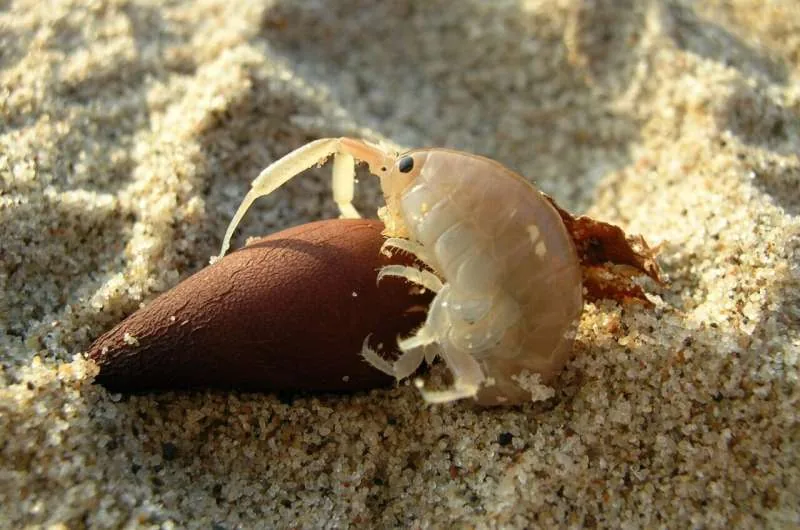
Can an organism measuring barely an inch reshape miles of oceanic shoreline? Beneath the damp sand of Southern California beaches, millions of sand hoppers (burrowing talitrid amphipods belonging to the genus Megalorchestia) operate as an unsuspected earthmoving workforce. While visitors perceive sandy shores as passive recreational buffers, these nocturnal crustaceans actively displace massive volumes of coastal sediment during their nightly foraging routines. Recent field measurements demonstrate that their excavations displace up to 50 kilograms of sand per meter each night, rivaling the daily sediment loads transported by coastal rivers. [1]
Nocturnal Diggers in the Goldilocks Zone
Sandy beaches function as dynamic littoral reservoirs where ocean waves, winds, and tides continuously rework mineral grains. Most burrowing marine organisms construct a single semi-permanent tunnel and maintain it over long periods. In contrast, sand hoppers excavate entirely new burrows every single day. These centimeter-long crustaceans retreat underground during daylight hours, digging between 10 and 30 centimeters (4 to 12 inches) deep into the moist sediment or sheltering under stranded seaweed wrack. When night falls, they emerge across the intertidal zone to consume decomposing kelp washed ashore by tides. [2]
Substrate moisture dictates exactly where these crustaceans establish their daytime shelters on sloping beaches. David Hubbard, a marine scientist at the University of California, Santa Barbara Marine Science Institute, explains that the animals actively seek an intermediate moisture zone where tunnels resist collapse. They avoid saturated sand near the breaking surf because liquid-like slurry causes their tunnels to collapse instantly. Similarly, dry powdery sand situated above the high-tide line lacks sufficient cohesion to support an open chamber. Instead, the crustaceans cluster within a narrow intermediate strip where capillary moisture maintains structural stability. In densely populated stretches, species like Megalorchestia corniculata and Megalorchestia benedicti can exceed 1,000 individuals beneath a single beach towel footprint. [3]
Every tunnel requires fresh excavation. Because wave action constantly reworks intertidal slopes, these crustaceans must displace new mineral sediment every single evening. [1]
How Sand Hoppers Shift Shoreline Sediment
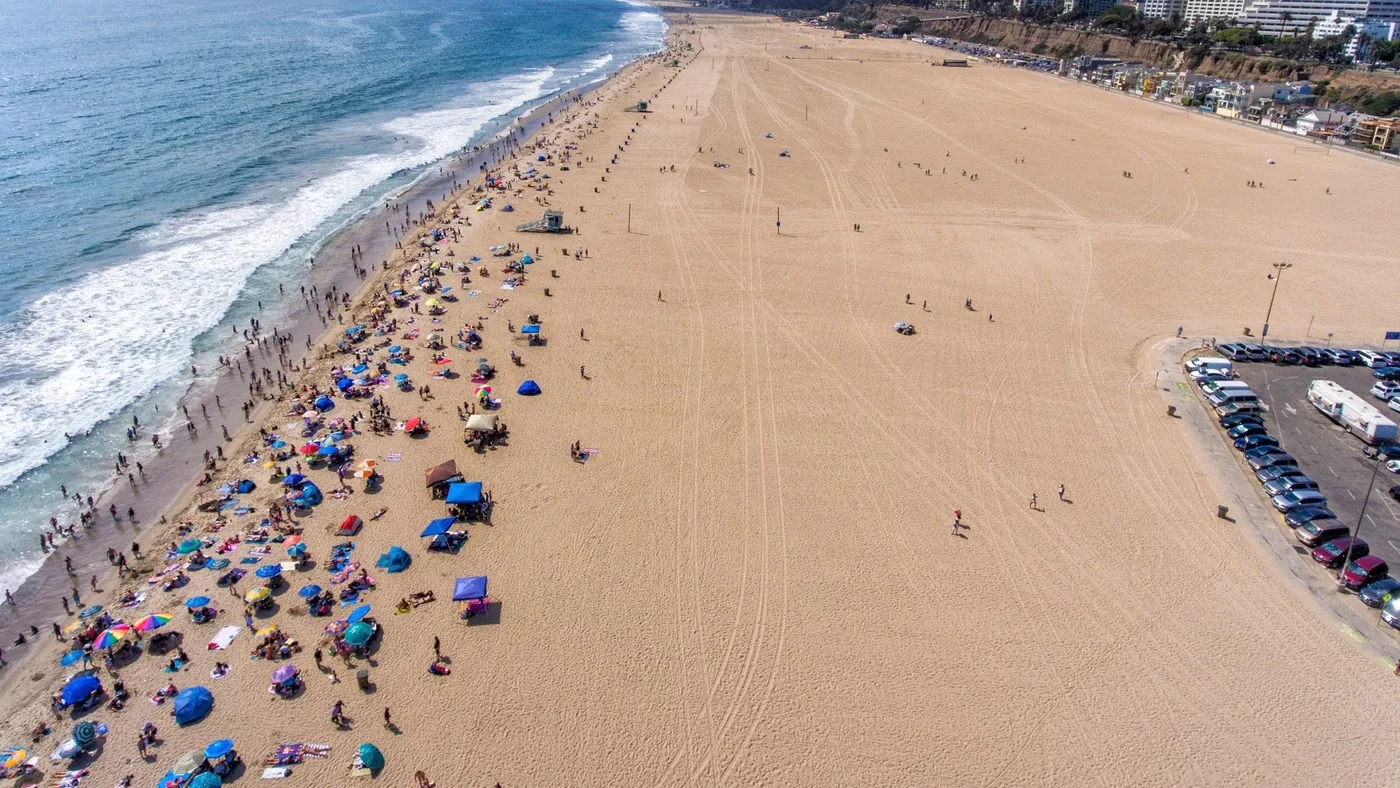
To quantify this cryptic earthmoving capacity, physical geographer Tim Baxter collaborated with marine scientists David Hubbard, Kyle Emery, and Jenny Dugan at UC Santa Barbara. When Baxter arrived from the United Kingdom to pursue postdoctoral research with geography professor Ian Walker, the team focused on Isla Vista Beach, a bluff-backed coastline bordering the university campus. In July 2025, following an evening high tide that smoothed the shore, the researchers delineated 21 sampling plots across the burrowing zone using metal frames set flush with the sand. Flags marked each site. They positioned these bright reference flags beside each frame to ensure accurate recovery after dark. [1]
The overnight transformation astonished the research team when they inspected the plots the following morning. Mounds of freshly excavated sediment had completely buried multiple sampling frames, rendering them invisible without the marker flags. After collecting and precisely weighing the displaced material, the researchers calculated that sand hoppers had moved up to 50 kilograms (110 pounds) of dry sand per meter (3.3 feet) of shoreline in a single night. Hubbard observed that these amphipods exhibit one of the highest bioturbation rates (the biological displacement of sediment particles) recorded anywhere on Earth. For centimeter-scale organisms, shifting that volume of mineral material represents an extraordinary geomorphic output. [2]
Rivaling Rivers Across Southern California
Local measurements at Isla Vista Beach prompted the researchers to evaluate the regional footprint of this crustacean activity. By synthesizing their single-night experimental data with eight years of population surveys from the Santa Barbara Coastal Long Term Ecological Research (SBC LTER) program, the team modeled sediment movement across a broader coastal landscape. Extrapolating the burrowing rates along 25 kilometers (15.5 miles) of Southern California shoreline revealed that sand hoppers relocate approximately 340 tons (310 metric tons) of sand every day. The regional scale of this transport shocked the investigators. [3]
That daily total places amphipod excavation on par with primary physical drivers of coastal evolution. In Southern California, major rivers discharge massive sediment pulses primarily during episodic winter storms, yet these small crustaceans maintain continuous mechanical transport throughout warm seasons. Their daily output also rivals longshore drift, the wave-driven current system that shuffles sand along the intertidal corridor. Coastal geomorphology traditionally focuses on fluid mechanics while treating fauna as passive inhabitants. Here, living organisms act as major sediment conduits within the littoral cell. The ocean provides constant flux. [1]
Could biological engineering rival seasonal river discharge? Field data confirms that talitrid burrowing matches major regional river loads, demonstrating that small biological habits generate macroscopic geological transformations. [2]


Nutrient Cycling and Microbial Aeration
Beyond moving mineral grains, sand hoppers fulfill foundational roles within the coastal food web that sustain intertidal ecosystems. By feeding aggressively on kelp wrack and decomposing organic debris deposited by receding tides, they accelerate nutrient recycling across sandy shores. Much like crustaceans hitching rides on sea snakes to exploit mobile oceanic niches, intertidal amphipods exploit tidal cycles to harvest drift algae. In turn, dense hopper populations provide an indispensable food supply for foraging shorebirds and nearshore fishes that patrol California beaches during morning low tides. [2]
The burrowing habit itself triggers significant geochemical transformations beneath the sand surface. Hubbard emphasizes that nightly excavations create a substantial sediment churn. When organic matter such as kelp fronds or carrion washes onto the beach, burrowing amphipods inadvertently bury these fragments deep into lower sediment strata, transferring carbon to specialized subsurface decomposers. Open burrows deliver oxygen. Furthermore, these open burrows introduce atmospheric oxygen into compact, water-saturated sand layers. This mechanical aeration fuels aerobic microbial respiration in zones that would otherwise become anoxic. Through continuous bioturbation, sand hoppers transform inert mineral beds into chemically active biological reactors that process shoreline nutrients. [1]

Building Dunes and Coastal Resilience
Excavation dynamics extend upward from intertidal slopes into protective coastal landforms. When sand hoppers eject sub-surface grains, they construct loose surface mounds that dramatically increase beach topographic roughness. Baxter notes that undisturbed beach crusts resist wind erosion, whereas hopper-reworked sediment provides easily transportable grains for onshore breezes. Just as oceanographers examine how currents dictate coastal debris and plastic accumulation across fragile shorelines, coastal geomorphologists must evaluate how biological turbulence delivers sand to embryonic foredunes. Wind captures the loosened grains and deposits them into vegetated dune systems that buffer bluffs against severe storm surges. [1]
Coastal dunes have emerged as vital nature-based infrastructure against sea-level rise and accelerating erosion throughout Southern California. Because self-repairing dune ridges absorb wave energy during high-tide storms, maintaining healthy sediment supply lines is paramount for coastal municipal resilience. Baxter points out that the discipline of biogeomorphology (the study of mutual interactions between organisms and physical landscapes) has historically treated animal activity as localized and fleeting. Demonstrating that talitrid amphipods dislodge hundreds of tons of sand daily confirms that biological processes actively supply the raw building blocks required for coastal dune growth. [2]
Dunes depend on loose sediment. Without nocturnal excavators, coastal wind transport operates on much harder, compacted shores. [1]

Beach Grooming and Unanswered Coastal Questions
Human maintenance practices frequently collide with these nocturnal sediment cycles. Across popular Southern California shores, municipal tractors drag heavy mechanical rakes over the sand every morning to remove stranded kelp wrack and litter, smoothing the terrain for visitors. While this grooming satisfies recreational beachgoers seeking manicured shorelines, it strips away the primary nutritional foundation that sustains sand hoppers. Removing wrack deprives hoppers of shelter and food, while heavy tractor tires crush fragile burrows within the Goldilocks moisture zone. Researchers caution that sanitizing beaches disrupts an overlooked geomorphic engine, inadvertently starving downwind coastal dunes of fresh sediment and diminishing essential foraging opportunities for protected shorebirds. [3]
Significant scientific puzzles remain regarding the ultimate fate of excavated sediment. Because current measurements account solely for surface mounds, the true volume of sand displaced within sub-surface galleries remains unquantified. Baxter, now based at the University of Oxford Pitt Rivers Museum, aims to resolve whether waves simply return dislodged grains to the intertidal bed or whether wind permanently removes them to alter coastal geometry. Future field studies across the United Kingdom and continental Europe will examine whether regional amphipod species replicate these extraordinary sediment displacements on Atlantic and Mediterranean shores. [3]
Beach grooming breaks this chain. Preserving natural kelp lines may safeguard both coastal ecology and physical shoreline stability. [3]
- ACADEMIC JOURNAL Baxter, T. I., Hubbard, D. M., Emery, K. A., Dugan, J. D., Adams, W., Alvarez, S., & Walker, I. J. (2026). Mega Mounders: Burrowing Talitrids (Megalorchestia spp.) Excavate Large Quantities of Sand on California Beaches. Journal of Geophysical Research: Earth Surface, 131(9). [Article Link]
- ONLINE NEWS Fernandez, S. (2026, September 20). Tiny beach-dwelling crustaceans are big-time sand movers, shaping the California coast. Phys.org. [Article Link]
- ONLINE NEWS Putol, R., & Ralls, E. (2026, September 19). Tiny beach creatures move as much sand as some California rivers. Earth.com. [Article Link]
APA 7: PerEXP Teamworks. (2026). California Sand Hoppers Move as Much Sediment as Coastal Rivers. PerEXP Teamworks. https://perexpteamworks.com/en/sand-hoppers-move-california-beach-sand/


